Hello, it's four o'clock, UK time on Friday, the 25th September 2020 and here we are on yet another YouTube live event. My name is Farzana from SF Digital and I'm happy to be back here again, to present to you. Those of you that are new to our channel, we go live every weekday at four o'clock, either myself or Uzair presenting information topics, lots on Google AdWords, Google Ads, I should say YouTube and video marketing in general, lots and lots of content!
Enjoy the journey! Those of you who have been with us before, welcome back, as you know, we like you to put comments through on the chat so that I can keep an eye on that as well through the presentation. What I tend to do is do the presentation and I will, of course, happily, answer any questions related to the presentation today, so that we can interact with each other.
So, without any further ado, let's get talking about today's topic. So, we're actually going to continue from last week's topic and actually take a slightly deeper dive into the actual areas that make up part of the marketing flywheel model. So, before I go into that... The quick issue, bear with me, while we just, let me give 'tech support' a quick shout over here, Uzair, my screen seems to have frozen....!
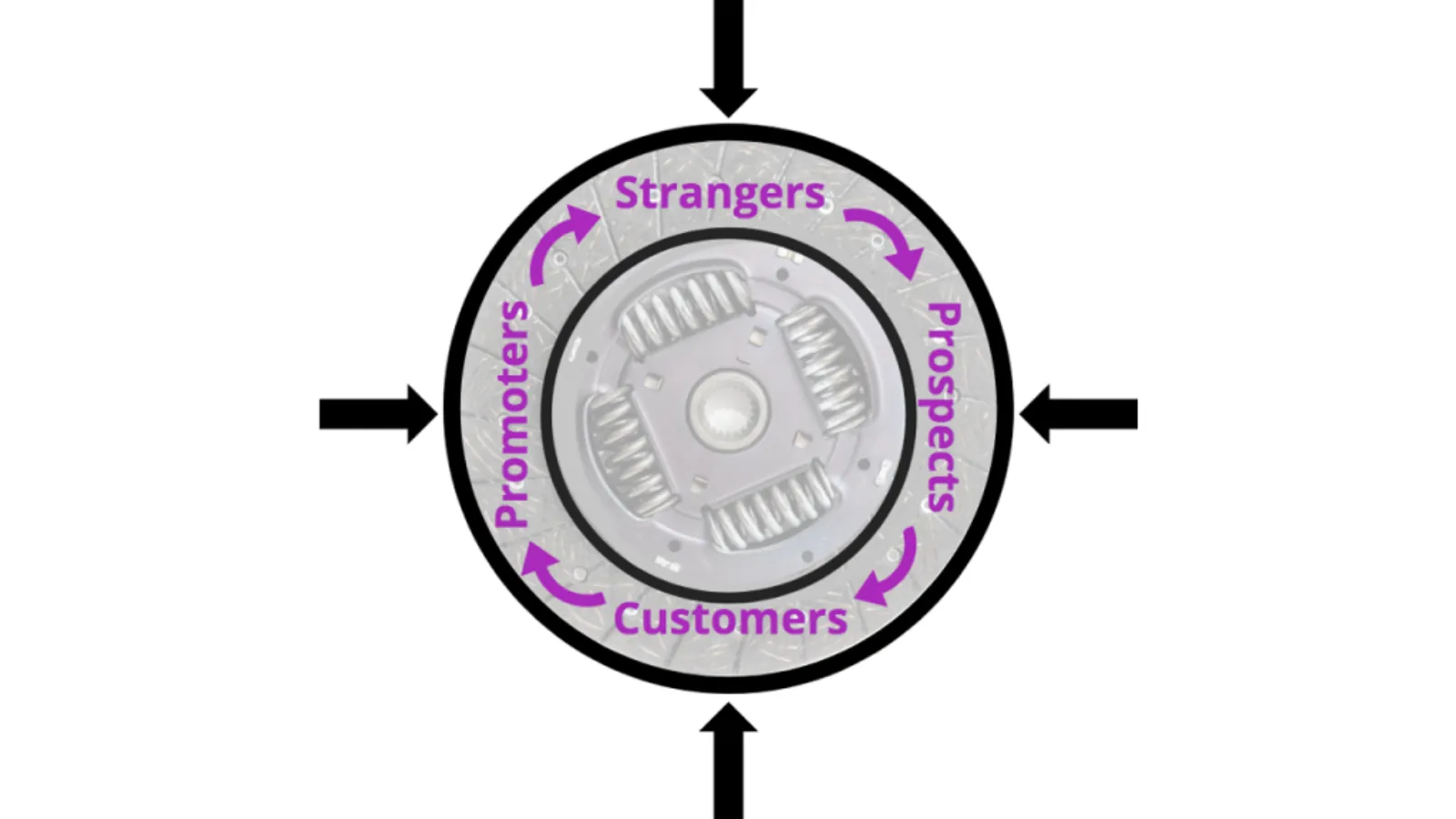
Here we go. Easy when you know-how...so we're actually today going to go, like I said, a little bit deeper into the flywheel method or the flywheel model and we're actually going to concentrate today on the four main areas of that outer ring and applying some forces to them, those four areas are your strangers, prospects, customers and finally promoters.
So, before we go onto that, this is a slide I was trying to reach... Just a quick recap of some of our wins of the week and our favourite win of this week is that we are ranking really highly now for lots of different keywords, Google related topics and this particular keyword was for Google Display Network explained, have a quick look on the top here.
You will see that, as you can see, we are above some really high-ranking authorities, including HubSpot, WordStream and the Google Support Center itself. So, this featured snippet is way above the other areas. These other, like I said, are high ranking authority sites and we are there right at the top of the page. We also feature again further the down, which is this time, the video, and again at the bottom of that screen, you'll see another little snippet, which...
Featuring again. Now, it's interesting that one of the things that I am going to be talking about is content marketing and we're going to come to that in a bit more detail in a moment, but this is really relevant because the work that we are doing, putting out content regularly and consistently on our blog post is why we get the featured snippet and that would only happen if Google is recognising that yes, this company, this is the work they are doing.
They themselves are an authority and we are willing to feature that snippet and promote that content and for that to happen, you know, that is for us a really, really big win because, you know, I always, I remind every week we are a modest-sized digital marketing agency. We are not the huge organization with lots of power behind them.
The likes of Google, needless to say, have, you know, thousands of pieces of content that they can put out. We could never compete with that. We've just put out a sensible, modest-sized blog, not a mega-blog, not something that's, you know, ten thousand words, nothing like that. This is just probably less than a thousand words and yet we've managed and this is why, again, I repeat be consistent with your posting and look at your content marketing and you will start to see the rewards.
A couple of other smaller wins. We spent some time this week actually sitting down and looking at our ninety-day plan. It's a great time of the year to do that. I don't know about you, but I actually like this change of season that we have in the UK autumn time for us or fall if you're in North America, it's the perfect time to take stock of your activities over the last nine months and that ninety-day does happen to just coincide so well right now with what's going to end up being roughly the end of the year and we've managed to brainstorm some great ideas, build on some of the strong foundations we've put in place over recent months, but also have some clear thinking of what our strategy is going to be for 90 days and of course beyond that.
So, that was a good win for us. It is very easy when you're working in the day to day to take your eye off the ball and not remind yourself of your actual goals of what you're trying to achieve. That was really important for us. A funny little win for us. Finally, we managed to get our own headshots done.
Now, of course, we are ex-photographers and we have a full-on studio here. So, why would we possibly get round to doing our own shots?! So, it was really good that we managed to finally get Uzair in front of the camera while I took his pictures earlier this week and the main driving force is that I'm sure many of you that follow us regularly are probably getting a little bit tired of seeing Uzair in his same four different outfits.
So, we decided, right, we need to get a whole load done! So, forty, fifty, sixty shots that we've done. So, look out for those. There'll be hitting your screens very soon. So, back to the topic in hand, why are we doing all of this? Why are we putting out so much content, creating our audiences, engaging with you on a daily basis?
It's really quite simple. We are looking to engage with our audience and look at how we are going to build with our future clients. How are we going to give out meaningful content that they are finding useful to get them to get to know us, get to like us, get to trust us because if we can follow that process through that's when we're going to start and win.
Now, just a quick recap. Last week, I looked at the flywheel method or flywheel model on how to grow your business and we had a touchpoint on the efficiency of a flywheel and some of the things that might hinder the effectiveness of your flywheel model. It could be the size, speed, it could be friction. We're not going to spend too much time on that today because I'd like to take a deeper look into how we apply some forces to our business and those four main areas within our marketing strategy that we need to think about.
Now, we've got a rough drawing here where we've got strangers, prospects, customers, and promoters and I've just put some very simple arrows to show you that we need to apply forces, marketing forces to each of those areas, to make sure that they actually transition through this cycle that we're looking at. Now, depending on the size of your business and the maturity of your business, how long you've been in business, you might have different people, different clients, customers at different positions of this wheel.
So, it's important to remember that, you might be at different stages of maturity within that wheel, that you need to also nurture and manage through the process. It's not a linear process. We don't start with everyone being at the same starting point at strangers and everyone finishing that cycle at the same time, because different projects will have different pipelines.
So, obviously, some will come and go and some will still be with you hopefully for many years to come. So, let's start with strangers. Now, this is obviously, probably the hardest point. How are we going to find strangers to get to know us initially and to see what we are doing and what we are offering and we often - I'm sure you're you also have this in your communities on your own personal Facebook threads - You'll see lots of ads popping up and lots of interest and content being put out there because often people see that as a shortcut way of getting strangers to get to know them.
That's all very well. But if you are making a genuine, fairly high-value purchase or engagement of a service, you will want to do your homework. You will take another look at other platforms, the website that is your key area, where people are going to go and see what you're really about. You don't have that social proof of a website clearly showing what you do, what you offer, hints, tips, added value in general, that people can engage and say, yes, I think I quite like the look of this company, I'm going to take this further.
It's a huge opportunity - it's not enough just to have a social media page set up, with everything tucked away in different screens. We all know it. Social media is changing at such a fast pace, that to keep abreast of all those changes all the time can be very confusing for your audience. Just as they've got familiar with finding something in a particular place, the platform goes and changes their functions again, and this is why a website can be your absolute strong foundation, strong core to your business because it's in your control.
You get to decide when you're going to change. You get to decide how you build your website to be a familiar and easy to navigate the site using best practices in the industry so that you don't actually turn off your 'stranger' that has finally decided to... And it really is about adding value. So, your customer can't get to know you, this stranger, I should say until you're able to actually connect with those really important that you pay attention.
Content marketing, now, I often tell people who are not blogging or not looking at that side of their business, I normally ask them a little question, which is 'now who's the biggest reader of your blog?' And they're normally looking at me as if I'm asking some kind of trick question, or I'm asking for a special magic number or some sort of identity of their customers that are actually reading.
I'm not, it's not a trick question! I'm actually just trying to highlight to you that aside from the humans that are engaged, the biggest reader of your blog is Google. Why do we go to Google? Google gives us the most relevant information that we are looking for and so, if Google, through its bots, can see that, yes, this website let's say SF Digital, are regularly updating their blog.
They are putting out meaningful, useful content. I'm going to give them brownie points because they are doing that and so they must be worthwhile because they're getting the visits, getting the hits. So, they are worthy of crediting them with points. Now, going back to the favourite win of the week for us, where I showed you a blog post featured snippet.
That's how that has got to that page because Google is tracking what we are doing and is then able to put us in front of an absolutely huge Google audience, somebody that has searched for that particular keyword. And this is why your content marketing strategy needs to be consistent, our blog posts now are regularly going out twice, three times a week.
This is part of our system of how we are outputting our content. It's not an 'I'll do it if I have some time,' it's not a 'nice to have, but I'm far too busy.' It is essential to all our activity. It's something that we are doing faithfully, with all the team to make sure the content... And it's a work in progress where we started however many years ago with blogs has evolved, where we started at the beginning of lockdown, which was March for us, here in the UK, what we were doing with our blogs, even at that point has completely changed, to where we are six months down the line and, you know, further to our planning meeting.
And, obviously our continual improvement, we are also going to be changing a little bit of that content again, going forward. So, we are constantly, like I say, evolving and hopefully improving our output. It's not enough, good enough is not good enough. It's about always improving and trying to reach the best we possibly can. So, that's a little bit about content marketing now, next one, video marketing.
So, we've all seen, the huge explosion of people suddenly talking to their devices and all putting out content on devices, various social platforms and Facebook, Insta, some are playing with TikTok and many, many others, why do we do it? Clearly, we as advocates of video marketing and campaigns for our customers. We know this works - our audience, our strangers if you like, come to us, majority of the time through our video marketing, but let's not forget that I've just talked about blogs.
So, how come you're now saying video marketing? Well, actually, if you were to go and take a look at our blogs, you will see that the origination of that blog, is actually coming from the video, so today's video will become part of a blog post, the video becomes embedded within that page of the blog, but then there'll be a blog article, accompanying it as well.
So, the video marketing again for us is about consistent output regularly, putting out good quality information and content that your audience will engage with. It's also a great advantage to be able to humanise what is basically a very cold, hard face - the internet. How are you going to stand out from the many businesses that are out there selling products...
Being able to demonstrate what you do and putting a face to the name will help with that engagement and increases the likeability. Now, of course, you know, we're all human. I don't think any of us naturally enjoy being in front of a camera. I'm no different, Uzair's no different, but once you are... Well, if you're passionate about what you do and if you enjoy what you do and are knowledgeable, it's actually just a mechanism.
It's just a device to get the information out there and suddenly people being able to ask questions as you will be doing hopefully, a little later on, you will see that that interaction starts to build up. Now for us to skip from the strangers, which all our clients are, of course like yours dotted around the world. How do they find us?
How have they managed to get to us and actually start to speak to us and become prospects and hopefully eventually customers? It is through video marketing and I would say probably... Dare I say ninety-five percent, perhaps more of our leads are coming from video marketing and that has taken time to systemise, but that's pretty much all that we do.
Social media. I touched on this earlier. It's really important to have your touchpoints on social media because we don't know where our audiences necessarily hang out. You know, if you figure out your avatar that your audience hangs out, let's say on Twitter, then, of course, you as a business need to also be on Twitter, because that's one of the biggest, things, situations with the flywheel model, unlike the sales funnel, which is all about converting and getting that final squeeze through the narrow end of that funnel to get a customer, the flywheel model is actually looking at the whole process and a little more holistically, a little more nurturing towards that customer because we want to look after their needs.
We want to do that with authenticity and trust. So, social media, yes. Get yourself out there, decide which platforms you want to be on. Again, I repeat myself to be consistent. It's not enough to put some quick offer together in a desperate smash and grab approach on let's say Facebook, you know, I've got this special thing, you know, something's fallen through and I'm going to sell 10 cake boxes by this afternoon.
That's fine, but it's not really building up trust and authenticity. You need to mix up the offers with content, with tips, a little bit about yourself. It might be about your team. There are ways of engaging with your audience, social media, that isn't just about the hard sell and I would encourage you to just look at your own social media strategy, see how you're actually going to build that in, to actually be an addition to your marketing and not just a last-minute afterthought, because it is so quick, to grab your phone and quickly tap away and put a post-up there and I would say probably ninety-nine percent of what I see on my feed.
It's the people haven't put headshots, no logos, no branding, no consistency of style. Your branding message is completely lost if you don't pay attention to these details. You want people to almost start to subliminally recognise what you are doing, what your brand is about, that they almost look forward to seeing your posts and not just scroll by.
You might also look at referral programs. So, this actually ties in a little bit with the end of the cycle where somebody might become your promoter, but hopefully, if you have done your job, well, those promoters go and find their contacts who are strangers to you and be able to refer them back to you. So again, it's really important that you've got some kind of way of capturing those potentials, but also nurturing them.
Nobody wants to feel that if they give a referral to a friend and you know, I've given you a lead and off you go, you take the lead, you make contact. Now, it becomes even more important. Actually, get back to the referrer and thank them, thank them properly as to what they've done, but also look after that person that they referred because they've done a huge part of your marketing process.
Costs you next to nothing to get a referral. Whereas, you know, you are investing as a business, this whole cycle of activity, which is a cost, isn't it, well it's an investment, hopefully, that pays off and gives you the return. So, it's really important that your model of looking after people is consistent through your whole process and I've put the final one offline activities into brackets.
Because if you hadn't realized before COVID, you certainly should have by now your traditional offline activity, advertising in magazines, printing up flyers, possibly even cold calling, these non-online options that are out there are actually really hard, because the world has changed. We don't have the same freedoms that we had to six months ago and depending on where you are, I suspect regardless of where you are in the world, this situation is not going away any day soon, we are emerging as businesses having to modify how we work, even down to things like networking.
That is your way of attracting strangers to business. It's all those that have survived have gone online and that model has had to completely change of how we're going to actually pass on referrals. So, it's really important that you start to think about your online processes when you're looking for strangers. So, hopefully, if we've done our job well, those strangers are going to turn into prospects.
So, one of the situations we have is obviously our day job is to convert leads from Google Ads, for our clients to turn into prospects. We can obviously track as can the client as to how many leads that they have actually received. It might be through call ads. It might be search ads. It doesn't matter. We can track that.
However, we as the digital marketers, have no control as to what actually happens with prospects if you're getting prospects in a sizeable number and you're not actually converting, that boils down to the processes you have in place and the people you have in place, who look after those prospects and this is where you need to start thinking about possibly investing in the sales team.
There will come a time when you know, business owners can't do all the tasks themselves, nurturing leads and prospects and converting them is actually a specialist job - to be done nicely. Sales do not have to be pushy. There are many ways to convert your sales. So, it's important to find the right people that get your business and are willing to work with you, to make an effective team.
It's also really important to systemise your leads and how you're going follow them up. I think I touched on this last week as well, where a good CRM system where if somebody says to call them in a week's time, call them in a week, not the week before, not the week after, do as you're asked to do - you won't annoy them.
Even if they have to say, actually still not convenient, call me in another week. Because actually, they should hopefully have some respect that what you are asked to do is what you actually followed through and so there's nothing to be annoyed about off of their part because you've only done what they've asked to do, I think I said last week as well, you know, it's never a no until it's a no until then.
It's always a maybe so sometimes it can be tricky using a CRM system and following through on the leads and finding that something's still not quite biting. It's a little tight rope that you do have to walk to gauge the feel of that client. Are you going to annoy them if you ring again, is it too soon?
Of course, the frequency might be slightly higher at the beginning and you might just tail off as you're not quite getting that bite, but I would never take a prospect off of my list, till I get that definitive no! Remarketing. Now, that's one of those things where people often leave money on the table. So, having spent, let's say on campaigns on Google Ads, remarketing is when you start to see those ads following you on different platforms on the internet, through banner ads, et cetera.
Now, having spent let's say ten pounds on, let's say Google Ads, if you then and go to start to look for the next new batch of people with your next lot of ten pounds, well there are some people that had thought about, got distracted and will forget about you. But if you've got a remarketing campaign, then you won't have to spend another ten pounds to get to a new audience, perhaps one pound another additional one pound to nurture that potential prospect is enough to actually convert them and that's something that we often see with people that have been running existing campaigns.
They've not even really thought about that aspect. So, we always look at budgets and how to utilise budgets, to get the best possible return on investment, because it's better to spend one more pound, which takes your budget up to eleven instead of spending ten times two. So, it makes more sense to actually look at remarketing and then we come to your customers.
So, let's assume that your prospects have come along and they have become your customers. Here, we would look after them internally. We have internal account managers. We have internal project managers. It could be that your client only sees you. They don't even realise the team behind you, but it's really important that if you have got a team or even if you're your own team, your workflows, processes and systems need to be set up correctly so that you can then scale that, otherwise, all that happens is that you win one or two bits of work and you are constantly firefighting.
I haven't got anything in place and you're having to reinvent your system on every single job. Whereas, if you take the time to step away and actually sets things up systematically, every time you get a new job, you know, you've got to follow the same system. That's how you start to get the efficiencies in your workflow and something that's really important is communication.
So, we now have our weekly team meetings, for example, Mondays they're in the diary, two o'clock doesn't matter which time zone anybody is in. We will have that team meet because it's really important, especially now that some many of us are working from home, to keep that interaction with each other, to know that we are supporting each other.
If we've got anything that we need to sort out during the week, we've got that opportunity to do so, a great opportunity to also share our wins of the week and we're all able to move forward in a positive way, that also applies to our external communications. So, just because somebody has become our customer, it has become vital now that we look after them, make sure we keep them up to date.
Where are their projects up to, how are their Google Ads campaigns running? What are the statistics? How are the reports going? Do they need any additional help, has anything changed to their campaign or locally that we need to know about so that we tweak the campaign. This all comes through strong communication and again, that's really important that you set up your systems, it could just be simple emails.
You might have a private WhatsApp group, whatever works best for you and should I say your client is the route to follow, make it easy for your customers to be accessible and look after them in the way that they would like to be looked after. Don't try and force them to follow your system, adapt your system, to suit them.
And finally, we come to promoters. If you've done your job well, and you've looked after that customer, they may well be with you just for the one job. It might be hopefully a relationship where they stay with you. For many, many bits of work, they will become your best evangelists - through them, you can get testimonials, referrals, word of mouth, Google reviews.
These are all really important factors, complete that cycle. Let those strangers come back to you, and again, I'm going to highlight Google reviews in particular. This is another thing that Google looks at when it's trying to work out who to give - I call them my brownie new points - who to give more points to promote them.
We can't all be on the top of page one. We can't anyway, because Google Ads takes up a lot of places. So, how else are they going to, one of the factors is Google reviews, if you're not already doing so, make sure you build this into your system, ask every customer, whether they're partway through the cycle of a project or whether they've come to completion or even if they're a regular, make sure you get your Google review because the more reviews you have on there the faster your traction is going to be to build up a good relationship and that concludes this week's topic.
I think I've just slightly over by a minute or so next week, I'm going to be focusing on how to attract, engage, and absolutely delight your customers and how that's going to grow your business. Okay. Take a little look into there and before I sign off, I'm going to have a quick little look at the comments. Let's see what we have here.
We have various hellos still here for a moment. So, if you have any last-minute questions, now's the time to put them in because it does cut short just about 10 seconds or so before the live end so, just do put them in right now. If you're interested. Yes... Sandy, get great comments about awareness, value, lead magnets, attracting strangers.
You're absolutely right. These are all part of this model. You need to do all of those things, Sandy, thank you so much for your kind comments on the content. Really glad that you've enjoyed it. This question about, looking for a co-founder I suspect a partner to your business, I'm a real people person and you must do your due diligence, whoever you're planning to work with it's really important to do that and, yes, you need to look through as much information as you, can you trust this person?
You know what? You can't beat your gut. Something. I actually use very, very regularly when I've gone against my gut instinct, my first impression I've normally lived to regret it. I've reached my ripe old age now, and now I never ignore that! I used to doubt myself when I was young. now I don't do that. If I'm not comfortable, I don't do it no matter how good it looks.
It's a bit like going to choose a school for your child, your precious child, and you can have in this country, we have a thing called Ofsted reports, you know, highly... Done by inspectors, et cetera, for the school you can have the best Ofsted in the world. But as a mum, when you step inside a school and you don't get a good reaction, you'll never choose that school.
So, I would say you need to do your due diligence and use your instinct and again, from Sandy, we've got don't force to stay with the system. Just adapt them to stay with the system with value, best estimate. That's fine. Yes. Thank you, Sandy. Yes, absolutely. It's not about forcing it. Nobody likes to be forced, so yes, you're absolutely right.
Just adapt where you need to internally do what you need to your client. So, I think that's come to the end of the comments and questions. I don't think there's anything else there. Thank you so much to everyone that's been with us today. I do hope you've enjoyed the content. Hopefully, you're finding these useful. If you have any particular topics that you might want have covered off in the future, please do send them through as an email or drop us a line, some point and more than happy to take a look at covering that topic for you.
If you are able to give us a review on Google My Business, the link is on your screen right now. That would be much appreciated. So, we're practising what we preach. I said that Google reviews are important and that just as important, so we would really be... And with that, I'm going to bring today's live stream to an end.
I hope you have a wonderful weekend and I do hope that you will join us again from Monday back to Uzair on Monday and hopefully, I will see you next week. Thank you once again.

 LIVE