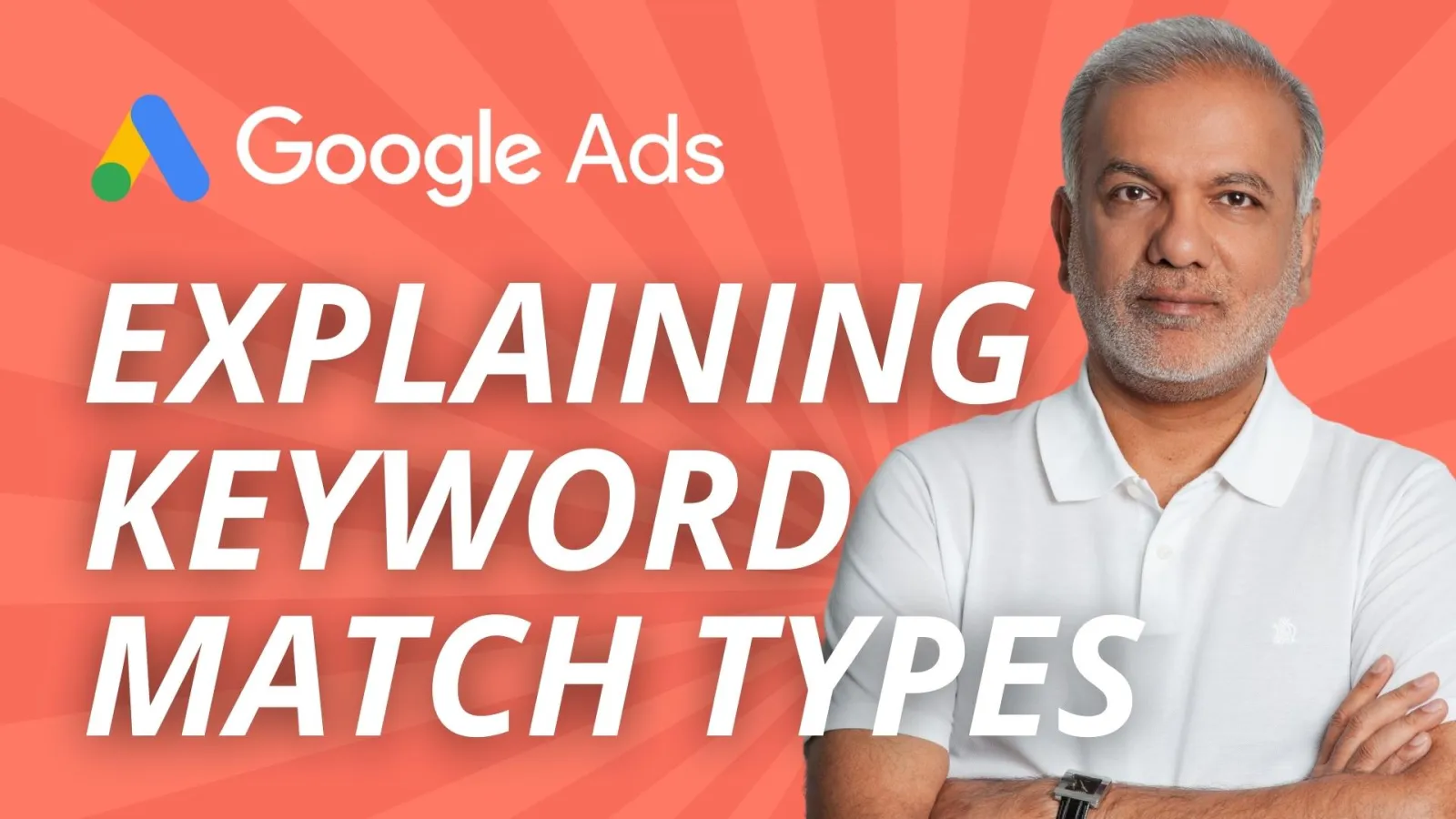
Are you confused to decide which keyword match type to use for Google Ads?
Then, you are in luck today!
Get Found, Get Chosen, Get Your Time Back
A free one-day marketing seminar in Milton Keynes · 10 November 2026
When choosing a keyword match type for your ad campaign, it’s important to remember that users’ search queries are rather varied. When marketing with Google Ads, you have three distinct keyword match types to select from:
Get your free Marketing Action PlanNot sure where to start? Answer a few questions and get your plan in about a minute. No email needed.
Get my plan →- Broad match keywords
- Phrase match keywords
- Exact match keywords
In this short blog post, you will learn about the use of three keyword match types accessible in Google Ads, how these differ, and why they are so important for the success of your pay-per-click (PPC) ad campaigns.
What are keyword match types?
You may choose an exact match, broad match, or phrase match as the keyword match type while creating a compelling text ad copy in your PPC campaign. Every match type for the Google Ads account has benefits and drawbacks.
Broad match type keywords
Broad match is the most common match type which covers the most individuals. When you use a broad match, the ad will be displayed whenever a person’s search query contains any word similar to your key phrase, regardless of sequence.
 LIVE
Live every Tuesday at 2pm UK. Bring your marketing questions.
Get your Google, local SEO and AI questions answered live.
Let’s understand the concept by using an example. For instance, if you employ broad match on “luxury car” your ad may be seen if a person enters “luxury vehicles” “luxury apartments” or “fast cars”
Google might even match the ad to searches utilising synonyms – for instance, the ad may appear if anyone searches for “expensive vehicles” that do not have any of the phrases in your keyword.
Phrase match type keywords
The phrase match can bring you more traffic because it is now combined with BMM. Let us explain to you the reason with the help of an example. Let’s say you are targeting a keyword like “running shoe” as the phrase match. It does not matter whether you use shoe or shoes with a phrase – you will get the same results no matter your audience searches for shoe or shoes. Please make sure to write your keywords in quotation marks as the phrase match. Now, when someone searches for “cheap running shoes” your ad will be displayed to them because they have used your keyword in the same order. Similarly, if someone searches for the “best running shoes”, “running shoe cheap” it is still going to trigger your ad because of the order of keywords. Here, if someone searches for the “tennis shoes”, your ad will not be displayed because this phrase does not contain both of your keywords.
Exact match type keywords
The most specific and restricted keyword match type is the exact match. In past years, people could only see the ad if they entered the exact keyword phrase by themselves.
For instance, if the key phrase was “black cocktail dress” then the ad will only appear if a person queried for “black cocktail dress” (these words in the precise sequence), not “expensive black cocktail dress”, “black dress” or “cocktail dress”.
Selecting the Ideal Match Types for Your Keywords
I’d suggest not using the broad match type at all. The main reason is that it’s too broad and will result in a lot of irrelevant traffic for your keywords or ads.
So, which keyword match type is the best?
I suggest using the exact and phrase match for your Google Ads. Both of these will give you the best results. As we have explained the concept and usage of both of these keyword match types above, you can use the one based on your requirements and end goals.

Written by Uzair Kharawala
Partner at SF Digital Studios, a Google Premier Partner agency. Uzair has been helping businesses grow with Google Ads since 2002 and teaches it every week on YouTube.
Get our best Google Ads tips by email
New articles and videos, straight to your inbox. Unsubscribe any time.