I believe we are live. Please give me a moment. I'll make sure everything is working fine and we shall get started. Okay. All looks good. Hello and a very warm welcome to today's live stream. It is not five o'clock today. Actually, it is four in the UK and going forward it is the new time for the live stream, so instead of five o'clock please log back on here an hour earlier wherever you are in the world.
My name is Uzair and at four o'clock every weekday in the UK I'll go live and talk about Google Ads, digital marketing, online advertising and generate new leads or sales for your business. I'll go through a presentation or a workflow and then answer any questions you may have. There is a comment box on the right-hand side of your video.
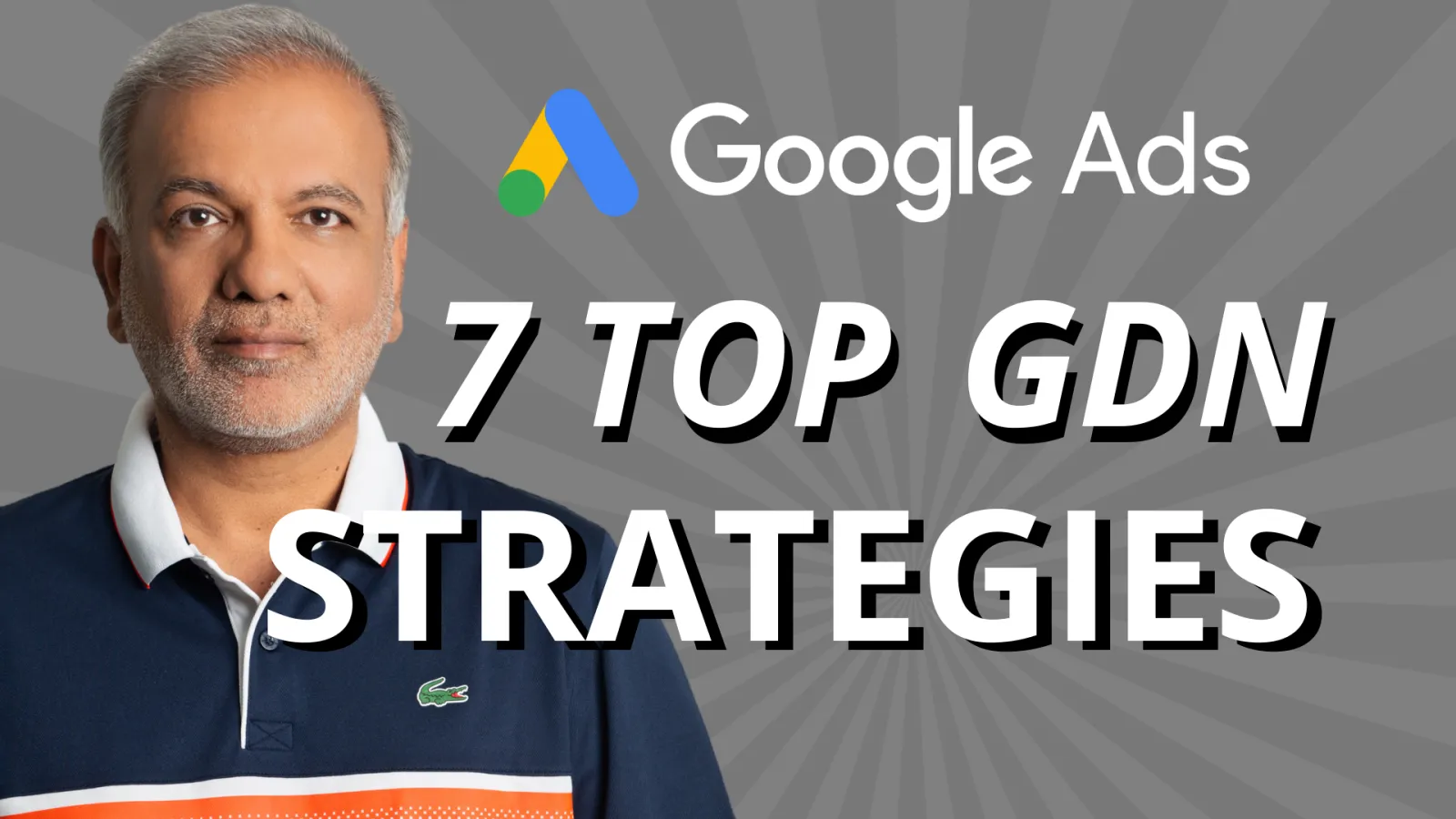
Please put any questions in there, if you have any. Let's get started. Hello Sandy. So, today I'm going to talk about some strategies for the Google Display Network. I should say the top seven or seven of my favourites. Last week I live streamed on what not to do, so, today it is about what to do on Google Display Network get your brand in front of the people, products or your services in front of the right audience.
Let's start with what is GDN as it is popularly known as. Google Display Network consists of over 2 million high-quality websites where Google can potentially place your ads. Be it text, video or image ads, the traffic and the amount of people on the GDN equates to around 87% of the internet, possibly more. Pretty much anywhere, ads can be placed.
Google is able to place your ads. The good thing is you can target your ads or audiences with keywords intent remarketing and a few other ways you can target. The biggest problem with GDN is and which is where a lot of people struggle is because it is such a massive network. It is the biggest network on the internet for running ads by a fair distance.
Your budget can potentially be consumed or eaten up or wasted in a matter of minutes, hours or days depending on where you are targeting your ads. You can run these ads for locally, nationally or internationally. You can pretty much go all over the world with your brand product. Let me show you the kind of websites available on GDN: CNN.com, you see an ad at the top over here.
Right in here. Let's go another. Huffington Post or SEMrush. They are probably remarketing to me. It's the same guys remarketing to me as well over here. See that there's another ad popping up here. You can have static image ads, animation or video. That is the cool thing about it. I'm trying to read my news or consume the sports pages or check the score of a match and all of a sudden, these ads keep following me all over the internet.
If somebody, let's say, if I don't click on this ad which I won't, Ford has got free branding. It's a great way to get out and get your business out in front of your targeted audience. Fraction of the cost, because it's kind of like a magazine or a newspaper telling you "Look, only pay us for your ads if we bring visitors." They can't.
They will take your 500 or a thousand dollars or whatever it may be and whether you get any visitors, leads or sales, you have to pay them for your ad but as this is on a CPC basis which is the cost per click, you only pay as an advertiser when somebody clicks on your ad, so if your targeting is pretty good, you can place your ads in front of those targeted visitors and then drive them either back to your website as a remarketing ad or target new visitors for your website who have not seen you, know of you or know about you.
Raising brand awareness is the key over here because you can see how visual these ads are. You just cannot miss it, you got this logo all the time on the ad if you have one that is and I would highly recommend that you do place your logo on the ad and your descriptive headline 'Complete competitive research with SEMrush.
Try for free.' and that is the ad. The only thing I should add over here would be perhaps put the 'try for free' in a button but I guess they might be split testing. It's one with the text and with the button because they run lots of different types of ads and I know that they do split tests.
I know that they know what they are doing. Another one over here. This is another type of ad with animations on it you see, there's another ad, here's another ad, so different shapes, different sizes of ads which you can run on these channels. Okay. Let's go back to my slides. Okay. Hi Mike and Muneppa. I hope I pronounce your name correctly.
Okay. So, first of all, what you want to do is, if you don't have a lot of budgets to start with, don't go after the cold audience. Go after your website visitors or what we call the remarketing ads. Those visitors who have been to your website, you try to get them back to that conversion. Now, you only need a minimum of 100 visitors in your audience, unlike the search network, where if you want to run a search network remarketing RLSA campaign, you need a minimum of a thousand.
You need a hundred but what I would highly recommend, that you need to have a bit more to make sure that it is running fine and Google has got enough audiences in that list so, anything around 500 plus, you should be able to get some impressions for your remarketing ads. You can also run a remarketing ad or on Youtube as a video ad.
Those visitors who have been to your website or anyone who has viewed a video of yours. So, right now you are watching my video, either live stream or as a recording. So, what you can do, what I can do in fact is, if I've set up my audiences, I can get you in my remarketing and then remarket to you.
I offer products. Dynamic remarketing works great for e-commerce websites so you need to set up the feed to the Google Merchant Center. We're not going to go into the techie side of things today. It's just a general overall view to give you a bird's eye view of what the GDN strategies need to be. Let's say you've been to Amazon and you did not buy that product.
You will find that that product will keep on following you until you give up and say yes, I'm going to buy. That is what we call the dynamic remarketing. That is for doing that same product to that same person. Then we also have similar audiences in Google. So, you can tell Google I want similar audiences, the type of visitors who come to my website or those who view my video.
This is too broad and used with extreme caution because you can pretty much blow away your budget with very little or no results. So, I would experiment test it with a little budget, see what the performance is of that campaign and then scale it up and you can really scale it up if you can start to get the right cost per acquisition or the right metrics which you are looking for, you can scale it to thousands and thousands of dollars.
The last one, customer match but you need to be spending about 50,000 dollars a month to be able to upload your list of emails, be it a lead you generated from your opt-in page or as a customer, you can upload that list and then you remarket. Here's where most people go wrong. They go too broad, too early thinking that I want to get lots of traffic to my website.
Sure, you need lots of traffic but what you want to do is to test your whole funnel because the funnel does not just include the ads and the targeting, it also includes your landing page, the page design, offers the pricing. How it has been built, whether it is loading up fast enough or not. So, you need to make sure that each piece of that jigsaw puzzle is fully optimized and then you start to scale.
So, if you have got a limited budget and let's say you are a local business and you just want to run ads within a 10-mile radius of where you are because you can't service or you don't want to target people outside your local community, then I would set up a GDN campaign for a 10-mile radius and if you start with placements only, you will find that you may not get a lot of impressions clicks on your ads.
So, what you need to do then is to go a bit broader, to an audience like affinity in-market or a custom intent audience. Placements work really well if you want to go nationally or internationally because if a website like... What I mean by placement is let's say you want to place your ads on CNN and you are in London.
Now, London is a big city so there will be lots of thousands of tens of thousands of people going to CNN from London. So, I could get impressions, clicks and traffic onto my website from that placement on CNN just in London. So, I'm telling Google, do my ad on CNN, to those people who are only in the city of London, but if you're in a small town like we are.
Not many people may go to CNN. So, I will not find a lot of traffic. So, what I want to do then is either two things. Have a lot of traffic... Placements or find websites which accept Google Ads and has got a lot of local traffic. So, it could be a local traffic information website or a local weather website or a news website.
Every local newspaper has got a website and most newspapers are now obviously closing down or cutting down on the printed newspaper but the online versions still get a fair amount of traffic. So, you can go and target those newspaper sites in your local community and that's what I mean by my placement and if you still find that the placements aren't getting you enough traffic or results then you go broad, to all these other audience types.
You don't want to be expecting too much from your campaigns right off the bat. It needs to be optimized. You need to throw a lot of things on the wall. See what sticks and what doesn't and you want to nurture it give it a bit of love and its own budget, for testing and don't compare the GDN campaigns to search campaigns.
Oh well, we're not getting the conversions or the cost for conversions is very high. What you will find over a period of time if you keep on running these ads, your brand campaign is going to increase because what will happen is that your company name will stick in people's mind and heads. So, if I'm running the marketing campaigns or display campaigns and video campaigns on Google in my local community and my local audiences keep seeing my ads and when they do need somebody for Google Ads or web design or video marketing then potentially what they will do is go to Google and search for SF Digital Studios and up we will pop, will come up my website and it will drive that traffic, that person to our site.
Now, it can be through an organic link to my Google My Business Page or through a brand campaign which I can run on the Google search network. So, you will find that Google Display Network will increase your brand awareness for sure and people will start to remember you and recognize. There is no other channel I personally think is capable of doing this for small businesses because if you want to run a brand campaign you need to go out to TV, radio, newspapers, magazines and the mainstream media which will cost you tens and tens of thousands of dollars, whereas over here you can target your local community with ten dollars a day and you'll find that you are still getting a hell of, a lot of impressions for sure and even if they are not clicking your ads which you want them to do because you want to drive them to your website, but if they are not clicking at least they can see who you are and the message keeps on getting in front of them.
So, don't expect to too much too quickly and never compare GDN campaigns to search campaigns. You will also find that the apps where these ads can potentially be placed by Google, is going to eat up a lot of your budget and the majority of the ads which are shown will go on the apps because the huge amount of traffic on the apps is just unbelievable and within a matter of minutes, you will find that the whole budget has been eaten up, because people are playing games and by accident they click on your banner, or especially, you know, toddlers and young kids are playing on the smartphone of the parent and they keep on clicking on it, so, you want to exclude these and you can only exclude them in the Google Ads Editor and not through the interface.
Test your in-market audience and in-market audience are those who have gone to Google and searched for a term, or service or a product. So, let's say if I've been to Google today and search for 'Buy running shoes' or something like that, Google knows I'm in the market to buy running shoes or I'm looking to buy running shoes.
So, In-market audience is made up of around the search history of someone for the past 14-days or thereabouts. So, it's a very hot audience and you must try it and see how it performs. One thing which I often see is that people, I won't say they're lazy, but they don't have the resources or they don't see the bigger picture as to how these ads should be created.
All they do is set up one design and put it up and see what happens. Now, you've got to put up multiple sizes and there are loads of them on the Google Support Center page. You can go there and find out all the sizes. I believe they're over 25-30 different sizes and pick 5 or 10 or something like that, the most common ones and create the same ad in different sizes.
So, if Google on one website like you saw in, that you saw on CNN, we had a very big horizontal ad going right across the page and we had some vertical ones as well, some square ones. So, you want to try and see which ones are getting the most clicks and Google has got more options to place these as wherever it potentially can.
So, if, let's say New York Times is accepting all these three sizes, then potentially on a page, all these three sizes can show your ad. So, it's going to look even better when all the sizes, all the ads are being shown, is of your company and when you run ads on such high-quality website, your customers and your people who see them, they will quite often comment, "Oh, I see, I keep seeing your ads on CNN." What that means is they are linking your business to CNN.
It raises your brand awareness. They think "Oh wow! They are running ads on Huffington Post" or "They are running ads on FT.com," very high-quality websites, so you get a brand lift for sure. Today, I showed you just image ads and some animated one but you can also run the same expanded text as on the display network. So, sometimes, when we have accounts which are run in a very small area or location and we don't have a lot of search term or not many people searching for that term, so, obviously, we're not going to get much impressions and clicks on the search network.
Then we go on to the display network and see if we can find some clicks from there. So, run both, but what I would recommend you do is, keep them in separate campaigns to see which ones are performing, which one is eating up most of your budget or giving you the best results. Setting up micro and macro goals in Google Analytics is important, I would say extremely important and critical if you are running a Google Display Network because you want to find out and see how good or bad the quality of the traffic is.
Now, if you're getting a 100 clicks from apps at five cents a click you might think, "Wow! I got 100 people to the website at such a low cost," but they could be junk traffic. They are not targeted. They are not interested in your offer or your business, so, it doesn't matter how cheap that is. It is not going to convert.
You don't want that. You will waste up all your money, so the way we look at it is through these two goals which we set up in analytics. Micro goals is what we say are the goals which lead up to that main macro conversion. So, a Micro goal could be someone viewed or clicked a video button on our website, scrolled to the bottom of the page, stayed on the website for let's say three or more minutes.
So, I can see and track all these levels of engagement from different campaigns, different targeting, different audiences and then I can see, you know what, when we get people from that in-market audience, they take all these actions. So, they are interested in our offer because they did not bounce off after two seconds or five seconds. You want to exclude them at the first opportunity.
So, what you want to do is to create a remarketing audience on the basis of a remarketing campaign, on the basis of that audience. Okay, when I get these people, I can then target and we have a value system where any action which one takes is allocated a value to it, then we can work out and calculate how valuable that visitor is to our website.
They may not have become a lead or they may not have made a purchase but we can see that if we get more of the good ones, we are going to get somebody to convert but if we are getting all the bad traffic, nobody's going to convert. So, if you find these live streams of value and benefit to you, I'd really appreciate if you could hop onto our Google My Business Page for a minute or so and give us a little review or if you don't have that much time then I'd appreciate if you give us a little thumbs up or comment over here on Youtube and subscribe to our channel.
Okay. Now is the time to look at the comments, so, please put them in and I can see some already here. Raj, "How to target a new audience?" So, when you say by 'new,' what do you mean by 'new'? You can target those people who have never been to the website. I presume that's what you mean. So then, you can go on audiences by in-market affinity.
You can even create a custom intent audience and that is a very powerful way of, in fact, I should have put that on the slide, which I forgot to do. Let me bring up that... So, what you can do is you can tell Google, "I want to show ads to visitors of a certain website or websites." You can take a handful of your competitors URLs, make a custom intent audience and then target them in that group.
An extremely powerful way to get in front of that audience who are interested in your product because they are going to your competitor's websites. So, Pick and choose the websites very carefully. Falcon Mlik, Salam to you as well my friend and thank you for your comment, I appreciate that you like the content. Mike, hi Mike, "Thank you for the tip about using biteable.
I've been using this tool for my Facebook clients." Yeah, it's very simple, very easy and you can do some wonderful stuff. Mike, what you're saying is, "Is it ever a good idea to exclude search partners?" No, not for a display. I mean I would exclude them from the search network campaigns but from the display, no you don't.
It will go on the display network, so this won't matter. If they do allow a certain... I believe like platforms like AOL and Wiki does allow Google Ads on them. So, they are part of the search partner network. They don't publicly say that so sure, no. Hi Adam, "How do you deal with onboarding new clients who want to advertise on Google but may not have the best looking or converting website, and they don't have the budget for a new website?" We have a saying in the UK which is "Do they want to be penny-wise or pound foolish?" Just ask them, "Look, you can save money upfront without getting the right landing page but you're going to lose a ton of money, lots of money on the back end.
Either way, you're going to spend it." So, it's their choice. We tend not to take those clients on because if they're not going to convert, we know that they'll get frustrated, we'll get frustrated or sometimes when we do get bigger accounts, we'll say, "Okay we're gonna split test it with our landing page as well. We'll just create one." It doesn't take long to create one and run it or what you could also offer, as an incentive to come on board with you rather than going with some other agencies, "Look, this website is not going to convert or this landing page is not...
I'm going to set up a new one and test it out for you." Then at least you have the control over it, to test it, split test it, change it and make things work. TechnoSelf, hello, "For location targeting, should I manually input zip codes individually or use the radius tool?" No, you can do both. You got the zip codes.
You can and usually, we just use the radius tool because that covers pretty much everyone and excludes certain zip codes. If we don't want to put up if you don't want to run any ads. Schubert Catch, hi, "What the average conversion rate between shopping and search in your experience?" The conversion rate between shopping and search? If it's an e-commerce website and you're selling products then I would absolutely 100% start with the shopping campaigns and then potentially run dynamic search ads and a couple of other brand campaigns along with it on the search because this dynamic search ads is going to catch a lot of keywords or search terms which we don't know or which we never see in the shopping.
So, you want to be running as many as you potentially can along with the dynamic remarketing. What you are saying for you. Search is 20% revenue. Yeah, Google shopping. That's right. That's how it's going to play out. Brilliant. (Schubert Catch:) "Dynamic is not good for me." Yes, but you got to keep running them. Don't cut it out.
Just cut the budget and see what happens. It could be that they are being placed on the... I wouldn't say they're placed on the wrong websites because it's the same person. If I'm one of your potential clients, I've been to your website and then I go on to some little website and I see your ad and that's what we want is to build up, that brand.
So, keep on running and especially if you are going into automated bidding then you need all these... As many signals as possible from all these other campaigns to help the smart campaign to get those conversions. Okay. I believe I've covered all the questions. Thank you, guys, for being here. I know it's an early start. It will be four o'clock from now on in the UK, so just change your alarms or the calendars accordingly.
Just going through more, (Schubert Catch:) "What's my opinion on Criteo with regards to remarketing?" I personally have not used it as such, so I would not like to comment. We don't use Criteo. TechnoSelf, "I have about 10 high traffic keywords, should I make a landing page for all 10?" If they are different, they are not relevant to each other, you got high traffic and you are getting conversions, then absolutely 100% yeah, because let's say you...
I'm just going with a very broad term 'red apple.' If you are selling red apple then you want to visit the page, that shows the red apple, not a category page where you got golden apple, green apples and a red apple. Take that to exactly the same landing page. You got good traffic then by all means, absolutely.
You've been running ads for a long time. Let them out. Create the landing page. If it's an e-commerce site, then obviously the product will have its own page but if a lead generation or a service campaign, still you will want to have a landing page. Okay. That's all for today boys and girls. I shall see you hopefully tomorrow at four o'clock.
Till then, stay safe and thanks for being here.

 LIVE