

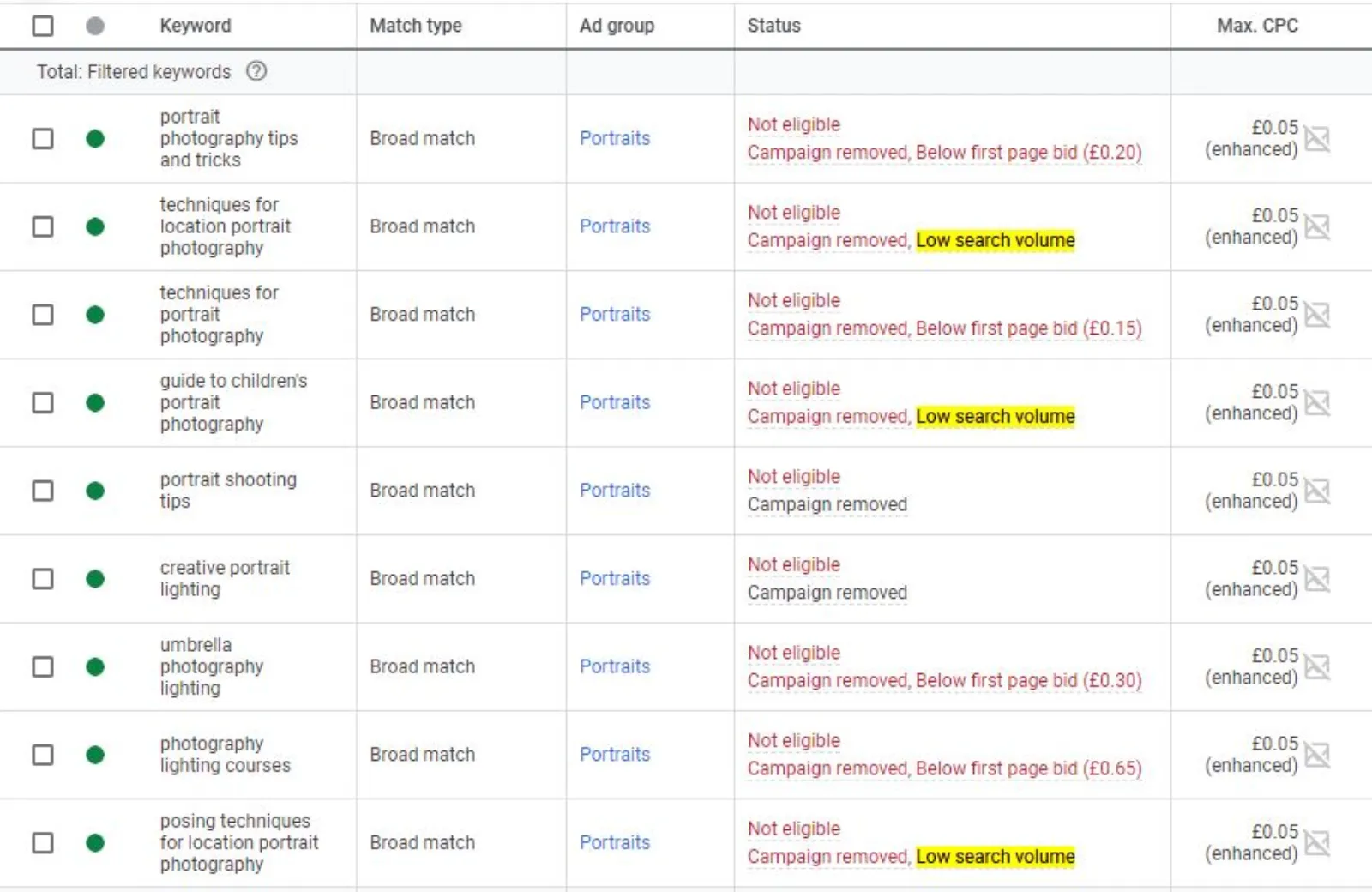
So, you’ve launched a campaign. Great. Then you inserted tons of keywords to your account, all relevant to your service or product. But, the next day, you realise your keywords don’t generate many impressions – and they’re showing up as “low search volume”.
Don’t despair. In this blog post, let’s look at what you can do with low search volume keywords in Google Ads. But first, we’ll take a dive into what, exactly, a low search volume keyword is.

Get Found, Get Chosen, Get Your Time Back
A free one-day marketing seminar in Milton Keynes · 10 November 2026
The Meaning Of A Low Search Volume Keyword
If a keyword in your Google Ads account doesn’t rank highly enough in a Google search, it’ll show up as a “low search volume” keyword. That is to say, a keyword will stay out of action and will fail to prompt your advert until users type in your keyword more frequently. Once search traffic for the keyword increases, it’ll become active and start showing ads.
Get your free Marketing Action PlanNot sure where to start? Answer a few questions and get your plan in about a minute. No email needed.
Get my plan →Just How Harmful Is A Low Search Volume Keyword?
Thankfully, a couple of low search volume keywords sitting in your account won’t impact how well your account performs. But if you have numerous low search volume keywords, these may influence your campaign’s Quality Score, adding unwarranted volume.
What To Do With Low-Search Volume Keywords
Here’s what you can do to deal with low-volume keywords appearing in your account.
Don’t Touch Them
As soon as users type your keyword into Google more often, more ads will show automatically. If your keywords are for a brand-new product, this makes sense, as they’ll start ranking.
 LIVE
Live every Tuesday at 2pm UK. Bring your marketing questions.
Get your Google, local SEO and AI questions answered live.
If you’re launching a new site or product, your business won’t gain traffic overnight. However, it’ll begin getting traffic once users know more about it.
Adjust Match Type
If your keyword is particularly lengthy or an exact match, these are typically marked as low search volume because there isn’t much chance that a person will search for a keyword consisting of five to six words.
As such, set your match type to “broad” and watch your search report closely so you can update inappropriate queries as negatives.
Research Different Keywords
Launch the Google keyword planner to research new keywords to target. Be sure to insert keywords that already provided traffic.
Pause Low-Quality Score Keywords
Think about pausing generic, low-quality score keywords that have low search volume, especially if you have a considerable amount of them.
House Keywords In A Separate Campaign
Occasionally, low search volume keywords are seasonal or connected with a product or event that hasn’t launched or happened yet. But trawling through low search volume keywords each time you assess how well your account is doing isn’t a great way to spend your time.
We advise placing these keywords into a separate campaign. Hold the same ad group names attached with “low search volume” then shift all low search volume keywords to an individual campaign.
Not only is this a much simpler way to evaluate active keywords without the noise these keywords create, but it also boosts your total campaign quality score.

Written by Uzair Kharawala
Partner at SF Digital Studios, a Google Premier Partner agency. Uzair has been helping businesses grow with Google Ads since 2002 and teaches it every week on YouTube.
Get our best Google Ads tips by email
New articles and videos, straight to your inbox. Unsubscribe any time.