
Navigating Google Ads can be challenging, especially when trying to figure out the best bidding strategy. There are different strategies for different types of campaigns, whether you’re dealing with Google Ads, Display Ads, or Shopping Ads. Let’s break it down to make it simple and clear.
Understanding Bidding Strategies
Before diving into the specifics, it’s essential to understand some common bidding strategies:
Get Found, Get Chosen, Get Your Time Back
A free one-day marketing seminar in Milton Keynes · 10 November 2026
- Manual CPC (Cost-Per-Click): You set your maximum CPC, giving you more control over your bids.
- tROAS (Target Return on Ad Spend): Google aims to maximise your return on ad spend.
- tCPA (Target Cost Per Acquisition): Google tries to get as many conversions as possible at your target CPA.
Which Strategy Is Best?
Choosing the right strategy depends on what you’re selling and your campaign goals.
Get your free Marketing Action PlanNot sure where to start? Answer a few questions and get your plan in about a minute. No email needed.
Get my plan →For E-Commerce (Selling Products)
If you’re running an e-commerce business, the tROAS strategy is generally the best fit. Here’s why:
 LIVE
Live every Tuesday at 2pm UK. Bring your marketing questions.
Get your Google, local SEO and AI questions answered live.
- Diverse Product Pricing: Let’s say you have products priced at $5, $19, $44, and $79. Each customer might buy a different combination, leading to varying cart values.
- Maximise ROI: With tROAS, Google aims to get you the highest return on your ad spend. For example, if you want every $1 spent on ads to generate $4 or $5 in sales, tROAS helps achieve that by optimising bids based on the expected return.
For Lead Generation (Service-Based)
For service-based businesses focused on generating leads, tCPA is usually more effective:
- Consistent Lead Value: Unlike e-commerce, where purchase values vary, leads generally have a consistent value.
- Controlled Acquisition Cost: tCPA helps you maintain a target cost for acquiring each lead, making it easier to manage your budget and predict costs.
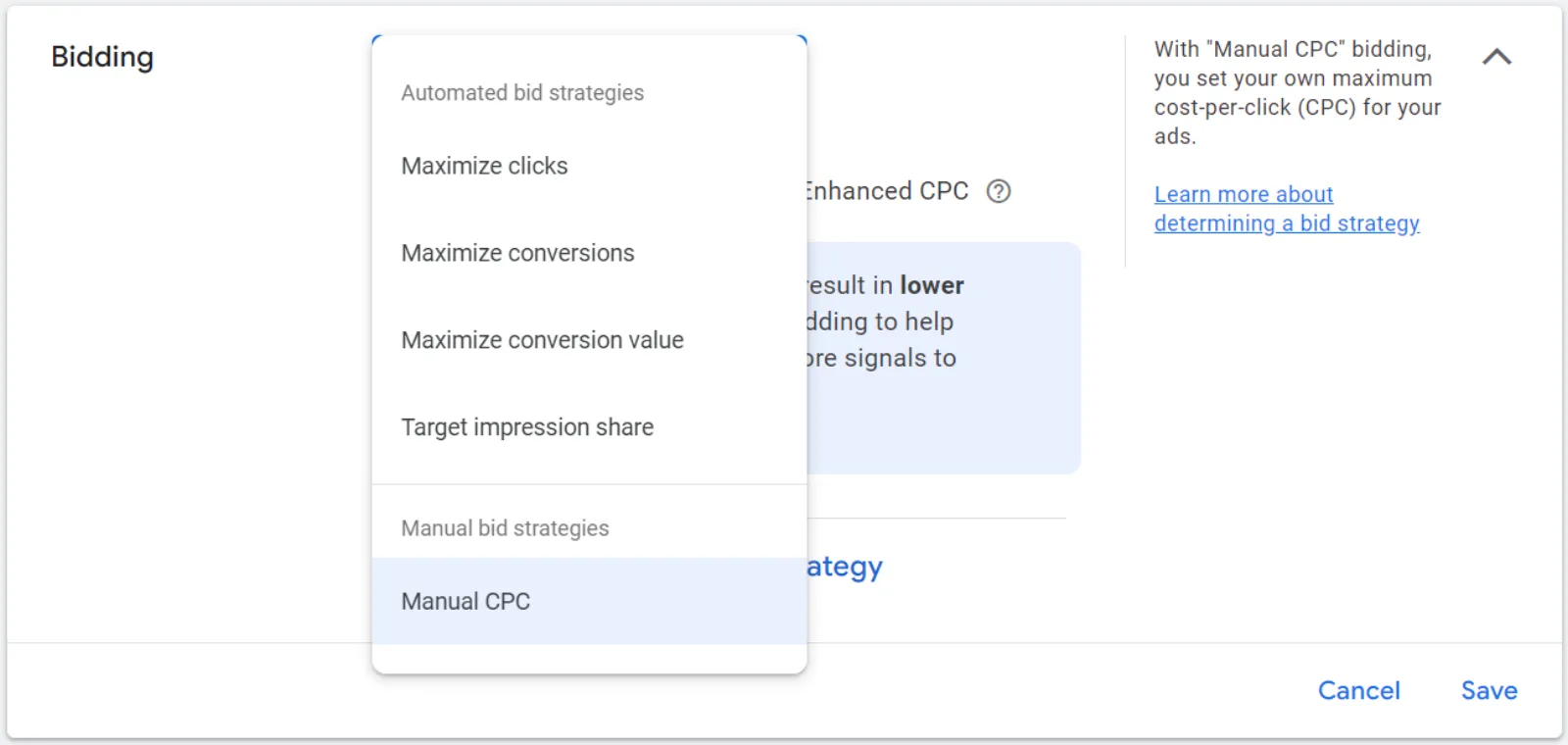
Starting with Manual CPC
While tROAS and tCPA are powerful, starting with Manual CPC can be beneficial:
- Gather Initial Data: Begin with Manual CPC to collect data on how your ads perform. This gives Google the information it needs to optimise effectively later.
- Transition to Smart Bidding: After you have enough data (ideally 30 conversions in the last 30 days), you can switch to tROAS or tCPA. This ensures that Google’s algorithms have enough information to work efficiently.
Step-by-Step Approach
- Set Up Manual CPC: Start your campaigns using Manual CPC. Adjust your bids to control costs and gather data.
- Analyse Performance: Monitor your campaigns to see how they perform. Look for patterns in conversions and costs.
- Switch to Smart Bidding: Once you have sufficient data (about 30-50 conversions), switch to tROAS for e-commerce or tCPA for lead generation.
Conclusion
Choosing the right bidding strategy is crucial for the success of your Google Ads campaigns. For e-commerce, focus on tROAS to maximise your return on ad spend. For lead generation, tCPA helps control your acquisition costs. Starting with Manual CPC allows you to gather valuable data before transitioning to more automated strategies. By understanding and applying these strategies effectively, you can optimise your ad spend and achieve better results.

Written by Uzair Kharawala
Partner at SF Digital Studios, a Google Premier Partner agency. Uzair has been helping businesses grow with Google Ads since 2002 and teaches it every week on YouTube.
Get our best Google Ads tips by email
New articles and videos, straight to your inbox. Unsubscribe any time.