Okay. Hello and welcome to another YouTube live from SF Digital. My name is Farzana and together with Uzair my husband, we present these daily at four o'clock UK time. For those of you that have been with us before, you know the drill, please do put your comments in the comments box and if you're new to us today, then obviously, please feel free to interact with us.
We will keep an eye on the comments and you'll be able to ask any questions that you may have, and we will do our very best to answer them at the end, as you all know, it tends to be a Uzair free zone on a Friday when I present now, only because his topics are very much working in the business and we've decided to switch my day to Friday rather than the Tuesday when I first started, for the moment, because rather than working in the business, we're going to give you some food for thought each week on working on your business and actually setting some time aside to actually think about how you're doing things.
Bear with me for a moment, just lost my screen. It's not a completely free Uzair zone!... We still have him here. Bear with me. Well, while he sets that up again for me, I've just had a little reminder on my Facebook that actually today is international smile dayI believe.! So, I hope you are smiling on this Friday afternoon and you've had a good week, a productive week and that you've got some good things to smile over.
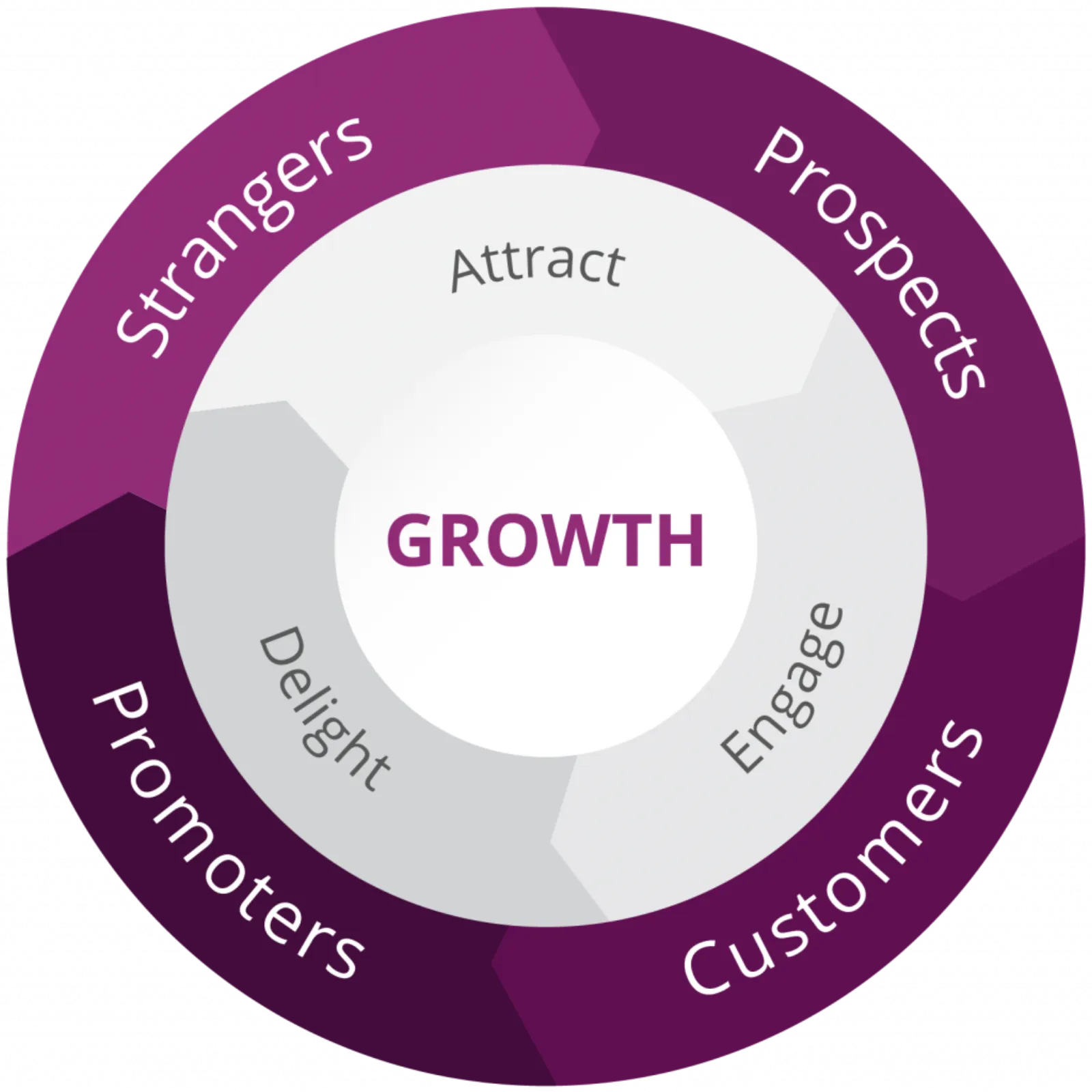
There you go. The Google message's worry less, smile more, and I think that's probably a nice affirmation to keep us all positive and active. Bear with me while we just get the text back. Thank you so much. Perfect. Thank you so much. Okay. So, today I'm going to continue with the final part of the presentation on the Flywheel methodology, and that is the attract, engage, delight phase of this wheel.
So, here we go. We're going to look at these all in more detail. So, just to summarise previously we looked at strangers, leading into prospects, becoming customers, and hopefully becoming your promoters and I think I touched on this last week that if you can apply some forces to each of those four areas, you may indeed have different people, different customers at different parts of that process, but that will become a ball of energy, a flywheel of energy that can dissipate within your business and really help to grow your business.
Ultimately, the centre of that flywheel. My favourite probably is promoters because we're going to talk about that today, the journey of the attract, engage, delight cycle because if you do this process, well, it becomes almost your habit and you will find that your best customers will become your evangelists and rather than you going and finding new clients each time, everything becomes inbound and you actually spent a lot less on your marketing, but of course there are lots of things that you need to do before you can actually do that.
So, as I say, we have three stages of the methodology, which is to attract, engage, and delight and we're going to start off obviously, first of all, with the attract stage. So again, as I previously mentioned, in my previous two episodes, we need to apply some forces to be able to actually get the attractors to engage with our useful content and of course, make that journey really easy for them.
So, we need to make sure that we eliminate any possible barriers to them actually interacting and learning about your business and by that, what I mean is, there is no point, for example, let's say putting everything on Facebook because if it's a considered purchase, that person is going to need to find a little bit more about you to verify you and to make sure that their considered purchase is indeed trustworthy and going to deliver to what their expectations are.
So, of course, if you then, for example, don't have a website where they can go and do some checking up on you, you've potentially put a barrier up now to them actually completing that process. An example of that, for example, in my daily life, on my Facebook feed, I know I mentioned Facebook a lot. I tend to be a Facebook user rather than m?Insta.
Just my personal preference and I will often see things like special offer, I've got cupcakes that are waiting to be picked up, they're all available to be picked up. They haven't even bothered to make a Facebook business page. It'll just be a name posted to a selling site. So, even if I did want to go back and engage with them, I've got no way of finding them for the future to perhaps order a cake rather than seeing a free offer and of course, if they haven't even bothered to make a Facebook page, the chances of finding a website for them are probably zero.
So, they've lost that moment. It's fine. It's quite a short-term approach. You can put some posts up. That's not a problem, but how are you going to capture and engage a visitor and actually keep them with you? Of course, the other problem is that sometimes people are almost forcing that attention and trying to make you engage with them and I do really believe that you can't really force it.
It's got to be something that's natural, authentic, sincere, all those things that we would all look for in our day-to-day lives. So, what can we actually do in marketing terms to attract our customers and clients, lots of methods here? I've got a few listed down for you. So, we've got content marketing, search engine optimisation, social media marketing, social media selling, paid advertising, and a big one at the end of their conversion rate optimisation.
So, content marketing, we hear this buzzword a lot, probably the last eighteen months or so speak to any marketeer and that's what they're going to tell you. You need to be marketing your content. You need to be looking at your blogs. You need to be putting good information out there. They don't actually explain how you're going to do that.
Again, that's where SF Digital probably is a little bit more, a little bit different. We like to sit down with our clients and actually go through what they're already doing, how they can do that better and what potential improvements they can make to their content marketing. That's really important to us because that is almost the key. There is no point a client coming to us and us just giving them a long list of things, they need to do.
It's just going to become overwhelming and the clients are probably going to become turned off and actually not engage. So, it's really important for us to understand their journey, where they are in their cycle with their business, and then help them to understand what they can do to improve things. Search engine optimisation. Absolutely vital, we know we all need to look at that for our websites, just one caveat and that is that obviously, we say search engine, let's face it, the reality is we're probably referring to Google.
We know that Google is trying to give the user the best possible user experience. That's why ninety-nine percent of us probably go to Google first. I appreciate there are many other search engines too, but beyond one or two, we probably couldn't. We probably couldn't even list a dozen. If we, unless we scratched our heads and sat down and listed them out.
We also have to remember that obviously on Google, a lot of the upper half of that Google page has already been filled up, paid advertising, Google My Business. Then, we finally come down to the organic searches. So yes, it's really important to optimise, but it's also important to bear in mind that the algorithms are constantly changing. We can't all be on page one and even five years ago when we realised, yes, I don't go to page two.
We already knew that now there are actually less positions even to be on page one. So yes, we need to do it, but we need to pay attention to probably to some other methods as well. Social media marketing. Now, as I've already touched on, it's important that you realise it's a touchpoint for your clients and your customers, it's a way of engaging with them.
It's part of that journey of where they're looking to find you. So, you're reducing the barriers to them engaging with you. They can see you, but if I can just say that, you know, just as much as we hate pushy sales, we all shrug our shoulders and go, oh no, I don't want to be a pushy salesperson.
Probably the matching phrase, if I may say, in marketing terms would be wishy-washy, non-descript, non-planned marketing, because that is probably just as detrimental as a pushy sales technique. So, your marketing you've really got to think about it again, not just stick a post-up there and think that that's going to engage and that's going to win your business.
There has to be a strategy in there. We've actually, you know, our team now is growing. We've got full-time strategists for our own content marketing, whose role is not only to put out the content but to also report back on the activity. This is really vital because without that reporting back, we can't actually see whether our message is reaching our audience and indeed, if we are getting the conversions that we're looking for, and it allows us to have a cycle of continual improvement, literally this morning, actually, we've had another brilliant brainstorming session.
We've decided to change something that has evolved over the last six months and overnight we've decided no that's got to change. So, from next week, again, processes are about to be tweaked again, and we are going to change what we're going to be doing because we want to see some slightly different results and some improved results. As I joked with my team good enough is not good enough, there is always room for improvement.
So, we are always striving to add something extra to what we're already delivering. Social media selling, obviously self-explanatory, if you choose to go down that route and would like to sell on social media, of course, go for it. But it's a very funnel-based theory. It's important to start thinking if you have followed this set of episodes to start thinking about more of a circular, slightly more holistic approach to your selling, not just about closing the deal and winning the business.
Ok, we've come to paid advertising, so obviously we're talking it might be YouTube Ads. It could be Google Ads. It could be banner ads. There are a number of methods that you can use to go down the paid advertising route. Obviously, normally when Uzair is presenting, you have a very good insight in all of those areas and of course the detail around Google Ads and Google Analytics.
So, I'm not going to spend any time on that, there are quite a few other things that I can cover off for you. Of course, if you're interested in paid advertising, please do look up our channel and you'll be able to see lots of information there and conversion rate optimisation. Now, this is really, really important to pay attention to we've managed to attract our audience by whatever the route let's say, we've managed to get a hundred people to our landing page.
Now, we may find that for every hundred people that are attracted to our landing page, let's say fifteen converts. Sorry. So, let's say, as I say, a hundred people have been attracted to your landing page and fifteen percent have converted. If we've got the data which we should have, and the campaign has been set up correctly. The first thing we need to be looking at is the reports.
The thing I just touched on a moment ago, because we might find that by carrying out any number of actions and I've listed a few for you here, it could be changing a headline, making our call to action better, improving our photo or video, changing button colour, shortening the form fields. Nobody wants to enter a form and have lots of fields that they need to fill in or write a very lengthy message.
It turns them off. So, we need to find that balance between engaging with our audience and actually getting them to take the next course of action, which is to get hopefully beyond the attract and actually become one of our customers. So, by looking at some of these things, we will find that actually, we've managed to get another two percent uplift, another five percent uplift.
We've already spent the money to attack the hundred. So, if we can get another two, three, five, ten percent conversion added on top, we've not actually had to pay for it. We've already done it and this is why it's important to start looking at these things, to review them. Again, I call this money on the table. We're often so busy as businesses chasing down the new leads, attracting new customers, trying to find a new person that we can interact with.
We forget that we already have an audience that's warm to us, it's time to actually nurture those a bit better and see what we can do to improve their experience. So, let's say we've managed to capture our audience. We've managed to get them attracted to us. What are we going to do to actually engage with them? So, the first thing we need to do is think about how we are going to make it really, really simple for them to shop, buy our product or our services and make that really as smooth a process as we can.
Now, that could be a website. If obviously, you have a product to sell, slightly trickier obviously, if you are service because it's not something you're going to click and add to a cart, this is where it gets really important to start thinking about how you're going to reduce the friction in your system. We talked about friction in the Flywheel previously, and this is one of those frictions.
We've got to minimise that to make sure that we can engage with our audience. Another really important factor is to make sure that we are able to engage with our audiences, on their terms, on their preferred timelines and channels and that in itself can be challenging. We have so many options now of communicating. It's not just emails or telephone calls.
We've got chatbots, form submissions, obviously emails, you name it, they are there. Increasingly so, and dare I say, especially since the pandemic this year that has started, we are having to be a lot more creative about how we're actually going to capture our audience and if anything, the world has become a little bit smaller. Still, there are no boundaries to who we interact with because we're doing everything online.
If I may give a personal example, obviously we're based in the UK. Many of our clients are based in North America, we've got few in Australia, we've got a few dotted around the Middle East and so on, Africa as well. But with a lot being in North America, obviously, as our day is probably coming to an end.
They're only just waking up and depending on whether they're in the East Coast or the West Coast, we could have quite a considerable time, you know, the number of hours difference in there as well. So, for example, when I finish this live today, I've got to get on... Hop on a call, my time five o'clock this evening, five-thirty to California.
Now, that's the daytime for the client, but that's actually the end of my Friday night, but I'm prepared to do that because I need to be able to do that and have that flexibility, there's a flip side to that. I had an email invitation earlier this week, please come and join our networking event. We'd love to have you there, have your input on what you do.
Oh okay. Sounds interesting. Let me see. When is it? Quarter to six in the morning. So, much as I love my work, there comes a point where I think I cannot burn the candle at both ends! So, kindly declined that offer to wake up and be ready for the quarter to six in the morning, because my timeline is actually much later in the day.
So, I need to be able to work with my clients. I can't be up at quarter to six in the morning, dressed and ready for a networking meeting! So, Like I say, engage with your clients on their terms. Now, I touched on this earlier. Obviously, Flywheel method is all about working on open relationships and the word relationships is really important.
This is not just about closing a deal. It's not a transactional interaction. We're actually looking to build that strong relationship so that we can continue for many weeks, months, years. Some relationships in our business have gone on for many, many years now. And what are the forces? What are those actual forces that you can apply to the Flywheel to actually make that happen for you?
I've got a little list there for you. It could be personalised emails, market automation, lead nurturing again, the multi-channel communication, obviously on their terms and a little one I've thrown in the end there, money-back guarantee programs. So, often on, coaching programs or even digital marketing agencies. They will often have things like a money-back guarantee program. If it's a sizeable considered purchase, let's say in the thousands for a coaching program, for example, that's quite a hard conversion to gain because yes, you can have lots of touchpoints and you can do all the lead nurturing, et cetera.
How are you going to get that all-important conversion for them to actually part with their money and sign up to you? Now, if you're confident in what you're doing and you know that your delivery is excellent and meets above expectations, you really should have no problem doing a money-back guarantee program. We've often done this on even some of our smaller purchases, online courses, et cetera.
Very, very rare that somebody would say, no, I'd like my money back, please. Actually, in our service industry, it's really not a big deal. If somebody decides to buy an online course, and they're going to ask for their money back, obviously you would have your terms and conditions and how they've got to meet certain criteria for that.
But beyond that, let them have it back because much rather that they leave happy and remember that, then you reneging on what you have already promised. So, do your very, very best that once you've engaged, you make it as smooth as possible for your customer to stay with you and then we come to the delight phase. So, what are we trying to do in the delight phase?
They've already converted. They're already working with us. We need to make sure that we are helping them, nurturing them, supporting them, giving them everything they need to make their journey as easy as possible and that's when they then can hopefully reach their goals. We should know what their goals are because, at the attract and engage phase, we would have already done that as part of our audit.
When we took on a client, we will know what their expectations are that makes it so much easier for us to meet their expectations. So, for example, to give it a small example, when we used to have the portrait studio, I'd have families come through the door, they'd all have a nice seat and the first question I would ask them is what are you looking for from your pictures and for a split second, they would actually be taken aback because the hadn't really given it much thought, they rocked up to a photographer, photographers going to do their thing.
But I don't know, without asking them, are they looking for formal, informal, black and white, fun. Is it for the home? Is it for an album? I need to know all of those because otherwise, I'm going to spend the next hour with this family, trying to shoot every possible combination under the sun, because I don't actually know what they want, but by eliminating all the waste in my time and energy, trying to satisfy unknown needs, I've actually figured out what they needed, done what they needed to have done and now hopefully those pictures would meet their expectations and hopefully beyond and be better than their expectations, which dare I say they always were.
So, everyone's a winner, if you are successful and performed excellently for your client. Now, by this, let's say in our terms as a digital marketing agency, if we can set up campaigns that perform above average, meet expectations, surpass those expectations. Well, we've met our goal that will have given... The reason it's a success is because the client is getting conversions.
They're getting more sales or obviously selling their services. If they're selling more, they're happy, they're happy with their campaign. They're happy with what we've offered. We win. They win, their customer wins and this is why it's really important that actually that's when the momentum really gets going and we can actually really start to grow our businesses. Again, some forces that you might want to consider to make that delight phase happen is keeping your customer service really, really proactive, quite important to incentivise your teams here as well and actually think about that journey for your customer.
One of the ways that you can manage your customer service is, we've all had it when we've gone to make a complaint, let's say for something, suddenly everybody falls by the wayside. Nobody wants to take responsibility. Oh, it's that department and such and such person I'll get them to call you. All that happens is that gets your back up.
So, it gives a very fragmented experience for the customer. However, if you can give your client a dedicated person, that's going to look after all their needs from start to finish. That gives that customer, the end customer real reassurance that they are being looked after and nurtured and cared for and then hopefully you shouldn't even need to ever get to the point where there will be a complaint.
You've also same as before multichannel availability. So again, having won the business, we need to make sure that we are accessible at all times. So, we've obviously got the traditional ones, phone, email. Now, increasingly people are using WhatsApp to communicate. Obviously, Skype is still there, numerous other methods and of course, we now are also taking onboard Slack because that allows us to integrate with Asana, as I've already talked about previously, that's the system we use for all our project management and it means that all the conversations, the casual conversations around a project all stay linked in and all of the stakeholders within that project can also see all the conversations.
Otherwise, we're trying to relay across many platforms and it can get really confusing. So, obviously make sure that for your customer's viewpoint, you're also still available. You might decide that you might be a ticketing system. So of course, you know, bigger organisations might have a ticket system where then everything can be looked after through a process and through scripts so that nobody can fall through the net with the wrong information being given out to them.
So, everybody's going to be working on the same system, almost like a fast-food chain where everybody's following the system. You can also use automating onboarding and customer feedback experience surveys, and of course, referral and loyalty programs and just to summarise if you're going to be using the Flywheel method, hopefully, I've given you a very small insight as to how it can work for you, but in essence, becomes a really efficient way of attracting your customers, keeping the ones you've already got really happy and as I've said, eliminating some of that friction again, just to give you a very quick example of how you're eliminating friction, I'm going to give you the example of one of my hairdressers from many years ago.
I would turn up for my appointment. They'd be running late. I've made time to get to my appointment on time, but they're running late, so that's fine. I'm waiting. I've now been greeted by person number one, sat down. I then get sent to another person, not my hairdresser. Who's going to wash my hair. I then get another person who ends up towel drying my hair.
Then, I finally get to my hairdresser, but he decides that, oh, actually, would you mind. I've just got to go and finish something else. So-and-so will blow dry your hair. I've now been seen by four, five individuals at this hairdresser. I haven't had great customer experience and it's very easy. Stop going. They've lost me and I won't go back again because I know that I'm not being cared for as a customer.
Now, I know that might seem like, well, where's the example in that, we forget sometimes when we're talking about marketing examples, actually, we are all real people think about your own behaviour when you're out and about with your purchases, see how you behave, apply that to your business and you'll realise that actually, am I guilty of the same thing.
And just to close, that's probably the appropriate time to do this, one of the things that we used to do, I hope you can see that, was this little postcard, just a simple, thank you. We'd just literally write a couple of lines of a message and stick that in the post, literally a few pennies, a few cents to get that posted out, the number of clients, every client, actually, would say, thank you for the thank you.
It was such a simple gesture. We would do that the day after somebody had converted for us and by the way, we would not stick the second-class cheap stamp on there. It would always go first-class. Our clients are first class. They're worthy of receiving something that is posted first class and it's the small things that can make a great difference to your business.
So, I hope you've enjoyed that. I'm just going to flick over to the laptop and see what I have here. There might be the odd comment or something here. Thank you so much, Mike. I do my wins every week and this week I didn't do my wins, but for those that don't know, I actually became the Mayor of our town, which has a population of about forty-two thousand and now I'm the Mayor.
So, that brings with it responsibility and duty, fundraising, a whole number of things, which, I'm really looking forward to engaging with my community on a completely different level, nothing to do with my day job. We've got that here. Got some questions here, which are more, related to actual campaigns and things, so, Sandy, in particular, I'm going to leave those for Uzair to pick up on, I'm sure he will answer those on his next live and Sandy's also said thank you.
Sir should be very proud of you. I think he might be enjoying. Yes. I think he's been enjoying my sidekick, it's only been week one, I haven't given him any jobs yet. He doesn't know what he's in for yet, but yes, thank you so much for all your kind sentiments and with that, we come to an end.
So, just to let you know that next week, I'm going to talk about nurturing your business and giving you some real-life productivity hacks and how to really get things done. So, dare I say it, on a daily basis, I get asked, how do you get so many different things done and I do wear many, many hats. You will know me as SF Digital, as I've already touched on one other hat.
I have a number of other hats too. So, I'm going to show you some of my secret ways of how I actually managed to divvy up what I'm doing. Actually, get things done on time every time and make sure that nothing suffers for that. It can be a little bit close sometimes, but it does get done. I promise you, and with that, I'm going to call today's meeting to an end.
Please feel free to give us a Google review on Google My Business. If you can. That's very much appreciated. If you like these live streams, please do let us know if you have a particular topic that you'd like covered. Like I say, more of working on the business, as opposed to in the business that you'd like me to cover off.
Be very happy to do so and with that have a lovely weekend and I'll see you all again next week. Thank you.

 LIVE