

A small business owner asked a simple question on Reddit this month. What is the best Semrush alternative for AI visibility? Dozens of people replied.
The replies were telling. One owner called Otterly and Semrush "insanely expensive". Another said no single tool did both SEO and AI visibility well. A rug maker said knowing where they appear in ChatGPT was only half the battle.

Get Found, Get Chosen, Get Your Time Back
A free one-day marketing seminar in Milton Keynes · 10 November 2026
That's the problem with the best AI visibility tools in 2026. They are powerful, they're priced for big marketing teams and they bury you in data.
Get your free Marketing Action PlanNot sure where to start? Answer a few questions and get your plan in about a minute. No email needed.
Get my plan →I've run Google Ads accounts for almost 15 years. I have watched the same thing happen with every new kind of tool. The first wave is built for enterprise, and small businesses pay enterprise prices for features they never open.
This guide compares the main tools on price, the AI engines they cover and how far you can trust their numbers. It also shows you a free way to check today, and what to do with the results so AI starts naming you.
What Are The Best AI Visibility Tools In 2026?
The best AI visibility tools in 2026 are Semrush, Profound, Peec AI, AthenaHQ, Ahrefs Brand Radar, Frase and Frizerly. Each one checks whether ChatGPT, Gemini, Claude and Perplexity mention your business. Covering all four usually means a top-tier plan, from roughly £200 to £500 a month.
That's the short answer. The longer answer is that "best" depends on what you need.
A national software brand needs daily tracking across nine AI engines, in ten countries. A local accountant needs to know one thing. When someone in their town asks ChatGPT for an accountant, does their name come up? That's it.
Those are very different jobs.
Most of the tools on the market are built for the first one, priced for the first one and designed around the reports that a marketing director in a large company would want to show their board.
What Does An AI Visibility Tool Actually Do?
An AI visibility tool asks AI assistants the questions your customers ask, then records whether your business is mentioned. It does this over and over, on a schedule, and turns the results into a score.
Here is how it works in practice.
- You give the tool a list of questions, called prompts. For example, "Who's the best plumber in Milton Keynes?"
- The tool asks those prompts to each AI assistant it covers. That might be ChatGPT, Gemini, Claude and Perplexity.
- It records the answers. Were you named? Were you linked? Which competitors were named instead?
- It repeats this daily or weekly and shows the trend on a dashboard.
Most tools also show which websites the AI quoted when it answered. That part is useful.
It tells you where the AI gets its information about your industry, which is often a handful of directories, review sites and trade websites that you can get yourself listed on.
Some tools go further and suggest content to write, or even write it for you. That's the split the Reddit thread kept coming back to. Some tools only track. Others track and help you fix things.
Why Should A Small Business Care Whether ChatGPT Mentions It?
Because your customers are already asking it. They are asking ChatGPT which builder to use, which solicitor is good and which café does the best breakfast.
When someone asks Google, they see ten links and pick one. When someone asks ChatGPT, they often get three names and a recommendation. If you're not one of the three, you are not in the running.
That's why this matters more than old-style rankings. There's no page two in an AI answer. You are either in the answer or you're invisible.
We've written about this shift before. The short version is that AI answers are becoming a new kind of word of mouth. People trust them, and they act on them.
The trouble is, you cannot see these conversations. Google Search Console shows what people typed into Google. Nothing shows you what they asked ChatGPT. That's the gap AI visibility tools are trying to fill.
You cannot fix what you can't see. That's the honest case for tracking your AI visibility.
What You Are Really Paying For
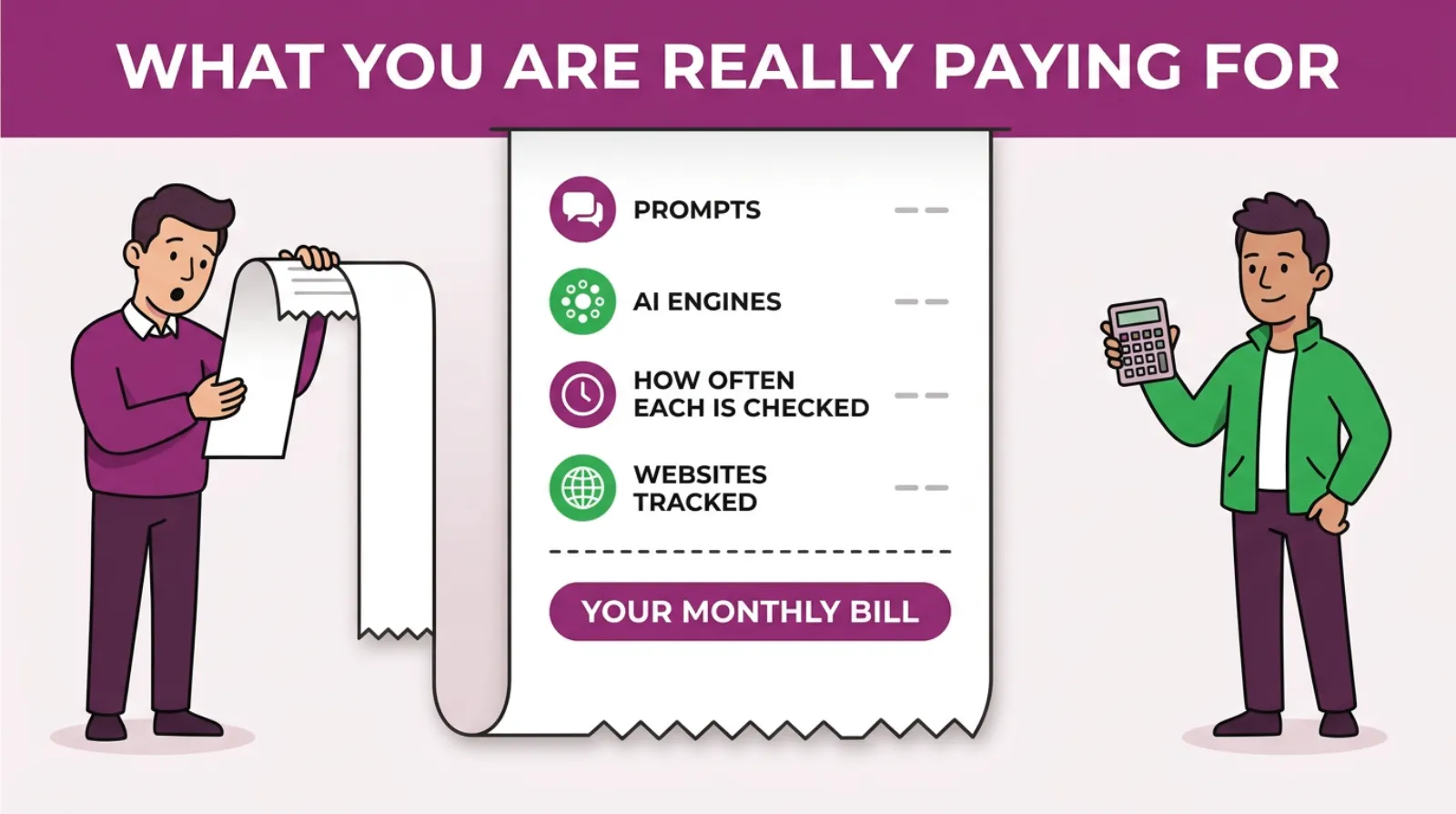
Every AI visibility tool charges on the same four things. Once you see them, the prices start to make sense.
How Much Do AI Visibility Tools Cost?
Most AI visibility tools cost between £40 and £300 a month for a small business plan. To cover ChatGPT, Gemini, Claude and Perplexity together, you usually need a higher tier. Enterprise plans are priced on request and often run into thousands.
Here is what the main tools charge. We checked every price on the vendors' own pricing pages on 22-10-2026.
| Entry plan | What the entry plan covers | Plan you need for all four big AI engines | |
|---|---|---|---|
| Semrush (SEO + AI Search) | £161 a month (£134 a month paid yearly) | 50 prompts. Google, ChatGPT, Perplexity, Gemini "and more" | Pro+ at £242 a month for 100 prompts |
| Frase | $49 a month | 50 prompts. ChatGPT and Google AI only | Scale at $299 a month |
| AthenaHQ | $295 a month | 3,600 AI answers a month, 11 AI models | Starter at $295 a month |
| Ahrefs Brand Radar | Custom prompts from €47 a month | Pay per platform and per check | €654 a month for all models |
| Profound | Free 7-day trial | 50 prompts. ChatGPT, Gemini and AI Overviews | Enterprise, price on request |
| Peec AI | Not shown on its pricing page | Starter, Pro and Advanced plans | Not shown on its pricing page |
| Frizerly | Not shown on its homepage | Writes and publishes content for you | PRO plan covers all four |
A few things jump out from that table.
The cheap entry plans don't cover all four engines.
Frase's $49 plan only checks ChatGPT and Google AI. You need its $299 plan to add Claude and Gemini.
Claude costs extra almost everywhere.
Ahrefs says a Claude update uses eight checks, where other engines use one. Profound only offers Claude on its enterprise plan.
And the prices are in three currencies. If you are a UK business, the dollar and euro prices move with the exchange rate every month.
Why Do These Tools Cost So Much?
Because every prompt costs them money to run. Each time a tool asks ChatGPT a question, it pays for that answer. Multiply that by four engines, fifty prompts and daily checks, and the bill climbs fast.
Here's a simple example. Say you track 50 prompts across four AI engines every day. That's 200 answers a day, or about 6,000 a month.
The tool pays for every one of those answers.
Then it adds its own margin, its dashboard and its support team. That is how you end up at £200 to £300 a month.
There are three other reasons the price climbs.
- Most tools are built for agencies and big brands. They add seats, client workspaces and reports you'll never use.
- Many charge per domain. If you run two websites, you often pay twice.
- The best prices usually need a yearly contract. Paying monthly can cost you around 17 percent more.
None of that is wrong. These are serious tools for serious marketing teams. But a local business owner is paying for a lot of engine they'll never drive.
Which AI Engines Should You Track?
Track the four that most of your customers use: ChatGPT, Gemini, Claude and Perplexity. Add Google's AI Overviews if you already rank well on Google. Skip the long tail of smaller engines unless you sell to a niche that uses them.
ChatGPT is the one everyone asks about first. It's the most widely used AI assistant, so it is the one most of your customers will try.
Gemini matters because it sits inside Google.
It's in Android phones, in Gmail and in Google's own search features.
Claude is popular with business users and professionals. If you sell to other businesses, your buyers may well be using it.
Perplexity is built for research. People who use it are often comparing options, which makes them close to buying.
Each engine pulls from different sources, so your results can be very different on each one.
One tool maker in the Reddit thread said three quarters of the websites cited for a question were cited by one engine only. That is why a single blended score can hide a lot.
The Tools, One By One
Here's what each tool is good at, and who it's really built for. We have kept this honest. Each has real strengths. The question is whether those strengths are worth the price for your business.
Semrush AI Visibility
Semrush added AI visibility to its main SEO plans. As of 22-10-2026, its pricing page lists the Starter plan at £161 a month, with 50 AI prompts tracked daily.
It's the natural choice if you already pay for Semrush.
Your keyword data and your AI data sit side by side.
The downside is price. The owners in the Reddit thread called it expensive, and one called it "enterprise" level. If you only want AI visibility, you are paying for a full SEO suite as well.
Profound
Profound is built for large brands. It tracks up to nine AI engines, including Claude, DeepSeek and Microsoft Copilot, and it offers the kind of single sign-on, API access and dedicated support that a big in-house team expects.
You can try it free for seven days with 50 prompts. After that, it's an enterprise plan with a custom price. Most small businesses will never need its depth.
Peec AI
Peec AI is one of the most searched-for tools in this space. It's popular with in-house marketing teams that want to track a lot of prompts.
Its pricing page lists Starter, Pro and Advanced plans billed monthly. When we checked on 22-10-2026, it did not show the prices on that page. You'll need to sign up to see them.
AthenaHQ
AthenaHQ covers 11 AI models, which is more than most. Its Starter plan is $295 a month and includes 3,600 AI answers.
There is also a free tier with a small number of credits. That's a handy way to see your baseline before you commit.
Ahrefs Brand Radar
Ahrefs Brand Radar is a good fit if you already use Ahrefs. It's priced per platform and per check, which makes it flexible.
The catch is the jump. Custom prompts start at €47 a month, but the page lists €654 a month for all models. Claude also uses eight checks per update, so it eats your allowance faster.
Frase
Frase combines AI visibility with content writing tools. Its Starter plan is $49 a month, the cheapest here.
But that plan only covers ChatGPT and Google AI. Claude and Gemini only arrive on the Scale plan at $299 a month. Frase also says its tracking sends alerts but does not change your content.
 LIVE
Live every Tuesday at 2pm UK. Bring your marketing questions.
Get your Google, local SEO and AI questions answered live.
Frizerly
Frizerly works differently. It connects to your website, writes blog and social posts for you and publishes them on a schedule.
Its PRO plan tracks how often ChatGPT, Claude, Gemini and Perplexity mention your brand. One Reddit user liked that it tracks and acts in one place. Its homepage doesn't list prices, so check before you sign up.
Are AI Visibility Tools Accurate?
Not exactly. They give you a rough reading, not a precise number. AI assistants don't give the same answer twice, so any score is a snapshot of a small sample.
Try this yourself. Open ChatGPT and ask, "Who is the best electrician in my town?" Then open a new chat and ask again. You'll often get a different list. Sometimes a very different one.
One person in the Reddit thread put it well. Run the same prompt twice and you can get two different answers. So any dashboard number is a snapshot at best.
This matters more than most tool makers admit.
Say a tool asks a question ten times and you are named in four. It reports 40 percent visibility.
But with only ten answers, your true rate could be anywhere from about 17 percent to about 69 percent. That's basic statistics, not an opinion. Ten answers is simply too few to be sure.
So treat scores as a direction of travel.
If your number climbs month after month, you're probably doing something right. If it jumps 10 points in a week, do not celebrate yet.
Five Questions To Ask Before You Pay For Any AI Visibility Tool
Before you sign up for anything, ask the sales team these five questions. The answers tell you whether the numbers are worth having.
- How many times is each prompt run on each engine, and how often? One run a day is too noisy to trust on its own.
- Does the tool use the real apps, or the developer versions of the AI models? The answers can be quite different.
- Does it show a margin of error, or just one percentage? A score with no range can mislead you.
- Can you open the actual answers and the sources they cite? If you can't check the evidence, you cannot act on it.
- Does it show each engine separately? A blended score can hide that you're strong on one and missing on another.
A good tool will answer all five without fuss.
If the sales team dodges them, that tells you something too.
Before You Pay: The Five-Question Checklist
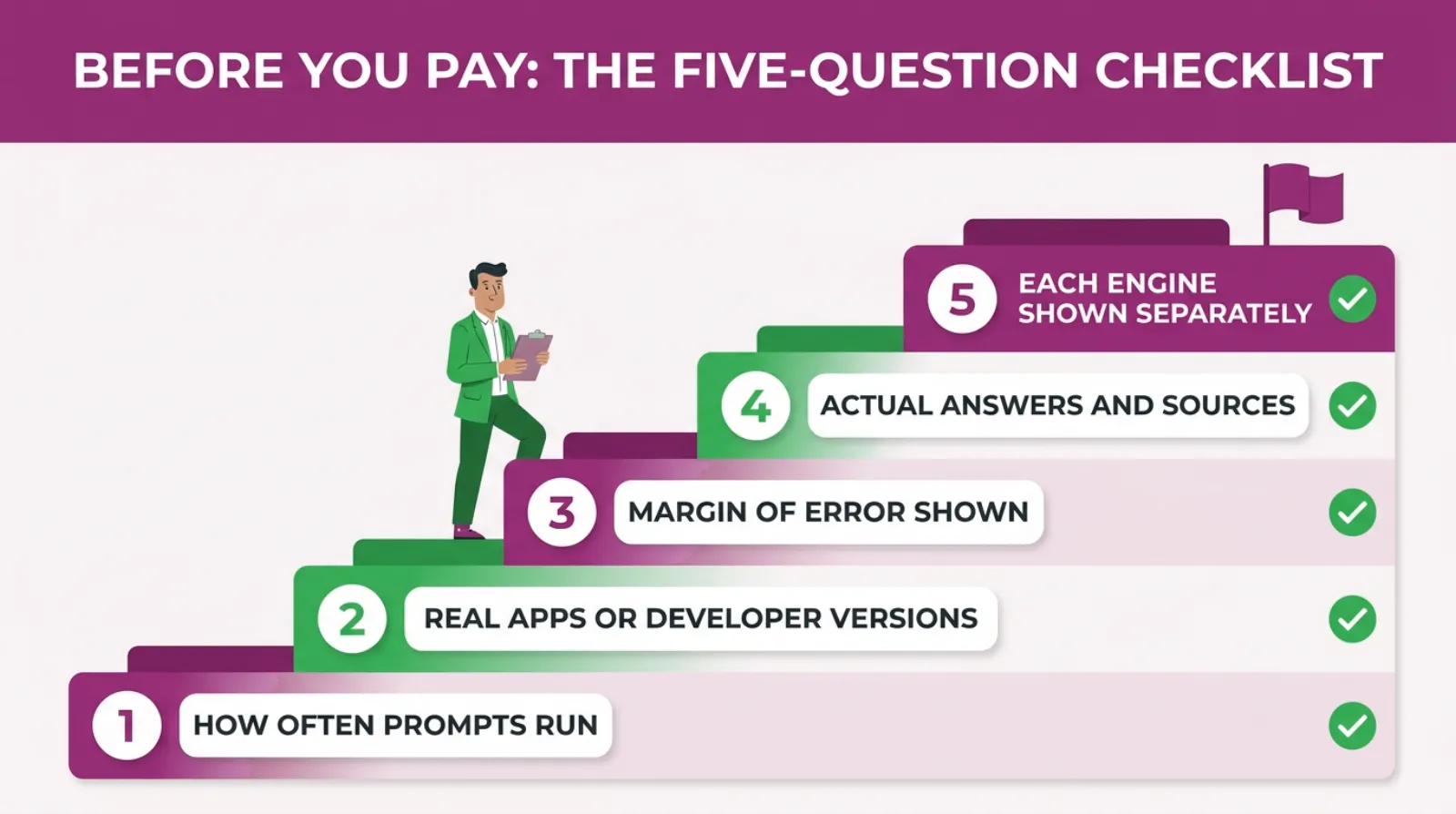
Keep this list next to you when you book a demo. It works for every tool in this guide, including ours.
How Can You Check Your AI Visibility For Free?
You can check your AI visibility for free in about an hour a month. Write down 15 questions your customers ask, put them into ChatGPT, Gemini, Claude and Perplexity, and log which businesses get named.
This is the method one Reddit user suggested, and it's a good one. Here is how to do it.
- Write 15 questions your customers would really type. Use their words, not yours. "Who fits boilers near Leighton Buzzard?" beats "boiler installation services".
- Open each AI assistant in a private or logged-out window, so your own history doesn't skew the answer.
- Ask each question once and note who gets named. A simple spreadsheet is fine.
- Note the websites the AI links to or quotes. Those are the sources it trusts.
- Repeat on the same day each month and compare.
That gives you a baseline that's yours. It will not change when a tool changes its method.
It also shows you what to fix.
The same Reddit user noticed something useful. The pages that got quoted were the ones that answered the question in their first two sentences.
The downside is time. Fifteen questions across four engines is 60 answers to read and log each month. Most owners do it twice, then stop.
Which Questions Should You Track?
Track the questions a customer asks just before they pick up the phone. Those are the ones that turn into work. Questions about general topics are nice to win, but they rarely bring in a customer.
A good list has three kinds of question in it. Aim for about five of each.
- Best-of questions. "Who is the best wedding photographer in Bedford?" These show whether AI recommends you by name when someone is ready to choose.
- Problem questions. "Why is my boiler losing pressure?" These show whether AI trusts your website enough to quote it when someone needs help.
- Comparison questions. "Is a local accountant better than an online one?" These show whether you come up when a buyer is weighing up their options.
Add your town or area to most of them. AI assistants try to answer local questions with local businesses, so a question without a place name tells you very little about your own patch.
Then look at the questions your customers actually ask you on the phone and by email, because they're usually better than anything a keyword tool will suggest. Write them down word for word.
Keep the list the same from month to month. If you change the questions every time, you cannot compare one month with the next, and the whole exercise loses its point.
What Should You Do Once You Know Where You Stand?
Fix the pages AI should be quoting, and get mentioned on the sites it already trusts. Those two jobs move your visibility more than anything else.
Start with your own website.
Pick the five questions where a competitor gets named and you don't. Make sure you have a page that answers each one, clearly, in its first two sentences.
Then look at the sources the AI quoted.
If it keeps citing one directory, one review site or one local news site, that's where you need to be. Get listed, get reviewed or get featured there.
Keep your Google Business Profile complete and your reviews coming in. Gemini and Google's AI features lean on that information when someone asks a local question.
Finally, give it time. AI assistants do not update overnight, and it can take a couple of months before a new page or a new mention starts to show up in their answers.
What's Wrong With Having All That Data?
Nothing, if you have a marketing team to read it.
Everything, if you are running the business yourself and the only time you get to look at a dashboard is late on a Sunday evening with a cup of tea.
Open most AI visibility dashboards and you'll see share of voice, citation rates, sentiment scores, prompt volumes and competitor rankings. Each one comes in a chart, split by engine and by week.
It looks impressive.
But it doesn't answer the two questions an owner actually has. Am I showing up? And what should I do next? Most dashboards leave you to work that out.
We see this with every kind of marketing data. More numbers do not lead to more action. They lead to people logging in once, feeling overwhelmed and never logging in again.
A tool you don't open is the most expensive tool of all. You pay every month and get nothing back.
Is There An AI Visibility Tool That Tells You What To Do Next?
Yes. We built one. It's called SEO Buddy. It tracks ChatGPT, Gemini, Claude and Perplexity, and it tells you what to change so they start naming your business.
That's the part most tools leave out.
They show you a score, a chart and a list of competitors. Then the hard bit, working out why you're missing and what to fix first, is left to you.
A few tools, like Frase and Frizerly, help you write new content. That helps. But a new blog post is only one of the fixes, and often not the first one you need.
SEO Buddy starts from the gaps. For each question where a competitor gets named and you don't, it shows you which sites the AI is quoting instead, and the next step to close that gap.
There are no 40 charts to read. Just what's happening, in plain English, and what to do about it this week.
You don't need to be technical to use it, and you don't need a marketing team to read it. If you can read a bank statement, you can read SEO Buddy.
If you want to know what it would take for AI to start recommending you, book a call. We'll show you SEO Buddy and walk you through your first steps.
Which Option Is Right For Your Business?
Here's a simple way to decide.
- If you just want to know where you stand, start with the free 15-question check. Do it this week.
- If you already pay for Semrush or Ahrefs, try their AI visibility features first. You may already have some of it.
- If you are a large brand tracking hundreds of prompts in several countries, look at Profound, Peec AI or AthenaHQ.
- If you want help writing content as well as tracking, Frizerly and Frase are worth a look.
- If you want all four big AI engines tracked, with a clear next step for every gap, book a call about SEO Buddy.
Whichever you choose, start with the free check. It costs nothing and gives you a baseline to judge every tool against.
Frequently asked questions
What is an AI visibility tool?
An AI visibility tool checks whether AI assistants like ChatGPT, Gemini, Claude and Perplexity mention your business. It asks them the questions your customers ask, records the answers and shows how often you're named.
How much do AI visibility tools cost?
Most cost between £40 and £300 a month for a small business plan. Covering all four big AI engines usually needs a higher tier, and enterprise plans are priced on request.
Is there a free AI visibility checker?
Yes. Several tools offer free trials or free tiers, including Profound and AthenaHQ. You can also check by hand by asking 15 customer questions in each AI assistant and logging who gets named.
Can I track ChatGPT mentions with Google Search Console?
No. Search Console only shows searches made on Google itself. It cannot see what people ask ChatGPT, which is why AI visibility tools exist.
How often should I check my AI visibility?
Once a month is enough for most small businesses. AI answers change from day to day, so weekly ups and downs are mostly noise. Look for the trend over three months.
How do I get mentioned more by ChatGPT?
Answer your customers' questions clearly on your website, in the first two sentences of each page. Get mentioned on trusted sites in your industry, and keep your Google Business Profile and reviews up to date.
Keep Reading
If you want to go deeper on AI search, these posts pick up where this one leaves off.
- Why Your Customers Are Asking ChatGPT About You (And How To Win That Conversation)
- The Real Reason Some Brands Show Up In ChatGPT (And You Don’t)
- How To Rank in ChatGPT: The New SEO Playbook for 2026
- Best Tools To Use For AI SEO Content Optimisation (The Honest 2026 Guide For Small Business Owners)
- How To Win The Reddit Citation Game Without Getting Banned In Your First Week
We picked these because each one covers a next step. Why AI mentions you, how to rank in it and the tools that help you write for it.
Sources
Every price in this post comes from the tool makers' own pricing pages, which we checked on 22-10-2026. Prices change often, so check them again before you buy.
So, Is AI Recommending You Or Your Competitor?
You can find out this week, for free. Write down 15 customer questions, ask the four big AI assistants and see who comes up.
If you're not there, you are not alone. Most small businesses aren't, yet. That's your opening.
And if you'd rather have a tool do the checking and tell you what to fix, book a call. We'll show you how SEO Buddy tracks ChatGPT, Gemini, Claude and Perplexity, and turns what it finds into a to-do list you can actually work through.

Written by Uzair Kharawala
Partner at SF Digital Studios, a Google Premier Partner agency. Uzair has been helping businesses grow with Google Ads since 2002 and teaches it every week on YouTube.
Get our best Google Ads tips by email
New articles and videos, straight to your inbox. Unsubscribe any time.