
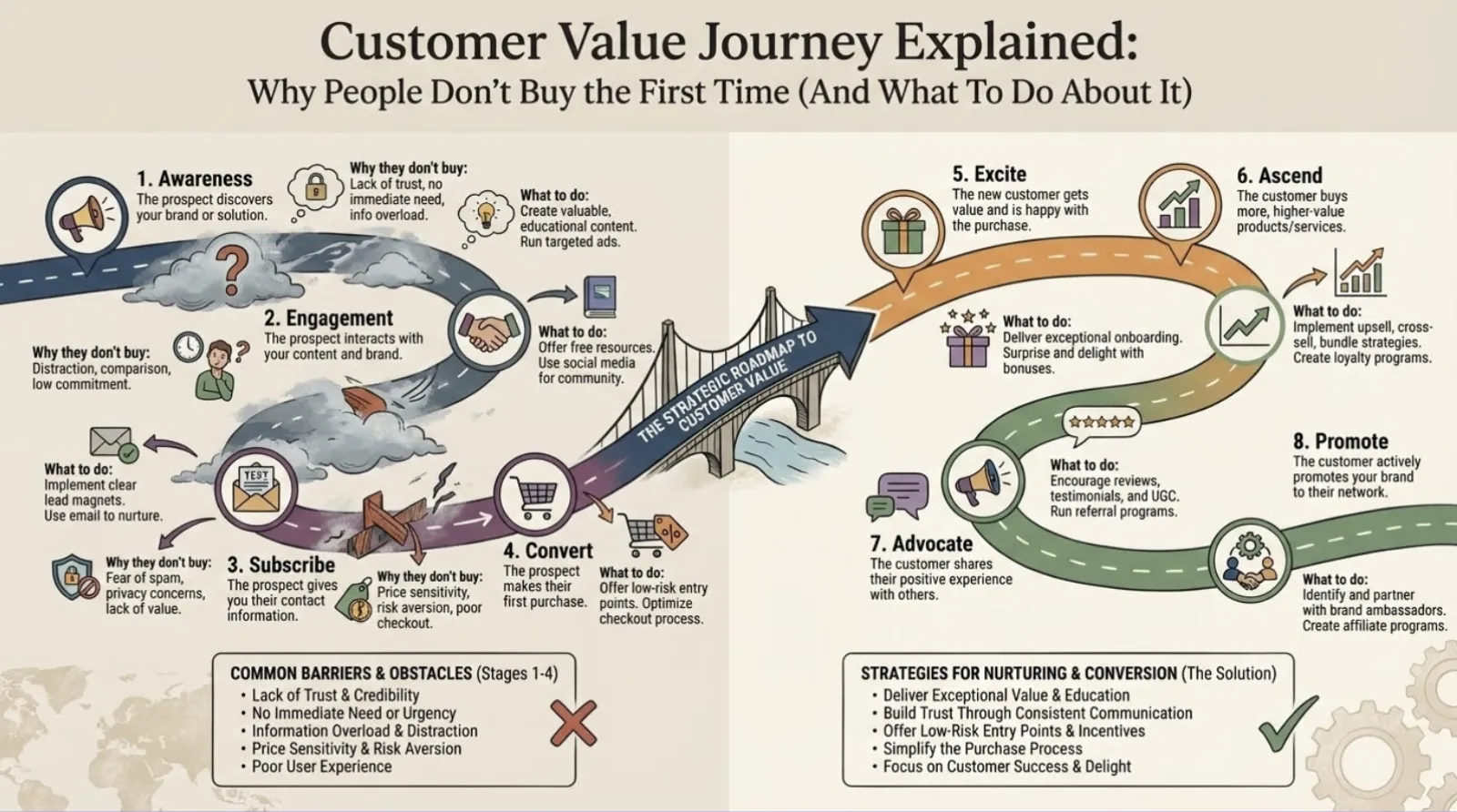
Ever wondered why some people visit your website, engage with your social media, or even sign up for your newsletter, but then disappear without making a purchase? You’re not alone. Many small business owners pour their heart and soul into attracting potential customers, only to be left frustrated by low conversion rates on the first interaction.
What if there was a clear, step-by-step map that showed you exactly where your potential customers are, what they need, and how to guide them effectively from curiosity to becoming your most loyal advocates?
For small business owners, understanding the customer path is essential for growth. The Customer Value Journey (CVJ) demystifies this process, offering a clear blueprint to attract, nurture, convert, and delight customers. It’s about building relationships, not just chasing sales. Grasping each stage optimizes marketing, reduces wasted ad spend, and creates invaluable experiences.
Understanding the Core Problem: Why Most People Don’t Buy Immediately
The Myth of the Instant Sale
In today’s fast-paced digital world, it’s easy to believe every visitor should instantly become a paying customer. Many business owners launch a product, run ads, and feel disheartened by low immediate sales. This expectation is a myth; most buying decisions involve a series of interactions, research, and trust-building.
Imagine Sarah, a baker launching her online cake service. Despite beautiful ads, few placed orders, leaving her frustrated. Her customers weren’t ready to buy; they were just starting their journey, needing guidance and value at every step, not just an initial glance.
Introducing the Customer Value Journey: A Strategic Roadmap
This is where the Customer Value Journey comes in. It’s a comprehensive framework outlining eight stages, from first awareness to becoming a raving fan. Unlike a traditional sales funnel focused on transactions, the CVJ builds long-term relationships and delivers continuous value. For small businesses, it transforms sporadic sales into consistent growth, improving customer acquisition and customer retention.
The Eight Essential Stages of the Customer Value Journey
The Customer Value Journey is a continuous loop, designed to cultivate lasting relationships and maximize customer lifetime value. Let’s break down each critical stage.
Stage 1: Awareness – Getting Noticed in a Noisy World
This is the first step where a potential customer discovers your brand, perhaps via social media, Google, or a recommendation. They might be unaware of their problem. Your goal is simply to get on their radar and introduce your existence without asking for anything in return.
Actionable Tip: Focus on content marketing, engaging social media, and basic SEO. Create valuable blog posts or informative videos. Make your brand visible and spark initial curiosity. Brand awareness is paramount.
Stage 2: Engagement – Building a Connection
After awareness, the next step is meaningful interaction, not buying. It’s about building connection and demonstrating value. They might read your blog, watch videos, or engage on social media, actively consuming content and forming an opinion about your brand.
Actionable Tip: Provide consistent, high-quality content that educates or inspires. Encourage comments, Q&A sessions, or polls. Offer free, valuable resources. This fosters customer engagement and demonstrates expertise.
Stage 3: Subscribe – Turning Interest into Leads
At this stage, your potential customer exchanges contact information for more value, becoming a recognizable lead. They might sign up for your newsletter, download a free e-book, or register for a webinar, actively inviting direct communication.
Actionable Tip: Create compelling lead magnets like e-books or mini-courses. Ensure clear CTAs for subscription offers and landing pages optimized for lead generation.
Stage 4: Convert – The First Small Commitment
Here, your lead takes their first tangible step towards becoming a customer, often a small, low-risk commitment. This could be a “tripwire” product, a free trial, or a paid consultation. The goal is a minimal financial commitment, signifying a shift in their engagement.
Actionable Tip: Develop attractive “tripwire” offers providing immense value at a low price. Optimize your conversion rate for these. Make the entry barrier low, requiring a minimal financial commitment.

Stage 5: Excite – Delivering on Your Promise
Congratulations, you’ve made a sale! But the journey doesn’t end there. The Excite stage is all about ensuring your new customer gets exactly what they expected, and ideally, even more. It’s about delivering an exceptional experience that validates their decision to purchase from you. This creates positive sentiment and makes them happy they chose your brand.
Actionable Tip: Implement smooth onboarding, clear instructions, and excellent support. Delight with bonuses or personalized touches. This builds trust and sets the foundation for customer loyalty, ensuring quick wins.
Stage 6: Ascend – Increasing Customer Lifetime Value
Once your customer is excited, the next natural step is to offer them more value through additional products or services. This is where you increase their customer lifetime value by encouraging them to buy higher-priced items, subscribe to premium plans, or purchase complementary products. This stage is about nurturing the relationship and showing them how your full suite of offerings can further benefit them.
Actionable Tip: Create a clear product or service ladder. Offer relevant upsells, cross-sells, and premium versions. Develop loyalty programs. For example, offer a higher-tier coaching program after entry-level results.
Stage 7: Advocate – Turning Customers into Raving Fans
At this point, your customer loves your brand, trusts you, and has experienced significant value. They are now willing to speak positively about you to others. This doesn’t necessarily mean actively seeking out new customers for you, but rather being happy to share their positive experiences when asked or presented with an opportunity.
Actionable Tip: Make it easy for customers to leave reviews/testimonials. Ask for feedback; share user-generated content. Create a simple referral mechanism. Word-of-mouth marketing strengthens brand loyalty and credibility.
Stage 8: Promote – Empowering Evangelists
The final, ultimate stage is when your customers become active evangelists. They are so thrilled they actively and enthusiastically promote you to their network without being prompted. They become your unpaid sales force, genuinely passionate about sharing your value with others.
Actionable Tip: Implement structured referral programs with clear incentives. Consider affiliate programs for passionate customers. Host exclusive events or create a community. Empower them to easily share your message, leveraging customer loyalty fully.
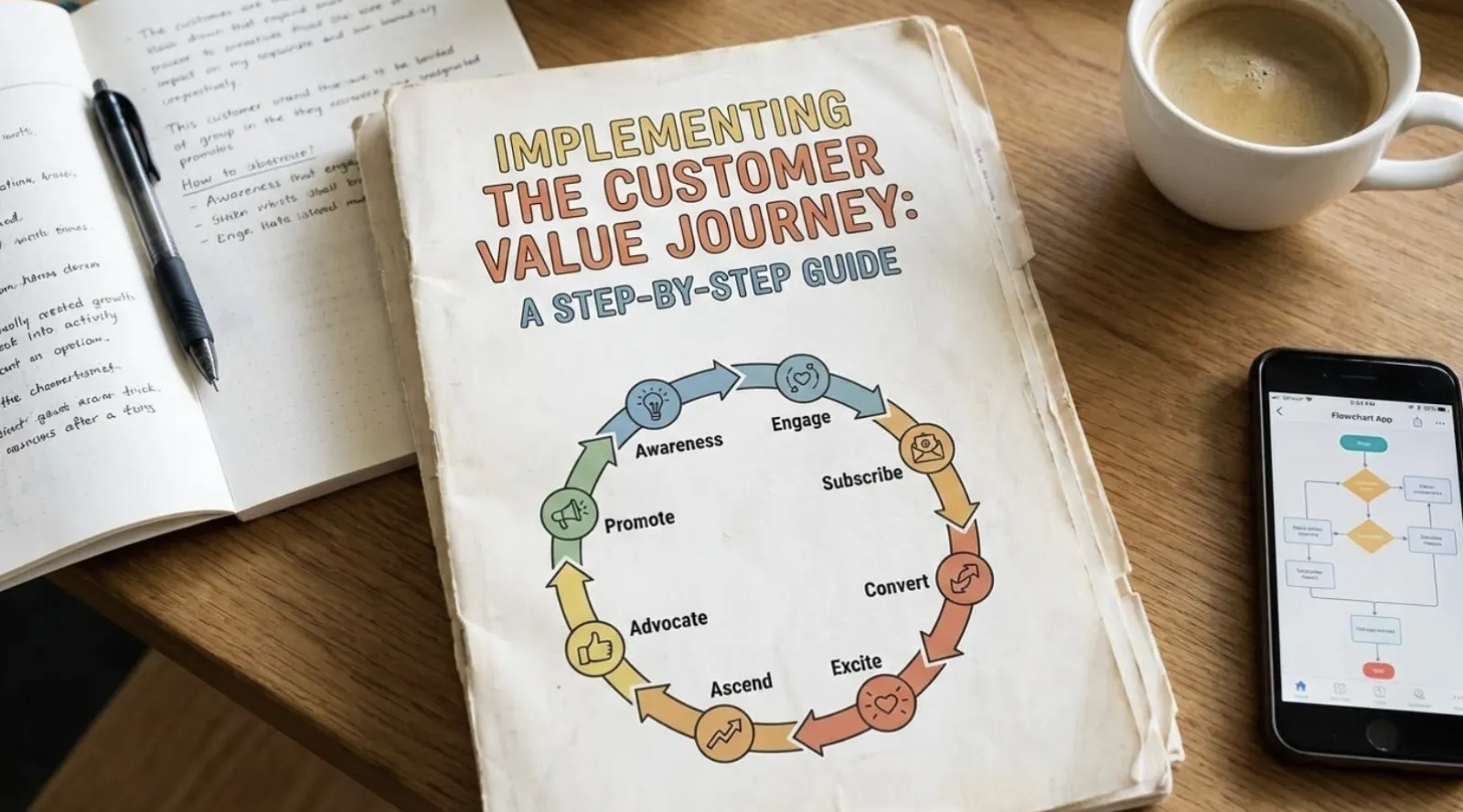
Implementing the Customer Value Journey: A Step-by-Step Guide
Putting the CVJ into practice might seem daunting, but by breaking it down, any small business can start seeing significant improvements in their digital marketing strategy.
Map Your Current Customer Experience
Actionable Step: Begin by drawing out the eight stages and honestly documenting how your customers currently move through them. What are their existing touchpoints? Where do they encounter your brand, engage, subscribe, and convert? This initial mapping highlights areas where you excel and, importantly, where you have gaps.
Identify Gaps and Opportunities for Improvement
Actionable Step: Critically evaluate each stage after mapping. Are there stages with no specific strategy? For instance, great awareness but no lead magnet (Subscribe)? Or conversions but no upselling (Ascend)? Look for customer drop-off points or disjointed experiences. These gaps offer major opportunities to boost your marketing strategy and sales funnel efficiency.
Create Targeted Content for Each Stage
Actionable Step: Develop specific content and offers aligning with customer needs at each stage. For Awareness, think broad blog posts. For Subscribe, craft an e-book. For Convert, design a low-cost trial. For Excite, create onboarding guides. Tailoring your message ensures relevance and guides customers smoothly.
Leverage Automation for Nurturing
Actionable Step: Utilize marketing automation tools like email marketing platforms to streamline the journey. Set up automated email sequences that deliver value, answer questions, and guide customers. This maintains consistent communication without manual effort, preventing potential customers from falling through the cracks and improving customer engagement at scale.
Measure and Optimize Continuously
Actionable Step: The CVJ is not set-it-and-forget-it. Track key metrics at each stage: traffic (Awareness), engagement rates (Engagement), sign-ups (Subscribe), purchase rates (Convert), satisfaction (Excite), average order value (Ascend), reviews (Advocate), and referrals (Promote). Regularly review data, identify bottlenecks, A/B test, and refine. Continuous optimization is vital for long-term success and maximizing return on investment.
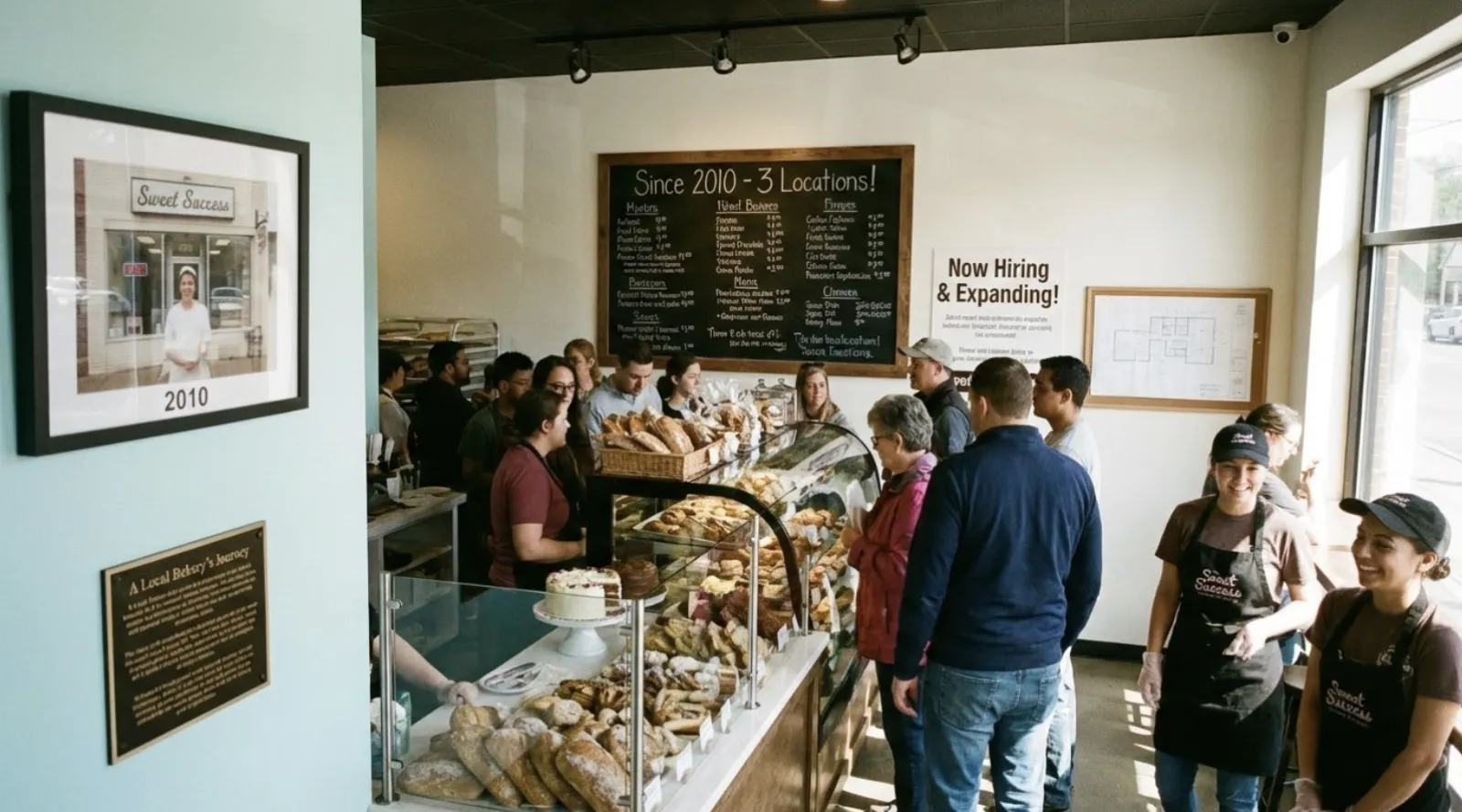
Case Study: A Local Bakery’s Journey to Sweet Success
Let’s revisit Sarah, our frustrated baker. After learning about the Customer Value Journey, she decided to implement it systematically:
- Awareness: Sarah posted engaging photos and videos of her baking on Instagram/TikTok with relevant hashtags, and optimized her Google My Business.
- Engagement: She created “Baking Tips” videos and blog posts, engaging with comments and questions.
- Subscribe: She offered a free “Ultimate Cake Flavor Pairing Guide” for email sign-ups.
- Convert: Email subscribers received a discounted “Mini Cupcake Sampler Box” offer.
- Excite: Every order included a handwritten thank-you note and a surprise cookie sample, followed by a satisfaction email.
- Ascend: Customers received emails featuring custom cake designs or “Baker’s Dozen” discounts on larger orders.
- Advocate: Sarah encouraged Google reviews and social media shares via QR codes, highlighting testimonials.
- Promote: She launched a “Refer a friend, get 15% off” program.
By applying the CVJ, Sarah transformed her struggling side hustle into a thriving local business with a loyal customer base.
Why Neglecting the Journey Costs You Money
Ignoring the Customer Value Journey is akin to trying to build a house without a blueprint. You might get some walls up, but it will be inefficient, unstable, and ultimately, more expensive in the long run.
The Hidden Costs of a Broken Journey
When you don’t have a clear CVJ, you often face:
- Higher customer acquisition costs: Constantly finding new customers without retaining existing ones.
- Lower customer retention: Customers churn quickly due to a lack of engagement strategy.
- Missed upsell and cross-sell opportunities: Limiting customer lifetime value.
- Weakened brand loyalty: No consistent positive experience.
- Inconsistent messaging: Scattered marketing efforts and wasted budget.
The Power of a Seamless Customer Experience
Conversely, a well-defined and executed Customer Value Journey leads to:
- Increased profitability: By retaining customers and increasing their lifetime value.
- Stronger brand loyalty: Customers feel understood and valued.
- Organic growth through referrals: Delighted customers become effective marketers.
- More efficient marketing spend: Purposeful actions targeting the right customer at the right stage.
- A deeper understanding of your audience: Invaluable insights into needs and pain points.
Implementing the CVJ is not just about more sales; it’s about building a sustainable, customer-centric business.
Frequently Asked Questions About the Customer Value Journey
1. What is the main difference between a sales funnel and the Customer Value Journey?
A sales funnel focuses on moving a prospect to a single transaction, often ending there. It’s linear and sales-focused. The Customer Value Journey is a holistic, circular framework encompassing the entire customer lifecycle, from initial awareness through multiple purchases and advocacy. It emphasizes building lasting relationships and maximizing customer lifetime value, not just a one-time sale.
2. How long does it take to see results from implementing the CVJ?
Results vary by industry and existing efforts, with initial improvements in lead generation or conversion rates visible within weeks to months. However, the true power of the CVJ—increased customer retention, customer loyalty, and organic growth—unfolds over several months to a year or more. It’s a long-term strategic investment.
3. Is the Customer Value Journey only for online businesses?
Absolutely not! While widely adopted by online businesses, its principles are universal. Any business interacting with customers—online, in-person, or hybrid—can benefit. A local restaurant, consulting firm, or retail store all have customer journeys that can be mapped and optimized using the CVJ framework to improve their marketing strategy and customer experience.
4. What are some common mistakes to avoid when mapping my CVJ?
Common mistakes include treating the CVJ purely theoretically, rushing customers through stages, or neglecting any stage (especially Excite, Ascend, Advocate, Promote), which limits customer retention and lifetime value. Failing to measure and optimize each stage is also critical, leading to wasted effort and unclear results.
5. How can a small business with limited resources effectively implement the CVJ?
Start small, focusing on 1-2 stages with immediate need. Leverage free/low-cost tools for email marketing. Prioritize valuable content for multiple stages. Simple changes, like clear CTAs or thank-you emails, significantly impact customer journey mapping.
Final Thoughts: Your Blueprint for Lasting Customer Relationships
The Customer Value Journey is more than just a marketing framework; it’s a philosophy for building a thriving business centered around your customers. By understanding that people don’t typically buy the first time they encounter you, and by intentionally guiding them through each stage, you transform mere interactions into meaningful relationships. This journey empowers you to deliver exceptional value consistently, turning curious strangers into committed customers and, eventually, into passionate advocates who fuel your growth.
Take Action: Start Mapping Your Customer Value Journey Today!
Don’t let another potential customer slip away. Take the first step today: start mapping out your own Customer Value Journey. Identify where your customers are, what they need from you at each point, and how you can provide an unparalleled experience. Begin with one stage, implement a small change, and then measure its impact. Your customers, your business, and your future success will thank you for it. Embrace the journey, and watch your business flourish!

Written by Uzair Kharawala
Founder of SF Digital Studios, a Google Premier Partner agency. Uzair has been helping businesses grow with Google Ads since 2002 and teaches it every week on YouTube.
Get our best Google Ads tips by email
New articles and videos, straight to your inbox. Unsubscribe any time.