
Every week, a local business owner tells me the same thing. Their agency has asked for more budget again.
My answer surprises them. You don't need a bigger budget. You need a smaller map.
Most of them say nobody has ever told them that, because every marketer and agency they've spoken to has asked for more budget and then more again. Spending more will not grow a business whose customers all live within 20 miles.
Get your free Marketing Action PlanNot sure where to start? Answer a few questions and get your plan in about a minute. No email needed.
Get my plan →Spending well will. And the best place to start is a Google Ads brand campaign. It is the cheapest campaign you'll ever run, and often the most profitable.
I covered this on my live stream on 13 October 2026. This post sets out the whole thing, step by step, so you can build yours this week.
I have managed Google Ads accounts for almost 15 years. This is the campaign I would never switch off.
What Is A Google Ads Brand Campaign, And Does A Local Business Need One?
A Google Ads brand campaign is a small search campaign that shows your ad when someone types your business name into Google. A local business needs one because competitors can bid on that name too. It can start at £10 a day, takes about ten minutes to build and is usually the cheapest click in the account.
That is the short answer. The rest of this post explains why it works, how to set it up and what to watch once it's running.
One point before we start. "Local" does not mean "small". You could run a large and thriving company whose customers all sit within 10, 15 or 20 miles of your door.
If that's you, this campaign is for you.
What Counts As A Brand Search?
A brand search is any search that includes a name. The person already knows who they want.
Here is an easy way to see the difference. Someone types "buy Apple iPhone 18". That's a brand search. They know the brand, the product and the model.
Now someone types "buy latest smartphone". That is a non-brand search. They don't care who makes it. They just want the newest one.
Your business works the same way. "Emergency electrician Bedford" is non-brand. "Smith and Sons Electrical Bedford" is brand.
Nobody types your name by accident.
They may have had a quote or a proposal from you, they may have seen your van on a job nearby, or a friend may have told them to ring you. Either way, they are looking for you and nobody else.
That makes a brand search the warmest search you'll ever get. It is also the one you can least afford to lose.
Why Should You Pay For Clicks When You Already Rank First?
Because ranking first in the free results doesn't put you first on the page. Ads sit above the map, and the map sits above the free results. A competitor's ad can appear over your own name.
You will hear this debate a lot. "I'm already at the top of Google. Why would I pay to be there twice?" I hear it most weeks.
There are two camps, and you'll get two different answers. I'm firmly in the camp that says protect your name.
Think about what the page looks like when somebody searches. The ads come first, then the Google Maps results and only then the free listings, which we call organic results.
So the top organic result can be the third thing a customer sees. Now picture that on a phone. The screen is small. The first few ads fill it, and most people tap one of them.
If one of those ads belongs to a competitor, you have just lost a customer who was looking for you. That was a job with your name on it.
Losing a brand click to a competitor is losing work that was already yours.
Can A Competitor Really Bid On Your Name?
Yes. Anyone can bid on your business name as a keyword, and it isn't illegal. Nothing in Google Ads stops a rival from appearing when someone searches for you.
There is one limit worth knowing. If your name is a registered trademark, you can ask Google to restrict its use in other people's ad text. Google's trademark policy covers this, and the rules vary a little by country.
That stops a rival writing your name in their headline. It doesn't stop them showing an ad when someone searches for you.
So a trademark helps, but it will not protect the click. Only your own ad does that. You may rank first organically, and you may lead the map as well. A competitor's ad can still sit above both.
Why First Place Can Still Be Third
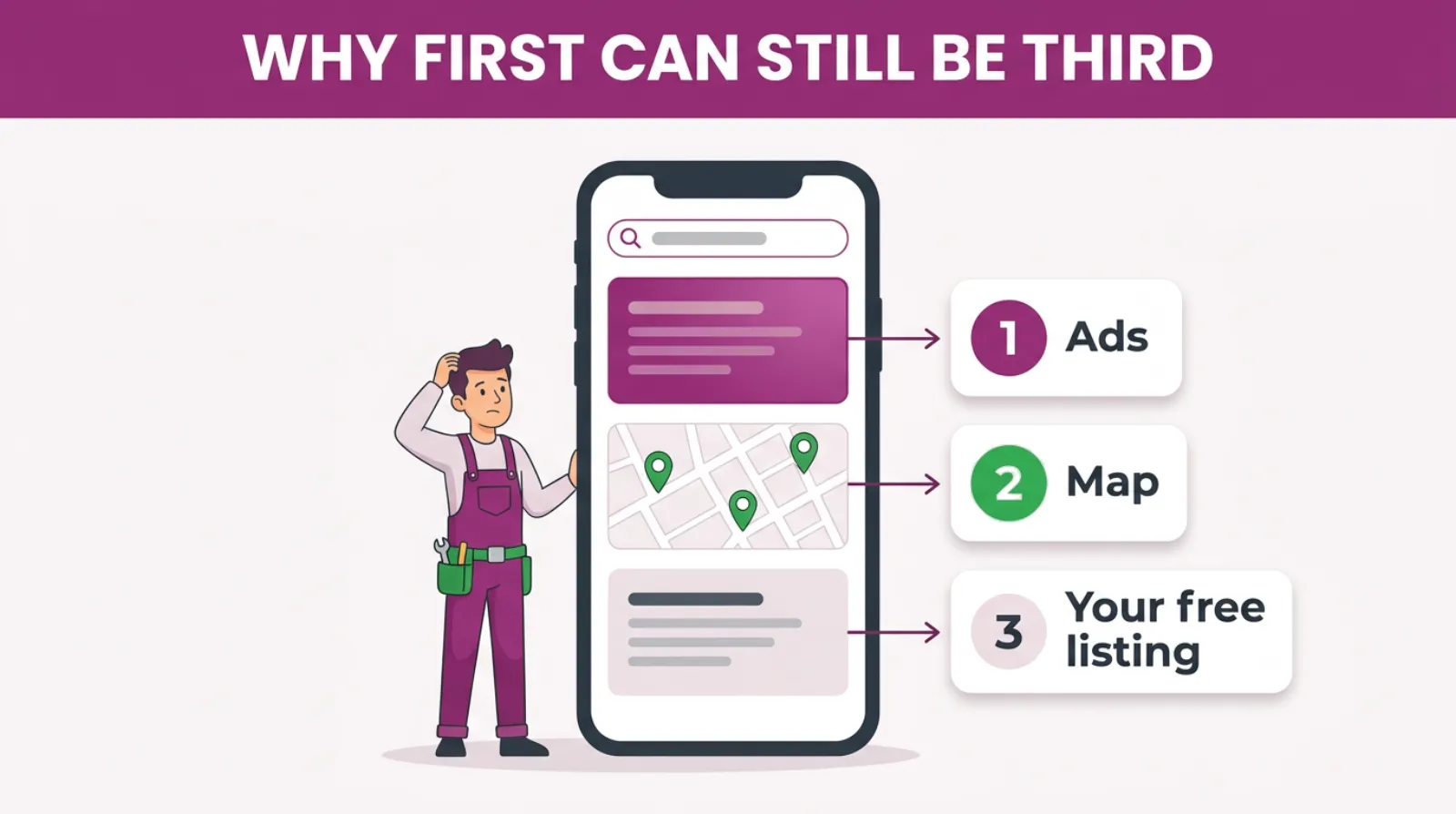
The order matters more on a phone than anywhere else. A person searching your name on a mobile may never scroll as far as your free listing.
What Does A Brand Campaign Give You That Ranking First Doesn't?
It gives you four things: the warmest searches, the cheapest clicks, control of the message and a place to collect the demand your other marketing creates. A free listing gives you none of that control.
Let's take them one at a time.
The Warmest Searches You'll Get
These people already know you. They are not comparing five firms. They want your number, your address or your prices.
That is why brand clicks convert at several times the rate of anything else in the account. It will always be that way.
The Cheapest Click In The Account
For most local businesses, a click on your own name costs less than any other click you buy. Google sees that your ad is exactly what the person wanted.
Don't quote me on every case, though. I have seen brand terms that were quite expensive. Names like Apple or Samsung attract a lot of bidders.
For a local firm, it's usually the best value in the account.
You Choose What They See
This is the part I always point to. With an ad, you control the message at the top of the page.
Google decides which page to show in the free results, and it could be your about page, your contact page or an old service page that you would forgotten was there. You don't get a say.
With an ad, you write the headline, and you pick the phone number, the links underneath and the exact page that people land on after they click. If you have an offer this month, you can lead with it.
It Collects Demand
A brand campaign does not create demand. It collects it. Your search campaigns, display ads, videos and remarketing all make people aware of you, and some of those people will come back days or weeks later and search for your name.
The brand campaign is there to catch them. It's the net at the bottom, and it only works when something above is filling it.
Here is how the free listing and the brand ad compare.
| Your free listing | Your brand ad | |
|---|---|---|
| Position on the page | Below the ads and the map | Above everything |
| Who writes the headline | You | |
| Which page people land on | Google decides | You decide |
| Phone number and address shown | Not guaranteed | Yes, with call and location assets |
| New offer or event | Waits for Google to update | Shows once the ad is approved |
| Can a competitor sit above it | Yes | Rarely, if your impression share is high |
The table makes one thing plain. The free listing is worth having, but you don't control it.
What A Brand Campaign Collects
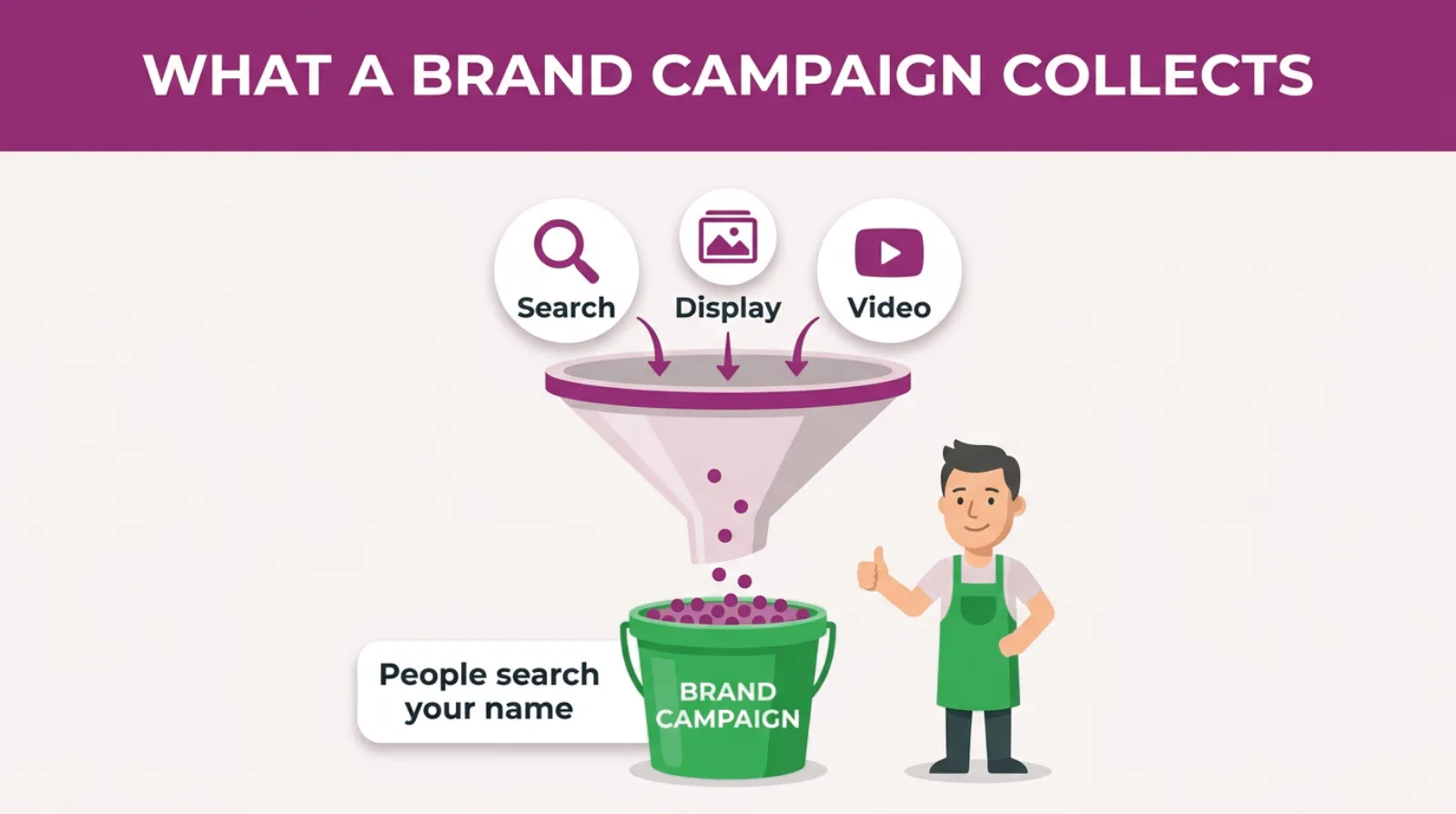
This is why I call it step three. It comes after the search campaign that targets the job and the town.
Why Does The Brand Campaign Come After Your Main Search Campaign?
Because a brand campaign can only collect searches that already exist. If nobody knows your name yet, there is little for it to catch.
Step two, in the series I've been running, is the search campaign built on the job and the town. "Boiler repair Luton" is a good example. That campaign finds people who do not know you yet.
Get that working first. Then add the brand campaign on top. If you're brand new, your brand campaign may get very few clicks at first. That is fine. It costs almost nothing while it waits.
As your other marketing does its job, the searches for your name will grow. The brand campaign will be ready.
How Do You Set Up A Brand Campaign In Ten Minutes?
Create a separate search campaign with one to three keywords: your business name in exact match and phrase match. Use the same settings as your main search campaign, widen the map a little and send people to your homepage.
It is the simplest setup in Google Ads. Here is each step.
- Make it a separate campaign. Don't put your name in the same campaign as your non-brand keywords. It needs its own budget and its own numbers.
- Add your name in exact match and phrase match. Use your business name, and your name with the town. Add the way people actually say it on the phone.
- Do not worry about every misspelling. Google's close variants pick up most of them for you.
- Choose the Search Network only. When you set the campaign up, untick the Display Network and search partners.
- Set the location to presence, not interest. It's the first option under the location settings. You want people who are in your area, not people who are reading about it.
- Attach your negative keyword list. Use the shared list you built for your main search campaign, so the same junk searches stay out.
- Go a little wider on the map. If your main campaign targets a 20 mile radius, set this one to 30 or even 40, because people outside your area who search for your name still want you.
- Send them to the homepage. This is the only campaign where I'll recommend that.
That last step needs a word of explanation. Normally, I tell people never to send ad traffic to the homepage. It is usually the worst page you can choose.
A brand search is different. The person wants you, not one service. For most service businesses, the homepage serves them well.
The exception is a specific search. If someone types "Apple iPhones", send them to the iPhone range. If they type "Apple iPhone 18", send them to that product page.
Match the page to what they asked for.
This will be the smallest campaign in your account, and it should stay that way.
You don't need dozens of keywords or piles of ads. Build it once and build it properly.
Why Must Brand And Non-Brand Stay In Separate Campaigns?
Because brand clicks convert so well that they flatter everything around them. Mixed together, they make your other campaigns look far healthier than they are.
This is critical. It takes a little more effort, but please do not skip it. Here's an example to show the gap. Say your non-brand campaigns convert at 10 per cent. Your brand campaign could convert at 40 or 50 per cent.
Blend those two and the average looks wonderful, because the conversion rate goes up, the cost per conversion comes down and the number of conversions climbs.
Everything looks great, and none of it tells you the truth.
You'd be judging your advertising on customers who were coming to you anyway.
So keep them apart, and do three things.
Add Your Name As A Negative
Put your business name in as a negative keyword in your main search campaign. Otherwise, that campaign picks up your brand searches and takes the credit.
Read The Search Terms Both Ways
Check the search terms report in both campaigns. If your name shows up in the main search campaign, the negative is missing. Add it.
If general searches show up in the brand campaign, the match type is too loose. Tighten it, and add those searches as negatives.
Report The Two Numbers Separately
Brand and non-brand have different jobs, so they have different targets. Look at each on its own line. When someone shows you one blended cost per lead, ask them to split it.
How Much Should You Spend On A Brand Campaign?
Start at £10 a day, and raise the budget whenever Google says the campaign is limited by budget. The aim is that it never runs out.
That may sound like a lot for one small campaign. But some brand clicks cost pennies, so most days it will spend far less.
You don't want this campaign held back. Here is the good news. A budget is a ceiling, not a bill.
You only pay when someone searches your name and clicks, so in most months a local brand campaign won't spend anywhere near the limit you have given it.
So where does the money come from? It comes out of your total, not on top. If you spend £300 a month on Google Ads, the brand budget sits inside that £300.
If you see "limited by budget", act on it. It means people are searching for you, and your ad isn't showing.
Take a little from another campaign and move it across. This is the highest converting campaign you have.
Never let it run out of budget. That is like driving to an appointment and letting the car run out of fuel on the way.
Which Bidding Strategy Works Best For A Brand Campaign?
Use Target impression share, aimed at the top of the page, with a maximum cost per click. This is the one place where that strategy makes sense for a local business.
Target impression share is a bid strategy inside Google Ads. You tell Google how often you want to appear, and where on the page. Google then sets the bids to get you there.
As of October 2026, Google's own help page uses a brand search as its example. It says you can set the target to 100 per cent, and the system will try to show your ad every time.
For your own name, that's the goal. Tell Google you want to show almost every time, at the top.
Then set a maximum cost per click. Sometimes Google goes a bit wild and bids more than it should. The cap stops it from overpaying.
Do not set the cap too low, though. If it's too tight, your ad will not show as often as you asked.
For every other campaign, I'd choose a strategy built around leads. For brand, being there every time is the whole point.
What Should Your Brand Ad Say?
Put your business name in headline one and pin it there. Then add call and location assets, sitelinks to the pages people want, anything current and your review count.
You own the top of that screen, so use all of it.
Pin Your Name In Headline One
They searched for your name. Your name should be the first thing they see. Do not let headline one say "We're based in your town" or "We offer these services". Pin the name so it always shows first.
Add Call And Location Assets
A lot of brand searches only want one of two things. They want to ring you, or they want to find you.
A call asset puts your phone number on the ad. A location asset shows your address. If you run a shop, a restaurant or an office people visit, add both.
Add Sitelinks To What People Come For
Sitelinks are the extra links under your ad. Use them for your main services, your prices, your reviews and your contact page.
These assets make your ad much bigger on the page. It costs nothing to show them. You only pay when someone clicks.
So fill in as many as you can. Do not be lazy here. You only have to do it once.
Say What's Current
This is where an ad beats a free listing every time.
Running a Black Friday sale? Put it in. A Mother's Day offer, a Father's Day offer, a Christmas event, a new service you're launching or your next free appointment slot can all go in the ad.
You cannot change your free listing in a morning. Google takes time to pick up a new offer. An ad shows your latest message once Google has approved it.
Use Your Review Count And Your Years In Town
"Over 150 five star reviews on Google." "Established in the town for 20 years." Lines like these earn the click. If those are true for you, say them. That's your edge, and it belongs on the ad.
Who Else Is Bidding On Your Name?
The auction insights report tells you. Check it once a month. It lists the other advertisers showing on your name and how often they appear.
You will find it inside the brand campaign. It takes two minutes to read. If nobody else is there, good. Your campaign is cheap insurance.
If a competitor is there, you've learned something useful. They want your customers enough to pay for them.
You can return the favour. Bidding on a competitor's name is allowed in Google Ads, as long as you follow the rules on ad text.
I'm not saying do anything unfair. I'm saying that what Google allows them to do, it allows you to do as well.
There is another chance here too. Some competitors don't bid on their own name at all, so if you appear at the top when people search for them, you may pick up clicks while they sleep.
Watch those clicks closely, though, and check whether they turn into enquiries. Some will be that firm's own customers looking for support or chasing a bill, and those people will not buy from you however good your ad is.
What Is The One Number That Makes This Worth Running?
Brand impressions. Every impression in this campaign is a person who just typed your name, so it counts how many people are looking for you.
No other report gives you that so cleanly. Google is telling you how many times people searched for your business in a set period.
It's a direct measure of how well known you are. There is one condition. The number only counts if your impression share is high.
Impression share is the percentage of searches where your ad actually showed. I would aim for 90 per cent as a minimum. You may not reach 100, but get as close as you can.
I can't stress this enough. At 50 per cent, you are counting half of the searches. You're also handing the other half to your competitors.
If you are at 30 per cent, your budget is too low. Raise it, and the share will climb.
Some owners still say they don't want to bid on their own name, and that they shouldn't have to pay for a click from someone who was already looking for them. I understand the feeling.
But that click is the most likely one to turn into work. You can earn many times what you paid Google for it.
Write down your weekly brand impressions today. That number is your baseline.
Do it before you start any video advertising. You will need it for the next step. Then check a second source. Open Google Search Console, which is free, and filter your queries to the ones that contain your name.
When two sources move the same way, you can trust what they show.
How Do You Get More People Searching For Your Name?
Run display and video advertising alongside your search campaigns. Search finds people who need you today, while display and video make your name familiar to those who'll need you later.
Owners often say to me, "I don't have a brand. How do I build one?" My answer is always the same.
This is how. A brand is built when people start typing your name into Google. Search campaigns alone will not do much of that. They reach people who are already looking for a service.
Display puts your name on other websites, again and again, in the same colours and the same typeface, while video puts your face, your logo and your company name in front of people.
After a while, someone thinks, "Who is this?" They go to Google and search for you.
That's branding. It is also why I go live every week and post videos on our YouTube and social channels, because I want more people to know my name and search for it.
One warning, so you judge video fairly. Most video campaigns sit at the top of the funnel. Their job is to raise demand, not to bring the enquiry in.
So don't decide video has failed because it shows few conversions. Those conversions tend to arrive later, through your brand campaign.
That is why you wrote down your baseline. If brand impressions rise after video starts, the video is working. It takes time and effort. But it isn't only for big companies.
Five Ways To Get A Brand Campaign Wrong
The setup is simple, which makes the mistakes easy to spot.
Mixing It With Everything Else
Brand keywords in a general campaign hide the truth about both. Keep them apart.
Letting It Run Dry
A brand campaign that is limited by budget is leaving your warmest customers to someone else.
Using Loose Match Types
Broad match on your name pulls in searches that have nothing to do with you. Stay with exact and phrase.
Leaving The Ad Bare
An ad with no phone number, no address and no sitelinks is half the size it could be.
Never Checking Who Else Is There
Auction insights takes two minutes a month. Skip it, and a competitor can sit on your name for a year before you notice.
A Worked Example
Here's a made-up example to show how the pieces fit. Picture a family electrician in Dunstable with £300 a month for Google Ads.
Their main search campaign targets jobs and towns within 15 miles. It brings in steady enquiries.
One evening, the owner searches for the firm's own name on a phone and finds a competitor's ad sitting at the top, with the firm's free listing pushed down under the map.
So they build a brand campaign. One campaign, two keywords and a 30 mile radius. The budget is £10 a day, set as a ceiling inside the £300.
They pin the name in headline one. They add the phone number, the address and four sitelinks. They mention their review count.
They add the firm's name as a negative in the main campaign. Then they write down the brand impressions for the first full week.
Most days, the campaign spends well under its limit. Impression share sits above 90 per cent. A few months later, they start a small video campaign in the same area. The video shows almost no enquiries of its own.
But the weekly brand impressions begin to rise. So do the name searches in Search Console.
The video did not bring the enquiry in. It sent people looking for the name, and the brand campaign was there to meet them.
Frequently asked questions
How much does a brand campaign cost per click?
For most local businesses, a click on your own name is the cheapest click in the account. It costs more when competitors bid hard on your name, so set a maximum cost per click.
Should a brand campaign send people to the homepage?
Yes, for most service businesses. Someone searching your name wants you, not one service. Use a more specific page only when the search names a specific product or range.
Which match types should I use for brand keywords?
Use exact match and phrase match. Add your business name, and your name with the town. Google's close variants pick up most misspellings.
What impression share should a brand campaign have?
Aim for 90 per cent or higher. At 50 per cent, you're seen for half of the searches for your name. Competitors can take the rest.
Do I need a brand campaign if nobody is bidding on my name?
It is still worth running. You control the message, the phone number and the landing page. You're also covered on the day a competitor starts bidding.
How do I know if my brand searches are growing?
Record your brand impressions each week in Google Ads. Then filter Search Console queries to those containing your name. When both rise together, more people are looking for you.
Keep Reading
These five go deeper on the parts of this build.
- You’re Bidding On Your Own Brand Name. Here Is When It’s Smart (And When It’s Pure Profit Drainage)
- The Truth About The Target Impression Share Bid Strategy (And Why You’re Probably Using It Wrong)
- Brand Search Volume Is The One Marketing Metric That Doesn’t Lie. Here Is How To Read It
- Should You Run A Google Ads Campaign Targeting Your Competitors?
- Google Ads Sitelink Assets: The Simple Tweak That Doubled My CTR In 24 Hours!
The first weighs up the debate in full. The next two cover the bidding and the number to watch. The last two help with competitors and with the ad itself.
Protect The Name You've Built
You have spent years earning your name. People ask for you, recommend you and search for you.
A brand campaign makes sure that when they search, they find you first.
It takes ten minutes to build. It can start at £10 a day. And it tells you, week by week, how many people are looking for you.
So remember where we started. You don't need a bigger budget. You need a smaller map, and your own name at the top of it.
We work with local businesses across Milton Keynes, Bedford, Luton, Dunstable, Aylesbury and Northampton. Our office is on Grovebury Road in Leighton Buzzard, twenty minutes down the A4146 from Central Milton Keynes. If you would like us to check who's bidding on your name and build this campaign with you, get in touch.

Written by Uzair Kharawala
Partner at SF Digital Studios, a Google Premier Partner agency. Uzair has been helping businesses grow with Google Ads since 2002 and teaches it every week on YouTube.
Get our best Google Ads tips by email
New articles and videos, straight to your inbox. Unsubscribe any time.