
Most growth advice is written for businesses that can sell to anyone, anywhere. Yours cannot. Your customers live within a few miles of your door, and that is where you work.
So when someone says "just scale up", it does not help. You can't scale a town. There are only so many houses, shops and offices in it.
Here's the good news. Learning how to grow a local business is a different game, not a smaller one. Most one-town businesses are nowhere near the edge of their market. They are stuck because they keep pulling the one lever everyone talks about, which is finding new customers.
Get your free Marketing Action PlanNot sure where to start? Answer a few questions and get your plan in about a minute. No email needed.
Get my plan →I've run Google Ads for local businesses for almost 15 years, from my office in Leighton Buzzard. This post is everything I would tell a one-town owner who wants to grow. You won't need to move, spend a fortune or spread yourself thin.
How Do You Grow A Local Business When You Only Serve One Town?
You grow a local business in one town by pulling five levers, not one. Win a bigger share of the town, get customers back more often, raise the average sale, keep customers for longer and earn more referrals. A small gain on each one compounds. Only expand to the next town once your own town is working.
That's the short answer. The rest of this post shows you how to work out what your town can support, which lever to pull first and what to do in the next 90 days.
One point before we start. "Local" does not mean "small". Some of the most profitable businesses I've worked with never travel more than 15 miles. They just get very good at the people inside that line.
What Does Growth Look Like When Your Market Has A Border?
Growth for a one-town business means more revenue from a fixed number of people. You cannot add houses to the town. You can add customers, visits, value and years.
Researchers at Aberystwyth University studied business owners in two Welsh market towns. Many of them didn't see growth as getting bigger. They saw it as keeping going and getting better.
That's honest, and there is nothing wrong with it. But keeping going is hard when costs keep rising. Standing still in a small town usually means slowly going backwards.
So let's work out how much room you actually have.
Start with your town's ceiling
Every town has a ceiling. It's the most revenue your type of business could ever take from it. Most owners have never worked it out, so they guess. And most of them guess low.
Here is a simple way to estimate yours. I'll use a made-up example so you can follow the sums.
Say you run a window cleaning round in a town of 40,000 people. The ONS puts the average UK household at about 2.4 people. That gives you roughly 17,000 households.
Not everyone pays for a window cleaner. Say one home in four does. That's about 4,250 households who buy what you sell.
Now say you have 300 regular customers. You have about 7 per cent of your market. That means 93 per cent of the people who already pay for window cleaning in your town pay someone else.
Run the same sums for your own business
You don't need perfect numbers. Rough ones are fine. Take the number of people in your area and divide it by 2.4 to get households.
Then estimate the share of households, or businesses, that buy what you sell in a year. Divide your customer count by that number. The answer is your share.
If it is under 20 per cent, you have plenty of room. Your problem isn't the size of the town. It's how many people in it know you, trust you and come back.
What if you work with businesses, not homes?
The method still works. Swap households for businesses. Your council or your local chamber can give you a rough count for your area. So can the government's business population figures.
A bookkeeper in a market town might find 1,500 small firms within reach. If 200 of them change accountants each year, that is the real market to win.
Why A One-Town Business Has More Room Than It Thinks
Most one-town businesses have more room than they think because they only measure new customers. New customers are the most expensive way to grow, and the town has fewer of them than it has old ones.
Here's what I mean. In 2014, an article in the Harvard Business Review put a number on it: winning a new customer can cost five to 25 times more than keeping one. Frederick Reichheld of Bain & Company went further, and found that a 5 per cent rise in customer retention can lift profits by 25 to 95 per cent.
You do not need to trust the exact figures. Look at your own business instead. Who's cheaper to sell to, the person who's never heard of you or the person who paid you last spring? It is the second one, every time.
The maths of small gains
This is where it gets interesting. Your revenue is roughly three numbers multiplied together. How many customers you have, how often they buy and how much they spend each time.
Lift each one by 10 per cent and you don't grow by 30 per cent. You grow by 33 per cent, because each gain multiplies the others.
Do it again next year and you are up by about 77 per cent on where you started. None of that needs one extra house in your town.
The cost of standing still
There's a darker side to this. If you don't grow, someone else will take your share.
A new firm opens. An old competitor gets better at reviews. A national brand starts bidding on your town in Google Ads.
Every one of those takes a slice of a fixed pie. In a city, you would barely notice. In a town, you feel it within months.
In one town, every customer you don't keep goes to someone you know. That's why the levers below matter so much.
The Five Growth Levers In One Town
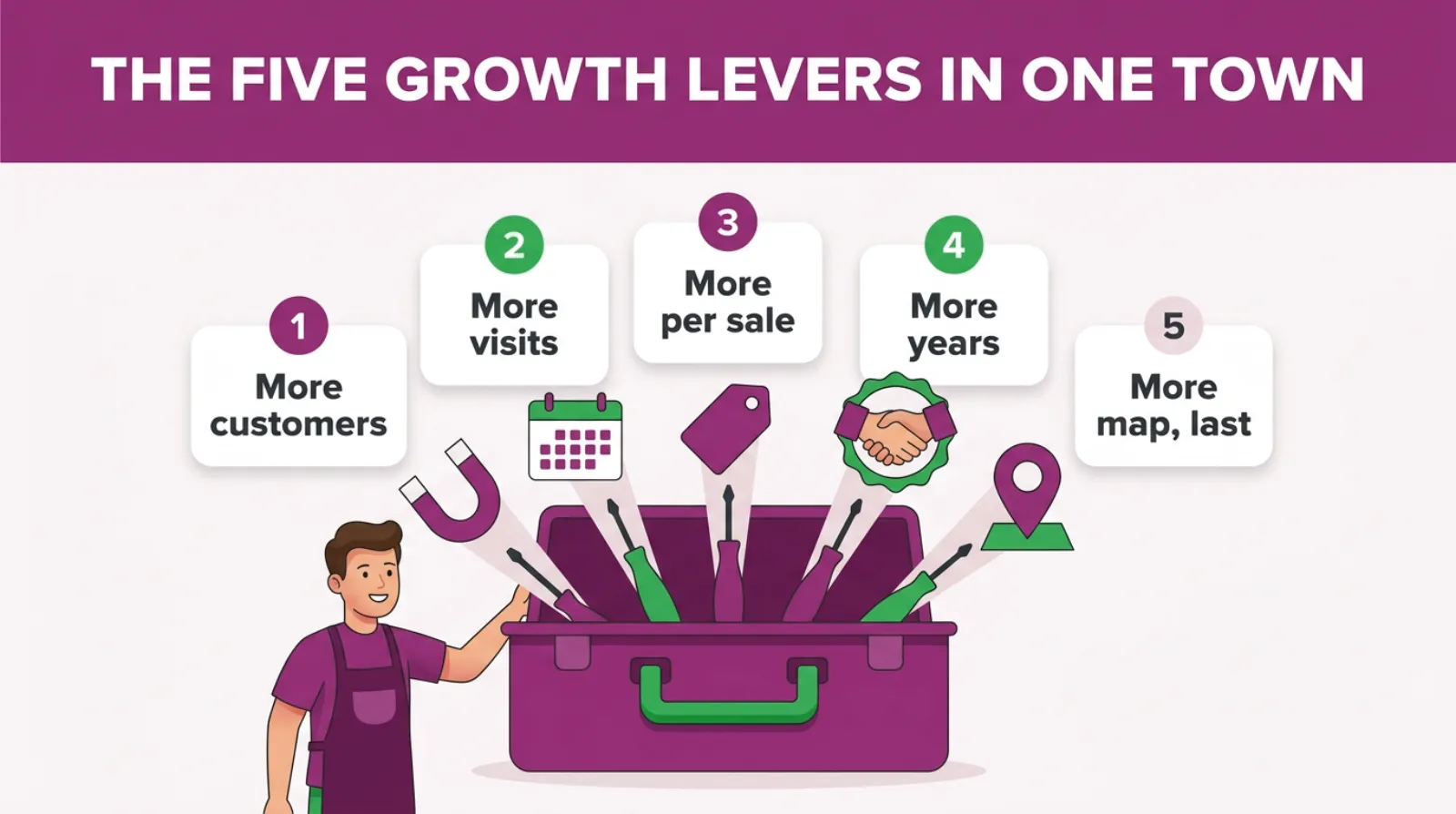
Each lever works on its own. The real gains come when you pull several at once, because the small gains multiply.
How Do You Get More Customers From The Same Town?
You get more customers from the same town by making sure everyone in it who needs you can find you, trust you and pick you quickly. That means a strong Google Business Profile and plenty of recent reviews. It also means a page for each service and ads that only show to people you can reach.
Let's take those one at a time.
Win the map first
When people in your town need a service, most of them start on Google. The first thing they see is often the map, with three businesses in it.
If you are not one of those three, you're invisible to a big share of buyers. The businesses that hold a place in the map for years are rarely the biggest in town; they're the ones that keep their profile complete, current and busy with reviews. Your Google Business Profile decides most of that. Fill in every field, choose the right main category and add real photos of your work.
Post an update every week. Add your services with a short description and a price where you can. Answer the questions people ask on the profile.
None of this costs money. It costs about an hour a week, and it is the best hour you'll spend.
Make reviews a habit, not a campaign
BrightLocal's 2026 Local Consumer Review Survey asked US adults how they use reviews. 97 per cent said reviews guide their choices. 41 per cent always read them, up from 29 per cent the year before.
The figure I'd watch is this one. 74 per cent look for reviews written in the last three months. A pile of old five-star reviews does not do the job any more.
So don't run a review drive once a year. Ask every happy customer, every week. Send a short text with a direct link the same day you finish the job.
Reply to every review, good or bad. Keep each reply personal. BrightLocal found that generic, copy-and-paste replies put off half of consumers.
And never buy reviews. Since April 2025, the Digital Markets, Competition and Consumers Act has made fake reviews illegal in the UK. It isn't worth the risk.
Build one page for each service
Most local websites have one services page with a list on it. Google cannot tell which of those services you're good at, so it shows someone else.
Give each main service its own page. Name the town in the heading. Answer the questions people ask before they ring you, such as price, timing and what happens on the day.
A plumber with separate pages for boiler repairs, bathroom fitting and blocked drains gives Google three chances to show up. One list gives it one.
Use paid ads on a short lead
Google Ads works well for a one-town business, as long as you keep it on a short lead. The mistake I see most is a radius that is far too wide.
Set your location to a tight radius around the town, or list the postcodes you actually cover. Choose people in or regularly in your locations, not people who are just interested in them.
Then bid on the jobs people search when they're ready to buy, such as "emergency plumber" plus your town. Leave the broad, curious searches alone.
A smaller map means every pound lands on someone you can reach the same day. That's why local budgets go further than owners expect.
Get known offline too
Online is not the whole story in a small town. People still talk at the school gate, the pub and the football club.
Sponsor the under-nines kit. Join one networking group and turn up every week. Put your name on the van and keep the van clean.
None of it shows up in a dashboard. But it's often why someone searches for your name and not your competitor's.
How Do You Get Existing Customers To Come Back More Often?
You get existing customers back more often by reminding them before they need you. Make it easy to rebook, and give them a reason to stay on a schedule. Most local businesses wait for the customer to remember. Most customers do not.
Think about the last time you went back to a business without being asked. It probably happened because they reminded you.
Send the reminder before they need it
A dentist sends a check-up reminder every six months. Your garage sends an MOT reminder. Neither of those is clever marketing. They're just on time.
Most services have a natural cycle. Gutters get cleaned once a year. Boilers need a service every year. Gardens need work every spring.
Write down the cycle for each of your services. Then put a reminder in your calendar, your booking system or a simple spreadsheet. Send a short message two weeks before the date.
Turn one-off jobs into a plan
A service plan turns a one-off sale into a regular one. The customer pays a small monthly fee. You visit on a schedule and they get priority when something goes wrong.
It works for boiler servicing, garden care, pest control, IT support and much more. One hundred customers on a £15 monthly plan is £18,000 a year you can count on before the phone rings.
Plans also smooth out your quiet months. When January goes quiet and the phone stops ringing, a plan still pays for the van, the insurance and the wages, which is why I push almost every service business I work with to build one.
Stay in touch between jobs
Keep a simple list of every customer's name, phone number and email. Ask permission to stay in touch, and keep the list safe.
Send a short, useful message once a month. A seasonal tip works well. So does a reminder of a service they might not know you offer.
Do not send discounts every time. You'll train people to wait for a deal. Send something helpful and keep your name in front of them.
How Can You Raise The Average Sale Without Losing Local Trust?
You raise the average sale by offering better options, not by pushing harder. Give customers three clear options at different prices, bundle jobs that go together, and review your prices at least once a year. Most small-town businesses charge too little because they fear the gossip.
That fear is real. In a small town, people talk about prices. But they talk about bad service far more.
Offer three options, not one
When you give one price, the customer decides yes or no. When you give three, they decide which one.
Take a decorator quoting for a living room. Option one covers the walls. Option two adds the woodwork and the ceiling. Option three adds a hall refresh at a lower rate because you're already set up.
Many people pick the middle option. Some pick the top one. Very few walk away, because you have given them a way to say yes.
Bundle the jobs that go together
Think about what customers often need next. A gardener who lays a new lawn can offer a feeding plan. An electrician fitting a new consumer unit can offer outdoor lights while they're there.
Mention it at the right moment, when you are already on site. It's a helpful suggestion, not a sales pitch.
Review your prices every year
Your costs go up every year. Fuel, materials, insurance and wages all rise. If your prices stay still, your profit shrinks a little each year.
Pick a date each year to review your prices. Tell regular customers a month ahead. Explain it simply and stick to it.
You may lose one or two price-led customers. That's fine. The customers who leave over a fair price rise are rarely the ones who send you referrals.
How Do You Keep Customers For Years And Turn Them Into Referrals?
You keep customers for years by making every job easy, on time and finished properly, and then by asking for the referral while they are happy. In a town, a loyal customer is also your best salesperson. They tell neighbours, friends and family who you are.
Word of mouth moves fast in a small town. That works both ways, so it pays to steer it.
Fix the small things that make people leave
Most customers don't leave over price. They leave because you were late, didn't call back or left a mess.
Write down the five things that annoy your customers most. Then fix one each month. Turn up when you say. Call back the same day. Tidy up before you go.
These sound basic. They are. That is why getting them right is such a big edge in a town where everyone compares notes.
Ask for the referral at the happiest moment
The best time to ask for a referral is the moment a customer says thank you. They're pleased, and you are still fresh in their mind.
Keep it simple. "I'm glad you're happy. If you know anyone else who needs this, I'd be grateful if you passed my number on." Most people are glad to help.
A small thank-you helps too. A card, a bottle of wine or money off their next visit all work. Keep it modest and personal.
Partner with businesses that share your customers
Other local businesses already serve your customers. An estate agent meets people who are about to need a cleaner, a decorator and a removal firm.
A kitchen fitter works next to an electrician and a plumber. A wedding venue sends couples to florists, cake makers and photographers.
Pick two or three businesses you trust. Agree to pass work to each other. It costs nothing and it brings in customers who already trust you, because someone they trust sent them. When a customer hears your name from an estate agent they already like, half the selling is done before you even pick up the phone.
When Should A Local Business Expand Into The Next Town?
A local business should expand into the next town once its own town is working, its diary is full most weeks and it can serve the new area without letting existing customers down. Grow outwards one ring at a time, starting with the town that already sends you the odd enquiry.
Expanding too early is one of the most common mistakes I see. The owner spreads the budget, the van and the diary across three towns. They end up being average in all of them.
Check where your enquiries already come from
Look at your last 100 jobs. Note the postcode for each one.
Most owners find a pattern. Most jobs come from home, then a cluster comes from one nearby town. That second town is already telling you it wants you.
Test the next town with a small, tracked budget
Do not jump in with both feet. Add the new town to your Google Business Profile service areas. You can list up to 20.
Then add it as a separate location in Google Ads with its own small budget, and build one page on your website that is written for that town.
Run it for 90 days and compare the cost per enquiry with your home town. If it's close, carry on. If it is far worse, you've learned that cheaply.
Watch your travel time
Every mile you add costs you time and fuel. A job 25 minutes away needs to be worth more than a job five minutes away, because the hour you spend on the road for that visit is an hour you can't sell to anyone else.
Some owners charge a small travel fee for outer areas. Others set a higher minimum job size. Both are fair, as long as you tell people up front.
The five levers at a glance
Here's the whole picture in one place. Use it to decide where to start.
| Lever | What it means | First move this week | Number to watch |
|---|---|---|---|
| More customers | A bigger share of your town | Ask every happy customer for a Google review | New enquiries each month |
| More visits | Customers come back more often | Set reminders for each service cycle | Repeat bookings each month |
| More per sale | A higher average job value | Quote three options, not one | Average job value |
| More years | Customers stay and refer | Ask for a referral at every thank-you | Referrals each month |
| More map | Serve the next town, one ring out | Check the postcodes of your last 100 jobs | Cost per enquiry by town |
Your Town, Then The Ring Around It
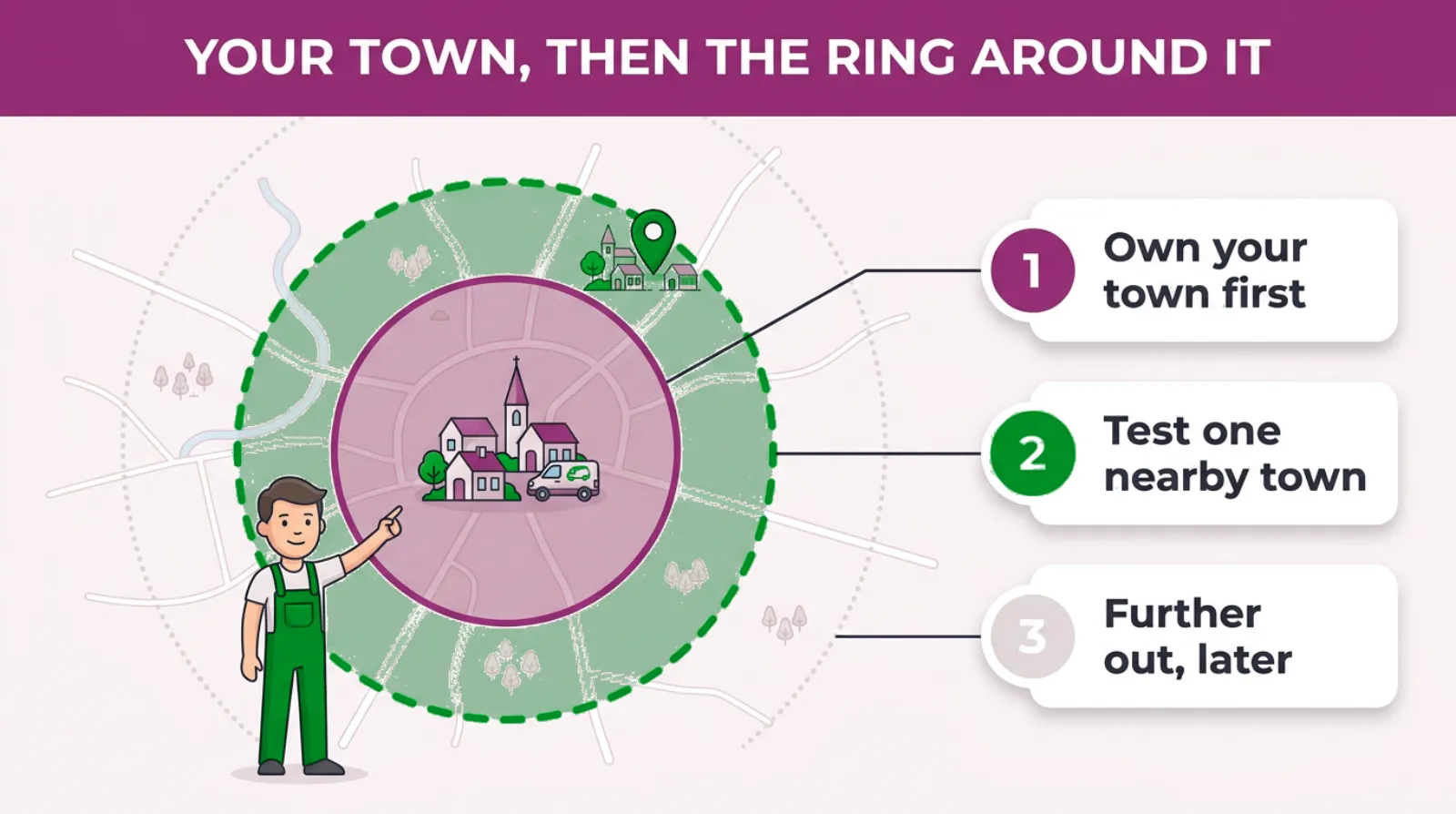
Think of your area as rings on a map. The centre ring is your town. The next ring is the one or two places your customers already come from. Grow the centre first, and only move out a ring when the centre is busy.
A 90-Day Plan For A One-Town Business
You do not need to do everything at once. Here's a simple 90-day plan that pulls each lever in turn.
Days 1 to 30: get found and get trusted
Work out your town's ceiling using the sums above. It takes about half an hour.
Then fill in every field on your Google Business Profile. Add 20 real photos. Start asking every happy customer for a review the same day you finish.
Pick your three most profitable services. Give each one its own page on your website, with your town in the heading.
Days 31 to 60: bring customers back
List the natural cycle for each service. Set up reminders two weeks before each one is due.
Design one simple service plan. Offer it to your best 20 customers first, by phone or in person.
Start a monthly email or text with one useful tip. Keep it short.
Days 61 to 90: raise value and reach
Change your quotes to three options. Pick a date for your yearly price review and write it in the diary.
Agree a referral swap with two local businesses. Then check the postcodes of your last 100 jobs to see which town comes next.
If you're running Google Ads, tighten the location settings to the area you actually serve. Check the search terms report every week.
What to track
Track five numbers each month, one for each lever.
- New enquiries, which show whether more of the town is finding you.
- Repeat bookings, which show whether your reminders are working.
- Average job value, which shows whether three-option quotes are paying off.
- Referrals, which show whether people are passing your name on.
- Cost per enquiry by town, which shows whether the next town is worth it.
Write them in a simple spreadsheet, which takes about ten minutes a month, and after a few months you will see which lever moves most, and that's where you put the next 90 days.
The Mistakes That Keep One-Town Businesses Small
I see the same mistakes again and again. Most of them come from trying to grow like a national business.
Chasing the whole county too early
A wide radius feels like more opportunity. It usually means more cost, more travel and fewer jobs that make money. I've seen accounts where more than half the ad budget went on clicks from places the owner would never drive to, and nobody had checked the location report in a year.
Own your town first. It is cheaper to win and easier to serve.
Treating every customer as a one-off
If you don't keep a list of customers, you start from zero every month. That is the most expensive way to run a local business.
Keep the list. Use it every month. It pays.
Competing on price alone
Someone will always be cheaper. Usually it is someone who won't be trading in two years.
Compete on being on time, easy to deal with and well reviewed. In a town, that's what people remember.
Doing marketing in bursts
Many owners market hard when they are quiet and stop when they're busy. Then they are quiet again a few weeks later.
Keep a small, steady amount running all year. Reviews, reminders and a tight ad campaign keep the diary smooth.
Frequently asked questions
How much should a local business spend on marketing?
Work back from what a customer is worth to you. Decide what you can afford to pay to win one. Then multiply that by the number of new customers you need each month. For many small service businesses, that lands somewhere between 5 and 10 per cent of revenue.
Is it better to grow locally or go national?
For a service business that has to turn up at the door, grow locally first. Going national only works when you can deliver without travelling, such as online sales or remote services. Most trades and local services do better owning a small area.
Do leaflets still work for a local business?
They can, when they go to the right streets with one clear offer. Give each drop a way to track replies, such as a code or a separate phone number. Untracked leaflets to the whole town usually waste money.
How many Google reviews does a local business need?
There's no magic number. Aim to have more recent reviews than the businesses around you in the map. BrightLocal's 2026 survey found 74 per cent of consumers look for reviews from the last three months.
Can I use Google Ads if I only serve one town?
Yes. Set the location to a radius around the town, or list the postcodes you cover. Then choose people in or regularly in your locations. A tight area keeps every pound on people you can actually serve.
What if my town is shrinking?
Lean harder on the levers that don't need more people. Repeat visits, a higher average sale and longer customer lifetimes all grow revenue from the customers you already have. Then test the nearest town with a small, tracked campaign.
Keep Reading
If you serve one town, these posts go deeper on the parts of this plan that cost money or time.
- The Five-Mile Test: Is Your Local Advertising Reaching Anyone Who Can Actually Buy?
- Your Ad Budget Isn't Too Small. Your Map Is Too Big
- 5 Google Business Profile Tweaks That Push You Into the Local Map Pack
- Your Best Reviews Are Quietly Killing Your Conversion Rate. Here Is The Mix That Actually Sells
- Do Google Ads Remarketing Campaigns Work For Local Businesses?
I picked these because each one covers a lever from this post in more detail: reach, reviews and bringing people back.
Sources
The household figure comes from the ONS, and the service area and location settings come from Google's own help pages.
- Families and households in the UK - Office for National Statistics
- Manage your service areas for service-area and hybrid businesses - Google Business Profile Help
- About advanced location options - Google Ads Help
Your Town Is Big Enough
Most one-town businesses do not have a town problem. They have a lever problem. They pull one lever hard and leave the other four alone.
Work out your ceiling. You'll probably find you have far more room than you thought.
Then pick one lever this week. Ask for reviews, set up reminders or quote three options. Next month, pick another.
A small gain on five levers beats a big push on one. And none of it needs you to leave the town you know best.
If you'd like help with the paid side, I'm happy to look at your Google Ads account. I'll show you where the budget is leaking outside your town. Book a free call at sfdigital.co.uk.

Written by Uzair Kharawala
Partner at SF Digital Studios, a Google Premier Partner agency. Uzair has been helping businesses grow with Google Ads since 2002 and teaches it every week on YouTube.
Get our best Google Ads tips by email
New articles and videos, straight to your inbox. Unsubscribe any time.