
Leighton Buzzard Is A Small Town. That Is Exactly Why SEO Works Here
Most business owners in a small town assume SEO is a big-city game. Something for London firms with marketing departments and five-figure budgets.
It is the other way round. SEO in Leighton Buzzard is easier than almost anywhere in a city, because far fewer businesses are doing it properly.
We can show you from our own numbers. Our office is on Grovebury Road, and our website has sat around position five for the search "seo leighton buzzard" without a single page written about the town. No dedicated page, no local campaign. Just a website that exists, in the right place, with a few basics done.
Get your free Marketing Action PlanNot sure where to start? Answer a few questions and get your plan in about a minute. No email needed.
Get my plan →That is what thin competition looks like. This guide explains why it happens, and how any business in the town can use it.
What Local SEO Actually Is
Local SEO is the work that helps your business appear when people nearby search for what you do. It covers the map results, the business listings beside them and the normal results underneath.
It is different from general SEO in one important way. A general website competes with the whole country. A local business competes with the handful of businesses near the person searching.
That changes everything about how hard it is. A plumber in the middle of a big city might be up against two hundred other plumbers. In a market town of around 42,000 people, it might be a dozen, and only a few of those will have done anything about their online presence.
Local SEO has four main parts.
- Your Google Business Profile, the listing that appears in Google Maps
- Your website, and whether it clearly says where you work
- Your reviews, how many you have and how recent they are
- Mentions of your business elsewhere online, from directories to local news
None of these needs technical skill to get started. Most of it is simply being clear, complete and consistent.
How Google Decides Who Shows Up
Google is unusually open about this. Its own help page says local results depend on three things.
Relevance is how well your Business Profile matches what someone searched for. If you are a dog groomer and your profile says "pet services", you are less relevant than one that says "dog groomer".
Distance is how far you are from the person searching. You cannot change where you are, but you can make sure Google knows exactly where that is, and which places you serve.
Prominence is how well known your business is. Google looks at links, reviews and ratings. In plain English, it wants to know whether people talk about you.
And one line on that page is worth remembering. Google says there is no way to request or pay for a better local ranking. Local SEO cannot be bought. It has to be earned.
That is good news for small businesses. It means a sole trader who does the basics well can beat a larger firm that has not bothered.
Why A Small Town Is An Advantage
Put those three factors together with a small town, and the maths starts to favour you.
Distance Works For You
When someone in the town searches for a service, Google leans towards businesses nearby. If you are based here and your competitors are in a bigger town twenty minutes away, you already start ahead on the one factor nobody can fake.
The Competition Is Thin
Look at page one for "seo leighton buzzard" and you will see what we mean. A few small web design firms, a business directory and several template pages from agencies based elsewhere, with the town name dropped into a page written for anywhere.
When a directory listing ranks fourth, it is because nothing stronger exists. That is an open door, not a wall.
Prominence Is Cheaper To Build
In a city, becoming "well known" takes serious effort and money. In a market town, it can mean a mention in the local paper, a sponsorship of a youth football team, a talk at a business breakfast and forty good reviews from real customers.
People in small towns talk to each other. That word of mouth has an online version, and Google notices it.
Few Businesses Finish The Basics
In our experience working with small businesses across the area, the most common state of a local Google profile is half done. Missing hours. The wrong category. Five reviews from three years ago. No photos since the shop opened.
Every one of those gaps is a reason Google might choose someone else. And every one is fixable in an afternoon.
What Makes Searching Here Different
Every town has its own search habits, and it pays to know yours.
The first thing to know is that the town is really two places. Leighton Buzzard sits on one side of the river and the canal, and Linslade on the other. Some people search for one, some for the other and many for neither, letting Google work it out from their phone's location. A business that mentions both, naturally, covers all three.
The second is the villages. A lot of work in the area comes from places like Heath and Reach, Stanbridge and Wing. People there often search with the village name, or with the town they think of as "nearest". If you serve those places, say so.
The third is the pull of the bigger towns nearby. Plenty of people who live here work in Milton Keynes or Luton, and some search as if they were there. You will not win every one of those searches, and you do not need to. Winning the searches made on your own doorstep is worth far more.
Local SEO is partly about knowing how your own neighbours search. No template page from an agency in another county can do that for you.
The Three Things Google Ranks You On
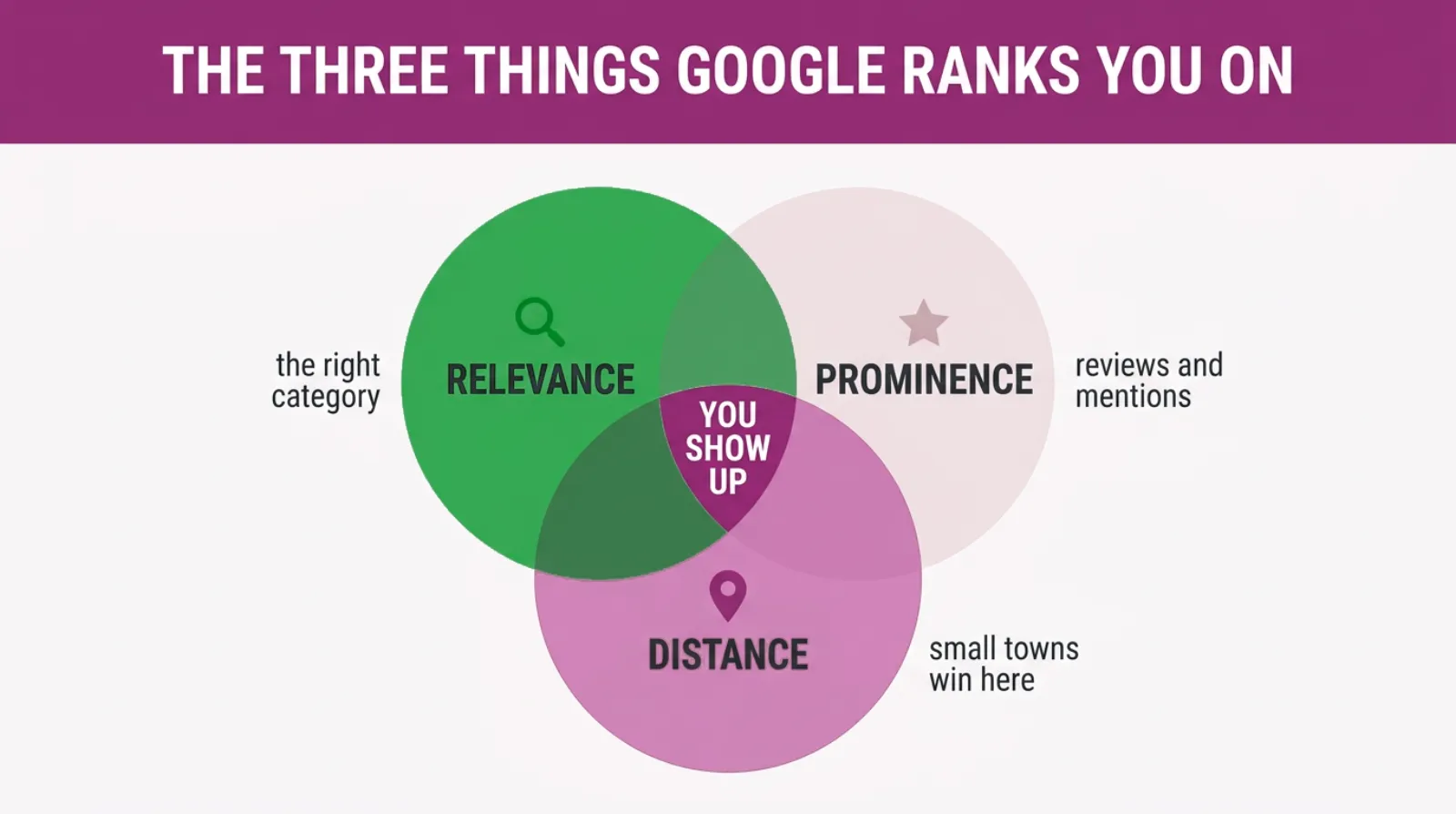
Relevance, distance and prominence overlap. The businesses that show up most are the ones that score on all three. In a small town, the distance part is often already done for you. The rest of this guide is about the other two.
Step One, Finish Your Google Business Profile
Your Google Business Profile is the single most important thing in local SEO. It is what appears in Google Maps, and it is free.
Start with the basics Google itself recommends.
- Verify the profile, so Google knows it is really yours
- Choose the most specific primary category you can, such as "dog groomer" rather than "pet service"
- Add your full address or, if you visit customers, your service areas
- Keep your opening hours accurate, including bank holidays
- Add real photos of your work, your team and your premises
- Write a clear description that says what you do and where
Then keep it alive. Add new photos every month. Post updates when you have news or offers. Answer questions people ask on the profile.
A profile that looks looked-after tells Google, and customers, that the business is active.
Step Two, Say Where You Work On Your Website
Your website needs to tell Google, clearly, which places you serve. A surprising number of local business websites never mention their own town beyond a postcode in the footer.
Write a proper page about where you work. Not a list of place names, but a genuine page that mentions the town, the areas around it such as Linslade, Heath and Reach, Wing and Stanbridge, and the kind of work you do there.
Put your business name, address and phone number on every page, usually in the footer. Make sure they match your Google profile exactly, down to the way you write the road name.
If you work from home or visit customers, you do not need to show a street address. Google lets service-area businesses hide the address and list the places they cover instead. Your website should then say the same thing, naming the town and villages you serve.
And if you serve several distinct places, each with real customers, a page for each can help. The rule is that every page must be genuinely useful. A page that swaps the town name into the same copy is exactly what the template pages on page one are doing, and it is why they are beatable.
Step Three, Get More Reviews, Steadily
Reviews feed the prominence factor, and they also persuade the humans reading your profile.
The best approach is simple and steady. Ask every happy customer, at the moment they are happiest, usually when the job is finished. Make it easy with a short link or a QR code on your invoice.
Aim for a steady flow rather than a burst. Ten reviews in one week followed by nothing for a year looks odd. Two or three a month, every month, looks like a busy business.
Reply to every review, good and bad. A short, polite reply to a complaint often does more for trust than the complaint does damage.
Never buy reviews or write your own. Google removes them, and it can suspend profiles that break the rules. In a small town, customers also notice.
Step Four, Get Mentioned Locally
Prominence grows when your business is mentioned and linked from other places, especially local ones.
In a market town, the opportunities are usually close to home.
- Local news sites and community magazines looking for stories
- Business networks and breakfast groups with member directories
- Local sports clubs, charities and events you sponsor or support
- Suppliers and partners who could list you as a stockist or partner
- The main UK directories, with your details exactly matching your profile
You do not need hundreds. A handful of genuine local mentions can set you apart when most competitors have none.
Step Five, Keep Your Details Consistent Everywhere
Google cross-checks your business details across the web. If your name, address and phone number appear in slightly different forms in different places, it becomes less sure they all belong to the same business.
Pick one exact version of your name, address and phone number. Use it on your website, your Google profile, every directory and every social media page.
This sounds dull, and it is. But inconsistent details are one of the most common reasons a genuine local business ranks below one that is newer and smaller.
Where Businesses In Leighton Buzzard Usually Lose Out
When we look at local businesses in the town, the same few gaps come up far more often than anything technical.
The first is a Google profile that was set up once and never touched again. The hours are from before the pandemic, the photos are of an empty shop and the last review is two years old.
The second is a website that never says where the business is. It talks about quality and service, lists the phone number and stops. Google has to guess the location from a postcode in the footer.
The third is inconsistency. The business is "Smith & Sons" on Google, "Smith and Sons Ltd" on the website and "Smiths Building" on a directory from years ago, each with a slightly different address.
None of these is hard to fix, and together they explain most of the gap between businesses that show up and businesses that do not. That is the whole opportunity in a sentence.
What Not To Do
A few shortcuts come up again and again. All of them backfire.
Stuffing Keywords Into Your Business Name
Adding "Best Plumber" or a town name to your business name on Google breaks Google's rules if it is not your real name. It can get the profile suspended.
Using A Virtual Office
A business address you do not actually operate from, to appear in a town you are not in, breaks Google's guidelines. If you visit customers, set your service areas and hide your address instead.
Buying Or Writing Fake Reviews
Covered above, but worth repeating. It is the quickest way to lose a profile.
Building Dozens Of Copy-And-Paste Town Pages
Pages that are identical apart from the town name add little and can make your whole site look thin. One genuinely useful page beats twenty copies.
How Long Local SEO Takes In A Small Town
The honest answer is faster than in a city, and slower than most people hope.
Fixes to your Google profile and website are often picked up within a few weeks. If your profile was badly incomplete, you may see a jump fairly quickly.
Reviews and local mentions build more slowly. Expect a few months of steady effort before you see where you really stand.
It also helps to know that local rankings move around. You might see yourself third one day and fifth the next, depending on who is searching and from where. Judge progress over weeks, not days, and look at the trend in enquiries rather than a single search result.
The advantage of a small town is that the finish line is closer. When only a few competitors are trying, being consistently good for three months can be enough to lead.
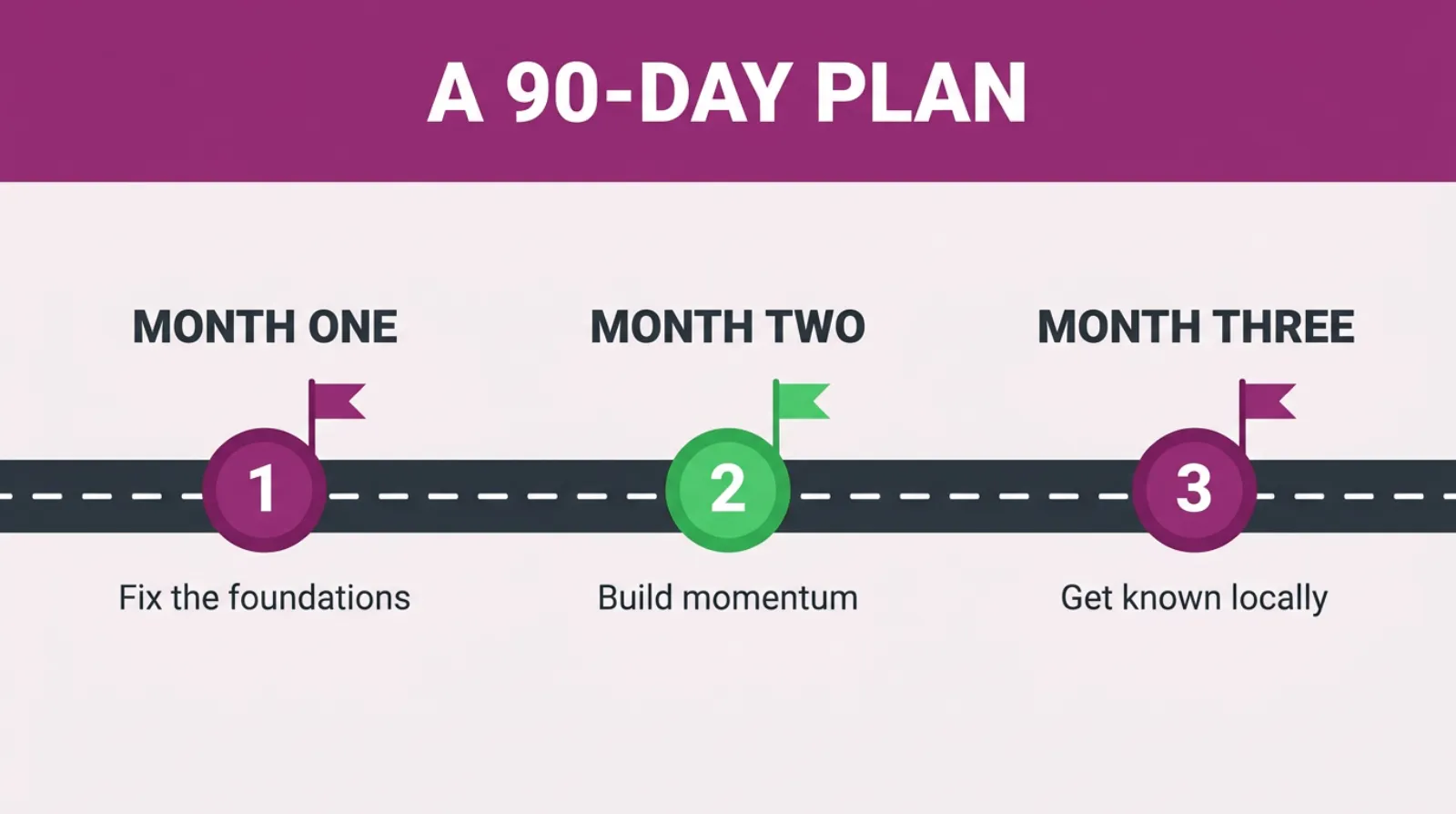
A 90-Day Plan For A Small Business
If you like a plan, here is one that fits around running a business. Each month builds on the last.
Month One, Fix The Foundations
Verify and complete your Google Business Profile. Choose the most specific category. Add hours, photos and a proper description.
On your website, add your full business details to the footer, matching the profile exactly. Write one genuine page about where you work and who you serve.
Set up a simple way to ask for reviews, such as a short link or a QR code, and start asking every happy customer.
Month Two, Build Momentum
Keep the reviews coming, two or three a week if you can. Reply to every one.
Add fresh photos to your profile. Post one update a fortnight, about a recent job, a new service or an offer.
Claim or update your listings on the main UK directories, using exactly the same details everywhere.
Month Three, Get Known Locally
Look for two or three genuine local mentions. A story for a community magazine, a sponsorship, a supplier who can list you.
Check where you stand. Search for yourself in a private window, look at your profile insights and, if you have it, Search Console.
Then decide what comes next. If you are near the top at home, look at the next town out. If not, keep going with the basics, because they compound.
What Local SEO Costs
The honest answer is that the most important parts cost nothing but time.
A Google Business Profile is free. Asking for reviews is free. Writing a page about where you work is free if you write it yourself. Updating directory listings is mostly free.
What costs money is time, skill and technical work. Improving a slow website, fixing technical problems, writing more content and building local links all take hours that many owners do not have.
That is where an agency or freelancer can help. Prices vary widely, from a few hundred pounds for a one-off set-up to a monthly retainer for ongoing work.
Whatever you spend, make sure the basics are done first. Paying for advanced SEO on top of a half-finished Google profile is like painting a house with the roof missing.
Questions To Ask Anyone Offering SEO In Leighton Buzzard
If you do bring in help, a few questions quickly separate the useful from the rest.
- Will you look at my Google Business Profile first, before the website?
- How will you know which searches actually bring me customers?
- Do you know how people in this town search, compared with a big city?
- Will you be writing one genuine page about my area, or lots of copied town pages?
- How will you report progress, and how often?
- What will you not do, because it breaks Google's rules?
Be wary of anyone who guarantees the number one spot. Google says local rankings cannot be bought, so nobody can promise them.
Be wary, too, of anyone offering hundreds of town pages or hundreds of links for a low price. That is the template-page approach, and it is exactly what a genuine local business can out-rank.
How To Check Where You Rank
You do not need expensive tools to get a rough picture.
Search For Yourself Properly
Open a private browsing window and search for your service plus the town. Then search for your service alone, with no town. Note where you appear, in the map results and in the normal results.
Remember the distance factor. Results change depending on where the search happens. Ask a friend on the other side of town, or in a nearby village, to search too.
Use Your Google Business Profile Insights
Your profile shows how people found you and what they searched for. Check it monthly and look for the searches you want more of.
Use Google Search Console
If your website is connected to Search Console, it shows which searches brought you impressions and clicks, and your average position. That is exactly how we know where our own site stands for the town's SEO searches.
A Worked Example
Here is a made-up example to show how it fits together. Picture a dog grooming business run from a unit in Linslade.
The owner's Google profile is listed as "pet service". It has six reviews, the newest from 2023, and no photos since opening. The website mentions the business name and a phone number, but never says where the salon is.
Over one weekend, the owner changes the primary category to "dog groomer", adds opening hours and twenty photos of recent grooms, and writes a proper page on the website about serving the town and nearby villages. The address on the website is updated to match the profile exactly.
Then the owner starts asking every happy customer for a review, using a QR code on the counter. Two or three a week come in.
Nothing here costs money. In a small town with few competitors doing the same, that combination is often enough to move from invisible to the first handful of map results.
When A Small Town Is Not Enough
A small town is a great place to start. For some businesses, it will not be enough on its own.
If you have more capacity than the town can fill, you will need to reach further. Dunstable, Milton Keynes and the surrounding villages each bring more customers, but also more competition.
That is where local SEO and paid advertising work well together. SEO wins the searches close to home, where you have the distance advantage. Advertising can reach the bigger towns nearby while your reputation grows there.
The order matters, though. Win your home town first. It is the cheapest ground you will ever take.
Frequently asked questions
What is local SEO?
Local SEO is the work that helps your business appear when people nearby search for what you do, in Google Maps and in the normal results. It covers your Google Business Profile, your website, your reviews and how often your business is mentioned elsewhere online.
How does Google decide local rankings?
Google says local results depend on relevance, distance and prominence. Relevance is how well your profile matches the search. Distance is how far you are from the searcher. Prominence is how well known you are, including links, reviews and ratings. Google also says you cannot pay for a better local ranking.
Why is my business not showing on Google Maps?
The usual causes are an unverified or incomplete Google Business Profile, the wrong primary category, too few reviews, or a searcher who is simply closer to a competitor. Check that your profile is verified, complete and in the most specific category first.
How long does local SEO take in a small town?
Fixes to your profile and website can show within weeks. Reviews and local mentions take longer, usually a few months. Small towns tend to move faster than cities because fewer businesses are competing properly.
Do I need an agency for local SEO?
Not always. Much of it is work an owner can do: completing the Google profile, asking for reviews and writing a proper page about where you work. An agency helps when you lack time, when competition is strong or when the website needs technical work.
Should I put my town name in my Google business name?
Only if it is genuinely part of your registered business name. Adding extra keywords or place names to your business name breaks Google's guidelines and can lead to the profile being suspended.
Is SEO worth it for a small business in Leighton Buzzard?
Usually, yes. Local searches come from people who are ready to buy, and in a town this size the competition is thin. The basics cost time rather than money, so the return on a few focused weekends can be large.
Can I rank in a town where I do not have an office?
In the normal search results, yes, with a genuinely useful page about serving that town. In the map results, distance matters a lot, so a business based elsewhere will usually find it harder. Never use a virtual office to fake a presence.
Keep Reading
If you want to go further on local search, these four pick up where this post leaves off.
- 6 Local SEO Fixes That Get SMEs Into the Google Maps 3-Pack Faster
- 5 Google Business Profile Tweaks That Push You Into the Local Map Pack
- 7 Local SEO Myths That Are Quietly Burying Your Google Business Profile On Page 2
- How To Create Google E-E-A-T For Local SEO (And Out-Rank The Big Brands In Your City)
The first three are practical fixes for your profile and the map. The last covers the trust signals that help a small business out-rank bigger names.
Small Is Not A Weakness Here
It is easy to feel that a small town limits what your business can do online. For SEO, it is the opposite.
Fewer competitors, a distance advantage and a community that talks add up to one of the easiest places in the country to rank. Most businesses simply have not done the basics yet.
So do them. Finish your Google profile. Say clearly on your website where you work. Ask every happy customer for a review. Get mentioned locally. Keep your details the same everywhere.
We are on Grovebury Road in Leighton Buzzard, and we see this every day in our own search data. We work with businesses across the town and out to Dunstable, Milton Keynes, Bedford, Luton and Aylesbury, but this is home. If you would like a second pair of eyes on your local presence, get in touch with our team. We are just down the road.

Written by Uzair Kharawala
Partner at SF Digital Studios, a Google Premier Partner agency. Uzair has been helping businesses grow with Google Ads since 2002 and teaches it every week on YouTube.
Get our best Google Ads tips by email
New articles and videos, straight to your inbox. Unsubscribe any time.