
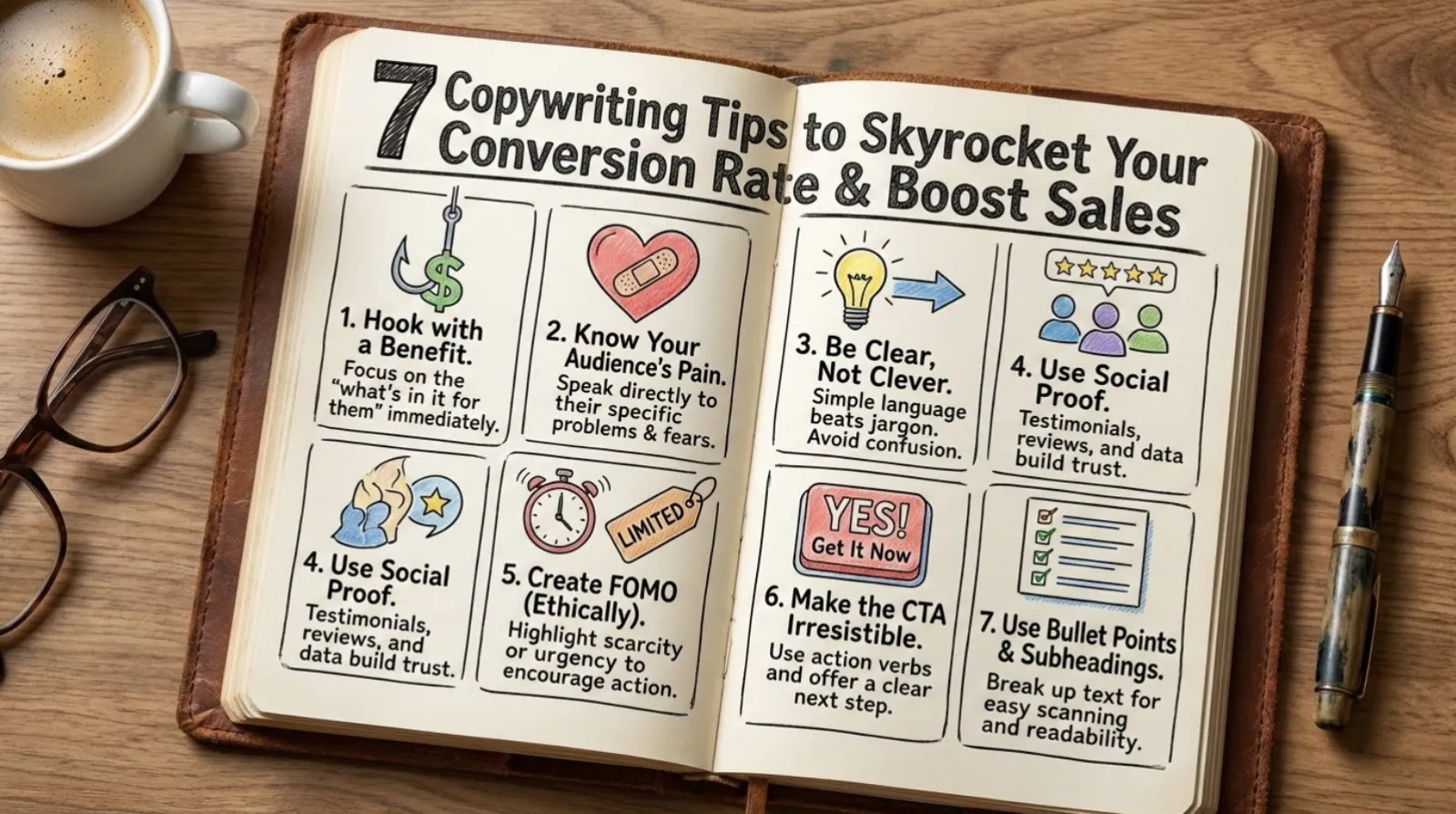
Did you know a tiny tweak in your website copy can lead to a monumental jump in sales? Many businesses struggle to turn visitors into loyal, paying customers, often overlooking persuasive copywriting. Imagine transforming lukewarm leads into eager buyers and repeat clients simply by refining your words. This guide unveils 7 proven copywriting tips to dramatically increase your conversion rate. Cultivate a robust, loyal customer base for long-term success.
In today’s competitive digital landscape, captivating your audience and convincing them to take action is more crucial than ever. Understanding effective copywriting can feel daunting for many, but it doesn’t have to be. Good copy isn’t about jargon; it’s about clear, compelling communication that deeply resonates. Here, we’ll break down impactful strategies to help you write copy that converts, turning browsers into buyers and casual visitors into passionate advocates, ultimately helping you boost sales.

Get Found, Get Chosen, Get Your Time Back
A free one-day marketing seminar in Milton Keynes · 13 January 2027
1. Understand Your Audience Inside Out
The foundation of all successful copywriting is a deep, empathetic understanding of your target audience. You can’t persuade someone if you don’t know their pain points, aspirations, and language. This goes beyond demographics to psychographics – their beliefs and emotional triggers. Knowing this allows you to position your product as the ultimate solution.
Get your free Marketing Action PlanNot sure where to start? Answer a few questions and get your plan in about a minute. No email needed.
Get my plan →To truly connect, step into your customer’s shoes. Conduct surveys, analyze reviews, and engage on social media. What are their questions, objections, or desired results? For instance, a small business owner overwhelmed by marketing seeks simple, time-saving solutions. Your copy should speak directly to that desire for simplicity and efficiency. Knowing their pain points allows you to position your product as the ultimate solution, making your message resonate personally.
Actionable Tip: Create detailed buyer personas. Give them names, backstories, goals, and frustrations. This makes your audience feel real and helps you tailor your copy to their specific needs and desires, ensuring your message hits home every time.
2. Craft Irresistible Headlines and Subheadings
Your headline is the gateway to your content, often the only thing people read before deciding to continue. In a saturated world, it has seconds to grab attention and compel deeper engagement. A weak headline means your brilliant copy remains unread. Legendary campaigns prove that a powerful hook and compelling headlines are crucial for success.
Effective headlines are clear, concise, and communicate a strong benefit or curiosity. They should also be keyword-rich for SEO, but not at the expense of readability. For example, instead of “Our New Software Features,” use “Boost Your Productivity by 50% with Our Revolutionary Software.” Subheadings are equally crucial, breaking up text, guiding the reader, and acting as mini-headlines to re-engage attention and signal content, making it digestible.
Actionable Tip: Experiment with headline formulas: numbers (e.g., “7 Ways to…”), questions (“Are You Making This Copywriting Mistake?”), or benefit-driven (“Unlock Your Business’s Full Potential”). Always test what resonates best with your audience to maximize your click-through rates.
3. Focus on Benefits, Not Just Features
This is a fundamental shift for many copywriters: focus on benefits over features. Features describe what your product *is*; benefits explain what it *does for the customer*. People buy outcomes, not specifications. They buy a drill for the hole, not the tool itself – the hole is the benefit.
Consider a new smartphone. Its “128GB storage capacity” is a feature. The benefit? “Store all your cherished memories and important documents without ever worrying about running out of space.” One is technical, the other offers peace of mind. When listing features, always ask “So what?” and “What does that mean for my customer?” The answer reveals the benefit, connecting emotionally and showing how lives improve.
Actionable Tip: For every feature you list, identify at least one corresponding benefit. Frame your copy around these benefits, using words that evoke positive feelings and demonstrate value. This practice will transform your copy from a technical description into a persuasive argument for improved living or business operations.
4. Use Emotion to Drive Action
Humans are emotional creatures, often influenced more by feeling than logic. While logic justifies a purchase, emotion compels it. Great copywriting taps into emotional triggers – joy, fear, excitement, or aspiration – to connect with readers. Car ads rarely list specs; they evoke freedom, luxury, or adventure, driving desire.
Storytelling powerfully injects emotion. Share relatable anecdotes, customer success stories, or your brand’s journey. When readers see themselves in your narrative, they become invested. Instead of “Our software reduces errors,” tell a story about a frustrated business owner finding peace of mind and free time with your solution. This vivid imagery and emotional connection enhance product appeal. Focus on how your offering makes them feel.
Actionable Tip: Identify the core emotions your product or service addresses. Does it alleviate pain? Inspire joy? Provide security? Use vivid, sensory language and storytelling to paint a picture of the emotional transformation your customers will experience. This emotional resonance is a potent force in increasing your conversion potential.
 LIVE
Live every Tuesday at 2pm UK. Bring your marketing questions.
Get your Google, local SEO and AI questions answered live.

5. Incorporate Social Proof and Trust Signals
In an age of skepticism, demonstrating credibility and building trust is non-negotiable. Social proof is when people assume others’ actions reflect correct behavior. When customers see others benefiting from your product, it reduces perceived risk and increases conversion willingness. It’s like choosing a busy restaurant – you assume quality.
Integrate various forms of social proof. Testimonials from satisfied customers are powerful, especially if specific. Case studies provide in-depth stories of success. Featuring logos of well-known clients or media mentions adds authority. Displaying star ratings, user numbers, or “award-winning” certifications also serve as strong trust signals. These elements validate claims and make your brand more reliable and desirable.
Actionable Tip: Gather authentic testimonials, develop mini-case studies, and prominently display any awards, certifications, or client logos on your sales pages. Quantify your success where possible (e.g., “Trusted by 10,000+ businesses”). These signals can drastically improve a prospect’s confidence and lead to higher conversions.
6. Simplify Your Language and Enhance Readability
The goal of copywriting is clear, effective communication, not complex vocabulary. Many use jargon or formal language, alienating their audience and making messages hard to understand. If readers reread sentences, you’ve lost them. Simplicity ensures your message is absorbed effortlessly, boosting readability.
Write conversationally, as if speaking to one ideal customer. Use short sentences and paragraphs. Break text with subheadings, bullet points, and white space for easy scanning. Avoid jargon unless your audience is highly technical. Remember, clarity always triumphs over cleverness. Make understanding your offer smooth, removing cognitive load that might cause readers to bounce.
Actionable Tip: Use readability tools to check your content’s Flesch-Kincaid grade level. Aim for a reading level that is accessible to a broad audience, typically around an 8th-grade level. Read your copy aloud; if it sounds clunky or unnatural, revise it for better flow and simpler language.
7. Master the Art of the Call to Action (CTA)
You’ve hooked your reader, built rapport, and presented benefits. Now what? The Call to Action (CTA) is the crucial final step, telling your audience exactly what to do next. Without a clear, compelling CTA, all persuasive efforts are wasted, like inviting someone to a party without the address.
Your CTA should be direct, benefit-oriented, and create urgency. Avoid generic “Click Here.” Use action-oriented language reinforcing value, like “Get Your Free Guide Now,” “Start Your 14-Day Free Trial,” or “Claim Your Discount Today.” Make your CTA visually prominent with contrasting colors and white space. Testing different CTAs reveals which phrases resonate most and drive highest conversion rates.
Actionable Tip: Place your CTA strategically throughout your copy, especially after you’ve delivered significant value or addressed key objections. Use verbs that inspire action and ensure the benefit is clear within the CTA itself. A well-crafted CTA is not an afterthought; it’s the culmination of your entire persuasive message and the direct path to conversion.
Frequently Asked Questions About Copywriting and Conversion
Q1: How quickly can I expect to see results from implementing these copywriting tips?
While some immediate improvements can be seen, significant and consistent increases in conversion rates typically require ongoing testing and refinement over several weeks or even months. It’s a continuous process of learning and optimization.
Q2: Is it better to write short-form or long-form copy for conversions?
The optimal length depends on your product, audience, and the stage of the customer journey. Complex or higher-priced items often benefit from longer copy, while simpler offers might convert well with concise messaging. Test both to see what works best.
Q3: Should I hire a professional copywriter or write my own copy?
For small business owners and beginners, learning the basics and writing your own copy is a great starting point. However, if you’re struggling to see results, investing in a professional copywriter can provide a significant return on investment by crafting expert-level, conversion-focused content.
Q4: How important is keyword research for conversion copywriting?
Keyword research is extremely important, not just for SEO but also for understanding the language your target audience uses. Incorporating these keywords naturally into your copy helps you connect with searchers and signals relevance to search engines, leading to more qualified traffic ready to convert.
Q5: Can these copywriting tips be applied to all marketing channels (e.g., social media, email)?
Absolutely! While specifics might vary due to platform constraints, the core principles of understanding your audience, focusing on benefits, using emotion, and having clear CTAs are universally applicable across all marketing channels, from social media posts and email campaigns to landing pages and advertisements.
Final Thoughts and Your Next Step
Mastering copywriting is an ongoing journey, but applying these tips will transform your conversion rates and achieve remarkable business growth. Effective copy connects, informs, and builds lasting relationships, guiding customers to solutions that truly improve their lives. Understanding your audience, crafting compelling headlines, focusing on benefits, and leveraging emotional triggers are key. Incorporating social proof and simplifying language builds trust, while a strong Call to Action guides conversion. Start implementing these strategies today to elevate your message and watch your sales soar!

Written by Uzair Kharawala
Partner at SF Digital Studios, a Google Premier Partner agency. Uzair has been helping businesses grow with Google Ads since 2002 and teaches it every week on YouTube.
Get our best Google Ads tips by email
New articles and videos, straight to your inbox. Unsubscribe any time.