
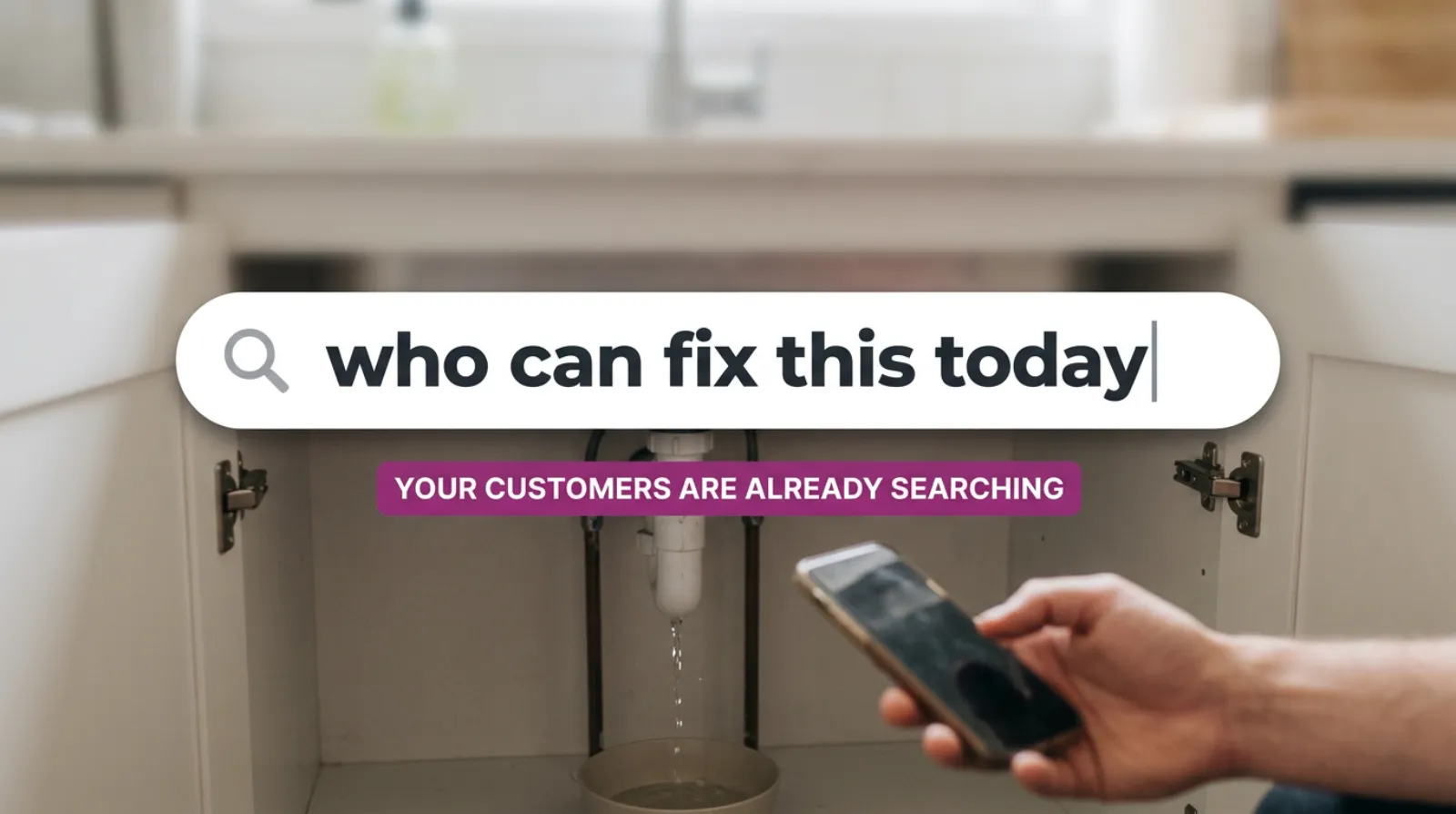
Your Customers In Milton Keynes Are Already Searching. Is Your Advertising There When They Do?
Right now, somewhere across the city, someone is typing into Google. An emergency electrician. A wedding photographer. A physio for a bad back. An accountant who understands small businesses.
They are not browsing. They have a need, and they are looking for someone to meet it today.
Get your free Marketing Action PlanNot sure where to start? Answer a few questions and get your plan in about a minute. No email needed.
Get my plan →That is the most valuable moment in advertising, and it happens thousands of times a week. The only question for your business is whether you are there when it does.
This guide explains how to see the searches your customers are already making, where your advertising needs to be to meet them and what a good advertising agency should do with your budget. It is written from our office on Grovebury Road in Leighton Buzzard, twenty minutes down the A4146 from Central Milton Keynes.
Why Search Is The Best Place To Start
Most advertising has to create interest. A billboard, a radio advert or a social media post interrupts people who were thinking about something else, and hopes some of them care.
Search advertising works the other way round. The customer comes first, with a need already in mind, and your advert answers it.
That changes the maths. You are not paying to persuade people they want what you sell. You are paying to be the business they find when they already want it.
It is also why search advertising tends to bring enquiries faster than almost any other channel. The person searching for "boiler repair" on a cold Monday morning is not going to wait a week. They will call one of the first businesses they see.
There is a second advantage that is easy to miss. Search advertising is measurable in a way most traditional advertising is not. You can see which searches triggered your adverts, how many people clicked, how many called or filled in a form, and what each enquiry cost. That turns advertising from a leap of faith into a set of numbers you can improve month after month.
For a local business, that is the whole game. Be one of the first businesses they see.
What "Already Searching" Actually Looks Like
It is easy to say people are searching. It is more convincing to see it for yourself, and you can, for free, in a few minutes.
Watch Google Finish Your Sentence
Open Google, type your service followed by the city name, and stop before you press enter. The suggestions Google offers underneath come from real searches people make. Try it with your main services, one at a time.
Then try it with the districts. Enquiries come from Bletchley, Wolverton, Newport Pagnell, Stony Stratford and Central Milton Keynes, and many people search with the district rather than the city.
Look Inside Keyword Planner
If you have a Google Ads account, even an empty one, Google's Keyword Planner is free. Type in your services and set the location to your area. It shows roughly how many searches happen each month and what advertisers typically pay per click.
The numbers are estimates, and they are grouped into ranges. But they answer the key question. Are people here searching for what I sell? For almost every local service, the answer is yes.
Check Your Google Business Profile
Your Google Business Profile shows which searches led people to your listing, and how many called, visited your website or asked for directions. If you have never looked, it is often a pleasant surprise. People are finding you already, and that is the demand you can meet more of.
Once you have seen the searches with your own eyes, advertising stops feeling like a gamble. You are not creating demand. You are catching it.
Keep a note of what you find. A simple list of the searches that match your best services, with a rough monthly volume and click cost for each, becomes the backbone of your advertising plan. It also makes any conversation with an agency far more useful, because you arrive knowing what your customers look for.
How People Across The City Search
Milton Keynes is a spread-out place, and that shapes how people search.
Many people search with no place name at all. They type "dentist" or "roofer" and let Google use their phone's location. That is true across Milton Keynes, where people move between districts for work, school and shopping. Your advertising needs accurate location settings, not just the right words.
Others search with the city name, especially when they are planning ahead or searching from work. Some search with the district, because that is where they live and they want someone close.
And a good number search for "near me". That phrase does not name anywhere, but Google treats it as a strong signal of local intent and leans heavily on the searcher's location.
The practical lesson is that you need to be visible for all of these, not just one. Location targeting in Google Ads covers the searches without a place name. A complete Google Business Profile covers "near me" and the map. Pages on your website that mention the areas you serve cover the city and district searches.
Where Your Advertising Needs To Be
When someone searches for a local service, the results page usually has three areas where businesses can appear. A good advertising plan covers all three.
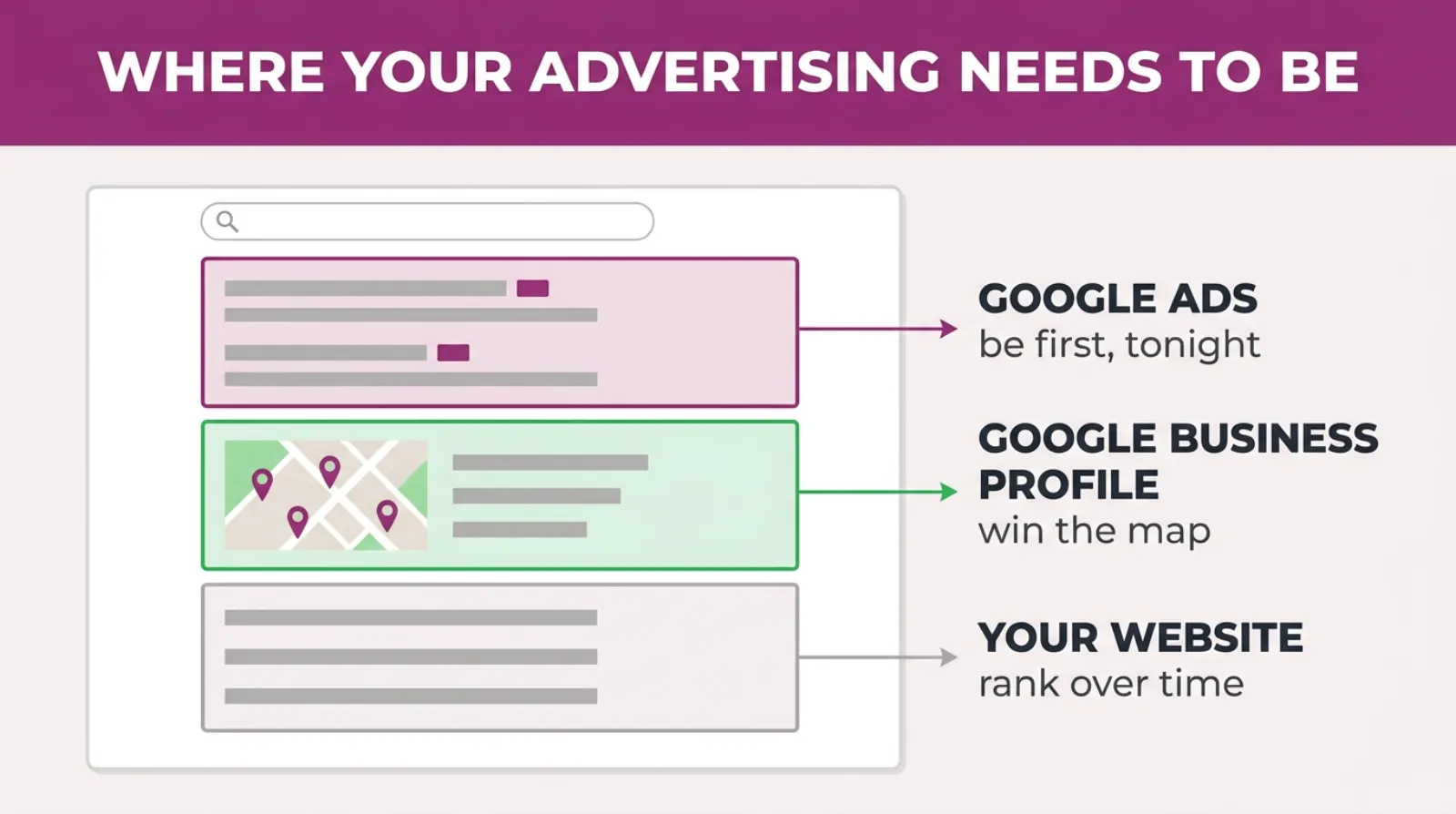
The top of the page is usually the paid adverts. Just below is often the map with a small group of local businesses. Beneath that are the ordinary website results. Each is won in a different way, and together they decide who gets the call.
The Top Of The Page, Google Ads
Google Ads puts your business at the top of the results for the searches you choose, in the areas you choose, at the times you choose. You pay when someone clicks.
For a local business, that control is the point. You can show your advert only to people in the parts of the city you actually serve, only during the hours you can answer the phone, and only for the services that make you money.
Get The Location Setting Right
This is the single most common mistake in local Google Ads accounts. Google offers a choice between showing ads to people who are in, or regularly in, your chosen area, and people who have simply shown interest in it.
For almost every local business, the first option is the right one. The second can put your ads in front of people hundreds of miles away who once looked up your town. Google itself recommends the first option for most advertisers.
Choose Searches That Mean Business
Not every search is a customer. "Plumber jobs" and "how to fix a tap" contain the word plumber, but neither person wants to hire one. Choose keywords that signal someone ready to buy, and block the ones that do not with negative keywords.
Send People Somewhere Useful
Send clicks to a page about the service they searched for, not your homepage. The page should say clearly what you do, where you work and how to get in touch, with a phone number people can tap on a mobile.
Make It Easy To Call
For many local services, the phone is still how customers buy. Call adverts and call assets let people ring you directly from the advert. Make sure someone answers.
The Map, Your Google Business Profile
The map section is free. You cannot pay to rank higher in it. You earn your place there with a complete, active profile.
That means the most specific category for your business, accurate hours, real photos, a clear description and a steady flow of recent reviews with replies. It means your business name, address and phone number matching exactly across your website and directories.
For many local searches, the map is where people decide. They see a handful of businesses, their star ratings and how far away they are, and they call. A strong profile makes every pound of Google Ads spend work harder, because people who see your advert and then check your reviews find a business worth calling.
The Results Below, Your Website
The ordinary results beneath the ads and the map come from search engine optimisation. It is slower than advertising, but it compounds.
Genuine pages about each service and the areas you cover, a fast website that works well on a phone and mentions of your business elsewhere online all help. Over time, they mean more of your enquiries arrive without a cost per click.
The best local plans run advertising and SEO together. Advertising brings enquiries now. SEO reduces how much you depend on advertising later.
Reaching People Before They Search, Social Advertising
Search catches people who are already looking. Social advertising on Facebook and Instagram reaches people before they start.
It is especially useful in three situations.
- When your service is something people do not search for often, such as a new product or an occasional treat
- When you want to remind people who visited your website but did not get in touch
- When you want to stay familiar with past customers, so they come back and refer others
Social advertising can target people by area, so a business in the city can reach people living nearby without paying to reach the whole country.
It usually works best alongside search rather than instead of it. Someone who has seen your social advert a few times is more likely to choose you when they later search and see your name.
What Search Advertising Looks Like For Different Businesses
The principles are the same for every local business, but the details change with the trade. Here is how search advertising tends to work for a few common types of business.
Trades And Home Services
Plumbers, electricians, roofers and locksmiths often get their best customers from urgent searches. Call adverts, tight location targeting and ads running during the hours someone can answer the phone matter most. Emergency searches usually cost more per click, and are usually worth it.
Clinics And Health Services
Physios, dentists, opticians and beauty clinics tend to get searches for specific treatments. Separate ad groups for each treatment, each sending people to a page about that treatment, work far better than one general advert. Reviews carry a lot of weight in the decision.
Professional Services
Accountants, solicitors and consultants often get searches from people comparing options. Clear, specific adverts that say what makes you different, and landing pages with real credentials and case studies, help people choose you. These searches can be expensive, so tight keywords matter.
Shops, Cafés And Leisure
For businesses people visit, the Google Business Profile and the map often do more work than paid adverts. Search ads still help for specific products, events and seasonal peaks, and social advertising helps keep people coming back.
Whatever the trade, the pattern holds. Find the searches people already make, be there when they make them, and send them somewhere that makes it easy to get in touch.
What A Sensible Starting Budget Looks Like
This is the question every business owner asks, and the honest answer is that it depends on your market. But you can work out a sensible figure yourself.
Start With The Cost Per Click
Keyword Planner shows the typical cost per click for your main searches. Competitive trades, such as legal services or emergency repairs, cost more per click than quieter ones.
Work Out How Many Clicks You Can Afford
Divide your daily budget by the typical click cost. That tells you roughly how many people you can reach each day. If the answer is one or two, your budget is probably too thin to learn anything useful.
Think In Enquiries, Not Clicks
Not every click becomes an enquiry, and not every enquiry becomes a customer. What matters is the cost of a new customer compared with what that customer is worth to you. A good agency helps you track this from day one.
Give it enough time and enough budget to learn. A campaign switched off after a fortnight rarely tells you anything. A focused campaign run properly for a couple of months usually does.
What A Good Advertising Agency Does With Your Budget
An advertising agency should make your budget go further, not just spend it for you. Here is what that looks like in practice.
It Checks The Basics First
Tracking that records calls and form enquiries. A landing page that works on a phone. A Google Business Profile that is complete. Advertising on top of broken basics is money poured into a leaking bucket.
It Targets Tightly
The right areas, using the "people in your area" setting. The right searches, with negative keywords blocking the wrong ones. The right hours, matched to when you can answer the phone.
It Reads The Search Terms Every Week
Google shows exactly what people searched before clicking your ads. A good agency reads that report every week and blocks anything that wastes money. It is unglamorous work, and it is where a lot of the savings come from.
It Reports In Plain English
What happened this month, why, and what comes next. Enquiries and cost per enquiry, not just clicks.
It Tells You When To Spend More, And When Not To
If the campaign is profitable and limited by budget, a good agency will say so. If it is not working yet, it will tell you that too, and explain what it is changing.
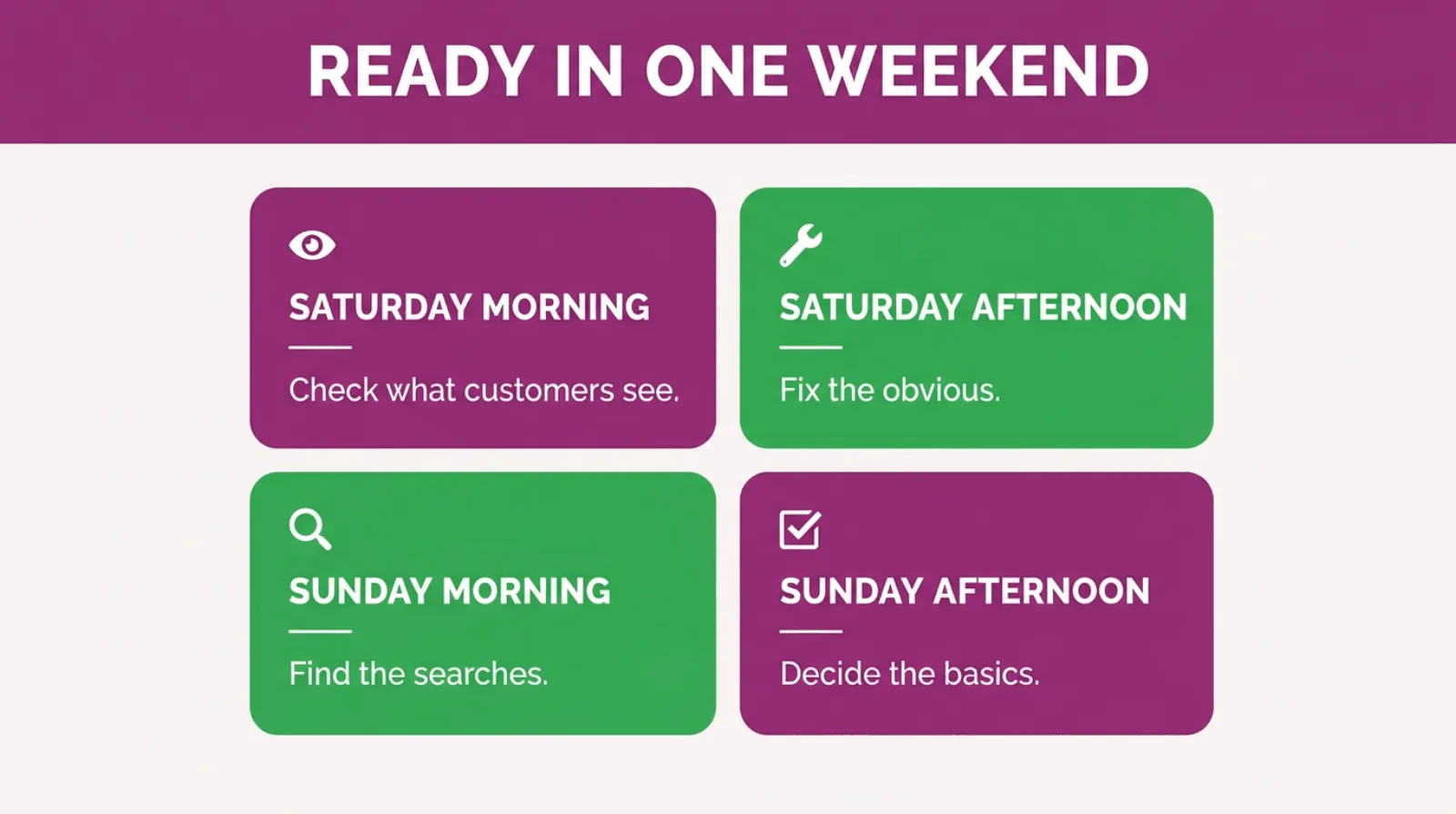
Getting Ready In A Weekend
You do not need weeks of preparation to start advertising well. Most of the groundwork fits into one focused weekend.
Saturday Morning, Check What Customers See
Search for your main services the way a customer would. Look at your Google Business Profile as a stranger would see it. Open your website on your phone with wifi switched off, and make sure your number is easy to find and tap.
Saturday Afternoon, Fix The Obvious
Update your profile's hours, category and photos. Make sure your contact form sends to an inbox someone reads. Add a clear line near the top of each service page saying what you do and where you work.
Sunday Morning, Find The Searches
Use Google's suggestions and Keyword Planner to list the searches that match your best services. Note the typical cost per click for each. Write down the words that would mean someone is not a customer, such as jobs, courses or free.
Sunday Afternoon, Decide The Basics
Choose the areas you genuinely serve, the hours you can answer the phone and a daily budget that buys enough clicks to learn from. Decide which page each service advert should send people to.
By Sunday evening, you have everything an advertising campaign needs to start well. Whether you set it up yourself or hand it to an agency, the hard thinking is done.
Common Mistakes That Waste Local Ad Budgets
A few mistakes come up again and again in local accounts. Each one is easy to avoid once you know about it.
- Showing ads across the whole country, or to people merely "interested in" the area
- Sending every advert to the homepage instead of a relevant page
- Bidding on broad searches without negative keywords, so job hunters and DIY fans click
- Running ads when nobody can answer the phone
- Not tracking calls, so the best enquiries never show up in the results
- Giving up after two weeks, before the campaign has learned anything
None of these needs a bigger budget to fix. They need attention, and a regular habit of checking.
What Good Looks Like After 90 Days
It helps to know what to expect, so you can tell whether your advertising is working.
In the first month, the focus is on set-up and learning. Tracking in place, the campaign running, the first rounds of negative keywords added. Enquiries usually start, but the numbers are still settling.
In the second month, the account should tighten. Wasted searches blocked, budget moving towards the searches and areas that produce enquiries, adverts refined. The cost per enquiry often starts to improve here.
By the third month, you should be able to answer three questions with real numbers. How many enquiries did the advertising bring in? What did each one cost? And how many became customers? Those three numbers are the whole story.
If you can answer those three questions, you can make every future decision with confidence. Spend more where it works, fix what does not and stop guessing.
Questions To Ask An Advertising Agency
If you decide to bring in help, a few questions quickly show whether an agency will make your budget work.
- Which searches do you think my customers are making, and how will you check?
- How will you set the location targeting for my area?
- How will we track phone calls as well as forms?
- How often will you read the search terms and add negative keywords?
- What will you report each month, and will it show cost per enquiry?
- Will the Google Ads account be in my business name?
The best answers are specific to your business. An agency that has already typed your service into Google before the first call is one worth listening to.
Why Waiting Costs More Than You Think
It is tempting to put advertising off until things are quieter, or until the website is perfect, or until next quarter.
The trouble is that the searches do not wait. Every day, people in your area are looking for what you sell. Every day you are not there, a competitor who is gets the call.
Those customers do not come back later. They book, they buy and, if they are happy, they return to that competitor next time and tell their friends.
Being there when people search is not just about this week's enquiries. It is about which business becomes the one people remember.
A Worked Example
Here is a made-up example to show how it fits together. Picture a small driving school covering the southern half of the city.
The owner types "driving lessons" and the city name into Google and sees a string of suggestions, including searches for automatic lessons and intensive courses. Keyword Planner confirms there are regular monthly searches for each, at a click cost the business can afford.
They set up a Google Ads campaign showing only to people in the districts they cover, only during the hours someone can answer the phone, and only for lesson searches. They block "instructor jobs" and "theory test practice" as negatives. Each advert goes to a page about that type of lesson, with a clear price guide and a tap-to-call button.
At the same time, they refresh their Google Business Profile with new photos and start asking every passing pupil for a review.
Within a few weeks, enquiries start coming through at a cost per new pupil the owner is happy with. A small social campaign follows, reminding people who visited the website but did not book.
Nothing in that plan is complicated. It simply puts the business in front of people at the moment they are looking.
Frequently asked questions
Where should a local business advertise online?
Start where customers are already looking. For most local businesses that means Google Ads and a complete Google Business Profile, so you appear when people search for what you sell. Add social advertising to reach people before they search and to remind past visitors.
How do I know if people are searching for my business?
Type your service and your town into Google and look at the suggestions it offers. Use Google's free Keyword Planner to see estimated searches and costs. Check your Google Business Profile insights to see which searches already find you.
Is Google Ads worth it for a local business?
For most local service businesses, yes, because it puts you in front of people at the moment they are looking. It works best with accurate location targeting, a clear landing page, call tracking and someone checking the search terms every week.
How much should a small business spend on Google Ads?
Work it out from the cost per click in your market. Divide your daily budget by the typical click cost to see how many clicks a day you can afford. You want enough clicks to produce regular enquiries and data to learn from.
Google Ads or Facebook ads for a local business?
They do different jobs. Google Ads reaches people actively searching, so it usually brings enquiries fastest. Facebook and Instagram ads reach people who are not searching yet and remind people who have already visited. Most local businesses do best starting with Google, then adding social.
How quickly can Google Ads bring in enquiries?
Often within days of a campaign going live, because it reaches people who are already searching. The first few weeks are about learning and tightening, so the cost per enquiry usually improves over the first couple of months as wasted searches are blocked and budget moves to what works.
Do I need an advertising agency in Milton Keynes to run Google Ads?
Not necessarily, but it helps. Google Ads rewards regular attention, from reading search terms to adjusting budgets. An agency that knows the area and checks the account every week often saves more than it costs. Ask what it would check first before you sign.
Keep Reading
If you are ready to make sure your business is there when customers search, these five go further.
- Google Ads Management Services - PPC Agency Milton Keynes
- 5 Google Business Profile Tweaks That Push You Into the Local Map Pack
- 6 Local SEO Fixes That Get SMEs Into the Google Maps 3-Pack Faster
- The Search Terms Report: The Most Expensive Tab You've Never Opened
- How To Reduce Google Ads Cost - How To Lower Your Google Ads Costs Without Sacrificing Results
The first is how we run Google Ads. The next two help you win the map. The last two help every pound of your advertising work harder.
Be There When It Matters
Your customers are not waiting for you to find them. They are already searching, every day, for exactly what you sell.
The businesses that grow are the ones that show up in that moment. At the top of the page with a clear advert. In the map with strong reviews. In the results with a genuinely useful website.
None of it is out of reach for a small business. It takes the right targeting, a sensible budget and someone paying attention every week. Start with the searches you already know about, and build from there.
We work with businesses across the patch, from Bedford, Luton, Dunstable, Aylesbury, Buckingham and Northampton to our home town of Leighton Buzzard. If you want your business in front of Milton Keynes customers when they search, get in touch and we will show you what that looks like for your trade.

Written by Uzair Kharawala
Partner at SF Digital Studios, a Google Premier Partner agency. Uzair has been helping businesses grow with Google Ads since 2002 and teaches it every week on YouTube.
Get our best Google Ads tips by email
New articles and videos, straight to your inbox. Unsubscribe any time.