
A Referral Happened This Morning. You Weren’t in the Room.
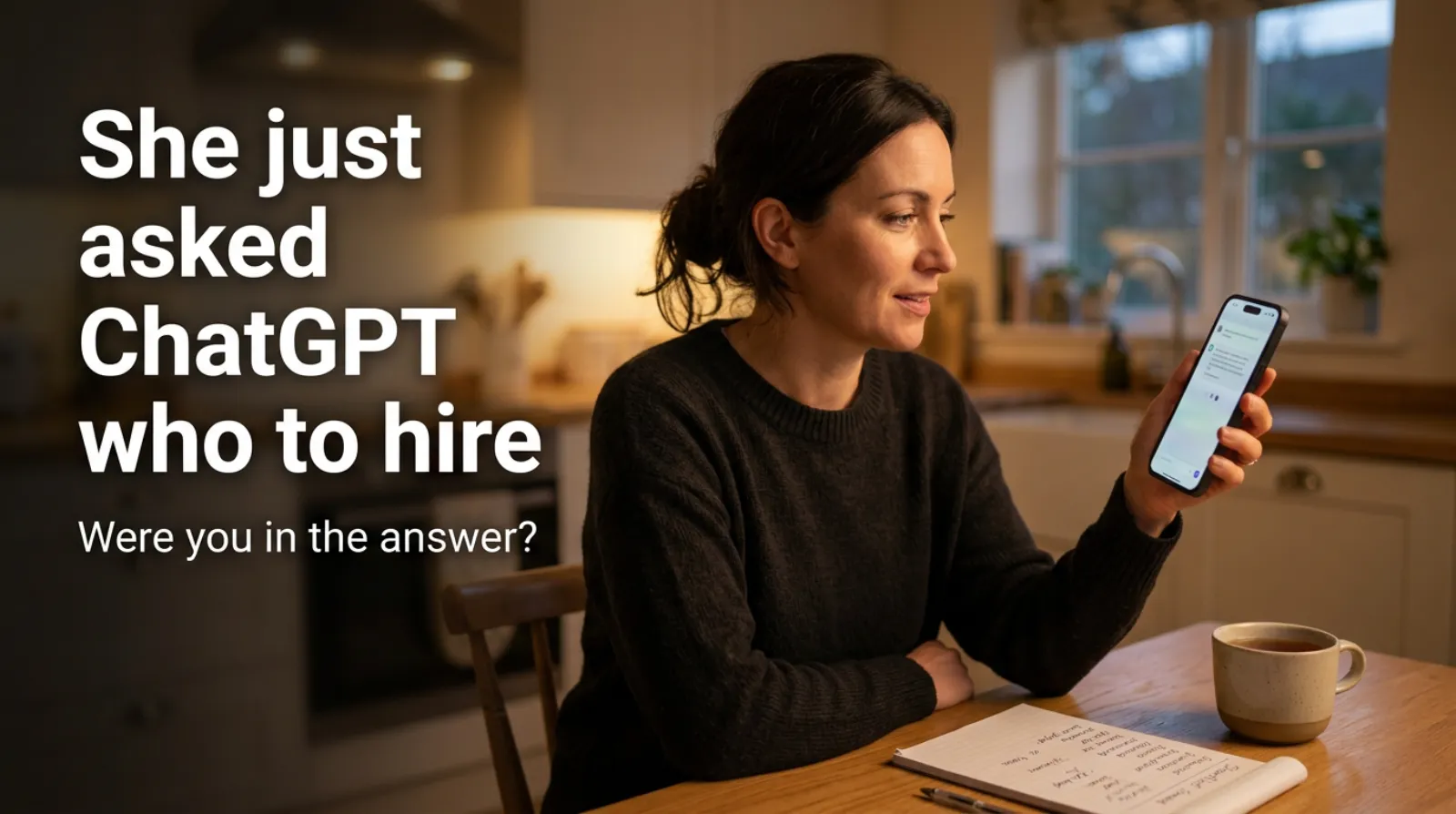
Somewhere in your area today, a buyer typed a question into ChatGPT. “Who’s a good roofer near me?” “What should I look for in an accountant?” “Is such-and-such worth using?”
Get Found, Get Chosen, Get Your Time Back
A free one-day marketing seminar in Milton Keynes · 10 November 2026
The answer came back in seconds: a short, confident shortlist with reasons attached. Three names. A recommendation, delivered with the authority of a trusted friend, to a buyer at the exact moment of deciding.
Get your free Marketing Action PlanNot sure where to start? Answer a few questions and get your plan in about a minute. No email needed.
Get my plan →If your business was not one of those names, you just lost a referral you never knew existed. No ad auction ran. No search ranking applied. There was nothing to outbid, because you were never in the room.
This is now happening at serious scale. Research compiled by Cheers found 45% of consumers used AI tools like ChatGPT, Gemini or Perplexity to find local business recommendations in the past year, up from just 6% the year before. AI has become the third most-used discovery channel for local businesses, behind only Google and Facebook.
And here is the strangest part: ChatGPT currently recommends only around 1.2% of local businesses, while 88% of businesses have no plan whatsoever for appearing. The room is nearly empty, and the door is unlocked.
What Is This New Channel?
Answer engine optimisation, sometimes called AEO or GEO, is the work of making your business visible and quotable when buyers ask AI assistants for advice and recommendations. Where SEO earns you a position on a results page, AEO earns you a mention in the answer itself.
The behaviour it serves is different from search, too. People do not give AI keywords. They give it situations. “My boiler is making a banging noise, who should I call in Luton?” The assistant interprets the situation, decides what matters, and names names.
Those names are not picked from a paid index. The AI synthesises them from everything it can read and cross-check about local businesses: websites, reviews, directories, articles and mentions across the web. It recommends whoever the written record makes look competent, consistent and safe.
That last word is the key to everything that follows. AI assistants are cautious by design. They recommend the businesses that are easy to verify, because a wrong recommendation embarrasses them. Your job is to become easy to verify.
How the Machine Decides Who to Name
Pull apart an AI recommendation, and you find a paper trail. The research on citations shows where the trail leads: 84% of the sources AI tools cite are earned media, meaning reviews, directories, press and third-party mentions, rather than the business’s own pages.
Read that carefully, because it rewrites the marketing job. Your website matters, but mostly as the place where claims get confirmed. The recommendation itself is assembled from what everyone else says about you: the review that mentions your punctuality by name, the local news piece, the directory listing that matches your website exactly, the supplier page that lists you as an approved installer.
Consistency runs through all of it. If your website says one service area, your Google Business Profile another, and an old directory a third, the machine finds a contradiction where it wanted confirmation. Cautious systems quietly drop the contradictions and recommend the business whose story checks out everywhere.
This is why the businesses being named are rarely the biggest. They are the tidiest.
Why This Referral Compounds
An AI mention is not the end of the buyer’s journey, and that is precisely its power. The behaviour data shows what happens after a recommendation: 62% of buyers immediately search Google for the business, 58% visit its website directly, and 52% click the sources the AI cited.
In other words, the AI answer starts the familiar loop: the brand search, the review check, the website visit. Every checkpoint you have built for the messy middle now gets warmer traffic, pre-sold by an introduction that felt like advice rather than advertising.
That is also why this channel rewards early movers so heavily. Reviews, mentions, and consistent records accumulate. The competitor who becomes the “safe answer” in your town this year will be very hard to dislodge from that seat next year.
 LIVE
LIVELive every Tuesday at 2pm UK. Bring your marketing questions.
Get your Google, local SEO and AI questions answered live.
The Playbook: Becoming the Business AI Recommends
Nothing here requires new technology. It requires making your business the easiest one for a cautious machine to verify.
Answer questions the way AI quotes
Lead every important page with a direct, complete answer in the first sentence or two, then expand. Build a real FAQ page from the ten questions customers actually ask you on the phone, each with a self-contained answer. AI assistants lift clear, confident answers and skip pages that make them dig.
Make your story identical everywhere
Same business name, same services, same areas, same phone number, across your website, Google Business Profile, directories and social profiles. Audit the old listings you have forgotten about. Every contradiction you remove makes you easier to confirm and safer to recommend.
Build the review estate
Reviews are the machine’s favourite evidence, and it reads them the way buyers do: for specifics. Steady, detailed reviews across Google and one or two other platforms, with your replies underneath, tell the machine how you actually operate. Thin or stale reviews leave it nothing to quote.
Earn mentions beyond your own pages
Since 84% of citations come from earned media, the local news piece, the trade association listing, the supplier’s approved-installer page and the community sponsorship all carry weight your own website cannot. One genuine local mention is worth more than another page about yourself.
Keep the machinery readable
Structured data, clean headings and schema markup on your pages help every engine parse who you are, what you do and what customers ask. It is the same markup that wins Google’s rich results, doing double duty for AI.
The Monthly Ten-Minute Test
You cannot manage what you have never asked. Once a month, open ChatGPT, Gemini and Perplexity and ask the four buyer questions: the best provider in your category in your town, what to look for when choosing one, whether your business is any good, and how you compare to your nearest competitor.
Log the answers. Note who gets named, what gets said about you, and what the machines get wrong. Wrong service areas and dead phone numbers point straight at inconsistent listings. Absence points at thin answers and a weak review estate. Each month’s log tells you exactly which part of the playbook to work on next.
Questions Owners Ask About AI Recommendations
What is answer engine optimisation?
Answer engine optimisation, or AEO, is the work of making your business visible and quotable when people ask AI assistants like ChatGPT, Gemini and Perplexity for advice and recommendations. Where SEO targets a ranking on a results page, AEO targets a mention inside the answer itself.
How do I get ChatGPT to recommend my business?
Become easy to verify. Lead your pages with direct answers, keep your business details identical across the web, build steady detailed reviews with replies, earn third-party mentions, and use schema markup. AI assistants recommend businesses whose written record is consistent and confirmable.
Why does AI recommend my competitors instead of me?
Usually because their paper trail is stronger, not their work. More specific reviews, more third-party mentions, more consistent listings, and clearer answers on their website give the machine material to quote. Run the monthly test to see exactly what the AI knows and where your record falls short.
How many people actually use AI to find local businesses?
More than most owners expect, and growing fast. Research in 2026 found 45% of consumers had used AI tools for local business recommendations in the past year, up from 6% the year before, making AI the third most-used local discovery channel after Google and Facebook.
Do I need to pay to appear in AI answers?
No. AI assistants assemble recommendations from the public written record: reviews, listings, mentions and your own pages. There is no auction to win. That is exactly why the channel favours businesses that invest in answers, consistency and reputation early.
How do I check what AI says about my business?
Ask it directly, once a month. Put the four buyer questions to ChatGPT, Gemini and Perplexity: best in your category locally, what to look for, whether your business is good, and you versus a competitor. Log the answers and fix the gaps and errors they reveal.
The Empty Room With the Unlocked Door
Every era of marketing has one moment where the channel is enormous, and the competition has not arrived. For AI recommendations, that moment is now: nearly half of buyers asking, barely one in a hundred businesses being named, and nine out of ten of your competitors with no plan at all.
The work is unglamorous and entirely doable. Clear answers. A consistent story. Reviews worth quoting. Mentions you earned. And ten minutes a month asking the machines what they think of you.
At SF Digital, AI search visibility is one of the pillars we build for small businesses, alongside the ads and the local presence it feeds. If you have never asked ChatGPT about your own business, do it tonight. Then call us about what it said.

Written by Uzair Kharawala
Partner at SF Digital Studios, a Google Premier Partner agency. Uzair has been helping businesses grow with Google Ads since 2002 and teaches it every week on YouTube.
Get our best Google Ads tips by email
New articles and videos, straight to your inbox. Unsubscribe any time.