
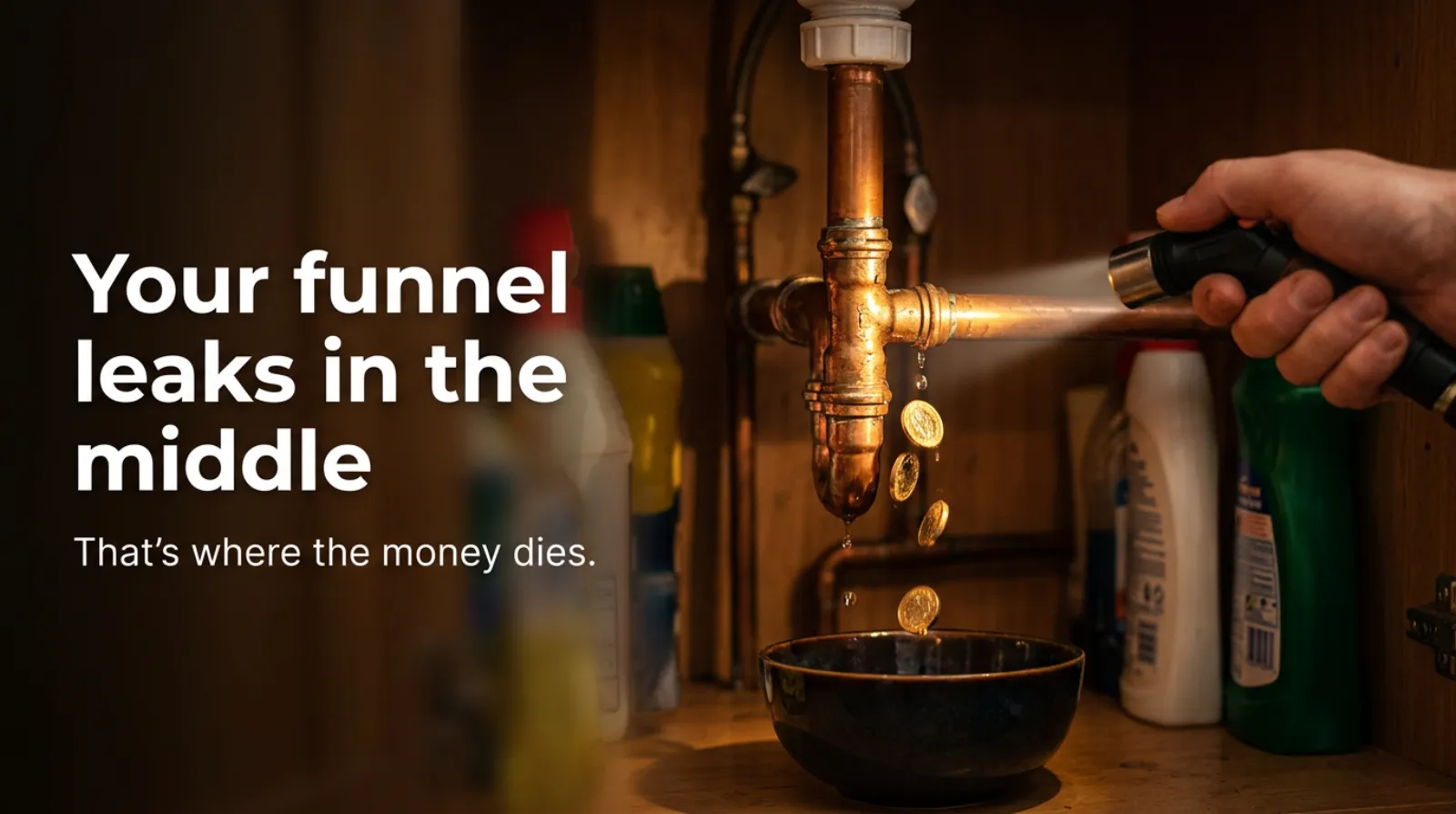
Everyone Watches the Two Ends. The Middle Eats the Money.
Business owners give their marketing attention to two places. The top, where the ads run, and the clicks arrive. And the bottom, where jobs get signed, and invoices go out. Both ends have dashboards, feelings and opinions attached.

Get Found, Get Chosen, Get Your Time Back
A free one-day marketing seminar in Milton Keynes · 10-11-2026
Between them sits a long, unglamorous middle. The visitor who read your quote page and left. The enquiry that got one reply and went quiet. The quote you sent nine days ago that nobody has chased. No dashboard celebrates this territory, so nobody looks at it.
Get your free Marketing Action PlanNot sure where to start? Answer a few questions and get your plan in about a minute. No email needed.
Get my plan →The numbers say the middle is exactly where the losses happen. Around 98% of website visitors do not convert on their first visit. Of the leads that do come in, 44% of salespeople give up after a single follow-up attempt, while 80% of sales need five or more touches to close. Only 2% of sales happen on the first contact.
Read those together, and the shape of the problem appears. Your ads are probably fine. Your work is probably fine. The money is dying quietly in the corridor between them, and this article is about fixing the corridor.
What Is the Middle of the Funnel?
The middle of the funnel is everything that happens between a person’s first click and a signed job. It splits into two gaps: the gap between visiting and enquiring, and the gap between enquiring and buying. Most small business marketing budgets leak more in these two gaps than anywhere else.
Think of it as plumbing. The top of the funnel is the water supply and the bottom is the tap. The middle is the pipework in the walls: joints, bends and washers nobody admires. When the flow at the tap disappoints, owners usually pay for more water. The leak, meanwhile, is in the wall.
The good news about plumbing is that it is mechanical. Nothing in the middle requires creative genius. It requires speed, persistence and a place to keep track of things, which is why fixing it is usually the cheapest growth available to a small business.
Gap One: The Visitors Who Left Without a Word
Start with the bigger, quieter gap. For every enquiry you receive, dozens of interested people visited and left silently. They are not lost. They are mid-decision, comparing you against others, and most of them will buy from someone within weeks.
The tool for this gap is retargeting: ads shown specifically to people who already visited your site. It is follow-up for people who never gave you their details, and the economics are consistently strong. Retargeted visitors convert around 70% more often than cold traffic, and retargeting ads earn roughly ten times the click-through rate of standard display ads, according to compilations from DemandSage and SearchLab.
The budgets are small because the audience is small: you are only advertising to your own recent visitors. A modest monthly spend keeps your name in front of every warm prospect while they loop through their comparison.
Two rules make it work. Keep the message consistent with what they saw, and rotate the angle: a review, an answer to a common objection, a look at recent work. You are not chasing them. You are staying visible while they decide.
Gap Two: The Enquiries That Went Quiet
Now the gap you can fix this week. An enquiry arrives, someone replies once, silence follows, and everyone moves on. The lead gets filed under “tyre kicker” and the ad that produced it gets the blame.
The statistics are blunt about what actually happened. Only 2% of sales close on first contact, 80% need five or more touches, and 44% of sellers stop after one attempt. The average rep makes 1.3 attempts. The lead did not die. The follow-up did.
Speed opens the gap and persistence closes it. Reply fast, then run a simple sequence: a call and a text on day one, a follow-up with something useful on day three, another touch in week two, and a friendly final message that closes the loop. Six to eight touches over two weeks is the range the nurturing research supports, and it is five more than most competitors will manage.
Vary the channel, because people who ignore email answer WhatsApp, and people who dodge calls read texts. And make each touch worth receiving: a relevant answer, a photo of similar work, a reminder of the quote’s expiry. Value is the difference between following up and pestering.
The final message matters more than owners expect. “Sounds like the timing isn’t right, so I’ll leave it with you. If anything changes, you know where I am.” Half the replies a sequence ever gets arrive after that message, because removing the pressure makes answering easy.
The Unsexy Plumbing Checklist
None of the above survives without infrastructure, and the infrastructure is embarrassingly simple.
One place where every enquiry lives. A CRM if you like tools, a spreadsheet if you do not. Date, name, source, stage, next action. The instrument panel for the middle.
One named owner. Enquiries that belong to everyone belong to no one. Someone owns the inbox, the follow-ups and the weekly review.
Templates for every touch. The day-three message and the break-up message should not be composed fresh each time. Write them once, personalise per lead in seconds.
Retargeting switched on. The audiences build themselves once the tag is installed. Even a small monthly budget keeps you in front of every recent visitor.
A weekly fifteen minutes. Open the list, count the quotes with no next action, and clear them. This one habit recovers more revenue than most new campaigns.
Finding Your Own Leak
Every funnel leaks somewhere different, and three ratios locate yours. Take last month’s numbers and divide: visitors to enquiries, enquiries to quotes, quotes to jobs.
A weak visitors-to-enquiries ratio points at your asks and your retargeting. A weak enquiries-to-quotes ratio points at reply speed and follow-up. Weak quotes-to-jobs points at persistence after the quote, which for most trades is the most valuable fix of all, because everything upstream has already been paid for.
Fix the worst ratio first, one change at a time, and re-measure monthly. The middle rewards maintenance, not heroics.
Questions Owners Ask About the Middle of the Funnel
What is the middle of the marketing funnel?
Everything between a person’s first click and a signed job: the visitors who left without enquiring, the enquiries awaiting follow-up, and the quotes awaiting decisions. It is where most small business marketing spend leaks, because attention goes to ads at one end and closed work at the other.
Why do my enquiries go quiet after the first reply?
Usually because the conversation depended on one reply. Only 2% of sales close on first contact, and most buyers need five or more touches while they compare options and life gets in the way. Silence normally means “not yet”, and a structured sequence turns a surprising share of it into work.
How many times should I follow up with a lead?
Six to eight touches over about two weeks, across mixed channels: call, text or WhatsApp, and email. Research shows 80% of sales need five or more touches, and 95% of leads that ever convert are reached by the sixth attempt. After the sequence, one polite break-up message closes the loop.
What is retargeting and is it worth it on a small budget?
Retargeting shows ads only to people who already visited your website. The audience is small, so the cost is small, and the returns are strong: retargeted visitors convert around 70% more often than cold traffic. For most local businesses, it is the cheapest advertising they will ever run.
How quickly should I send a quote?
Same day where possible, and within 24 hours as the outer limit. The quote is part of the follow-up sequence, not the end of it: diarise a touch two or three days after sending, because a quote nobody chases is a coin toss you paid for.
How do I follow up without being pushy?
Lead every touch with something useful: an answer, an example of similar work, a relevant detail you forgot to mention. Space the touches out, vary the channel, and end the sequence with a no-pressure message that hands control back to them. Persistence with value reads as service, not salesmanship.
Fix the Corridor, Keep the Spend
The middle of your funnel has no dashboard, no glamour and no opinions at dinner parties. It also has the best return on effort of anything in your marketing, because every improvement multiplies spend you have already committed.
Retarget the silent visitors. Run the sequence on every enquiry. Chase every quote. Keep the list, own the inbox, review it weekly. Plumbing, not poetry.
At SF Digital, we build the whole corridor for small businesses: the retargeting, the follow-up systems and the tracking that shows where each pound leaks. If your ads work but your months feel thin, the middle is almost certainly why.

Written by Uzair Kharawala
Partner at SF Digital Studios, a Google Premier Partner agency. Uzair has been helping businesses grow with Google Ads since 2002 and teaches it every week on YouTube.
Get our best Google Ads tips by email
New articles and videos, straight to your inbox. Unsubscribe any time.