
What A Digital Marketing Agency In Milton Keynes Should Fix Before It Sells You Anything
Most conversations with a digital marketing agency follow the same script. You explain that you want more customers. The agency explains its services. A proposal arrives for SEO, social media or Google Ads, with a monthly fee attached.
What rarely happens first is the obvious step. Someone checking whether your business can actually turn more interest into more customers.
If your marketing is leaking, pouring more money into it just makes a bigger puddle. Before any agency sells you anything, it should find and fix the leaks. Most of them cost little or nothing to fix.
Get your free Marketing Action PlanNot sure where to start? Answer a few questions and get your plan in about a minute. No email needed.
Get my plan →This guide sets out what those leaks usually are, so you can check them yourself or hold any agency to them. It is written from our office on Grovebury Road in Leighton Buzzard, twenty minutes down the A4146 from Central Milton Keynes.
What A Digital Marketing Agency Actually Does
A digital marketing agency helps a business win customers online. It usually works across several channels: search engine optimisation, Google Ads, social media, email, content and sometimes video or website design.
The channels are the tools. The job is the outcome, more customers at a cost that makes sense.
That distinction matters. An agency that starts with its favourite tool will recommend that tool whatever your business needs. An agency that starts with the outcome will first ask what is already working, what is broken and where customers are being lost.
Think of it like a good mechanic. A bad one sells you new tyres because the shop has tyres in stock. A good one listens to the engine first.
Why Fixing Comes Before Selling
Every business already has some flow of interest. People find you through word of mouth, Google, social media, signs, repeat customers and referrals. Some of them get in touch. Some of those become customers.
At every step in that flow, some people drop out. They cannot find your number. The form does not work. Nobody calls them back. They read two poor reviews and go elsewhere.
Fixing those drop-out points is almost always cheaper than finding new people. It converts interest you already have, rather than paying to create more.
And it makes every future pound of marketing work harder. An ad that sends people to a broken form is wasted money. The same ad sending people to a clear page, a working form and a quick reply might be the best money you spend all year.
That is why the order matters. Fix first, then sell. Any agency that skips the first step is guessing.
The Fix-First List
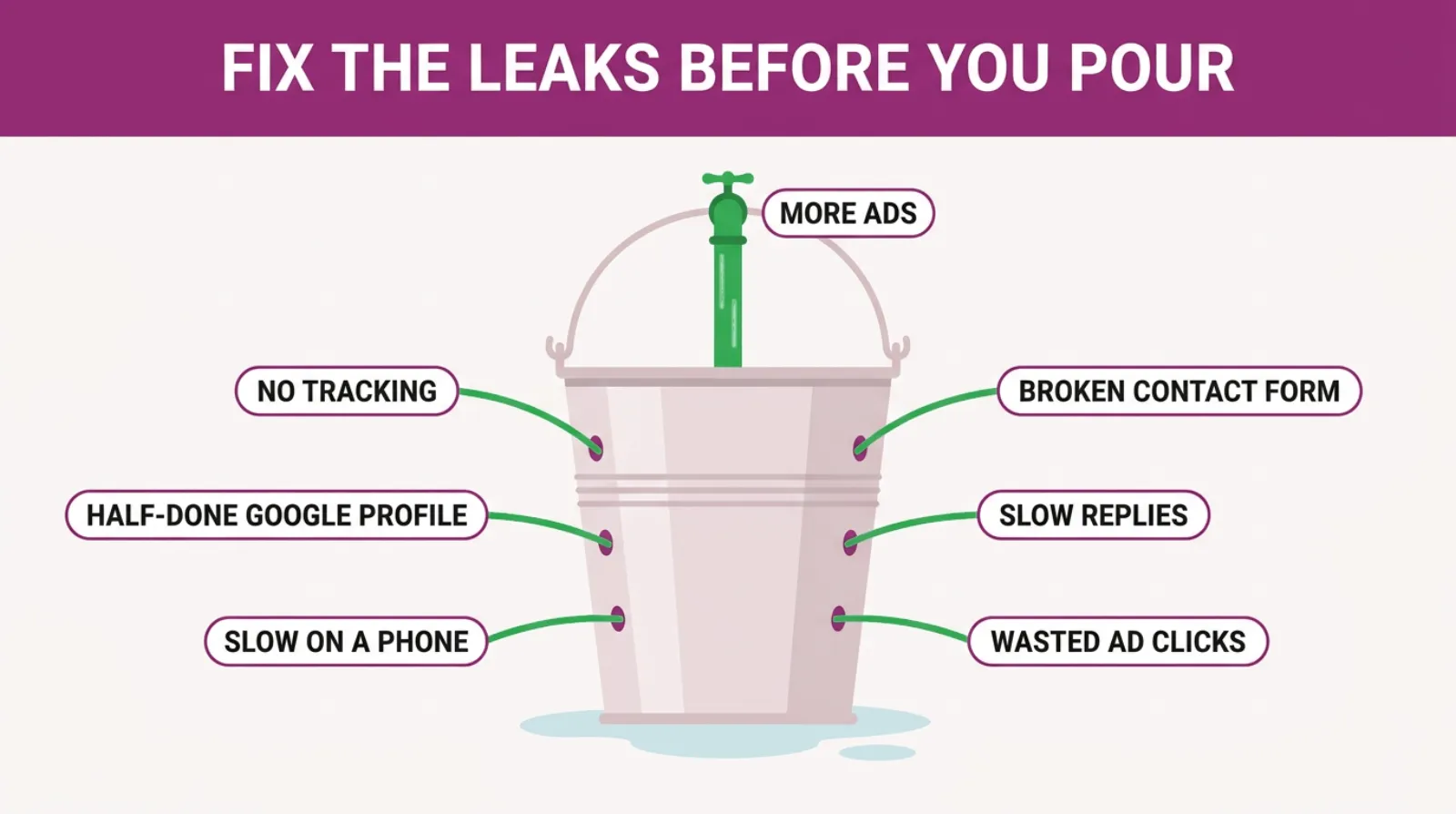
These are the six leaks we see most often in small business marketing. Each section below explains what the leak is, how to spot it and what fixing it involves.
Leak One, You Cannot See Where Customers Come From
If you cannot tell which marketing brought in which customers, you cannot tell what is working. Every decision after that is a guess.
What to check: can you say, roughly, how many enquiries came from Google, from your website, from social media and from word of mouth last month? Does your website record form submissions? Do you know which calls came from your website or your ads?
What fixing it involves: setting up conversion tracking on your website for forms, calls and bookings. Adding a simple question to every enquiry, "how did you hear about us?". If you run ads, making sure they record real enquiries, not just clicks.
This is the first thing any good agency should check, because every other fix depends on being able to measure it.
Leak Two, Your Google Business Profile Is Half Finished
For most local businesses, the Google Business Profile is the most-seen piece of marketing they own. It appears in Google Maps and beside search results, often before anyone visits your website.
What to check: is it verified? Is the category as specific as it can be? Are your hours right, including bank holidays? Are there recent photos? When did the last review arrive, and did you reply?
What fixing it involves: an afternoon of updating details, adding photos and writing a clear description. Then a simple habit of asking every happy customer for a review.
It costs nothing, and it is often the single biggest quick win for a local business.
It also shapes first impressions in a way a website cannot. Many people decide whether to call you from the profile alone, without ever clicking through. A profile with fresh photos, clear hours and recent replies to reviews says the business is active and cares. One that has not changed in years says the opposite.
Leak Three, Your Website Is Hard To Use On A Phone
Most local searches happen on phones. If your website is slow, fiddly or unclear on a small screen, people leave before they ever see what you offer.
What to check: open your website on your phone, on mobile data rather than wifi. Can you tell within five seconds what the business does and where it works? Can you find the phone number without scrolling? Does the page load quickly? Can you tap the number to call?
What fixing it involves: often small changes. A clear headline saying what you do and where. A tap-to-call button near the top. Compressed images so pages load faster. Removing pop-ups that cover the screen. Google's free PageSpeed Insights tool will show you the main speed problems.
Leak Four, Your Contact Routes Do Not Actually Work
This one sounds unlikely, and it is surprisingly common. Contact forms that send to an old email address. Phone lines that go to a full voicemail. A booking link that broke when the website was updated.
What to check: fill in your own contact form and make sure the message arrives, and arrives somewhere someone reads. Ring your own number at a busy time and see what happens. Try your booking system as if you were a customer.
What fixing it involves: usually minutes. Correcting an email address, clearing a voicemail, fixing a link. But until someone checks, the business has no idea it is happening.
Leak Five, Enquiries Wait Too Long For A Reply
People who get in touch with a small business are often contacting two or three others at the same time. The first one to reply properly often wins the job.
What to check: look at your last ten enquiries. How long did each one wait for a reply? How many calls went unanswered? Does anyone follow up if a quote goes quiet?
What fixing it involves: a simple rule, such as replying to every enquiry within the working day. A text or email acknowledging the enquiry straight away. A diary reminder to follow up quotes after a few days. None of this needs technology, just a habit.
No agency can fix a slow reply for you, but a good one will point it out. It is often worth more than any campaign.
Leak Six, You Are Already Paying For Wasted Clicks
If you already run Google Ads or social media ads, some of that money is probably going on people who will never buy. Job hunters, students, people outside your area and people looking for a competitor.
What to check: if you run Google Ads, open the search terms report and read what people actually searched. Look at which areas your ads show in. Check whether your ads are counting real enquiries or just clicks.
What fixing it involves: adding negative keywords, tightening location settings and fixing conversion tracking. The money you save can fund better marketing, or simply stay in your pocket.
The Leaks Nobody Mentions
The six above are the common ones. A few quieter leaks are worth checking too, because they rarely come up in an agency pitch.
No Proof On The Website
People want to see that you have done this before. Real photos of real work, short case studies and named reviews do more to convert a visitor than any clever headline. Many small business websites use stock photos and generic claims instead.
No Idea Of Price
Customers do not always need an exact price, but they want a sense of scale. A page that says "from £X" or explains what affects the cost filters out the wrong people and reassures the right ones. Silence on price sends many visitors straight back to Google.
A Website That Talks About You, Not Them
Read your homepage and count how often it says "we" compared with "you". Pages that list the company's history and values before explaining what the customer gets tend to lose people early.
The Way The Phone Gets Answered
This is not digital, and it matters as much as anything digital. A rushed, distracted answer loses jobs that the marketing worked hard to win. A friendly, clear answer and a quick next step win them.
Every one of these is fixable without a big budget, and every one makes paid marketing work harder.
What Should Come After The Fixes
Once the leaks are fixed, a good agency has something it did not have before: a clear picture of what works. Only then does it make sense to recommend more marketing.
The recommendation should depend on your business, not on what the agency sells most.
- If people already search for what you do, Google Ads and local SEO usually come first, because they meet demand that already exists.
- If people do not search for it, because the product is new or unusual, social media, video and content build awareness.
- If you have lots of past customers, email and referrals are often the cheapest growth available.
- If your reputation is thin, reviews and case studies make every other channel work better.
A good plan starts with the channel closest to a customer who is already looking. Awareness campaigns come later, when the business can convert the interest they create.
Why This Matters Around Milton Keynes
The area has a lot of small and medium-sized businesses competing for the same customers, and a lot of agencies competing for those businesses. That is good news for choice, and it makes it easy to be sold something you did not need.
Customers here are spread across very different places. Enquiries come from Bletchley, Wolverton, Newport Pagnell, Stony Stratford and Central Milton Keynes, and people in each search a little differently. A plan that treats the whole area as one market misses that.
Local knowledge helps in quieter ways too. Knowing which parts of the area a business really serves, how far customers will travel and where competitors are strongest shapes every recommendation. An agency three hundred miles away has to learn that from scratch.
What A Proper First Month Looks Like
If you do hire an agency, the first month tells you a lot. Here is what a fix-first month tends to look like.
Week One, Look Before Touching
The agency gets access to everything: website analytics, Google Business Profile, ad accounts, social pages and your enquiry records. It asks a lot of questions about your customers, your margins and your capacity.
Week Two, Find The Leaks
It runs the checks in this guide, and probably more. Tracking, forms, phone lines, mobile experience, reply times, reviews and wasted spend. It writes down what it finds, in plain English.
Week Three, Fix The Quick Ones
The cheap, fast fixes go in first. Tracking set up, forms corrected, the Google profile updated, obvious ad waste removed. Some of these the agency does. Some it hands to you, with clear instructions.
Week Four, Recommend The Next Step
Only now does it recommend where to spend. With tracking working and leaks plugged, it can say which channel should come next and why, based on your business rather than its price list.
If the first month skips straight to launching campaigns, the agency is building on sand.
How To Tell If An Agency Is A Fixer Or A Seller
You can usually tell within the first conversation. A few signs to watch for.
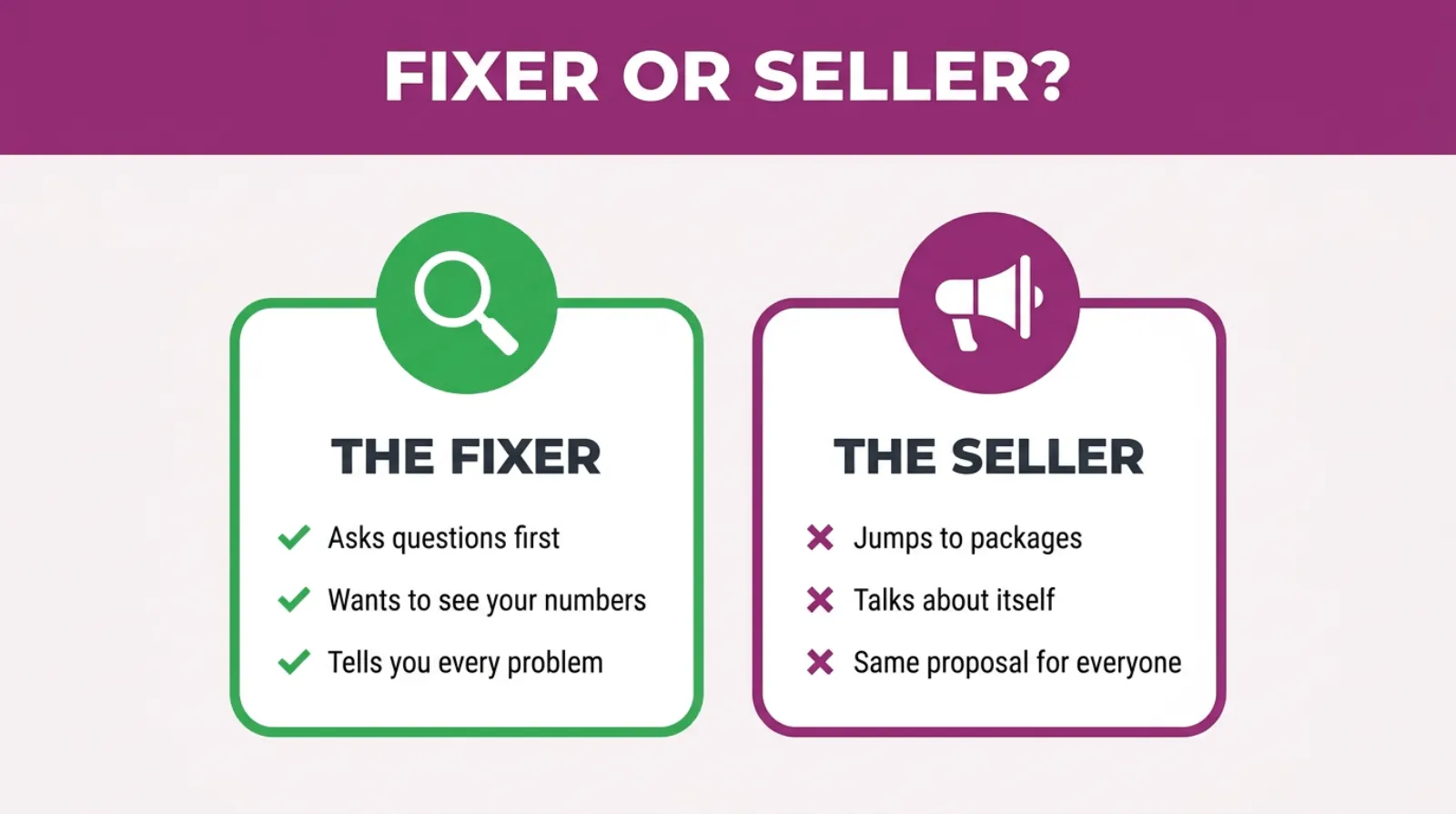
A fixer asks a lot of questions before talking about services. What your best customers look like. How enquiries come in. What happens after someone gets in touch. Which marketing you have tried before.
A fixer wants to see things. Your Google profile, your website on a phone, your ad account if you have one, your enquiry numbers.
A fixer tells you about problems that are not their product. "Your voicemail is full" is not a service anyone sells, but a good agency will tell you anyway.
A seller jumps to packages. It talks about what it does rather than what you need, and the proposal looks the same as the one it sent the last business.
If an agency could have written the proposal without looking at your business, it did not look at your business.
Questions Worth Asking On The First Call
These questions quickly reveal whether an agency diagnoses before it sells.
- What would you check first in my business, before recommending anything?
- How will we know which marketing is actually bringing in customers?
- Have you looked at my Google Business Profile and website on a phone? What did you notice?
- What would you fix that you would not charge me for?
- Which channel would you start with, and why that one for my business?
- What would make you tell me not to spend more on marketing yet?
The best answers are specific to your business. Generic answers usually mean a generic plan.
What To Pay For, And What Not To
It helps to know which parts of marketing genuinely need paying for, and which do not.
Worth Paying For
Proper tracking set-up, if you do not have the skills. Weekly management of paid advertising, because it needs constant attention. Technical website work, such as speed and structure. Strategy from someone who has seen many businesses like yours.
Not Worth Paying Much For
Updating your own Google profile. Asking customers for reviews. Replying to enquiries faster. Checking your own forms and phone lines. These need your time and attention, not an agency's invoice.
Be Careful With
Large social media packages for businesses whose customers do not buy through social media. Long SEO contracts with no clear measure of success. Anything sold as a package before anyone has looked at your business.
A good agency will happily tell you which of your problems do not need them. That honesty is usually the best sign you have found the right one.
What Digital Marketing Looks Like For A Local Business Here
For most service businesses in Milton Keynes, a sensible plan after the fixes looks something like this.
Start with the searches people already make. If people type what you do into Google, a well-run Google Ads campaign and a complete Google profile meet them at the moment they are looking.
Build your reputation alongside it. Reviews, real photos and a few local case studies make every click more likely to become an enquiry.
Add local SEO over time, with genuine pages about the areas you serve. It is slower, but it compounds, and it reduces how much you depend on paid ads.
Use email and social to stay in touch with past customers. Repeat work and referrals are often the cheapest customers a business will ever win.
Only then think about broader awareness, such as video or wider social campaigns. They work best when the rest of the system can catch the interest they create.
A Worked Example
Here is a made-up example to show the difference. Picture a small home-improvement firm in Wolverton that wants more enquiries and asks two agencies for proposals.
The first agency sends a polished proposal within a day. It recommends a monthly SEO retainer and a social media package. It never asks how enquiries come in now.
The second agency asks for a short call first. During it, they open the firm's website on a phone and find the phone number is buried at the bottom of the page. They try the contact form and the message goes to an email address nobody checks any more. The Google profile still shows old opening hours, and the newest review is eighteen months old.
The second agency suggests fixing those four things first, which takes a couple of weeks and costs very little, and measuring what happens before recommending any ongoing spend.
The first agency would have sent more people to a website that could not capture them. The second made the existing interest count first. That is the difference between selling and fixing.
Run The Check Yourself In One Afternoon
You do not need an agency to find most of these leaks. Block out three hours, make a cup of tea and work through this list. Write down everything you find.
The First Hour, Be Your Own Customer
Search Google for what you do, the way a customer would. Find your own business in the results. Look at your Google profile as a stranger would see it. Are the hours right? Are the photos recent? What do the last three reviews say?
Then open your website on your phone, on mobile data. Time how long it takes to load. Try to find your phone number. Tap it and see if it dials.
The Second Hour, Test Every Door
Fill in every contact form on your site, using a personal email address. Check each message arrives where it should. Ring your business number from another phone and listen to what a customer hears. Try any booking or quote system from start to finish.
Look at your last ten enquiries. Note how long each waited for a reply, and how many became customers.
The Third Hour, Follow The Money
If you run any advertising, look at where the money went last month. For Google Ads, read the search terms report. For social ads, check who actually saw them and where they live. Ask whether each channel produced real enquiries, not just clicks or likes.
Finally, look at your analytics, if you have it set up. Does it record form submissions and calls? If not, that is the first thing to fix.
By the end of the afternoon, you will have a list. Some items you can fix yourself this week. Some might need help. Either way, you will be in a far stronger position for any conversation with an agency, because you will know what you need.
When You Do Not Need An Agency Yet
It is worth saying honestly. Some businesses do not need an agency at all right now.
If the leaks above are the main problem, a determined owner can fix most of them in a few weekends. Checking forms, updating a Google profile, asking for reviews and replying faster need time, not expertise.
An agency earns its fee when the problems are harder. When tracking needs setting up properly, when advertising needs managing week by week, when the website needs technical work or when the owner simply does not have the hours.
A good agency will tell you which of those you are. One that says every business needs a full retainer is not being straight with you.
Frequently asked questions
What does a digital marketing agency do?
A digital marketing agency helps a business win customers online, through channels such as SEO, Google Ads, social media, email and content. A good one starts by checking what already works and what is leaking, then recommends the channels that fit the business.
Why is my marketing not bringing in customers?
Often the problem is not the marketing but what happens after someone finds you. Broken tracking, a half-finished Google profile, a website that is hard to use on a phone, missed calls and slow replies all lose people who were already interested. Fix those before spending more.
What should a marketing audit include?
At minimum: whether enquiries are being tracked, your Google Business Profile, how your website works on a phone, whether forms and phone lines actually work, how quickly enquiries get a reply, your reviews and any wasted spend in existing advertising.
How long does digital marketing take to work?
Fixing leaks can improve results within weeks, because it converts interest you already have. Paid advertising can bring enquiries soon after launch. SEO and reputation building usually take several months. A good plan combines quick fixes with slower channels.
How do I know if my website is losing enquiries?
Test it. Fill in your own contact form and check the email arrives. Ring your own number at a busy time. Open the site on your phone and try to find your number within five seconds. Then check whether your analytics records form submissions and calls at all.
Is it worth hiring a local digital marketing agency in Milton Keynes?
It can be. A local agency understands how people across the area search, which districts matter for your business and how strong the competition is. Being close enough to meet in person also helps. But local is not enough on its own, so ask what they would fix first.
Should I hire a digital marketing agency or do it myself?
If the main problems are basic leaks, many owners can fix them in a few weekends. An agency is worth it when tracking, advertising or the website need specialist work, or when you do not have the time. A good agency will tell you honestly which applies.
Keep Reading
If you are weighing up agencies or looking for leaks yourself, these five go further.
- The Uncomfortable Truth: Why Your Last Marketing Agency Fell Short on Delivering Real Results
- 6 Local SEO Fixes That Get SMEs Into the Google Maps 3-Pack Faster
- How To Reduce Google Ads Cost - How To Lower Your Google Ads Costs Without Sacrificing Results
- Digital Marketing Course For Small Business Owners - Traffic Leads Conversions (TLC)
- Creative Digital Marketing Agency Milton Keynes
The first explains why agency relationships often go wrong. The next two cover specific fixes for your Google profile and ad spend. The course is for owners who want to do it themselves, and the last is how we work.
Fix The Bucket Before You Pour
It is tempting to believe the answer to slow business is more marketing. More ads, more posts, more visibility.
Sometimes it is. But often the business already has more interest than it realises, and is losing it through small, fixable leaks. Finding those leaks is the most valuable thing an agency can do in its first month, and it is the step most skip.
So whoever you speak to, ask what they would fix first. If the answer is a package, keep looking.
We work with businesses across the patch, from Bedford, Luton, Dunstable, Aylesbury, Buckingham and Northampton to our home town of Leighton Buzzard. If you run a business in Milton Keynes and want a straight answer about what to fix first, we are happy to have that conversation, with no package attached.

Written by Uzair Kharawala
Partner at SF Digital Studios, a Google Premier Partner agency. Uzair has been helping businesses grow with Google Ads since 2002 and teaches it every week on YouTube.
Get our best Google Ads tips by email
New articles and videos, straight to your inbox. Unsubscribe any time.