
Ten percent off your next visit for a Google review. It sounds harmless. Lots of cafés, salons and trades have a card like that by the till.
Here is the problem. Offering a discount for a Google review breaks Google's rules, even if you only want an honest one.
Get Found, Get Chosen, Get Your Time Back
A free one-day marketing seminar in Milton Keynes · 13 January 2027
Since April 2025, hiding that a review was rewarded can also break UK consumer law.
Get your free Marketing Action PlanNot sure where to start? Answer a few questions and get your plan in about a minute. No email needed.
Get my plan →Most owners who do this are not trying to cheat. They just want more reviews and nobody told them the rules.
This guide sets those rules out in plain English. What Google allows, what UK law says and what happens if you get caught. Then how to get more reviews without giving anything away.
A quick note first. SF Digital Studios manages Google Business Profiles and Google Ads for local businesses. Reviews are part of our daily work.
Everything here comes from Google's own help pages and the Competition and Markets Authority's guidance. Where it is our view, we say so.
Can You Offer A Discount For A Google Review?
No. Google's review policy bans offering anything in return for a review, including discounts, free products, free services or money. That applies even if you ask for an honest review rather than a five-star one. You can ask every customer for a review, but the request must come with no reward attached.
That is the short answer. The longer answer has a twist. UK law and Google's rules don't say quite the same thing.
The law allows some rewarded reviews, as long as they are clearly labelled. Google does not allow them at all on Maps.
Google's rule is the stricter one, so it is the one you have to follow.
The rest of this guide explains both, then shows you what to do instead.
What Do Google's Review Rules Actually Say?
Google's rules say reviews must reflect a genuine experience, and businesses must not offer incentives to get them. As of November 2026, Google's Maps policy on prohibited content is clear.
Merchants must not offer incentives such as payment, discounts or free goods and services in exchange for a review.
The same line covers changing or removing a bad review. So you cannot offer a refund or a voucher to someone who agrees to delete their one-star review.
Google's help page for business owners is just as blunt. It says offering free or discounted goods for reviews is fake engagement and is strictly prohibited.
The same page shows you the safe route. It says you can ask customers to visit a Google link or scan a QR code, with nothing attached.
Here is what the policy bans, in plain English.
- Any reward for posting a review, whether it is money, a discount, a freebie or a gift
- Any reward for changing or deleting a negative review
- Asking only happy customers for reviews, which is often called review gating
- Discouraging or blocking negative reviews
- Pressuring people to review you while they are still on your premises
- Asking customers to include specific words in their review
- Asking staff to collect a set number of reviews, or reviews that name them
- Reviews from staff, family members or anyone else with a conflict of interest
And here's what it allows. You can ask any customer for a genuine review. Just do not offer a reward, and do not try to steer the rating or the words.
Two of those rules surprise people. The first is the one about staff quotas and named staff. PPC Land reported on 17 April 2026 that Google had added those lines.
The second is the rule about asking only happy customers. Plenty of review tools still work that way. We will come back to both.
Is It Illegal To Pay For Reviews In The UK?
Paying for reviews is not illegal in itself in the UK, but hiding that you paid is.
Since 6 April 2025, the Digital Markets, Competition and Consumers Act 2024 bans fake reviews and concealed incentivised reviews. Those are reviews that hide the fact that someone was rewarded for writing them.
The Competition and Markets Authority enforces it. Its fake reviews guidance, published on 4 April 2025, lists discounts and vouchers as examples of rewards that count.
The guidance gives worked examples of what is banned. One is offering a customer a free or discounted product in exchange for a five-star review.
Another is offering a refund or gift card for removing the bad part of a review.
The penalties are serious. The CMA can now fine a business up to 10% of its global turnover. That is from its own press release in June 2025.
So where does the law leave room? The guidance says businesses may reward customers for reviews, but only if two things are true.
The customer must be told the review is rewarded, and the review must still reflect a genuine experience.
That is where the twist comes in. The CMA's guidance also says many platforms don't allow rewarded reviews. Posting one where it isn't allowed is likely to be misleading.
Google is one of those platforms. So on Google, a rewarded review is against the rules even if it is labelled. The legal door that is open elsewhere is shut on Maps.
Google's Rules Versus UK Law: How Do They Compare?
Here is how Google's policy and UK law treat the most common review habits side by side.
| Habit | Google's policy | UK law (DMCC Act) |
|---|---|---|
| Asking every customer for a review | Allowed | Allowed |
| A discount or freebie for any review | Banned | Allowed only if clearly disclosed |
| A reward for a five-star review | Banned | Banned |
| A refund for deleting a bad review | Banned | Banned |
| A prize draw entry for reviewing | Risky, likely seen as an incentive | Unlikely to count as commissioning |
| Asking only happy customers | Banned | Can mislead customers |
| Staff writing reviews | Banned | Banned unless disclosed |
| Staff review quotas | Banned since April 2026 | Not addressed directly |
The pattern is simple. If it is banned by law, Google bans it too. Where the law allows a labelled reward, Google still says no.
The prize draw row needs a word of caution. The CMA's guidance says a prize draw is unlikely to count as commissioning, because it does not guarantee a direct benefit.
But Google's policy bans incentives for reviews and doesn't carve out prize draws. Customers can also report rewards to Google. In our view, a prize draw is too risky to use on Google.
What Happens If Google Catches You Offering Incentives?
If Google decides your reviews were rewarded, it can remove them. It can also stop new ones and put a warning on your profile.
In January 2025, Google gave the CMA formal commitments to do exactly that. They cover UK businesses that boost their star ratings with fake reviews.
The CMA's press release from 24 January 2025 sets out what Google agreed. Here is what the undertakings cover.
- Fake and rewarded reviews are detected and removed.
- A warning alert can appear on your profile, telling customers that suspicious activity was found.
- Your review function can be switched off, so no new reviews come in.
- Repeat offenders can have all their reviews deleted for six months or more.
Think about what that last one means for a local business. Years of genuine five-star reviews could disappear because of one discount card by the till.
In our view, a warning alert is worse than having no reviews at all. It sits on your profile where every searcher sees it.
Google also made it easier for the public to report rewards. The CMA says customers can now report incentives whether the offer was made in person or online.
So the customer who saw your sign can report you in a few taps. So can the competitor down the road. Your discount card is evidence.
Is Google Asking Your Customers About Rewards?
Yes, by most reports. In June 2026, PPC Land and Search Engine Roundtable reported on a prompt in Google Maps that has been rolling out since about September 2025. It asks visitors whether the business offers rewards in exchange for reviews.
People can tap Yes, No or Not sure. Local search experts quoted in that report say reviews are being deleted where people answer yes.
We couldn't find any Google statement on how it uses the answers. But the direction is clear. Google is no longer relying only on its own systems to spot rewards. It is asking your customers.
That changes the risk for small businesses. A discount offered quietly at the counter used to feel invisible. Now any customer who heard it can tell Google in a few seconds.
Why Do So Many Local Businesses Get This Wrong?
Most businesses that break these rules do it by accident. They copy what they've seen elsewhere, or they follow advice that was common a few years ago.
Here are the habits we see most often, and why each one goes wrong.
The till card. "10% off your next visit when you leave us a review." It's the most common one. And it is banned outright, even if you never check what the review says.
The voucher in the follow-up email. Same rule, different place. A reward is a reward whether it is printed or emailed.
The bad review buy-back. A customer leaves one star, you offer a refund if they take it down.
This is banned by Google and named as an example in the CMA's guidance. You can fix their problem. You cannot make the fix depend on the review.
The happy-customer filter. A review tool asks customers how their visit was. Five stars go to Google.
Everyone else goes to a private feedback form. That's review gating, and Google's policy bans selectively asking for positive reviews.
The counter tablet. A tablet by the till where customers write their review before they leave. Google's policy says businesses shouldn't require or pressure people to review while on the premises. A tablet isn't banned by name, but it's risky, because a customer standing at your counter can easily feel pressured.
The staff league table. Prizes for the team member who collects the most reviews, or who is named in the most.
Since April 2026, Google's policy bans asking staff to collect a set number of reviews or reviews that name them.
The family favour. Your sister, your mum and your best mate all leave five stars. Google treats family and staff as a conflict of interest. Those reviews break the rules, however well meant.
None of these owners set out to cheat. That is the point. Good intentions do not protect your profile. Only knowing the rules does.
Why Are Genuine Google Reviews Worth Protecting?
Genuine reviews are one of the few things on your Google profile that a competitor cannot copy overnight. They help you appear in local searches, and they help people choose you once you do.
Google says so itself. As of November 2026, its help page on local ranking says prominence is partly based on how many reviews you have.
It adds that more reviews and positive ratings can help your local ranking.
Reviews also do a quieter job. When two plumbers sit side by side in the map results, people read the reviews before they call. In our experience, the one with recent, detailed reviews tends to get the phone call.
That is why a warning alert hurts so much. It hits the exact spot where people decide whether to trust you.
It is also why shortcuts do not pay. A discount might bring in ten reviews this month. A warning alert could cost you every enquiry next month.
The safe route is slower, but it compounds. Every genuine review keeps working for you for years.
Allowed, Risky Or Banned: Where Does Your Review Habit Sit?
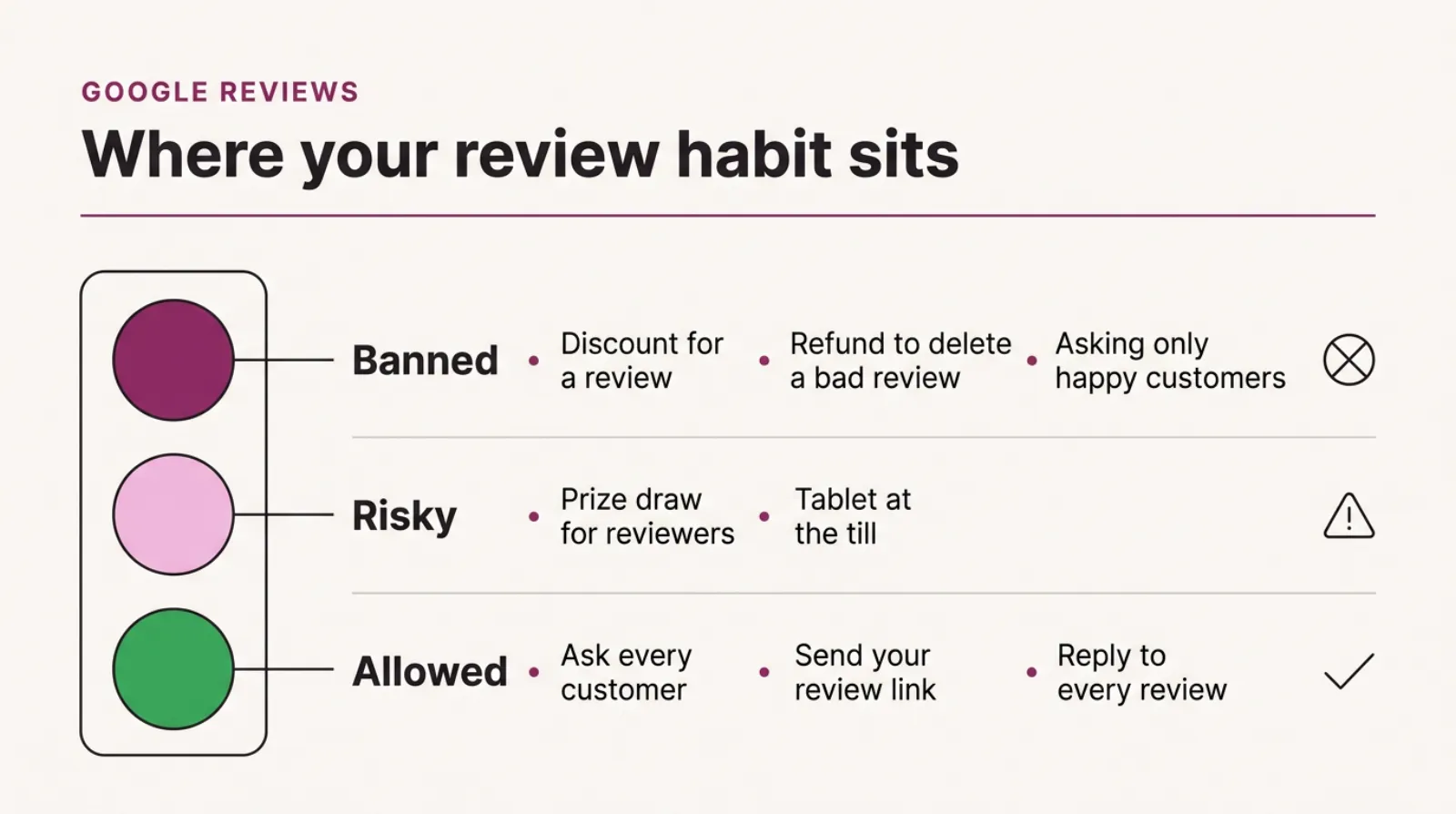
Google review habits sorted like a traffic light: banned for a discount for a review, a refund to delete a bad review and asking only happy customers; risky for a prize draw and a tablet at the till; allowed for asking every customer, sending your review link and replying to every review.
How Do You Get More Google Reviews Without Offering A Discount?
You get more reviews by asking every customer at the right moment. Send a direct link that takes them straight to the review box.
 LIVE
Live every Tuesday at 2pm UK. Bring your marketing questions.
Get your Google, local SEO and AI questions answered live.
In our experience, plenty of happy customers will review you if you make it easy. They do not need a reward. They need a reminder and ten seconds of their time.
Here is the routine we'd set up for any local business.
- Create your review link in your Google Business Profile.
- Ask every customer, not just the happy ones.
- Ask at the moment the job feels finished.
- Send the link by text or email the same day.
- Follow up once, a few days later, if they haven't reviewed.
- Reply to every review, good or bad.
Each step is simple. Together they are a habit, and habits beat discounts.
Let's go through the ones that make the biggest difference.
When Is The Best Time To Ask For A Google Review?
The best time to ask is the moment the customer feels the job is done. That is when they are most pleased and most likely to act.
For a café or a salon, it is when they are paying and chatting. For a plumber or an electrician, it is when the job's finished and the customer has seen it working.
For a solicitor or an accountant, it might be when the matter is signed off.
Ask in person if you can. Then send the link the same day, because people forget fast.
Do not wait a fortnight. By then the feeling has faded and your email gets buried.
How Do You Send Customers Straight To Your Review Box?
Use the review link from your Google Business Profile. Google's help page on reviews backs this up. It says you can ask customers to visit a Google link or scan a QR code.
As of November 2026, Google's help page gives the route. On your Business Profile, open Read reviews, then Get more reviews, and copy the link. To make a QR code, you'll need a computer browser.
Then put it everywhere a customer might see it.
- In the text or email you send after every job.
- On your invoice or receipt.
- On a small QR card by the till or in the van.
- In your email signature.
- On the thank-you page of your website.
A QR card by the till is fine. Just make sure it asks for a review and offers nothing in return. "Enjoyed your visit? We'd love a Google review" is safe. "Scan for 10% off" is not.
What Should You Say When You Ask For A Review?
Keep it short, friendly and honest. Do not ask for five stars. Do not tell them what to write.
Here's a text message that works for a trade business.
"Thanks for having us round today, Sarah. If you've got a minute, we'd really appreciate a Google review. It helps other people in the area find us. Here's the link." Send it the same day, while the job is fresh in their mind.
Here is one for a café or a salon.
"Thanks for coming in. If you enjoyed it, a quick Google review would mean a lot to a small business like ours. The link's on the card." Print it on a small card with your QR code.
And here is an email version for a professional service.
"Thank you for trusting us with your accounts this year. If you have a moment, we'd be grateful for an honest review on Google. It helps other local businesses decide whether we're right for them." Put the review link on its own line underneath.
Notice what is missing. No reward, no star rating, no suggested words.
The word honest does a lot of work. It tells the customer you want their real view. It also keeps you well inside the rules.
Can You Give Your Staff A Bonus For Getting Reviews?
Be careful here. Since April 2026, Google's policy bans asking staff to collect a set number of reviews. It also bans asking for reviews that name a staff member.
So a bonus for hitting twenty reviews a month is now a problem. So is a prize for the person named in the most reviews.
You can still make reviews part of how your team works. Train everyone to ask every customer. Put the review link on every invoice. Talk about the reviews you get in team meetings.
Reward great service, not review counts. If your team does great work and asks every customer, the reviews follow.
One more point. Staff shouldn't review the business themselves. Google's policy treats current and former employees as a conflict of interest.
And the CMA's guidance says asking a member of staff to write a review counts as commissioning one.
Can You Run A Prize Draw For Google Reviews?
We wouldn't. A monthly prize draw for everyone who leaves a review is still a reward for reviewing. Google's policy bans incentives for reviews.
Yes, the CMA's guidance says a prize draw is unlikely to count as commissioning under UK law.
But the law is not the only test. Google's own policy is stricter, and Google decides what stays on your profile.
If you want to run a competition, keep it separate from reviews. A draw for everyone who visits in December is fine. A draw for everyone who reviews you is not worth the risk.
Is It Okay To Use A Review Tool That Filters Out Bad Feedback?
No. Tools that send happy customers to Google and unhappy ones to a private form are doing review gating. Google's policy says businesses must not selectively ask for positive reviews.
The CMA's guidance makes a similar point. It says encouraging only satisfied customers to leave reviews can be cherry picking, which may mislead people.
Review tools are not the problem in themselves. Many are useful for sending links and reminders. The problem is the filter.
Check your settings. Does your tool ask for a rating before it decides where to send someone? Switch that step off. Every customer should get the same Google link.
What Should You Do About A Bad Review?
Reply to it, calmly and quickly, and try to fix the problem. Never offer a refund or a gift in exchange for deleting or changing the review.
The CMA's guidance is clear on this. It says you shouldn't make a fix depend on the customer not leaving a negative review.
You can still put things right. Offer a refund because the service wasn't good enough.
Just do not tie it to the review. If the customer chooses to update their review afterwards, that is their call.
A calm, helpful reply also shows future customers how you treat people when things go wrong. One honest reply to a bad review can win more trust than ten five-star reviews.
What Should You Do If You've Already Offered Discounts For Reviews?
Stop now, and remove anything that offers a reward for reviews. That means till cards, email templates, website pop-ups, QR cards and staff scripts.
Then fix the process going forward. Swap every reward message for a simple, honest request.
Should you delete the reviews you got through discounts? That is a judgement call, and it depends on how many there are.
You cannot delete reviews from your profile yourself, but you can ask the customers who wrote them.
What matters most is that the reward stops and the new routine is clean. If Google does remove some old reviews, a steady flow of genuine ones will rebuild your profile.
What If A Competitor Is Buying Reviews?
Report it. Anyone can flag reviews that break Google's rules. The CMA's agreement with Google also made it easier to report businesses offering incentives.
You can flag a single review from Google Maps, or report the business profile itself.
Keep a record of what you saw. A photo of a discount sign or a screenshot of an offer will do.
Then get back to your own routine. You cannot control what your competitor does. You can control how many genuine reviews you collect every week. Over a year, that wins.
Five Ways To Earn Reviews Without A Discount
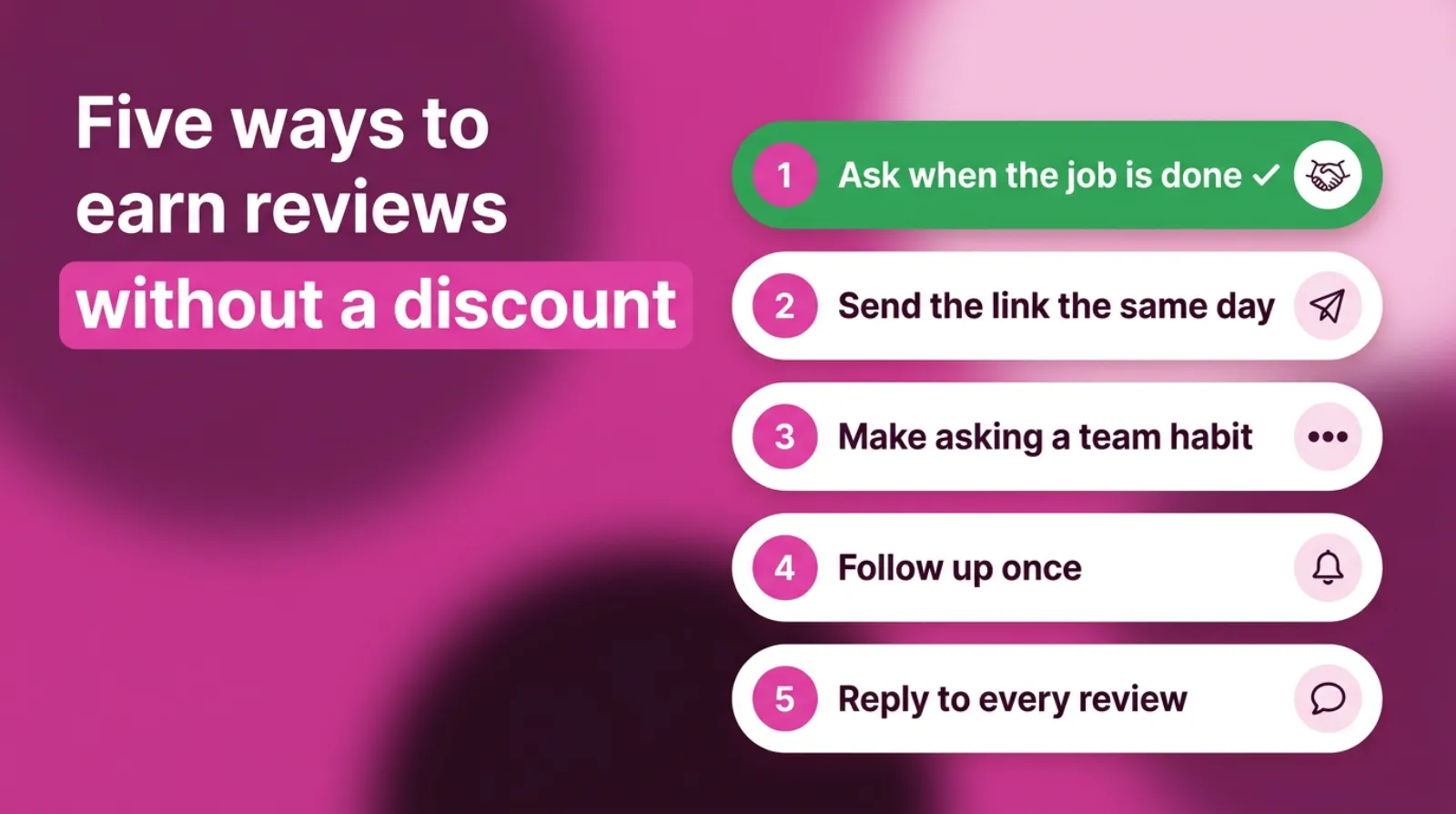
Five ways to get more Google reviews without offering a discount: ask at the moment the job is done, send the direct link the same day, make asking a team habit, follow up once, and reply to every review, with asking at the right moment highlighted as the one that makes the biggest difference.
How Many Google Reviews Does A Local Business Need?
There is no magic number. You need enough recent, genuine reviews to look trusted next to the businesses around you on the map.
Look at the three businesses that show in the map results for your main service in your town. Note how many reviews they have and how recent they are. That is your benchmark.
Then set a weekly target you can actually hit. Two or three new reviews a week adds up to about 100 to 150 in a year.
Recent reviews matter too. A profile with 40 reviews from the last six months often looks more alive.
One with 200 from five years ago can look tired. People want to know you are still good now.
Frequently asked questions
Can I offer a discount for a Google review if I do not ask for five stars?
No. Google's policy bans offering any reward in exchange for posting a review, whatever the rating. Asking for an honest review doesn't make a discount acceptable.
Can I thank customers with a discount after they leave a review?
Not if the discount is linked to the review. A thank-you reward still counts as an incentive. A loyalty discount offered to every customer, whether they review or not, is fine.
Can my friends and family leave Google reviews for my business?
Google's policy treats family and close relationships as a conflict of interest, so their reviews break the rules. Only genuine customers with no personal link to you should review your business.
Can I ask for Google reviews by text or email?
Yes. Google's help page says you can ask customers to visit a Google link or scan a QR code. Send the same link to every customer and do not attach a reward.
Is it illegal to buy Google reviews in the UK?
Almost certainly, yes. Since 6 April 2025, the Digital Markets, Competition and Consumers Act 2024 bans fake reviews and hidden rewards, and on Google even a labelled reward is likely to mislead. The CMA can fine up to 10% of global turnover.
Can I put a QR code for Google reviews on my counter?
Yes, as long as the card simply asks for a review and offers nothing in return. Do not pressure people to review you before they leave.
Will Google remove my reviews if I offered discounts in the past?
It can. Google's policy says rewarded reviews will be removed. Stop the offer now and build a steady flow of genuine reviews so your profile stays strong.
Keep Reading
If you want more reviews and a stronger map listing, these posts go further.
- Your Best Reviews Are Quietly Killing Your Conversion Rate. Here Is The Mix That Actually Sells
- Local SEO Ranking Factors Reward Proof, Not Technical Polish
- 5 Google Business Profile Tweaks That Push You Into the Local Map Pack
- How to Rank in the Google Maps 3-Pack: A Step-by-Step Guide for Local SME Owners
- 7 Local SEO Myths That Are Quietly Burying Your Google Business Profile On Page 2
We picked these because reviews are one part of a bigger job. That job is showing up on the map and winning the click.
Sources
The rules in this post come from Google's own help pages and the Competition and Markets Authority. We checked them on 10 November 2026. Rules change, so check them before you change how you ask for reviews.
- Prohibited and restricted content
- Tips to get more reviews
- Tips to improve your local ranking on Google
- CMA secures important changes from Google to tackle fake reviews
- Fake reviews
So, What Will You Say To Your Next Customer?
You do not need a discount to get Google reviews. You need a link, a habit and the nerve to ask every customer.
Take down any card or email that offers a reward. Switch off any filter that only sends happy customers to Google. Then ask everyone, at the right moment, with a short and honest message.
It is slower than a discount for the first month. After a year, it is the strongest thing on your profile, and nobody can take it away.
And if you would like help setting up a review routine that keeps your profile safe, book a call. We'll look at your Google Business Profile with you and show you where the next reviews should come from.

Written by Uzair Kharawala
Partner at SF Digital Studios, a Google Premier Partner agency. Uzair has been helping businesses grow with Google Ads since 2002 and teaches it every week on YouTube.
Get our best Google Ads tips by email
New articles and videos, straight to your inbox. Unsubscribe any time.