
Ask most people what local SEO ranking factors are, and they'll describe something technical. Code, tags, site speed and a lot of words you would need a developer to explain.
So when a local business isn't showing on Google, the owner assumes the website must be broken. They pay for an audit. They get back forty pages of red warnings.
The warnings get fixed. The business still isn't on the map.
Get your free Marketing Action PlanNot sure where to start? Answer a few questions and get your plan in about a minute. No email needed.
Get my plan →That's because the map was never judging the code. It was judging the evidence.
I've worked on local search for almost 15 years, and this is the idea I wish every owner heard first. Once you see local SEO as a matter of proof, the whole subject gets simpler. You'll also know which jobs to do and which to ignore.
What Is Local SEO?
Local SEO is the work of being shown on Google Maps and in local results when someone nearby searches for what you do. It rests mainly on your Google Business Profile, your reviews and what other websites say about you. Your website matters, but it plays a supporting part.
That mostly means the map. Search for a plumber, a café or a solicitor, and Google shows three businesses with a map above the ordinary results. Being one of the three is the prize.
What puts you there is your Google Business Profile, which is the free listing with your name, hours, photos and reviews.
So local SEO differs from the SEO people usually talk about. National SEO is a contest between websites. Local SEO is a contest between businesses.
That difference is the root of all the confusion.
What Are The Local SEO Ranking Factors Google Uses?
Google names three local SEO ranking factors: relevance, distance and prominence. As of October 2026, Google's Business Profile help page on local ranking says local results are mainly based on relevance, distance and popularity, and it explains the third under the heading prominence.
Relevance
Does this business offer what the person searched for? Google reads your categories, your services and your website to find out.
Distance
How close is the business to the person searching? You can't change this one. It explains why you show for some people and not others.
Prominence
How well known and well regarded is the business? Google looks at reviews, at mentions on other websites and at how much it can find out about you.
Read those three again. Not one of them mentions code, speed or tags. Two of the three are about evidence. Relevance is evidence of what you do. Prominence is evidence that people trust you.
Here's how each factor maps onto the proof a business can build.
| Factor | What Google means | Proof that feeds it |
|---|---|---|
| Relevance | How well your profile matches what someone searched for | The right categories, a full services list and a web page for each service |
| Distance | How far you are from the person searching | None, as you can't move, so put the effort into the other two |
| Prominence | How well known and well regarded the business is | Reviews and replies, local mentions and links from other websites |
Only one row is out of your hands, and neither of the others asks for any code.
Is Local SEO A Technical Problem?
Mostly not. For a local business, Google judges evidence far more than code. Think about Google's position. It has to recommend three electricians to a stranger, and it has never met any of them. It can't ring them up. It cannot inspect their work. It can't ask the neighbours.
All it has is evidence. What the business says about itself. What customers say. What other websites say. And whether all of it lines up.
A person choosing an electrician does exactly the same. You would ask who they are, look at their past work and check what others thought. You wouldn't ask how fast their website loads.
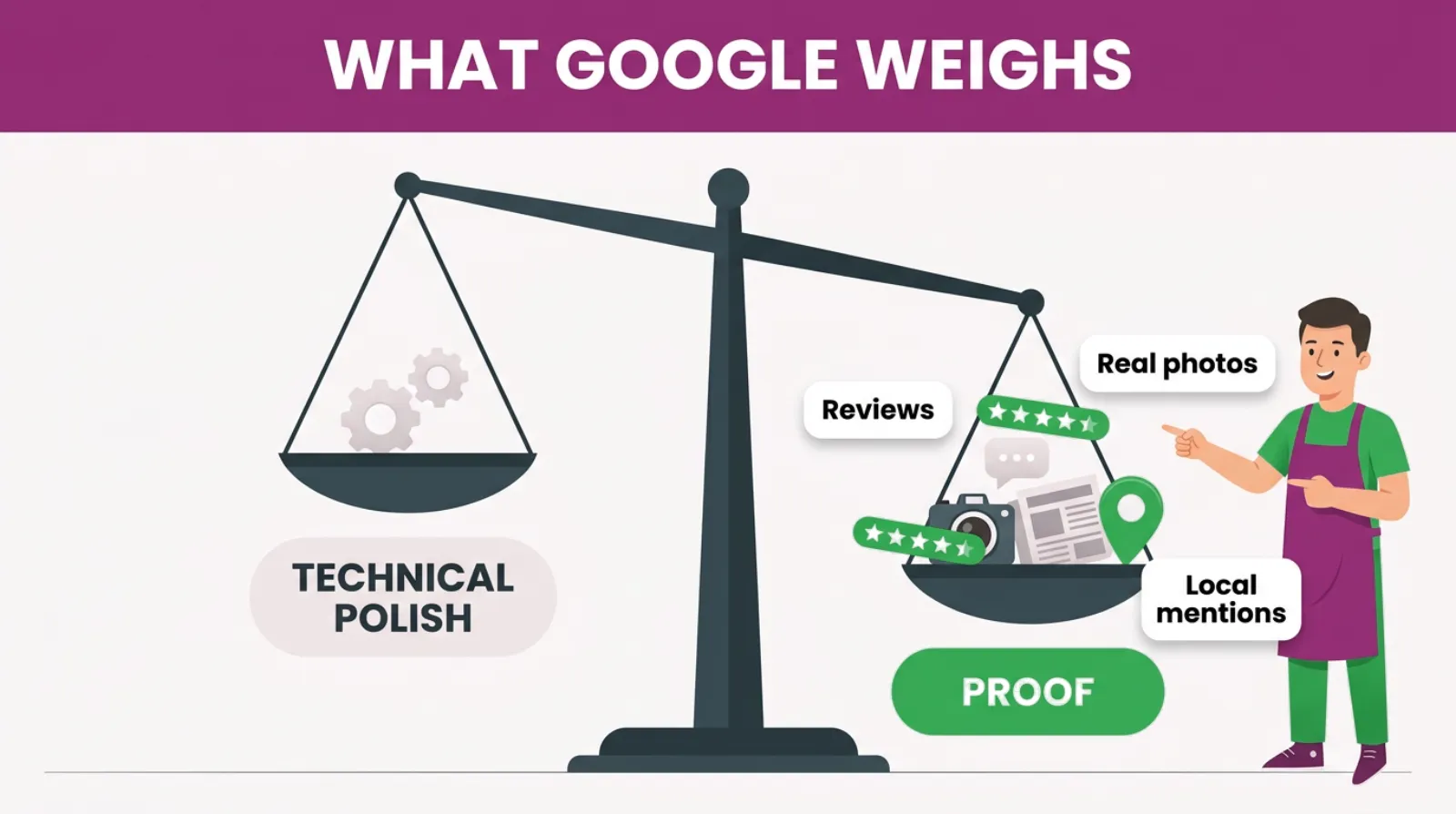
So the question to ask isn't "is my website optimised?" It is "what could a stranger find out about my business in two minutes?"
That's the question Google is asking too.
Picture Two Bakeries
Here is a way to make the idea concrete. Imagine two bakeries on the same street, and remember that this is an illustration, not a real pair of shops.
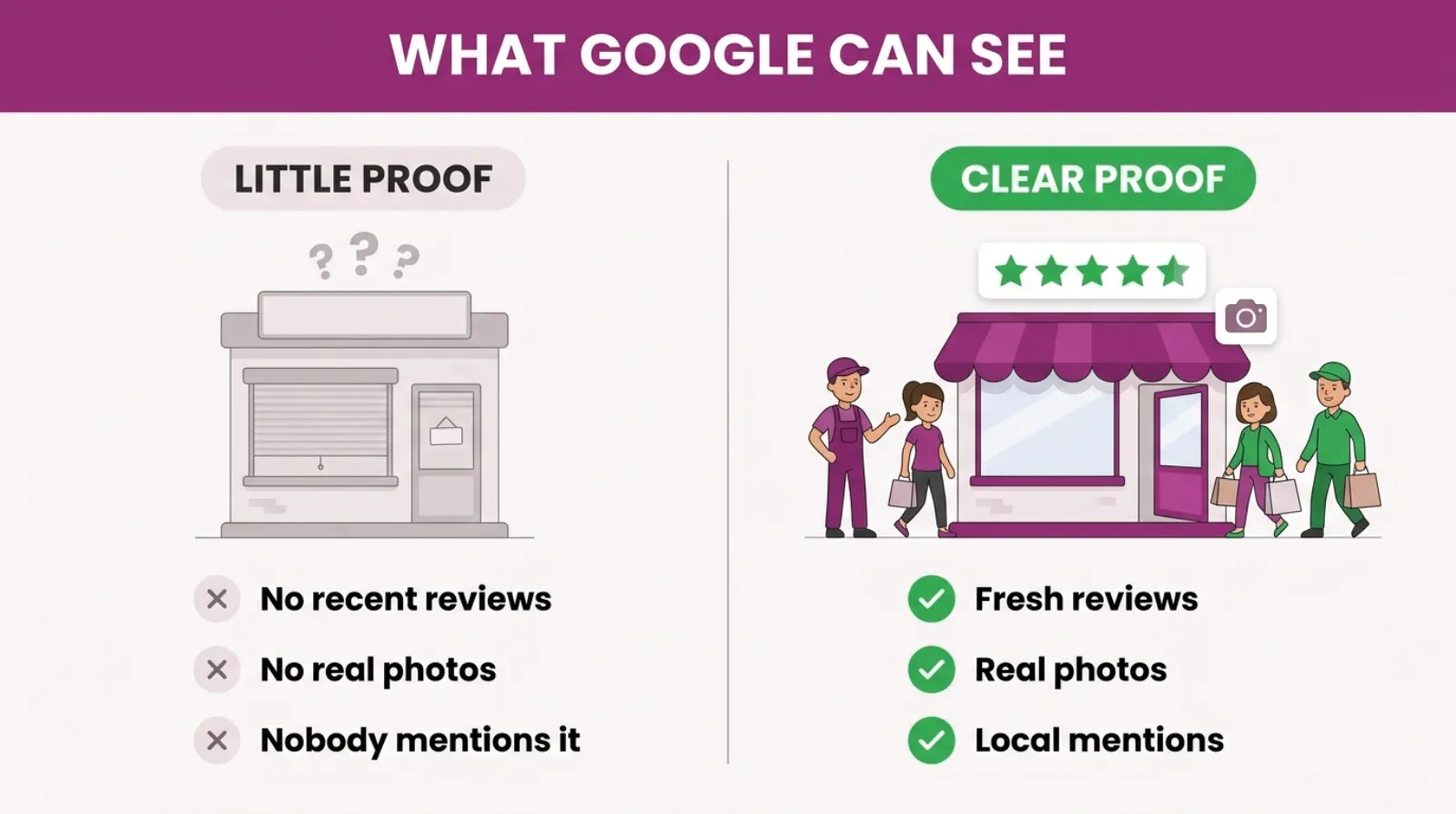
The first has a beautiful website, built last year, which loads in a blink and passes every technical test. Its Google profile has a logo, an address and eleven reviews, the newest of them two years old. There are no photos of the bread.
The second has a plain website that a relative made, and it's a little slow. Its profile has three hundred photos, many of them taken by customers, and a new review most weeks. The local paper wrote about its sourdough, and the primary school thanks it every summer for the fete.
Now put yourself in Google's place, with a stranger asking where to buy bread. You would send them to the second bakery without a moment's thought, and so does Google.
Nothing about that choice is technical. It rests entirely on what can be seen and checked.
Where Does Google Find Proof About A Local Business?
Google gathers its evidence from four places, not one. It helps to know them all.
The first source is your own Google Business Profile. Everything you enter there counts: the categories, the services, the hours, the description and the photos you upload.
The second is your customers. Their reviews, the photos they add and the questions they ask all sit on your profile, and you did not write a word of it. That's exactly why it carries weight.
The third is your website, which Google reads to confirm what the profile claims. If the profile says you fit kitchens and the website never mentions kitchens, the two disagree.
The fourth is everybody else. Directories, newspapers, clubs, suppliers and other businesses all leave traces that mention your name, your address or your number.
Local SEO is the work of making those four sources tell the same true story.
Why Does Everyone Think SEO Is Technical?
There are three reasons: SEO began as a technical craft, technical faults are easy to measure and technical work is easy to sell. First, SEO began as a technical craft. In the early days, ranking a website really was about code and links. The habits stuck.
Second, technical problems are easy to measure. A tool can scan a website in a minute and print a list of faults. Proof is harder to count, so tools don't count it.
Third, technical work is easy to sell. An audit with a score out of a hundred looks like value. "Ask your customers for reviews" does not.
None of that makes technical work useless. It makes it over-sold. On a large shopping site with ten thousand pages, technical work can decide who wins, which is why the people who write about SEO for a living spend so much time on it and so little on the things a local business needs.
What You Gain By Thinking In Proof
Once you swap the frame, four things change.
You Stop Paying For The Wrong Work
A monthly fee for "technical SEO" on a five-page website is rarely money well spent. Most of what such a site needs can be done once.
You Can Do Most Of It Yourself
Proof comes from the business. Reviews, photos and local mentions can't be made by an agency in another city. They come from you and your customers.
It Gets Harder To Copy
A competitor can copy your page titles in an afternoon. They can't copy two hundred honest reviews.
It Lasts
Technical fixes need redoing when the rules change. A reputation built over years keeps working.
What Are The Five Kinds Of Proof?
Proof splits into five kinds. Most businesses are strong on one or two and empty on the others.
- Proof that you exist. 2. Proof of what you do. 3. Proof that customers are happy. 4. Proof that the area knows you. 5. Proof that you're still active.
We will take them in turn. For each, I'll say what Google can see and what you can do about it.
Proof One, You Exist
This sounds too obvious to need saying. It's where a surprising number of businesses fall down. Google needs to be sure your business is real, and that it's where you say it is. It checks by comparing sources.
So your name, address and phone number should be the same everywhere. On your Google profile, your website, your social pages and every directory. Not nearly the same. The same.
A business listed as "Smith and Sons" in one place and "Smith & Sons Ltd" in another, with two phone numbers, looks like two businesses. Or like one that is careless.
What To Do
Verify your Google Business Profile. Pick one version of your name and one phone number. Then search for your business and fix every listing that disagrees.
It's dull work, and you only do it once. Set aside an afternoon, make a list of every place your business is mentioned online, and work through it with the correct details beside you until each entry reads the same as the last.
Proof Two, What You Do
Google cannot guess your services. If your profile says "builder" and nothing more, it has no reason to show you for "loft conversions".
This is relevance, and it's the easiest proof to add.
On Your Profile
Choose the right main category, then add the others that genuinely apply. Fill in the services section, with a line about each. Write a description that says plainly what you do and where.
On Your Website
Give each main service a page of its own. One page listing twelve services in a sentence each tells Google very little about any of them.
On each page, say what the service involves, who it's for and where you offer it. Add photos of that work.
A page for each service is the most useful piece of "SEO" most local websites are missing. And it's writing, not code.
Proof Three, Customers Are Happy
This is the proof people think of first, and it carries real weight. Reviews tell Google that real people used you and were pleased. They tell the next customer the same. Three things matter about them.
How Many
More is better, but there's no magic number. What counts is how you compare with the businesses shown beside you.
How Recent
Twenty reviews from this year say more than a hundred from five years ago. Google wants to know you are good now.
What They Say
Reviews that mention the job and the place are worth more than "great service". You can't write them for customers, but you can ask a helpful question. "Would you mind saying what we did for you?" Most people are glad of the prompt.
What To Do
Ask every happy customer, at the moment they are pleased. Send the link by text. Reply to every review. Never offer a reward, and never write your own. Fake proof is worse than none.
Proof Four, The Area Knows You
Google also looks at what the wider web says about you. A business that others mention looks more established than one nobody refers to.
For a local firm, the mentions that count are local ones.
- A listing on the council's or the chamber's business directory.
- A story in the local paper or a community website.
- A thank-you from a school, club or charity you've supported.
- A supplier or trade body that lists you as a member.
- Another local business that recommends you.
None of these is hard to get. They come from being part of the place you work in. A business that has traded honestly in one town for ten years already has most of them within reach, and usually only needs to ask the people it already knows.
Sponsor the under-nines. Give a talk. Tell the paper when you hire someone or win an award. Each one is a small, honest signal.
One mention from the local paper is worth more than fifty from directories nobody has heard of.
Proof Five, You Are Still Active
A business can have all four of the others and still slip, because nothing has changed in two years. Google wants to send people to businesses that are open and attentive. So it notices signs of life.
Recent photos. Recent reviews, with replies. Opening hours updated for the bank holiday. A post now and then about something real.
None of it takes long. A few photos a month and a reply to each review is enough.
Think of it like a shop window. You don't need to change it daily. But a display with last Christmas's decorations in March tells people something.
Do Photos Help Local SEO?
Yes, because photos are proof Google can see. Owners tend to treat them as decoration, but they're closer to evidence in a court case.
A photo of your van outside a job shows that you work where you say you do. A picture of the finished kitchen shows what you can do. A shot of the team shows there are real people behind the name.
Stock images do none of this. A handshake in a glass office could belong to anyone, and customers know it.
So take your own. They do not need to be professional. Clear, well lit and real is enough. Add a few every month, and name what each one shows.
Encourage customers to add theirs as well. A photo uploaded by a customer is proof you could not have made yourself, which is why it's worth so much.
Can A Business With No Shopfront Rank On The Map?
Yes. Google's guidelines for representing your business say a service-area business should hide its address from customers, and you list the area you serve instead. Plenty of local businesses have no premises that customers visit. Plumbers, cleaners, mobile hairdressers and dog walkers all work at the customer's address.
Proof matters even more here, because there is no shop for anyone to walk past. Reviews that mention the town, photos taken on jobs and pages on your website about the places you cover all stand in for a front door.
Be honest about the area. Listing forty towns won't make you show in forty towns. Google still leans towards where you are based, and a tight, truthful service area looks more believable than a sprawling one.
How Do You Score Your Own Proof?
Give yourself a mark out of two for each kind of proof, then add them up. It's a quick way to see where you stand.
- You exist: are your name, address and phone number identical everywhere?
- What you do: is there a category, a service entry and a web page for each main thing you offer?
- Happy customers: have you had new reviews in each of the last three months?
- The area knows you: can you name three local websites that mention you?
- Still active: have you added photos and replied to reviews this month?
Two means yes. One means partly. Zero means no.
A score of eight or more is strong. Five to seven means there's a clear gap to work on. Four or below means the map has very little to go on.
Start with your lowest score. That is where an hour of effort will do the most.
Which Technical Things Still Matter For Local SEO?
Four basics still matter: your site works on a phone, loads in reasonable time, can be read by Google and shows your details as text. I've been hard on technical SEO, so it's only fair to say so.
Your Site Must Work On A Phone
Most local searches happen on a phone. If people can't read your site or tap your number, you'll lose them.
It Must Load In A Reasonable Time
Not instantly. Just without making people wait.
Google Must Be Able To Read It
Your pages shouldn't be blocked or hidden. Any decent website builder handles this for you.
Your Details Should Be In Plain Text
Your address and phone number should be written on the page as text, not buried inside a picture. That is about it. If those four are true, your site is technically good enough for local search. Everything beyond is fine tuning.
Schema markup, which is a way of labelling your details for search engines, is a helpful extra. It won't rescue a business with no reviews.
Which SEO Jobs Can A Small Local Business Ignore?
For a typical small local business, the five jobs below can wait. It's a list most agencies will not give you.
- Chasing a perfect score on a speed test.
- Fixing every warning in an automated audit.
- Rewriting page titles every month.
- Building links from websites in other countries.
- Publishing a blog post every week for the sake of it.
Each of these has a place on a large website in a tough national market. On a ten-page site for a firm serving one town, they're a distraction.
If you're paying for any of them every month, ask what they've changed. A good provider will be able to show you.
A Simple Order Of Work
If you're starting from scratch, do it in this order.
- Verify and complete your Google Business Profile. 2. Make your name, address and phone number match everywhere. 3. Start asking every customer for a review. 4. Add real photos, and keep adding them. 5. Give each main service its own page on your website. 6. Earn three local mentions. 7. Check the four technical basics once.
Notice where the technical work sits. Last, and done once.
The first four steps cost nothing and need no outside help. Most businesses that do just those four see a difference within a few months.
How Long Does Local SEO Take To Work?
Expect small changes in the first month, visible ones by the third and a settled position by the sixth. Proof is slower than a technical fix, and that is worth knowing at the start. Changes to your profile, such as new categories or services, can show within days or weeks. They are the quickest wins available.
Reviews build at the pace you ask for them. A business that asks every customer might add four or five a month, and after half a year the difference is plain to see.
Local mentions are the slowest of all. A sponsorship, a newspaper story and a directory listing might take a few months to arrange, and longer for Google to notice.
The upside of slow is that it's hard to undo. A competitor who starts today is six months behind you.
A Monthly Routine
Proof needs a little upkeep, and it is easier with a routine. An hour a month covers it.
- Add five new photos to your profile.
- Reply to every review you have not answered.
- Check that your opening hours are right for the month ahead.
- Post one short update about something real.
- Note how many reviews you have, and how many your nearest rivals have.
Put it in the diary for the first Monday of the month. Businesses that keep this up rarely slip, because most of their competitors do it once and forget.
What Mistakes Can Undo Good Proof?
Five mistakes do the most damage: stuffing keywords into your name, buying reviews, listing places you don't serve, ignoring bad reviews and stopping.
Stuffing Keywords Into Your Name
Adding "best cheap plumber emergency" to your business name on Google breaks the rules. It can get your listing suspended.
Buying Reviews
They are often easy to spot, and Google removes them. Sometimes it removes the profile too.
Listing Places You Don't Serve
Claiming a huge service area doesn't make you appear across it. It makes you look less rooted anywhere.
Ignoring Bad Reviews
A calm reply reassures everyone who reads it. Silence looks like you don't care.
Stopping
Proof fades. A burst of effort followed by a year of nothing will not hold your place.
A Worked Example
Here's a made-up example to show the idea at work. Picture a family-run flooring shop in Aylesbury.
The owners have paid for a new website, and for a monthly technical package. The site is quick and scores well on every test. Yet the shop rarely appears on the map.
They score their proof. They exist, but the phone number on two old directories is wrong. One out of two. What they do: the profile has a single category, and the website has one page for everything. Zero.
Happy customers: thirty reviews, the newest from last year. One.
The area knows them: nothing they can find. Zero. Still active: no new photos in months. Zero. Two out of ten, with a technically perfect website.
So they change tack. They fix the directories. They add categories and write a page each for carpets, wood, vinyl and fitting. They ask every customer for a review at the till. They sponsor a local youth football team, and the club thanks them online.
Over the next few months, the reviews come in steadily and the shop begins to appear for searches it never showed for.
The website didn't change. What Google could find out about the shop did.
When Should You Pay For Local SEO Help?
Pay for help with the skilled or fiddly jobs, and do the proof yourself. Most of the rest is work only the business can do. Nobody else can ask your customers for reviews or take photos of your jobs.
Help is worth having for a few things. Writing a good set of service pages takes time and skill. Cleaning up a tangle of old listings can be fiddly. And if you want faster results, paid search can run alongside while the proof builds.
If you do hire someone, ask them one question. "What proof will my business have in six months that it doesn't have today?" Then listen carefully.
A good provider will answer with reviews, pages and mentions. A poor one will talk about scores.
Frequently asked questions
What is local SEO?
Local SEO is the work of being shown on Google Maps and in local results when people nearby search for what you do. It rests mainly on your Google Business Profile, your reviews and what the web says about you.
Does website speed matter for local SEO?
A little. A site that loads and works on a phone is enough. Beyond that, reviews, a complete profile and local mentions do far more for a local business than extra technical work.
How many Google reviews do I need?
There's no fixed number. Aim to have more recent reviews than the businesses shown beside you, and keep them arriving every month.
Do I need a schema for local SEO?
It helps a little, and it's worth adding once. It will not make up for a thin profile or a lack of reviews.
Can I do local SEO myself?
Yes, most of it. Completing your profile, asking for reviews, adding photos and earning local mentions all come from inside the business.
How long does local SEO take?
Profile changes can show within weeks. Building enough reviews and mentions to appear regularly usually takes three to six months.
Keep Reading
These five put the idea into practice.
- Leighton Buzzard Is A Small Town. That Is Exactly Why SEO Works Here
- Local SEO For Dentists: Why The Practice Down The Road Keeps Winning The Map
- 5 Google Business Profile Tweaks That Push You Into the Local Map Pack
- 6 Local SEO Fixes That Get SMEs Into the Google Maps 3-Pack Faster
- How Do I Promote My Business When I Have No Budget And A Van?
The first two show the idea in a small town and in one profession. The next two go deeper on the profile. The last is for anyone starting with nothing.
Sources
The ranking factors and the rules on service areas come from Google's own Business Profile help pages, checked in October 2026.
- Tips to improve your local ranking on Google
- Guidelines for representing your business on Google
Give Google Something To Go On
Google can't visit your business. It cannot taste the food, see the finish or meet the team.
All it can do is weigh the evidence, so the business with the clearest proof wins.
That's good news. Proof is something you already have. Happy customers, finished work and a place in your community. The job is to make it visible.
We work with local businesses across Milton Keynes, Bedford, Luton, Dunstable, Aylesbury and Northampton. Our office is on Grovebury Road in Leighton Buzzard, twenty minutes down the A4146 from Central Milton Keynes. If you'd like someone to score your proof with you and tell you honestly where the gaps are, get in touch.

Written by Uzair Kharawala
Partner at SF Digital Studios, a Google Premier Partner agency. Uzair has been helping businesses grow with Google Ads since 2002 and teaches it every week on YouTube.
Get our best Google Ads tips by email
New articles and videos, straight to your inbox. Unsubscribe any time.