
Search for a dentist on your phone and Google shows a map with three practices on it. For most people, the choice is made right there.
If your practice is one of the three, the phone rings. If it's not, most searchers will never know you exist, however good your dentistry is. Getting into those three is the whole job of local SEO for dentists.
It can feel unfair. The practice down the road isn't better than yours. It may be newer, smaller or more expensive. Yet there it is, every time.
Get your free Marketing Action PlanNot sure where to start? Answer a few questions and get your plan in about a minute. No email needed.
Get my plan →The map doesn't reward the best dentist. It rewards the practice that gives Google the clearest proof.
I've worked on local search for almost 15 years, and the gap between a practice on the map and one off it is nearly always a short list of unglamorous jobs. This guide goes through them, along with the rules a dental practice has to follow that most marketing guides never mention.
Why Does The Practice Down The Road Keep Winning?
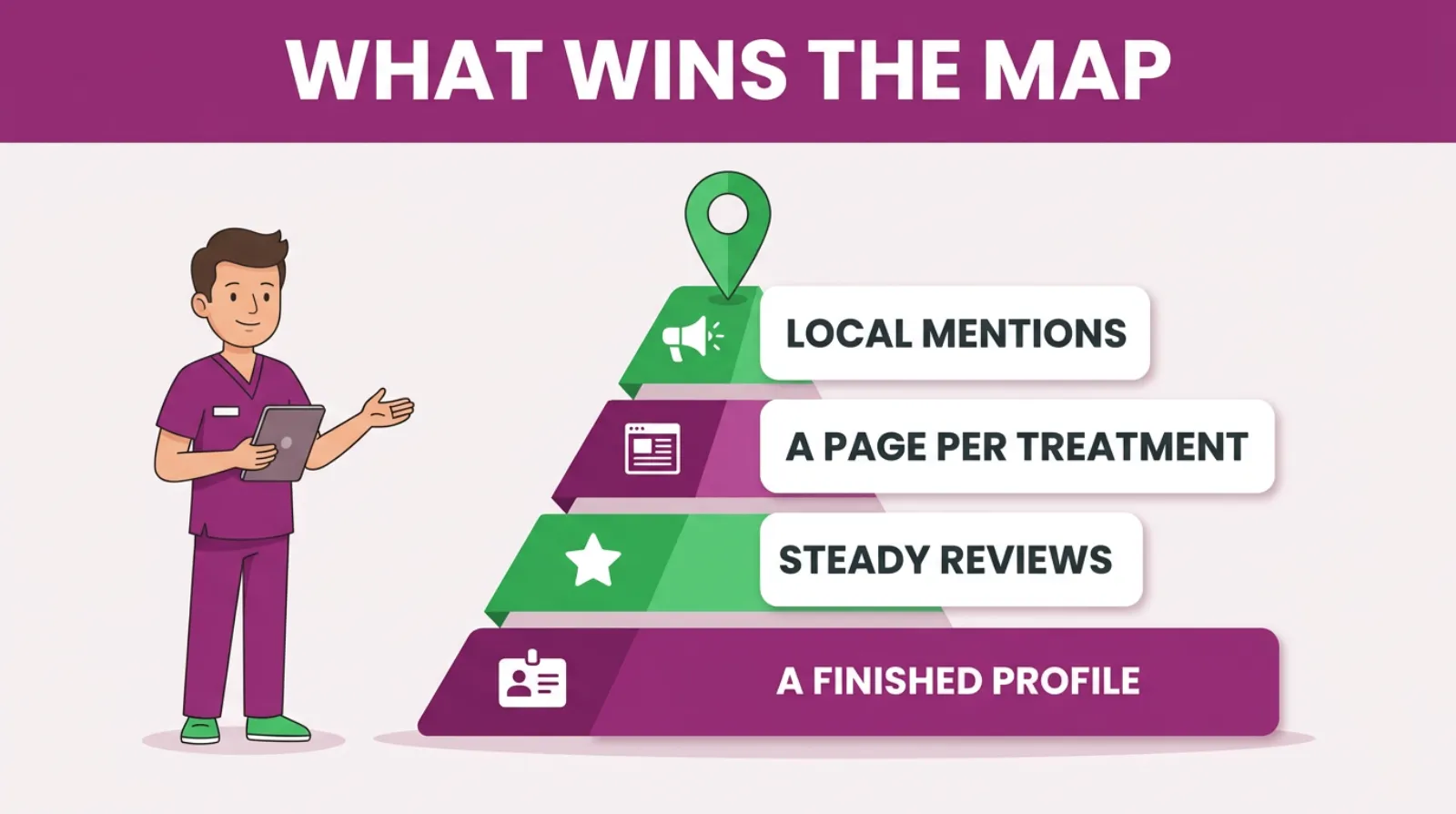
Because it gives Google more proof. Google picks the practices on the map mainly by relevance, distance and how well known they are. You can't move your building, but the practice that wins has a finished Google Business Profile, a steady flow of recent reviews, a page for each treatment and the same details everywhere.
Local SEO is the work of being shown when someone nearby searches for what you do. For a dentist, that happens in two places.
The first is the map, with its three practices. The second is the list of ordinary website results underneath.
The map matters more. It sits higher on the page, it shows your reviews and it has a button to call. Many patients never scroll past it.
What decides who appears there is your Google Business Profile. That's the free listing with your name, address, hours, photos and reviews. Your website supports it, but the profile does most of the work.
So local SEO for a dental practice is mostly three things. A complete profile. A steady flow of reviews. And a website that makes plain what you offer and where.
How Does Google Decide Which Dentists Show On The Map?
Google looks at three things, and it says so in public. As of October 2026, Google's help page on local ranking says local results are mainly based on relevance, distance and popularity. It explains the third as prominence, meaning how well known a business is, including how many reviews it has and how many websites link to it.
Relevance
Does this practice offer what the person searched for? If someone types "emergency dentist" and your profile never mentions emergencies, Google has no reason to show you.
Distance
How close is the practice to the person searching? You can't change your address, so this one is fixed. But it explains why you appear for some patients and not others a mile away.
Prominence
How well known and trusted does the practice look? Google judges that by your reviews, by mentions of you elsewhere online and by how complete your profile and website are.
You can't move your building. So the whole game is relevance and prominence. Both can be improved.
Why Does Local SEO Matter More For Dentists?
Dentistry is about as local as a business gets. People choose a dentist near home, near work or near the school run. Very few will cross a city for a check-up.
It's also a decision built on trust. Nobody wants to pick a dentist at random. So patients lean heavily on what others say, and on the map that means your star rating and your review count.
And the searches are specific. People do not only type "dentist". They type "emergency dentist", "dentist accepting new patients", "teeth whitening" and "dental implants". Each of those is a separate chance to appear, or to be missing.
Put together, that means a small number of practices take most of the new patients in any area. The ones on the map.
What The Practice Down The Road Is Doing
When one practice keeps appearing, it's rarely luck. It's usually doing five things that others aren't.
A Finished Profile
Every section is filled in. Categories, services, hours, photos, a booking link and a proper description. Half-finished profiles are common, so a finished one stands out.
Reviews Every Month
Not two hundred from three years ago. A few new ones every month, with replies. Google likes fresh evidence, and so do patients.
A Page For Each Treatment
Their website has a separate page for implants, one for whitening, one for emergencies. Each page gives Google a clear reason to show them for that search.
Real Photos
The actual building, the actual reception and the actual team. Stock photos of perfect smiles tell a patient nothing.
The Same Details Everywhere
Their name, address and phone number match on Google, on their website, on the NHS website and on every directory. Mismatches make Google less sure who you are.
None of that's clever. All of it is work that someone has to remember to do. Every month.
Side by side, here's what Google can see about each practice.
| The practice off the map | The practice on the map | |
|---|---|---|
| Profile | One category, a few old photos, services left blank | Every section filled in, all the categories that apply, recent real photos |
| Reviews | A batch from years ago, with no replies | A few new ones every month, each with a short general reply |
| Website | One page listing every treatment | A separate page for each main treatment |
| Details | Name, address or phone number differ from site to site | The same details on Google, the website, the NHS website and directories |
| What Google can tell | Not much, so it shows someone else | What the practice offers, where it is and that patients trust it |
The dentistry behind both columns could be identical. Google can only rank what it can see.
The Searches That Matter Most
Before you change anything, it helps to know which searches you're trying to appear for. Dental searches fall into four groups, and each one behaves a little differently.
The first is the general search, such as "dentist" with or without a place name. Distance matters most here. Google assumes the person wants somewhere close.
The second is the urgent search. "Emergency dentist", "toothache" and "dentist open now" all belong to it. Opening hours and the emergency category carry a lot of weight. The patient rings the first practice that looks open.
The third is the treatment search, for implants, whitening, braces or veneers. People travel further for these, and they compare more carefully. Reviews and treatment pages count for more than distance.
The fourth is the practical search. "Dentist accepting new patients", "NHS dentist" and "dentist with parking" are examples. The details on your profile answer these. Keep them accurate.
Write down the five or six searches that would bring you the patients you most want. Keep the list short. Everything else in this guide is aimed at those.
How Many Google Categories Should A Dentist Have?
Usually more than one, as long as each is true. Categories are the strongest signal on your profile, and many practices have only one.
Your main category should be Dentist. Then add the others that genuinely apply. Google offers options such as cosmetic dentist, emergency dental service, orthodontist and teeth whitening service.
Only add what you really provide. A category you cannot back up with a service on your website does more harm than good.
Check your competitors as well. Search for a treatment you offer, and look at the practices on the map. If they all list a category you've missed, that's a likely reason you aren't there.
It takes five minutes, and it's often the single change that makes the most difference. Start here.
Services, Treatments And The NHS Question
Below the categories, Google lets you list services. Fill them in properly, with a short plain description of each. Think about what a patient would type, not what the treatment is called in a textbook.
Then there's the question nearly every patient is asking. Are you taking new patients, and is it NHS or private? It comes up in almost every first phone call.
Be clear about it everywhere. On your profile, on your home page and on your contact page. If you aren't taking NHS patients, say so kindly and say what you do offer. A patient who rings to find out, and is told no, has had a poor first experience.
Keep it up to date. A profile that still says "accepting new NHS patients" from two years ago causes calls you don't want, and reviews you want even less.
If you are listed on the NHS website, check that entry too. It's a trusted source, and its details should match your own exactly.
How Do Dentists Get More Google Reviews?
Ask every patient after a good appointment, make it easy with a card or a text link, and never offer a reward. Reviews are where local SEO for dentists differs most from other businesses. They matter more, and there are firmer rules.
How To Ask
Ask at the end of an appointment that's gone well. Reception is usually the best place. A small card with a QR code works, as does a text with the link later that day.
Ask everyone, not only the patients you expect to be kind. A natural mix is more believable than a wall of perfect scores.
As of October 2026, Google's policy on prohibited and restricted content says businesses must not ask only for positive reviews, or pressure people to leave one while on the premises. So hand over the card and let them write it at home.
What You Must Not Do
Don't offer anything in return. No discount, no prize draw, no free whitening. Google's rules forbid it, and it sits badly with your professional duties as well.
Don't write reviews yourself, and don't ask staff or family to.
How To Reply
This is the part practices get wrong. A reply is public. You must never confirm that someone is a patient, or mention anything about their treatment, even if they've said it themselves.
So keep replies general. "Thank you for taking the time to leave this. We're glad to hear it." For a complaint: "We're sorry to read this. Please contact the practice manager directly so we can look into it." That's all a reply needs.
Reply to every review, and say nothing that identifies anyone. That keeps you on the right side of your duty of confidentiality.
What Dentists Can And Cannot Say
Dental advertising is regulated, and a profile or a web page counts as advertising. It is worth knowing the main points before you write anything.
The General Dental Council publishes guidance on advertising. In short, what you say must be accurate and must not mislead. As of October 2026, the GDC's guidance says anything carrying your name must include your GDC registration number, and practice publicity must make clear whether you're NHS, mixed or wholly private.
Take care with titles. The word "specialist" should only be used by someone on one of the GDC's specialist lists. A dentist with a strong interest in implants isn't a specialist in implants unless they're on the list.
Be careful with treatments that involve prescription-only medicines. These can't be advertised to the public, and that includes some facial treatments many practices offer. Describe a consultation, not the product.
And avoid promises. "Pain-free", "guaranteed" and "the best dentist in town" are all claims you would struggle to prove.
I'm not a regulator, so check the current GDC and Advertising Standards Authority guidance yourself. But these rules are another reason to write your own profile honestly. The practices that win the map over time are the ones that never have to take anything down.
Should Each Dentist Have Their Own Google Listing?
Usually not. Google does allow individual practitioners their own listings, separate from the practice, but for most practices one strong profile works better. Some may already exist for dentists who work with you. Google creates them, and so do dentists.
They can be useful for a well-known clinician with a following of their own. More often they cause confusion. Reviews meant for the practice end up on a personal listing that nobody looks after.
Decide on a policy. Then stick to it. For most practices it's simplest to put the effort into the main profile and ask patients to review the practice. If a dentist leaves, their listing should be updated or marked as moved, so it stops sending patients to your door for someone who is no longer there.
Questions, Posts And The Booking Link
Three smaller parts of the profile are often left empty, and each one gives a practice a small edge.
The first is the booking link. If you take bookings online, add the link. A patient can then book straight from the map. Every extra step loses a few people.
The second is posts. These are short updates that appear on your profile, a little like a noticeboard. Use them for real news, such as new opening hours, a new member of the team or appointments available this week. One a fortnight is enough to show the practice is active.
The third is the description. You have a few hundred words to say who you are, what you offer and who you are best suited to. Write it for a nervous patient reading on a phone, and leave out anything that reads like an advert.
What Photos Should A Dental Practice Put On Google?
Real, recent photos of the building, the reception, a treatment room and the team. Many people are nervous about the dentist, and a photo that shows them what to expect does a lot to calm that.
Add pictures of the outside of the building, so people can find it. Then the reception, a treatment room and the team. Smiling, real, and taken recently.
Add parking and access too. If there's a step-free entrance or parking at the back, show it. Those are the details that decide between two practices.
Get consent from any member of staff who appears, and never show a patient without written permission. Before-and-after pictures of treatment need particular care, with clear written consent for that exact use.
Add a few new photos each month. Google notices an active profile, and so do the people looking at it. It's a small job. Put it in the diary.
What Does A Dental Website Need For Local SEO?
A page for each treatment, your address on every page, a site that works on a phone and a page showing who works there. The profile gets you on the map. The website helps Google trust what the profile says.
One Page For Each Treatment
A single "treatments" page with a paragraph on each isn't enough. Give implants, whitening, hygiene, emergencies and orthodontics a page each. Say what it involves, who it's for and roughly what it costs.
Say Where You Are
Put your full address and phone number on every page, in the footer. Mention the areas your patients come from in a natural way.
Make It Work On A Phone
Most dental searches happen on a phone. The number should be tappable, the booking button easy to find and the pages quick to load.
Show Who Works There
A team page with names, roles and registration numbers. It's required, it builds trust, and it helps Google understand that this is a real practice.
How Should A Group With Several Practices Handle Local SEO?
Treat every site as its own business online. Groups with several sites often make one mistake. They treat the whole group as one.
Each site needs its own Google Business Profile, with its own address, phone number and hours. Each needs its own page on the website, with its own team, photos and directions.
Don't copy the same text across every location page. Write something true about each one. The car park, the bus stop, the school it's next to.
And ask for reviews at each site separately. A review left on the wrong profile helps the wrong practice.
Getting Known Locally
Prominence comes partly from other websites mentioning you. For a dental practice, there are plenty of honest ways to earn that.
Sponsor a school event or a junior sports team. Offer a talk on children's teeth to a local nursery. Support a charity run. When they thank you online, that's a local mention.
Tell the local paper when something happens. A new dentist joining, new equipment or a milestone year. Local news sites are always looking for stories.
Keep your entries on the main directories and on the NHS website accurate. They are not exciting, but they're trusted.
Local mentions build slowly, and that is the point. A practice that has supported the same primary school for five years, appears in the parish newsletter every spring and is listed by the local business group has a standing online that a newer competitor cannot buy in a month, however much it spends. Start now. It only gets stronger.
None of this is a trick. Far from it. It's being part of the place you work in, and letting that show online.
What Mistakes Keep A Dental Practice Off The Map?
Five come up again and again. A stuffed business name, old opening hours, ignored bad reviews, old listings left live and treating it as a one-off job.
Stuffing The Name
Adding "dentist implants whitening emergency" to your business name on Google. It's against Google's rules, and it can get a profile suspended.
Old Opening Hours
Nothing loses trust faster than a patient arriving at a closed door. Update hours for bank holidays and Christmas.
Ignoring Bad Reviews
A calm, general reply to a complaint reassures everyone who reads it. Silence does not.
Leaving Old Listings Live
A dentist who left three years ago may still have a listing at your address. So might a previous practice name. Tidy them up.
Doing It Once
A profile set up in an afternoon and never touched again slowly slips. The practice down the road is doing a little every month.
Answer The Phone
All of this work leads to one moment, which is a new patient ringing the practice. It's worth being honest about what happens next.
In a busy practice, the phone is often answered late or not at all. Reception is busy with the patient in front of them. The line is engaged. Or it's lunchtime. The person calling doesn't leave a message. They go back to the map and ring the next practice.
So look at your missed calls for a week. The number may surprise you. Most phone systems can tell you how many there were and when. If a large share of new enquiries go unanswered, more visibility on Google will not help until that's fixed.
It helps to give one person the job of ringing back every missed call before the end of the same morning or afternoon, with a simple tick sheet so that nothing is forgotten. A call-back within the hour rescues many of them. So does an online booking link, for people who would sooner not ring at all.
Does A Dental Practice Need An Agency For Local SEO?
Not for most of it. Most of what is in this guide can be done by the practice team, and I would always suggest starting there. Nobody outside knows your patients, your building or your dentists as well as you do.
There are parts where outside help earns its fee. Writing a full set of treatment pages takes time and care. The advertising rules make it harder still. Sorting out duplicate and outdated listings can be fiddly. And if you add Google Ads, running them well is a skill of its own.
If you do bring someone in, ask to see the work, not only the report. You should be able to look at your profile and your website and see what has changed. And keep the logins in the practice's name. Everything you build should stay yours.
A 90-Day Plan For The Practice Team
You don't need an agency for most of this. A practice manager and a keen receptionist can do it.
Month One, The Foundations
Complete every section of the Google Business Profile. Fix the categories. Check your name, address and phone number match on your website, the NHS website and the main directories. Add twenty real photos.
Month Two, Reviews And Pages
Start asking for reviews at reception, every day. Reply to all of them, old and new. Begin writing a page for each main treatment, one a week.
Month Three, Local Mentions
Arrange one local sponsorship or talk. Send one story to the local paper. Post an update on your profile every fortnight.
Then keep going. Month four looks like month three. The practices that hold the map are the ones that never really stop.
How Do You Know If Local SEO Is Working?
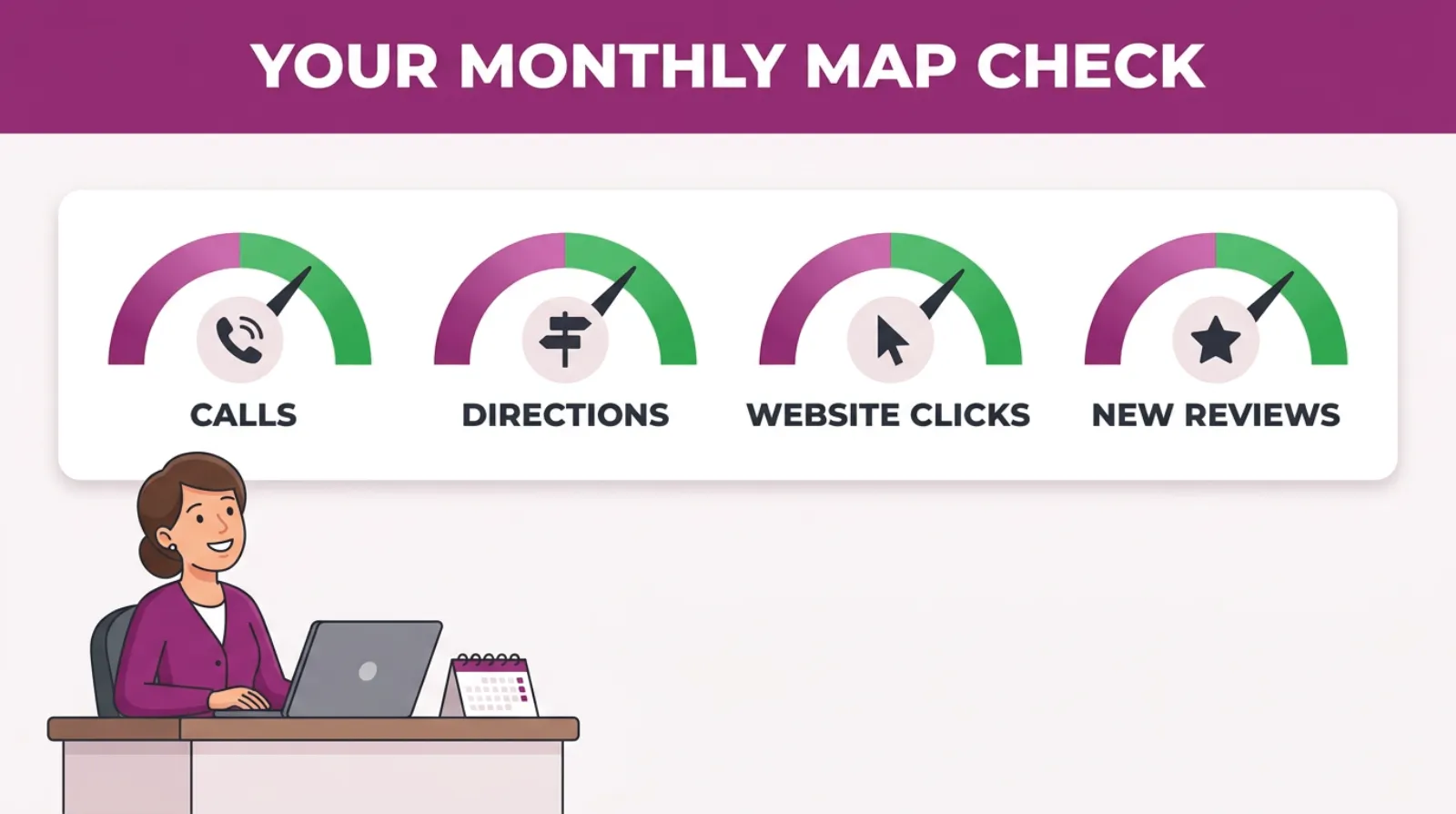
Your profile tells you. It has a performance section showing how many people found you, how many called and how many asked for directions.
Look at it on the first of each month, and write four numbers down.
- Calls
- Direction requests
- Website clicks
- New reviews
Then search for yourself. Use a private window, and try the searches that matter. "Dentist", "emergency dentist", "teeth whitening". Remember that results change with where you're standing, so try it from home as well as from the practice.
Ask new patients how they found you, and note it on their record. One question is enough. After three months, you'll have a clear picture.
A Worked Example
Here is a made-up example to show how it fits together. Picture a three-surgery private practice in Bletchley.
It has a good reputation, and forty Google reviews, mostly from several years ago. The profile has one category and six photos. The website has a single treatments page.
In the first month, the manager adds four more categories that genuinely apply, fills in the services and uploads photos of the building, the team and the car park.
In the second, reception starts handing every patient a card with a QR code. Reviews begin arriving at four or five a week. Each gets a short, general reply.
Over the same weeks, the website gains a page for implants, one for whitening, one for emergencies and one for nervous patients.
By the end of the third month, the practice is appearing on the map for treatment searches it never showed for before. Nothing about the dentistry changed.
All that changed is that Google can now see what the patients already knew.
When Should A Dental Practice Add Google Ads?
When it needs patients faster than local SEO can bring them, or wants more of one high-value treatment. Local SEO is free, and it builds over time. Sometimes a practice needs patients sooner than that.
Google Ads can put you at the top of the page today, for exactly the treatments you choose. It suits high-value work such as implants and orthodontics, and urgent searches such as emergency appointments.
It works best on top of the foundations above. An advert that leads to a practice with strong reviews and a clear page for that treatment will always do better than one that doesn't.
So do the free work first. Always. Then add paid advertising for the treatments where one new patient is worth the most.
Frequently asked questions
What is local SEO for dentists?
It's the work of getting a dental practice shown on Google Maps and in local results when nearby people search for a dentist or a treatment. It centres on the Google Business Profile, reviews and a clear website.
Why is my dental practice not showing on Google Maps?
Usually for one of three reasons. The profile is incomplete or has the wrong categories, there are too few recent reviews, or the person searching is closer to other practices.
Can dentists ask patients for Google reviews?
Yes. You can ask any patient for an honest review. You mustn't offer a reward for one, and your replies must never confirm that someone is a patient or mention their treatment.
Which Google Business Profile category should a dentist use?
Dentist as the main category. Then add any others that genuinely apply, such as cosmetic dentist, emergency dental service or orthodontist.
How long does local SEO take for a dental practice?
Profile changes can show within weeks. Building reviews and treatment pages to the point where you appear regularly usually takes three to six months.
Do I need a separate profile for each practice?
Yes. Each location needs its own Google Business Profile and its own page on your website, with its own address, phone number and team.
Keep Reading
These five go deeper on the map and on paid search for dental practices.
- 5 Google Business Profile Tweaks That Push You Into the Local Map Pack
- 6 Local SEO Fixes That Get SMEs Into the Google Maps 3-Pack Faster
- Leighton Buzzard Is A Small Town. That Is Exactly Why SEO Works Here
- 10 Amazing Google Ads Tips To Help Your Dental Marketing Strategy
- Dental Marketing Tips To Attract New Patients Using Google Ads
The first three cover the profile and local search in more depth. The last two are for when you're ready to add Google Ads.
Sources
The facts on Google's local ranking, its review rules and the GDC's advertising guidance come from these official pages, checked in October 2026.
The Map Rewards Proof
The practice down the road is not winning because its dentistry is better. It's winning because it has given Google more to go on.
A finished profile, a steady flow of honest reviews and a clear page for each treatment. That's most of it.
None of it needs a big budget. It needs someone in the practice to own it, and to do a little every week.
We work with practices and local businesses across Milton Keynes, Bedford, Luton, Dunstable, Aylesbury and Northampton. Our office is on Grovebury Road in Leighton Buzzard, twenty minutes down the A4146 from Central Milton Keynes. If you'd like someone to look at your profile and tell you honestly what's missing, get in touch.

Written by Uzair Kharawala
Partner at SF Digital Studios, a Google Premier Partner agency. Uzair has been helping businesses grow with Google Ads since 2002 and teaches it every week on YouTube.
Get our best Google Ads tips by email
New articles and videos, straight to your inbox. Unsubscribe any time.