
A lot of marketing advice starts in the wrong place. It assumes you have a budget, a website, an email list and a spare afternoon every week.
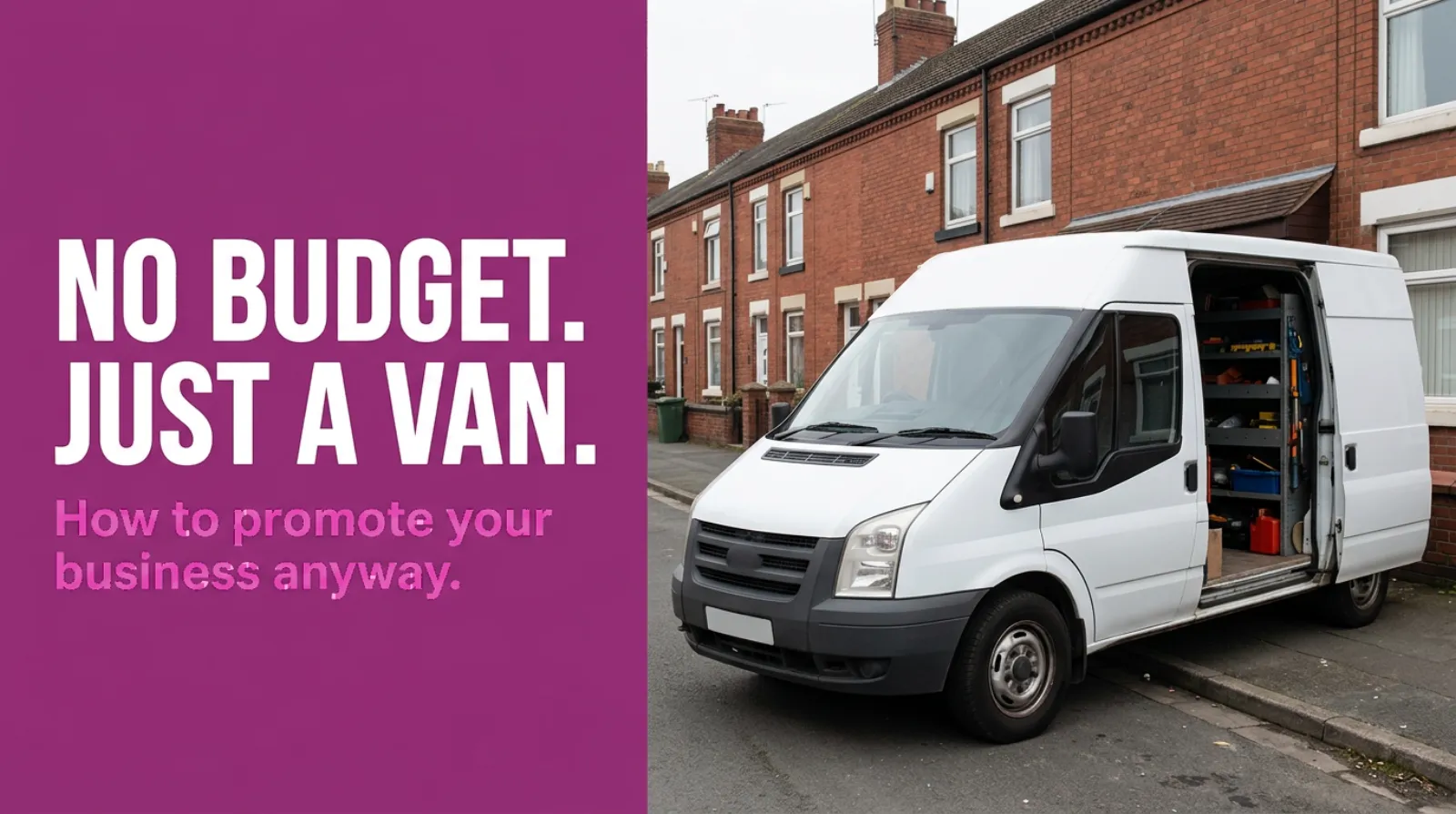
Most people who work from a van have none of those. They have a phone, a set of tools and a diary that's either too full or too empty.
The good news is that you already own most of what you need. A van that's seen by hundreds of people a day. Finished jobs. Customers who are pleased with your work. Neighbours who watched you do it.
Get your free Marketing Action PlanNot sure where to start? Answer a few questions and get your plan in about a minute. No email needed.
Get my plan →The trick is not finding money for marketing. It's using what you already have, in the right order.
I have spent almost 15 years helping local businesses win customers, and the trades that grow fastest often start exactly here. This guide puts the free things in order, and ends with a 30-day plan you can follow between jobs.
What Promoting A Business Really Means
Promoting a business sounds like something that needs a campaign. For a local trade, it's much simpler than that.
It means three things. People nearby know you exist. They can see you are good. And they can reach you easily when they need you.
That's it. Everything in this guide does one of those three jobs.
A van with a clear phone number does the first. A row of five-star reviews does the second. A Google listing with the right number and opening hours does the third.
None of them costs anything beyond a bit of time.
Why Free Works So Well For A Local Trade
Big companies have to pay to reach people, because their customers could be anywhere. You have an advantage they would love to have. Your next customer is probably within a few streets of your last one.
Think about how people choose a tradesperson. They ask a neighbour. They look at who's working on the house opposite. They search on their phone and pick someone with good reviews who is close by.
Every one of those is free to appear in. A recommendation costs nothing. Being seen outside a job costs nothing. A Google listing costs nothing.
Trust travels down a street faster than any advert. One good job, done where people can see it, is the best marketing most trades will ever have.
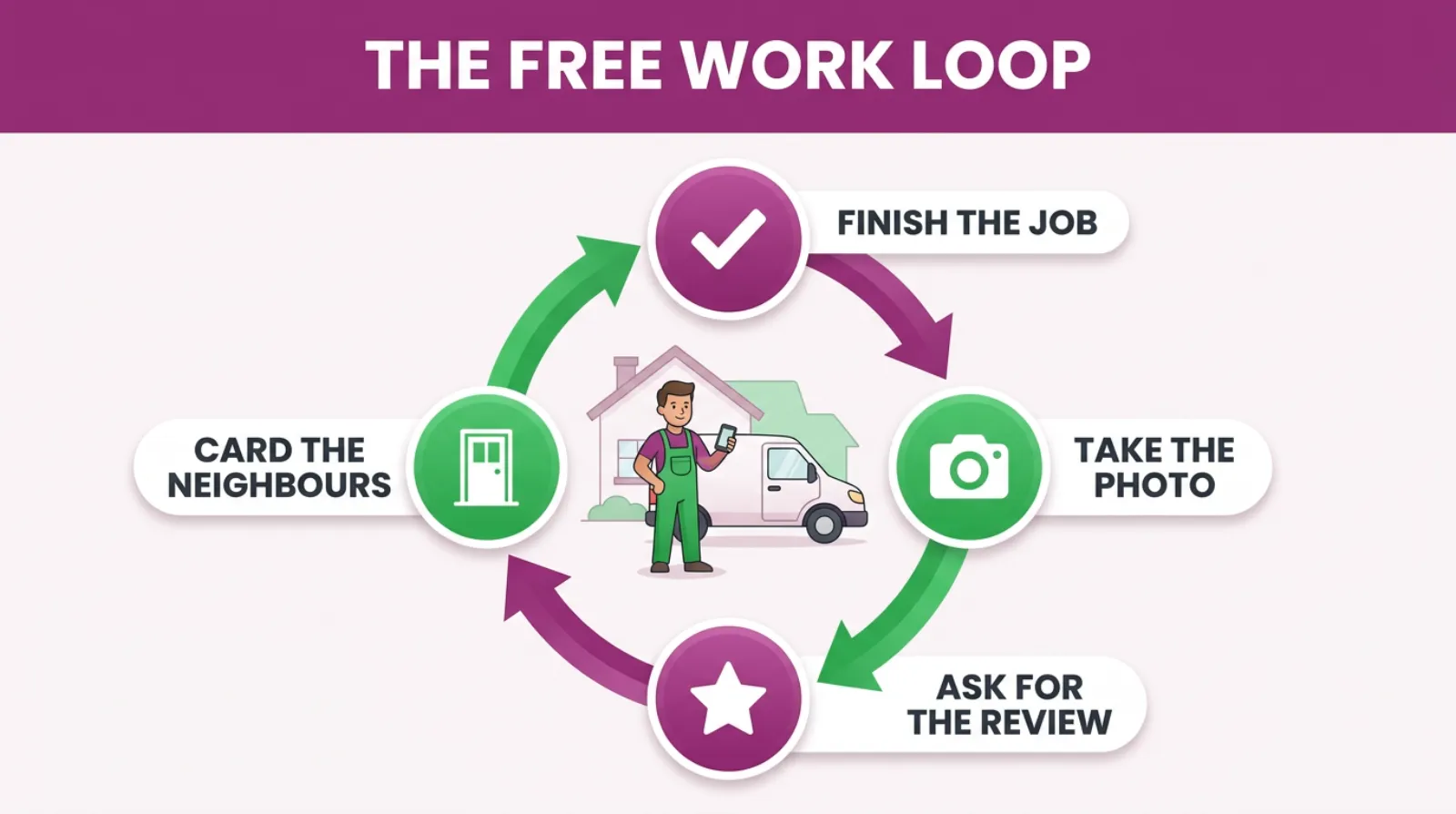
So the plan is to make sure each job leads to the next one.
What You Already Own
Before you do anything new, it helps to see what you've already got. Most trades are sitting on six things they do not think of as marketing.
Your Van
It's parked outside a customer's house all day and outside yours all night. It sits in traffic and in supermarket car parks. People look at it.
Your Finished Jobs
Every job you finish is proof that you can do the next one. Most tradespeople never take a photo.
Your Happy Customers
They would recommend you if asked. Hardly anyone asks.
The Neighbours
For the days you're on site, the whole street knows a tradesperson is at number twelve. Many of them have the same house and the same problem.
Your Phone
It takes photos, sends a review link and answers enquiries. It's the only marketing tool you need.
Your Name
In a small area, a name people recognise is worth a great deal. You build it by showing up the same way every time.
Step One, Make Your Van Work
If your van is plain white, you're driving round with a blank billboard. Fixing that is the single most useful thing you can do.
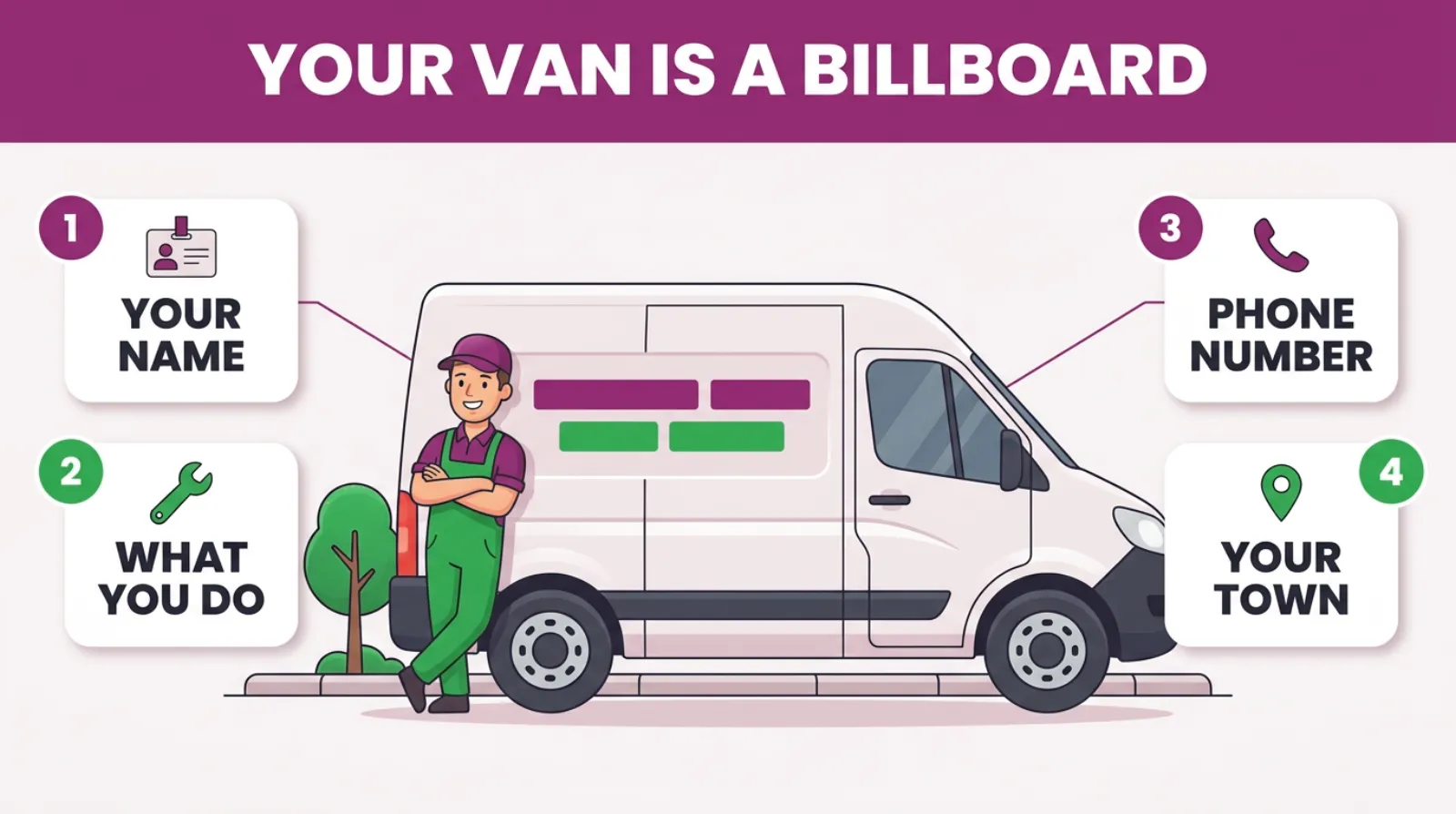
You do not need a full wrap. You need four things, big enough to read from across a road.
- Your business name.
- What you do, in two or three words.
- Your phone number.
- The town or area you work in.
That's all. Leave off the list of fifteen services, the email address and the social media logos. Nobody reads them at thirty miles an hour.
Put the number on the back as well as the sides. The person stuck behind you at the lights has nothing else to look at.
Magnetic signs are a fair start if money is tight. Cut vinyl lettering lasts longer, and it's one of the few things in this guide worth paying a little for when you can.
Then keep the van clean and park it where it can be seen. A tidy van outside a job tells the whole street something about how you work.
Step Two, Claim Your Free Google Listing
When someone searches for a plumber or an electrician on their phone, Google shows a map with a few local businesses. Being on that map is free.
It is called a Google Business Profile. If you've never set one up, do it this week. If you have one and have not looked at it for a year, look at it tonight.
Get these right.
- Your name, exactly as it's on the van.
- The right main category for your trade.
- The area you cover, kept honest. A few towns, not five counties.
- Your phone number and opening hours.
- Photos of real jobs.
You don't need an address on show if you work from home. You can hide it and list the area you serve instead.
Then add a photo or two every week. A profile with fresh pictures of real work looks alive. One with a single logo from three years ago does not.
Step Three, Ask For The Review
Reviews do two jobs. They help Google show you more often, and they help the customer choose you over the name next to yours.
Most tradespeople have far fewer reviews than they deserve, for one reason. They don't ask.
Here is a way that works without feeling awkward.
Ask in person, at the end of the job, when the customer is pleased. Something as plain as "would you mind leaving me a quick review on Google? It really helps." Most people say yes.
Then send the link by text before you drive away. Google gives every business a short link that opens the review box directly. Save it in your phone so it's always one tap away.
Reply to every review, even with a single line. It shows the next reader that there is a real person behind the name.
One review a week is enough. In a year that's fifty, which is more than most of the firms you are up against.
Step Four, Photograph Every Job
A before-and-after photo is the most convincing thing you can show a new customer. It costs nothing, and it takes ten seconds.
Make it a habit. One photo before you start. One when you finish. Wipe the lens first, and stand in the same spot both times.
Those photos have four uses.
- On your Google profile, where new customers look.
- In a text or message when someone asks for a quote.
- On the local community groups, where it's allowed.
- On a simple website, if you ever build one.
Ask before you photograph inside someone's home, and keep anything personal out of the shot. Most customers are happy to say yes.
After six months you will have a library of real work. That's something a new competitor can't copy.
Step Five, Use The Street You're On
This is the step that separates busy trades from quiet ones. When you are working on a street, you're the most visible tradesperson for a quarter of a mile. Use it.
Put A Board Outside
A simple board at the front of the property, with your name, trade and number. Ask the customer first. Most say yes, and it works all day while you are inside.
Leave A Card With The Neighbours
Knock on the doors either side and across the road, or post a card. Keep the message short. "We're working at number twelve this week. Sorry for any noise. If you need anything doing, here is my number."
It's polite, which neighbours appreciate. And it puts your name in the hands of people with the same kind of house.
Say Hello
If a neighbour stops to look, talk to them. People like to hire someone they've met.
The neighbours of a finished job are the warmest leads you will ever get. They've seen your van, your work and how you treat the place.
Step Six, Ask For The Referral
Reviews reach strangers. Referrals reach friends, and friends are easier to win.
At the end of a job, once the review's sorted, add one more line. "If you know anyone who needs this kind of work, I would be grateful if you passed my number on." Then leave it there.
Leave two cards, not one. One for the customer, one to give away.
Then say thank you when a referral comes in. A text, a card or a small discount on their next job. People who feel thanked refer again.
It's also worth getting to know two or three trades whose work sits next to yours. A plasterer and a decorator. A plumber and a tiler. A builder and an electrician. You'll each be asked for a name every week, so it may as well be each other's.
Old Customers Are The Easiest New Work
Before you look for new customers, look at the ones you have already served. They know you, they trust you, and most of them have not heard from you since the day you left.
Go back through your phone or your invoices and make a list of everyone you have worked for in the last two or three years. Then send each of them one short, friendly message. Nothing clever is needed. "Hello, it's Sam the electrician. Just letting you know I've got some space over the next few weeks if there's anything you need doing."
A surprising number will reply. Some have a job they have been putting off. Others know somebody who needs you.
Do this once or twice a year, and time it for the weeks before your quiet season. It takes an evening, it costs nothing, and it reaches the warmest audience you will ever have.
What To Say When You Ask
Most tradespeople skip the asking because they do not know what to say, and they worry it will sound like begging. It will not. Customers who are pleased with a job are usually glad to help, and they simply need a small nudge.
Keep the words plain and say them at the right moment, which is when the customer has just seen the finished work and said something nice about it.
- For a review: "I'm really glad you're happy with it. Would you mind leaving me a quick review on Google? I'll text you the link now."
- For a referral: "If you hear of anyone who needs this kind of work, I'd be grateful if you gave them my number."
- For a board: "Would you mind if I put my board at the front while I'm here? It comes down the day I finish."
Say them out loud a few times in the van until they stop feeling strange. After a fortnight you won't think about it at all.
Step Seven, Show Up In Local Groups
Most areas have community groups online, where neighbours ask each other for recommendations. "Can anyone recommend a good roofer?" appears in them every week.
You can't control what people say there. But you can make it easy for them to mention you.
Join the groups for the places you work, under your own name. Read the rules, because many do not allow adverts. Be useful. Answer a question now and then without selling.
When someone asks for your trade, a happy customer tagging you is worth ten adverts. So when you ask for a review, mention the group too. "If anyone asks on the village page, I'd appreciate a mention."
Do not post your number under every request. It looks pushy, and it can get you removed.
Step Eight, Answer And Follow Up
This one isn't glamorous, and it wins more work than anything above.
A lot of trades lose jobs they would already won, simply by being slow. The customer rang three people. One rang back within the hour. That one got the job.
So set yourself two rules.
Ring back the same day, every time. If you can't talk, send a text saying when you will call.
Chase every quote once. Three days after you've sent it, send a short message. "Just checking you got the quote, and whether you have any questions." A good share of quotes that go quiet come back to life with one message.
Neither costs a penny. Both make you look more reliable than most of the firms you're quoting against.
Look The Same Every Time
People in a small area recognise patterns. If they see the same name on the van, on the board, on the card and on the shirt, it starts to feel like a business they already know, even before they have needed it.
You do not need a logo designed by an agency. You need one name, one colour and one phone number, used everywhere without exception. A plain polo shirt with your name on the chest costs very little and does a lot of quiet work on a doorstep.
How you leave a job is part of this too. Dust sheets down, boots off at the door, rubbish taken away and the customer shown what was done. None of it's marketing in the usual sense, and all of it is what people mention when they recommend you.
A recommendation is only ever a description of how you behaved. Give people something good to describe.
What To Do In The Quiet Weeks
Every trade has slow spells. Roofers in a dry summer, heating engineers in July, gardeners in January. The mistake is to sit and wait for the phone.
A quiet week is when the free marketing gets done properly. Use the time for the things there is never time for when you are flat out.
- Message your past customers, as described above.
- Add twenty photos to your Google profile, with a line about each job.
- Reply to every review you have not answered.
- Call in on the trades you share work with.
- Chase every quote from the last two months that went quiet.
- Walk the streets around your last three jobs and post a card through each door.
One quiet week spent like this often fills the two that follow. It also means the slow spell is shorter next year, because the reviews and photos you added keep working after you're busy again.
The Few Things Worth Paying A Little For
This guide is about promoting a business with no budget, and nearly everything in it is free. There are four small costs that are worth meeting as soon as you can, because they make the free things work much harder.
Van lettering comes first. It is a single payment, and it is seen every day for years.
A site board comes second. One board, used on every job, pays for itself the first time a neighbour rings.
A box of printed cards comes third. Keep them plain, with your name, trade, number and town.
A proper email address comes fourth. One that ends in your business name looks more settled than a free one, and it costs a few pounds a month.
Everything else can wait. A website, paid adverts and a logo all have their place, and none of them is where a one-person trade with no budget should start.
How To Tell It Is Working
You'll not need a spreadsheet for this. You need one question and somewhere to write the answer.
Ask every new customer how they found you, and note it in your phone the same day. "Saw the van." "Next door had you in." "Found you on Google." "My sister gave me your number." Four words is plenty.
After a month, read back through the list. You will see quickly which of the steps above is bringing in the most work, and that tells you where to put more effort.
Watch two other things as well. Count your Google reviews on the first of each month, and write the number down. And notice how often a new customer says they have seen you around. When that starts happening, the van and the board are doing their job.
Your 30-Day Plan
That is a lot to take in, so here it's in order. Do one week at a time.
Week One, The Van And The Listing
Get your name, trade, number and town on the van. Set up or tidy your Google Business Profile. Save your review link in your phone.
Week Two, Reviews And Photos
Ask every customer this week for a review. Text five past customers who were happy and ask them too. Take a before and after photo on every job, and add them to your profile.
Week Three, The Street
Get a board made, or make one. Print a small stack of cards. On every job, speak to or card the neighbours on both sides and opposite.
Week Four, Referrals And Follow-Up
Add the referral line to the end of every job. Ring two trades you trust and agree to pass work to each other. Chase every open quote.
By the end of the month, none of this is a project any more. It's just how you finish a job.
Mistakes That Waste The Effort
A few things undo the good work.
A Van Nobody Can Read
Fancy fonts, pale colours and tiny numbers. If someone cannot read it in three seconds, it isn't doing anything.
A Different Name Everywhere
One name on the van, another on Google and a third on your invoices. Pick one and use it everywhere.
Waiting To Be Asked
Reviews and referrals do not happen by themselves. The trades with two hundred reviews asked two hundred times.
Covering Too Wide An Area
Saying you cover half the county makes you look less local, not more. Stick to where you really work.
Stopping When You Get Busy
This is the big one. The quiet spell in three months is caused by the marketing you didn't do this month. Keep the habits going when the diary is full.
A Worked Example
Here's a made-up example to show how it fits together. Picture a self-employed electrician working around Dunstable.
The van is plain white. There is a Google profile with two reviews and no photos. Work comes in fits and starts, mostly from old customers.
In the first week, the van gets lettering: name, "Electrician", a phone number and the town. The Google profile is tidied, with the right category and a handful of photos from the phone.
In the second and third weeks, every customer is asked for a review, and the link is sent by text from the driveway. A board goes outside each job. The houses either side get a card.
A month in, the profile has nine reviews. Two neighbours have rung about jobs of their own. One customer has passed the number to her sister.
Nothing was spent beyond the lettering and a box of cards. What changed is that each job now points to the next.
That's the whole idea. The work was always good. Now people can see it.
When Free Stops Being Enough
Free gets most local trades a long way. It doesn't go on forever.
There are signs you've reached the edge of it. Your reviews are strong, your van is doing its job and you are still not as busy as you want to be. Or you've taken on a second person and need steadier work than word of mouth can bring.
That is the point where paying for advertising makes sense. Google Ads can put you in front of people searching for your trade today, in exactly the area you choose. Because you've done everything above, it works far better. People who click find a real business with reviews and photos behind it.
Paid advertising on top of a blank van and an empty profile is money poured into a bucket with holes in it. Do the free things first.
Frequently asked questions
How can I promote my business for free?
Finish your Google Business Profile, ask every happy customer for a review, make your van easy to read, put a board outside each job and leave a card with the neighbours. All of it is free or uses what you already own.
What should I put on my van?
Four things, large enough to read from across a road. Your business name, what you do in two or three words, your phone number and the town you work in. Leave everything else off.
How do I get more Google reviews?
Ask in person at the end of the job, then send your review link by text the same day. Most happy customers will leave one if it takes less than a minute.
How do I get more work as a tradesperson?
Make each job lead to the next. Photograph it, ask for a review, speak to the neighbours and ask for a referral. Then ring back every enquiry the same day.
Do I need a website to get work?
Not at the start. A complete Google Business Profile does much of the same job for a local trade. A simple website helps later, mostly for bigger jobs where people want to see more.
Is it worth joining local community groups online?
Yes, if you use them properly. Be helpful, follow the rules and let happy customers recommend you. Posting adverts under every request tends to backfire.
Keep Reading
These five take you further when you're ready.
- The Five-Mile Test: Is Your Local Advertising Reaching Anyone Who Can Actually Buy?
- 5 Google Business Profile Tweaks That Push You Into the Local Map Pack
- Leighton Buzzard Is A Small Town. That Is Exactly Why SEO Works Here
- Your Ad Budget Isn't Too Small. Your Map Is Too Big
- Do You Actually Need A Marketing Agency Yet? A Bedfordshire Owner's Honest Test
The first helps once you start paying for anything. The next two are about being found on Google. The last two are for when free has done all it can.
Start With The Next Job
You do not need a budget to promote a business that works from a van. You need a van people can read, a listing people can find and a habit of asking.
Every job you finish can bring in the next one. Most trades just never set it up to.
So start with the job you're on tomorrow. Take the photo. Ask for the review. Knock on the doors either side. Leave two cards.
We work with trades and local businesses across Milton Keynes, Bedford, Luton, Dunstable, Aylesbury and Northampton. Our office is on Grovebury Road in Leighton Buzzard, twenty minutes down the A4146 from Central Milton Keynes. When free has taken you as far as it can, get in touch and we will tell you honestly what's worth paying for next.

Written by Uzair Kharawala
Partner at SF Digital Studios, a Google Premier Partner agency. Uzair has been helping businesses grow with Google Ads since 2002 and teaches it every week on YouTube.
Get our best Google Ads tips by email
New articles and videos, straight to your inbox. Unsubscribe any time.