
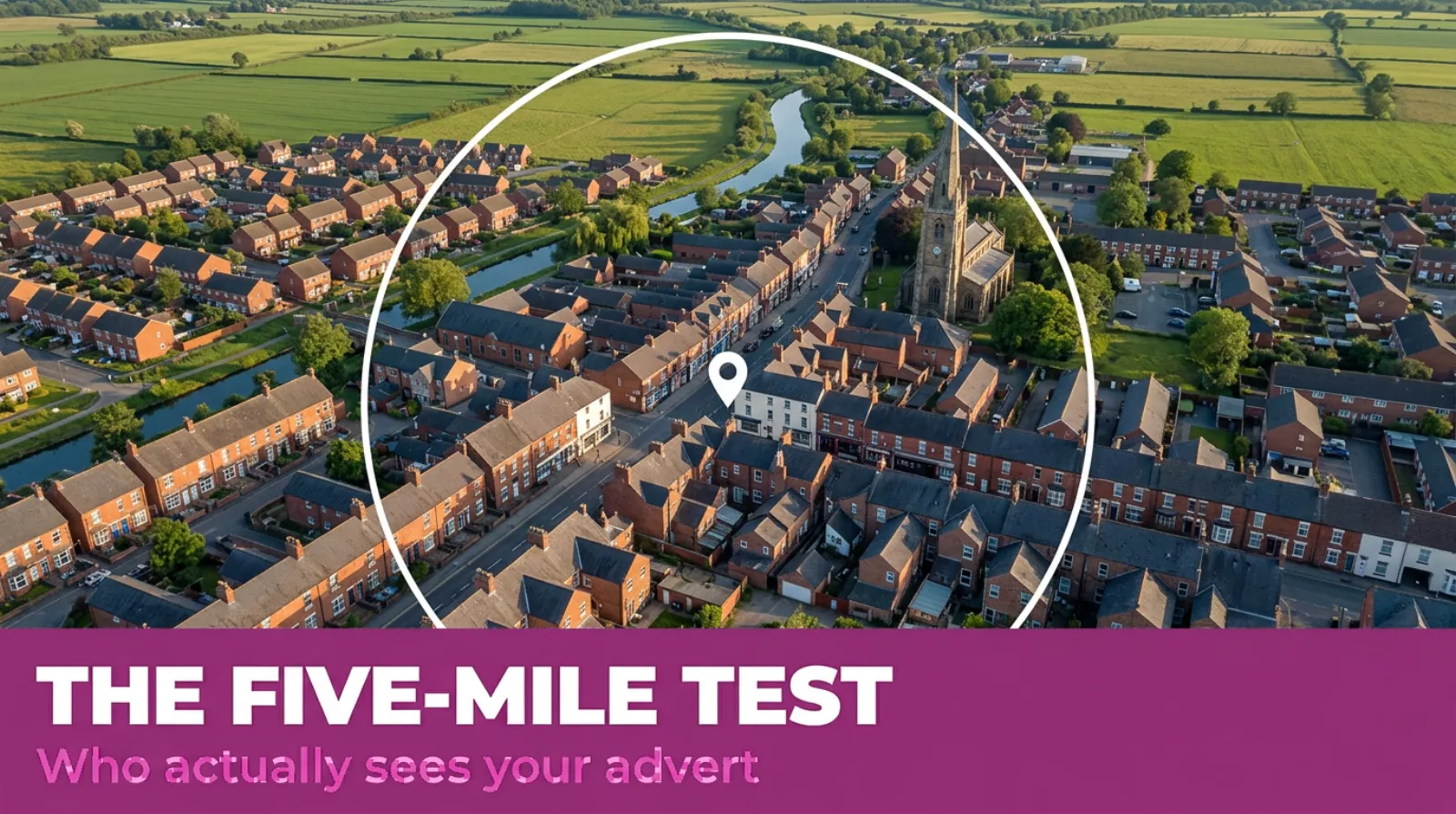
Here is a question most business owners have never asked about their advertising. Of all the people who saw it last month, how many could actually have bought from you? Most owners have no idea.
Not how many saw it. Not how many clicked. How many live or work close enough to walk in, book you or have you round.
For a business that serves one town, that number is often far smaller than you'd think. An advert can reach thousands of people and still reach almost nobody who matters.
Get your free Marketing Action PlanNot sure where to start? Answer a few questions and get your plan in about a minute. No email needed.
Get my plan →That is the problem the Five-Mile Test solves. It's one question you ask of every pound you spend on advertising.
I've run advertising for local businesses for almost 15 years, and this is the first check I would want any owner to make. It needs no software and no agency. It takes an afternoon.
What Local Advertising Really Means
Local advertising is anything you pay for, or put time into, to reach people close to your business. That covers a lot more than most people count.
There's the digital side. Google Ads, your Google Business Profile, Facebook and Instagram adverts, and online directories.
There is the print side. Leaflets through doors, the parish magazine, the local paper and posters in shop windows.
And there's the physical side. Your shop sign, your van, a board outside a job and a banner at the football club.
All of them cost something. Some cost money, some cost time, and most cost both. Very few owners have ever lined them up and asked the same question of each.
The Five-Mile Test In One Line
The test is simple. Pick one advertising channel and ask this.
Out of every ten people who see this, how many live or work close enough to buy from me?
That's all it is. You do not need an exact figure. A fair guess is enough to start, and you can sharpen it later.
If the answer is eight or nine, that channel is doing its job. If it's two or three, most of your money is reaching people who can't use you, however good the advert is.
Five miles is only a starting point. A locksmith might use eight. A café might use one. A wedding photographer might use forty. Pick the distance that fits your business, and we will come to how in a moment.
Why The Test Matters
Most advertising is sold on reach. The local paper tells you how many homes it goes to. Facebook tells you how many people saw your post. A directory tells you how many visitors it gets.
Reach sounds impressive. But reach counts everyone, and you can't sell to everyone.
Think about a hairdresser. A customer might travel two or three miles for a cut. Someone twenty miles away will not come, however lovely the advert looks. Showing it to them is money spent on nothing.
So two adverts with the same reach can be worth very different amounts. One puts you in front of two thousand people who could book. The other puts you in front of two hundred who could, and eighteen hundred who never will.
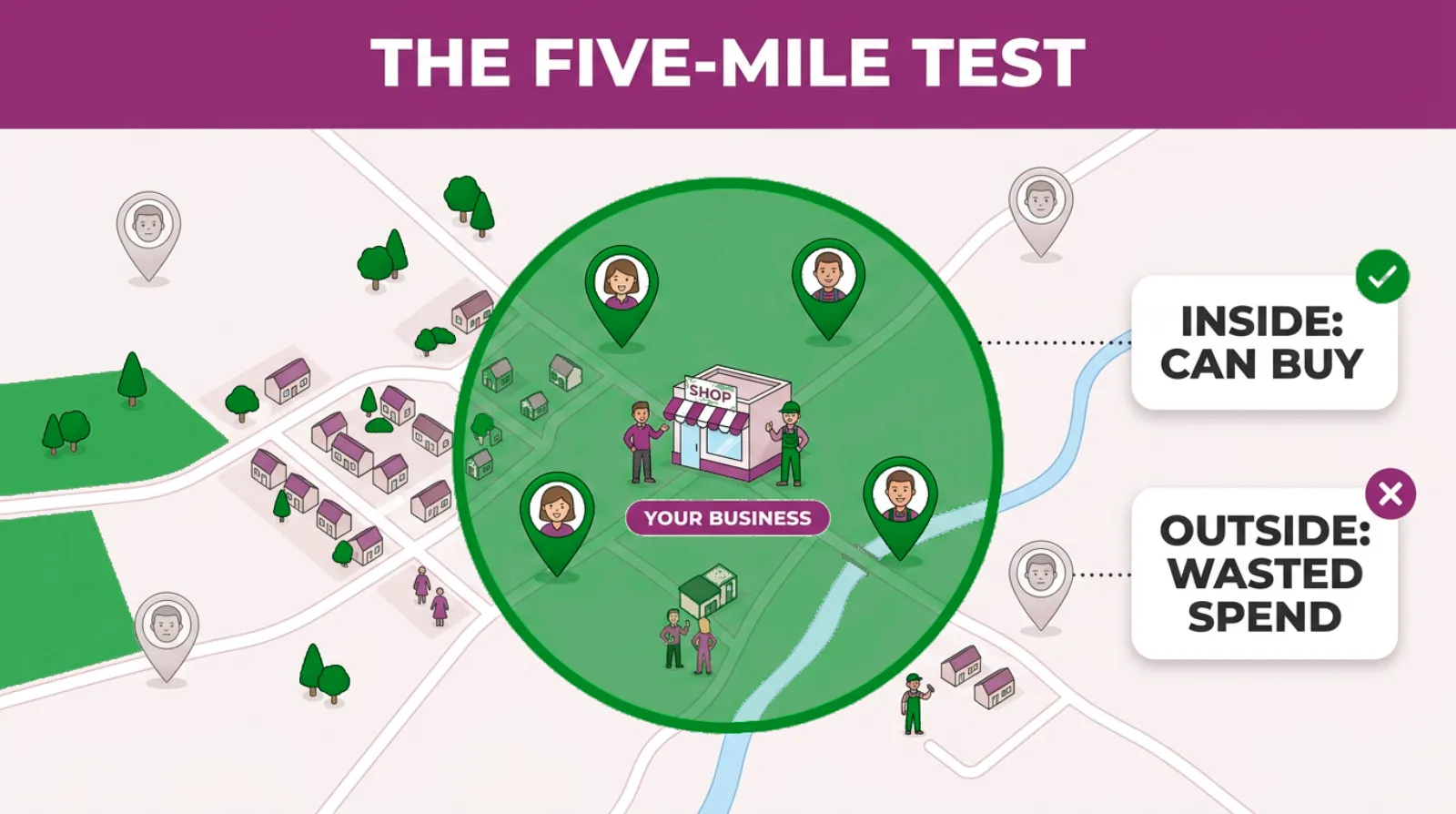
The test swaps the question "how many people?" for "how many of the right people?" Once you ask it that way, a lot of spending decisions get easier.
How To Set Your Own Distance
Before you test anything, you need your number. There are three quick ways to find it.
Look At Your Last Fifty Customers
Go through your last fifty jobs, bookings or sales. Note roughly where each customer came from. You'll usually find that most of them sit inside a surprisingly small area.
Ask How Far You'd Happily Go
If you travel to customers, ask yourself an honest question. How far would you drive for an average job and still be glad you took it? Not the furthest you have ever gone. The furthest you'd choose to go.
Ask How Far They'd Come
If customers come to you, think about what they would pass on the way. People will drive past one barber to reach a better one. They won't drive past six.
Put those three together and you will have a distance. Write it down. That's your circle, and everything below is measured against it.
What You Get From Running It
The test takes an afternoon, and it gives you four things most owners have never had.
A Fair Way To Compare Channels
You can't compare a leaflet with a Facebook advert on price or on reach. You can compare them on how many of the right people each one puts you in front of. For the first time, they are on the same scale.
A List Of What To Stop
Almost every business finds at least one channel that fails badly. Stopping it frees up money straight away, without any drop in enquiries.
A List Of What To Fix
Some channels reach the wrong people only because of a setting. Change the setting, and a failing channel becomes a good one.
Confidence In What's Left
When you know a channel reaches the right people, you can spend more on it without worrying. That is a very different feeling from hoping.
How To Score Each Channel
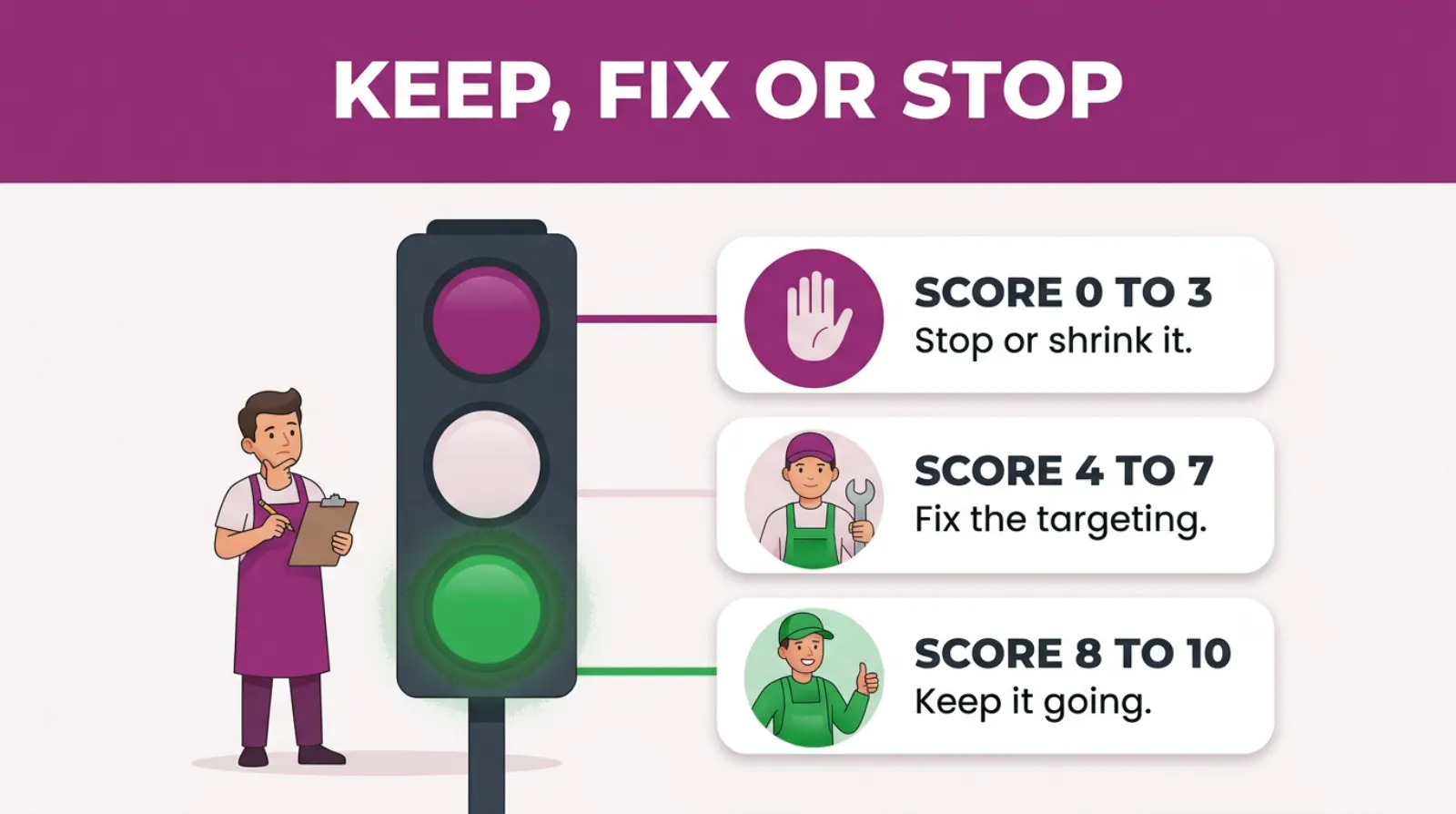
Give every channel a score out of ten. It's the number of people in ten who are inside your circle.
- Eight to ten means keep it. Most people who see it could buy.
- Four to seven means fix it. The channel can work, but the targeting is loose.
- Zero to three means stop or shrink it. You're paying mostly for people who cannot use you.
Don't worry about being exact. If you're torn between a six and a seven, it does not matter. What matters is spotting the twos and the nines.
Now let's go through the channels one at a time.
The Trouble With Big Numbers
Before the channels, a word on the figures you will be shown when someone sells you advertising.
Reach is the number of people who could have seen your advert. Impressions is the number of times it was shown. Readership is an estimate of how many people pick up a publication, which is usually a multiple of how many copies are printed.
None of these numbers is dishonest. They simply answer a different question from the one you care about. They tell you how big the audience is, and they say nothing about where that audience lives or whether any of it needs what you sell.
A seller will always lead with the biggest figure available. Your job is to ask the follow-up question every time: how many of those people are inside my circle? Ask it every single time.
A small number of the right people beats a large number of the wrong ones. It nearly always costs less as well.
Google Ads
Google Ads can score a nine or a two. It depends almost entirely on one setting.
When you choose a location, Google's default is to show your adverts to people in that place, and to people who have shown interest in it. That second group can be anywhere in the country.
Change it to people who are in, or regularly in, your chosen area. Then set the area itself to match your circle. A radius around your postcode usually does it.
Check the result in your account. There's a report showing where the people who clicked actually were. If you see towns you'd never drive to, you have found a leak.
With the right settings, Google Ads is one of the best scorers there is. You can draw your circle almost exactly.
Your Google Business Profile
This is the free listing that shows on Google Maps and in the local results. It's hard to beat on this test.
Google decides who sees it partly by distance. People close to you are far more likely to be shown your profile than people far away. So it tends to score an eight or nine with no effort from you.
There are two things to check. First, that your address or service area is right. Second, that you haven't claimed a service area far wider than you really cover. A plumber who lists five counties doesn't show up in five counties. They just look less local everywhere.
If you have never finished your profile, do that before you spend another pound on anything else.
Facebook And Instagram Adverts
These score well when you set a radius, and badly when you don't.
Boosting a post without choosing an audience is the usual mistake. Facebook will show it to whoever is cheapest to reach, and that might be anyone.
When you set up an advert properly, you can pick a point on the map and a distance around it. Choose people who live in that area, not people who have recently been there.
Then look at who responded. Likes from friends and relatives two hundred miles away feel nice. They aren't customers.
Organic posts are a different matter. Your page followers are whoever chose to follow you. For many local businesses that's a mix of customers, family and other businesses. Worth doing, but score it honestly.
Leaflets And Door Drops
Here is something you won't often hear from a digital agency. Leaflets can score ten out of ten.
If you choose the streets yourself, every single leaflet lands inside your circle. No digital channel can promise that.
The catch is in how they are delivered. A leaflet drop sold by postcode sector may cover streets you'd never serve. A shared drop, where yours goes out with five others, is cheaper but gets less attention.
So the test for leaflets is about the map. Ask the distributor exactly which streets are covered. If they can't tell you, that is your answer.
A leaflet's weakness isn't who sees it. It's how few people act on it. That is a separate question, and we'll come to it.
Local Papers And Magazines
These vary more than any other channel.
A parish or village magazine often scores very high. It goes to a few thousand homes in one small place, and people keep it for a month.
A county magazine or a regional paper scores much lower for a single-town business. It may reach a hundred thousand readers, and only a few thousand of them live close enough to use you.
Ask for the distribution map, not the readership figure. Then lay your circle over it. The share that falls inside is your score.
Price matters here too. A regional title charges for all its readers. You are paying for the ninety per cent you can't use as well as the ten you can.
Online Directories And Lead Sites
Directories look local because you can search them by town. Whether they pass depends on how they send you enquiries.
Some let you set the exact areas you cover. Those can score well. Others send you any enquiry within a wide region and charge you for each one.
Look at your last twenty enquiries from each site. Mark the ones inside your circle. If half are outside it, you're paying double for every useful lead.
Free listings are worth having, as long as your name, address and phone number match everywhere. Paid ones need to earn their place.
Sponsorship, Signs And Your Van
Physical advertising is easy to forget, and it often scores well.
A sign outside your premises reaches people who are already close by. A board outside a job reaches the neighbours, who have the same kind of house and the same kind of problem.
Your van is a moving advert, and it mostly moves around the area you work in. That is a high score for something you've already paid for. Make sure the phone number is readable from across a road.
Sponsoring a local team or school fair scores well on distance. Whether the people who see it need what you sell is another matter. A kitchen fitter at a school fair is in front of homeowners. An industrial cleaner isn't.
Your Own Website In Local Search
Your website is advertising too, and it is worth putting through the same test.
Open your website statistics and look at where your visitors come from. Most tools will show you a list of towns and cities. If the top of that list is London, Manchester and Birmingham, and you serve one market town, your website is reaching the wrong people.
That usually happens when the pages talk about your service in general terms and never say where you work. Google cannot guess. A page about boiler repairs could belong to a firm anywhere in the country.
The fix is plain. Say where you work on your home page, on your contact page and on each service page. Use the real place names, and write a sentence or two that only a local firm could write.
It takes a few weeks for Google to catch up. When it does, the list of towns in your statistics starts to look like the list of towns you serve.
Word Of Mouth And Reviews
No list of local advertising is complete without the oldest channel of all.
Word of mouth scores ten on distance almost by definition, because people recommend you to their neighbours, friends and colleagues. It scores highly on the second question too, since nobody passes on your name to someone who does not need you.
You cannot buy it, but you can feed it. Ask happy customers for a Google review while the job is fresh. Leave a card or two behind. Thank people who recommend you.
Reviews are word of mouth that strangers can read. They also help your Google Business Profile show more often, so one small habit improves two channels at once.
The Second Question: Can They Actually Buy
Distance is the first half of the test. The title has a second half, and it matters just as much.
Being close is not the same as being a customer. A student in a rented flat is inside a roofer's circle, and will never buy a roof. So once a channel passes on distance, ask one more thing.
Of the people inside my circle, how many are the kind of person who buys what I sell?
This is where channels differ again. Google Ads reaches people at the moment they're searching for your service. That is as close to "can buy" as it gets. A leaflet reaches every house on a street, whether they need you this year or not.
Neither is wrong. But it explains why a channel with a perfect distance score can still bring in little work. And it's why the best mix usually pairs one channel that catches people searching with one that keeps your name in front of the streets you serve.
What To Do With Your Scores
By now you'll have a list of channels and a score beside each. Here is what to do with it.
- Stop the lowest scorer this month. Don't replace it yet. Watch whether enquiries change. 2. Fix the middle scorers. Tighten the radius, change the location setting, or ask for a smaller drop area. 3. Move the money you have saved into your highest scorer. 4. Run the test again in three months.
Most owners are surprised by step one. They stop something they've paid for out of habit for years, and nothing happens. The phone rings just as often.
Don't change everything at once. If you stop three things and start two in the same week, you'll never know what made the difference.
How Much To Spend Once You Know Your Scores
The test tells you where to spend. It does not tell you how much, and owners often ask.
There is no figure that suits everyone. A fair starting point is to look at what one new customer is worth to you over a year, and decide what share of that you would happily pay to win them.
Then spend in order of score. Fund your highest scorer properly before you put anything into the next one down. A channel that scores nine and gets a thin budget will often do less than it could, simply because it runs out of money by lunchtime.
Spread thinly across six channels, a small budget does very little anywhere. Concentrated on the two that reach the right people, the same money usually goes much further.
Seasonal And One-Off Advertising
Some advertising only happens once a year. A stall at the summer fair, a Christmas advert in the local paper, a page in the school calendar.
These deserve the same test, and they are easy to forget because nobody reviews them. They are paid for in a rush, and the invoice is filed.
Keep a short list of every one-off you say yes to. When it comes round again, score it before you agree. Ask whether a single customer mentioned it. If nobody did, and the score was low, you have your answer.
Some of these are worth doing for reasons that have nothing to do with sales. Supporting the school or the football club is a fine thing to do. Just call it what it is, and do not count it as advertising.
Keeping A Simple Record
You do not need a system for any of this. A single sheet of paper, or one page in a spreadsheet, is plenty.
Write each channel on its own line. Next to it, put what it costs in a month, its score out of ten and the number of customers who said they found you that way.
Fill in the last column from one habit. Ask every new customer how they heard about you, and note the answer the same day. After a month you will have real numbers beside your guesses, and after three you will trust the sheet more than any sales pitch.
Look at it once a quarter. That is often enough to catch a channel that has drifted, and not so often that it becomes a chore.
Common Mistakes When Running The Test
A few things trip people up.
Trusting The Seller's Numbers
Every channel will give you its reach. None will tell you how much of it falls inside your circle unless you ask. So ask, and ask for a map.
Scoring On What You Hope
It is tempting to give a channel a kind score because you like the people who sell it, or because your name looks good in print. Score what you can see.
Forgetting The Free Channels
Time is a cost too. If you spend three hours a week posting to followers who mostly live elsewhere, that's a low scorer, even though it's free.
Stopping At Distance
A channel can score ten on distance and still bring nothing in. Always ask the second question.
Never Asking Customers
The simplest check of all is to ask every new customer how they found you. Write the answers down. After a month, you will have real numbers to set against your guesses.
A Worked Example
Here's a made-up example to show how it works. Picture a small dog-grooming salon on the edge of Leighton Buzzard.
The owner looks at the last fifty customers. Almost all live within four miles. So the circle is four miles.
Then the scoring starts. The Google Business Profile gets a nine. Almost everyone who finds it is searching from close by.
A half-page in a county lifestyle magazine gets a two. It reaches readers across the whole county, from Bedford and Luton to Dunstable, and most of them would never drive that far for a dog groom.
Boosted Facebook posts get a four. They would been going out with no location set. A leaflet drop to the nearest two estates gets a ten.
The owner stops the magazine advert. Nothing changes. The Facebook adverts get a four-mile radius, and the score rises to an eight. The money saved pays for a second leaflet drop and a small Google Ads campaign, set tightly to the same four miles.
Nothing extra was spent. The same budget simply stopped reaching people who were never going to come.
When You Should Advertise Further Out
The test isn't an argument for staying small forever. It's an argument for filling your circle first.
There are good reasons to go wider. You might have a service that people will travel for. You might have spare capacity that your own area cannot fill. Or you might be opening a second site.
When that's true, widen on purpose. Add one new area at a time, and treat it as its own test with its own budget. We work with businesses across Milton Keynes, Bedford, Luton, Dunstable, Aylesbury and Northampton, and the ones that grow well nearly always do it one town at a time.
What doesn't work is going wide by accident. That is what a default setting or a regional magazine does for you.
Frequently asked questions
What is the Five-Mile Test?
It's one question you ask of every advertising channel. Out of ten people who see this, how many live or work close enough to buy from me? You then keep, fix or stop each channel based on the answer.
What is the best local advertising for a small business?
The one where most of the people who see it can actually buy. For many local firms that is a complete Google Business Profile, tightly targeted Google Ads and leaflets or signs in the streets they serve.
How far should I advertise my business?
As far as you'd happily travel for an average job, or as far as a customer would travel to you. For many local businesses that's somewhere between three and ten miles. Your last fifty customers will tell you.
Is leaflet advertising still worth it?
It can be. Leaflets reach exactly the streets you choose, which very few channels can do. They work best for services most households need, and when you pick the streets yourself.
Is local newspaper advertising worth it?
It depends on the title. A village or parish magazine often reaches the right people at a fair price. A regional paper usually charges you for a great many readers who live too far away.
How do I know if my advertising is working?
Ask every new customer how they found you, and write it down. Set that against what each channel costs. Within a month or two you will see which ones bring in work.
Keep Reading
These five take the test further.
- Your Ad Budget Isn't Too Small. Your Map Is Too Big
- You Set Your Location – Google Interpreted It Generously
- 5 Google Business Profile Tweaks That Push You Into the Local Map Pack
- Your Customers In Milton Keynes Are Already Searching. Is Your Advertising There When They Do?
- Leighton Buzzard Is A Small Town. That Is Exactly Why SEO Works Here
The first two fix the Google Ads settings that fail this test most often. The third sorts out your free listing. The last two show what good local advertising and local search look like once the basics are right.
Fill Your Circle First
Advertising rarely fails because the advert is bad. It fails because it was shown to the wrong people.
So before you spend more, ask the question. Out of ten people who see this, how many could actually buy?
Score each channel. Stop the twos. Fix the fives. Put more behind the nines. Then ask your customers how they found you, and test again in three months.
Our office is on Grovebury Road in Leighton Buzzard, twenty minutes down the A4146 from Central Milton Keynes. If you'd like a second pair of eyes on your scores, get in touch and we'll go through them with you.

Written by Uzair Kharawala
Partner at SF Digital Studios, a Google Premier Partner agency. Uzair has been helping businesses grow with Google Ads since 2002 and teaches it every week on YouTube.
Get our best Google Ads tips by email
New articles and videos, straight to your inbox. Unsubscribe any time.