
Search for a Google Ads agency in Milton Keynes and you will find page after page of agencies telling you how good they are. Every one promises more leads. Several do not have an office anywhere near the city.
What none of them tell you is what you should actually expect once you sign. What happens in the first month. What you should pay. What should be in writing. And how to tell, three months in, whether it is working.
This guide answers those questions from the buyer's side. It is written from our office on Grovebury Road in Leighton Buzzard, twenty minutes down the A4146 from Central Milton Keynes, by a team that does this work every week.
Get your free Marketing Action PlanNot sure where to start? Answer a few questions and get your plan in about a minute. No email needed.
Get my plan →The short version: a good agency makes your account clearer, not more mysterious. If you finish the first three months understanding less about your own advertising, something has gone wrong.
What A Google Ads Agency Actually Does
A Google Ads agency plans, builds and runs your paid search advertising, and is responsible for turning your ad budget into enquiries or sales. That is the job. Everything else is detail.
In practice, the work splits into two parts.
The first part happens at the start. The agency checks your tracking, researches what your customers search for, looks at what competitors are doing, and builds or rebuilds the campaigns. This is where most of the effort goes in the first month.
The second part never stops. Every week, a good agency reads the searches that triggered your ads, blocks the ones that waste money, tests new ad copy, adjusts budgets and checks that leads are coming in. This is the unglamorous work that decides whether an account improves or drifts.
A lot of disappointment with agencies comes from mixing these up. A beautiful launch followed by months of silence is not management. It is a build with a monthly invoice attached.
Why The Choice Matters More In This Part Of The Country
Milton Keynes is not one market. Enquiries come from Bletchley, Wolverton, Newport Pagnell, Stony Stratford and Central Milton Keynes, and people in each of those places search slightly differently. Some add the district name. Some search the city. Many search with no place at all and let Google work it out from their location.
An agency that treats the whole area as one blob will set a radius, write one set of ads and hope. One that knows the patch will look at which districts actually produce customers, adjust bids and budgets around them, and write ads that mention the places people recognise.
The competition matters too. Page one for Google Ads services here is crowded with agencies from outside the area running template pages. The same pattern shows up in most trades. Your competitors may be advertising through large national firms that do not know the difference between Kingston and Kiln Farm.
Local knowledge is not a nice extra. It is part of how the budget gets spent well.
There is also a practical side. Being close enough to meet in person makes a difference when something needs a proper conversation. That is harder to arrange with an agency three hundred miles away.
What To Get In Writing
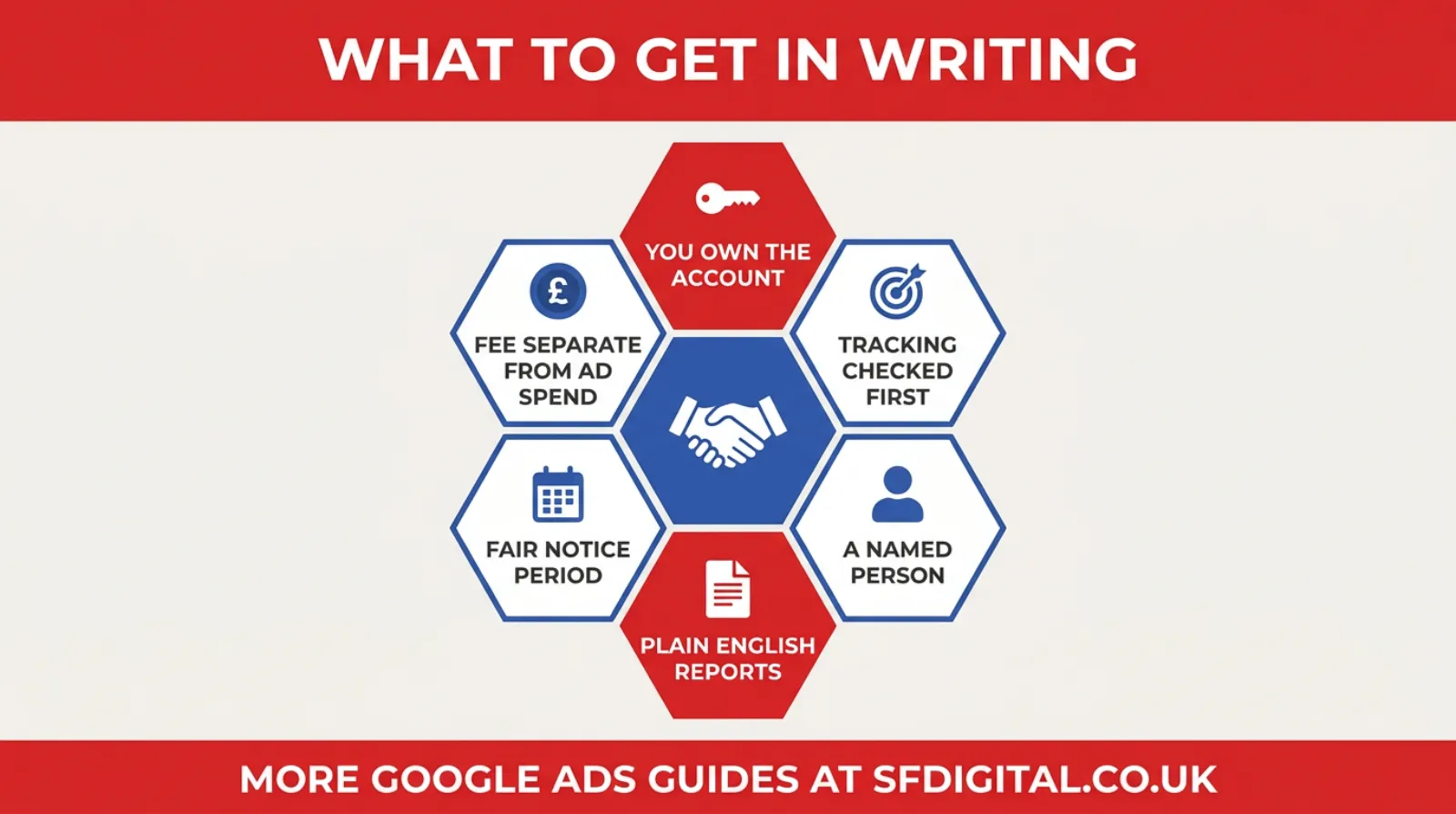
Before you sign anything, six things should be clear and written down. None of them is unusual, and a good agency will not hesitate over any of them.
The rest of this guide walks through each one, then covers the first 90 days, what you should pay and the questions worth asking on the first call.
You Own The Account
The Google Ads account should belong to your business. It should be set up in your business name, paid with your card, with you as an admin.
The agency should manage it through its own manager account, which is Google's standard way for agencies to work. That gives them the access they need without owning anything.
Why does this matter so much? Because the account holds years of history. Which searches worked, which ads won, what your customers respond to. If the agency owns it and you part ways, you can lose all of that and start from scratch.
Ask directly. "Whose name is the account in, and whose card pays for it?" The answer should be yours, both times.
Tracking Comes First
An agency cannot improve what it cannot measure. So the first real job should be checking that your conversion tracking works.
That means confirming that form submissions, phone calls and any online sales are being counted correctly, and that nothing is being counted twice. It also means agreeing what counts as a good lead.
A conversion is not the same as a customer. An account can report plenty of conversions that turn out to be spam forms, wrong numbers or people outside your service area. A good agency asks about lead quality, not just lead volume, and will want to know which enquiries actually turned into work.
If a new agency starts changing bids and budgets before checking tracking, it is steering without a map.
A Named Person
You should know who is working on your account. Not a department, not an inbox, a person with a name.
Ask who will make the changes, who will write the reports and who you call when something goes wrong. In smaller agencies it may be the same person. In larger ones it may be three. Either is fine, as long as you know.
Be wary if the person who sold you the service disappears the moment you sign. That is common, and it often means the work goes to someone much more junior.
Reports You Can Understand
A monthly report should tell you three things in plain English. What happened, why it happened and what the agency will do next.
It should focus on the numbers that matter to your business. Enquiries, cost per enquiry, sales if you track them, and the quality of the leads. Clicks and impressions have their place, but a report built mostly on them is often hiding a lack of results.
You should also be able to log in to the account and see the same numbers yourself. A report that cannot be checked against the account is a story, not a report.
A Fair Notice Period
Contracts vary. Some agencies work month to month. Others ask for a minimum term, often three or six months, because the first months involve a lot of set-up work.
A short minimum term is reasonable. A long lock-in with no break clause is not. Ask what the notice period is, what happens to the account when you leave and whether there are any exit fees.
The best agencies keep clients because the results are good, not because the contract says so.
A Fee Kept Separate From Ad Spend
The agency's fee and your ad budget are two different things. The fee pays the agency for its time. The ad spend goes to Google for clicks.
Make sure both are clear, and that you can see exactly how much of your money went to Google each month. If an agency bundles the two into one figure, ask for them to be split.
What The First 90 Days Should Look Like
Every account is different, but the first three months with a good agency tend to follow the same shape.
The First Month
The first month is about foundations. The agency gains access, checks tracking, reviews the account's history and researches your market. It looks at which searches have been wasting money and which have been producing customers.
Expect some quick wins here. Blocking obviously irrelevant searches, fixing broken tracking and pausing clearly wasteful campaigns can make a noticeable difference early.
Expect questions too. A good agency asks a lot about your business, your best customers, your margins and your capacity. If they ask almost nothing, they are guessing.
The Second Month
The second month is about tightening. Weekly search term reviews, adjustments to bids and budgets, and the first round of ad copy tests.
This is often where the cost per enquiry starts to move, as wasted spend comes out of the account and budget shifts towards what works.
The Third Month
The third month is about judging. By now there should be enough data to see what is working, what is not and what to do next.
Expect a proper review. Not just a report, but a conversation about results, lead quality and the plan for the following quarter.
Around 90 days is a fair point to judge an agency. Earlier than that, you are mostly seeing the set-up. Much later, and you may be paying for drift.
What Should A Milton Keynes Business Pay?
This is the question everyone wants answered and few agencies answer publicly.
Published UK pricing guides for 2026 put Google Ads management fees at roughly £300 to £2,500 or more a month. Where an account sits in that range depends on how many campaigns it runs, how competitive the market is and how much work the agency does each week.
Some agencies charge a percentage of ad spend instead, commonly 10 to 20%, usually with a minimum monthly fee. Others use a fixed monthly fee. Some mix the two.
Each model has trade-offs. A percentage fee grows with your budget, which can create a quiet incentive to recommend spending more. A fixed fee is predictable, but you should check what is included and whether it changes as the account grows.
Whatever the model, ask what the fee buys each month. How often will someone look at the account? How often will search terms be reviewed? How often will you talk? A cheap fee that buys an hour a month is expensive in wasted spend.
Remember the ad budget sits on top of the fee. That goes to Google, and a good agency will tell you honestly whether your budget is big enough to compete in your market, rather than taking the fee regardless.
What Premier Partner Status Actually Means
You will see a lot of agencies mention Google Partner or Google Premier Partner badges. They are worth understanding.
Google Partner status means an agency meets Google's basic requirements for certification, spend and performance.
Premier Partner is a different level. Google gives it to the top 3% of participating companies in each country, assessed every year. It looks at how well an agency grows its clients' accounts, how many new clients it brings to Google Ads, how well it keeps clients and how broadly it uses Google's products. An agency cannot apply for it or buy it.
We hold Premier Partner status, and we would still say this: a badge is a starting point, not a guarantee. Use it to shortlist, then judge the agency on the questions below.
Questions Worth Asking On The First Call
A first call should feel like a conversation, not a pitch. These questions tend to separate the careful agencies from the rest.
- Whose name will the account be in, and whose card will pay for it?
- Who exactly will work on my account, and how often?
- What will you check in the first two weeks?
- How will you know if the leads are any good, not just how many there are?
- How often will you review the search terms?
- What will a monthly report look like? Can I see an example with the client details removed?
- What is the notice period, and what happens to the account if I leave?
- Is my budget realistic for my market? What would you do if it is not?
- Which parts of the area do you think my customers will come from, and why?
- What would make you tell me Google Ads is not right for my business?
That last question is revealing. An agency that has never told a prospect "this is not a good fit" is an agency that says yes to everyone.
The Red Flags
A few warning signs come up again and again. Any one of them is worth a second conversation. Two or more is usually a reason to walk away.
- A guarantee of first position, or a guaranteed number of leads
- The account set up in the agency's name, or paid on the agency's card
- A long contract with no break clause
- Reports built mostly on clicks and impressions, with little about enquiries
- No access for you to log in and check the numbers
- A salesperson you never hear from again after signing
- Pressure to increase the budget in the first few weeks, before tracking is checked
- Vague answers about who does the work
How To Tell If Your Agency Is Actually Doing The Work
You do not need to be an expert to check. Google Ads keeps a record of almost everything, and a few minutes in your own account tells you a lot.
Look At The Change History
Every Google Ads account has a change history. It lists every edit, when it was made and which login made it. Open it and look at the last month.
A well-managed account shows steady activity. Negative keywords added, bids adjusted, ads tested, budgets moved. An account where the last change was six weeks ago is not being managed, whatever the report says.
Look At The Negative Keywords
Open the negative keyword lists and see when they were last added to. A healthy account adds negatives most weeks, because new wasted searches appear all the time.
If the list has not changed since launch, nobody is reading the search terms.
Look At The Ads
Check when the ads were last changed or tested. Good agencies run regular tests, keeping the winner and trying a new challenger. Ads that have not changed in a year are a sign of an account on autopilot.
Look At What Gets Discussed
Think about your last few conversations with the agency. Were they about results, lead quality and next steps? Or were they mostly about clicks and impressions, and why it is too early to tell? The answer usually tells you more than the report does.
None of these checks takes long, and none needs technical knowledge. If what you see in the account does not match what you hear in the report, ask why.
What A Good Agency Will Ask You
The questions an agency asks you are as revealing as the answers it gives. A careful agency wants to understand your business before it spends a penny of your budget.
Expect questions like these.
- Which of your services makes the most money, and which do you want more of?
- What does a good customer look like, and what does a bad one look like?
- How many new enquiries can you actually handle each week?
- Which areas do your best customers come from?
- What happens after an enquiry comes in, and how quickly do you respond?
- Which enquiries last month turned into paid work?
Those last two matter more than most people realise. Google Ads can only bring the enquiry. If calls go unanswered or forms sit for two days, the best campaign in the world will look like it is failing.
An agency that asks none of these is planning to run your account on guesswork.
When Google Ads Is Not The Right Answer
It is worth saying plainly: Google Ads is not right for every business, and a good agency will tell you when it is not.
It works best when people actively search for what you sell. Emergency plumbers, solicitors, clinics and trades that customers look up when they need them are natural fits.
It is harder when few people search for your product, when margins are too thin to cover the cost of a click, or when you cannot handle more work than you already have. In those cases, the honest advice may be to fix something else first, such as your Google Business Profile, your website or your follow-up process.
Be wary of any agency that says yes to everyone. The one that tells you to wait, or to spend less, is often the one worth trusting.
What You Need To Do On Your Side
An agency relationship works both ways. The best results come when the business plays its part too.
Answer the phone, and answer it quickly. Reply to form enquiries the same day. Leads go cold fast, and no amount of ad spend fixes a slow response.
Tell the agency which enquiries became customers. Even a simple monthly note helps it steer the budget towards what works.
Let the agency know about changes in the business. A new service, a busy season, a staff shortage or a price change all affect how the ads should run.
And give it time. Changing agencies every two months means you are always paying for set-up and never for improvement.
Switching Agencies Without Losing Ground
Plenty of businesses reading this already have an agency and are wondering whether to move. Switching is simpler than most people fear, as long as the account is in your name.
Check Ownership Before You Say Anything
Log in and confirm you are an admin on the account, and that the billing is in your business name. If either is not true, sort it out before you give notice. It is much easier while the relationship is still friendly.
Keep The Account, Change The Access
You do not need a new account. The new agency links its manager account to yours, and you remove the old agency's access. Every campaign, every piece of history and every learning stays in place.
Ask For A Handover
A good outgoing agency will explain what it has been working on, what tests are running and anything the new team should know. Ask for it in writing.
Expect A Short Settling Period
The new agency will want a few weeks to review the account before making big changes. That is a good sign, not a slow start. The worst move is to rebuild everything in week one and lose what was already working.
A Worked Example
Here is a made-up example to show how the questions work in practice. Picture a small physiotherapy clinic in Newport Pagnell comparing two agencies.
The first agency has a polished website and a strong pitch. On the call, it promises to double enquiries within a month. When asked who owns the account, the answer is that it will be set up under the agency "for simplicity". When asked about reports, the sample shows clicks, impressions and click-through rate, but no enquiries.
The second agency is less polished. On the call, it asks what a good patient looks like, which treatments have the best margins and how many new patients the clinic can actually take each week. It says the first month will be spent checking tracking and cleaning out wasted searches, and that it would want 90 days before judging results. The account stays in the clinic's name.
The second agency will almost always be the better choice. It promised less, asked more and left the clinic in control. That is what a good agency relationship looks like from the start.
Frequently asked questions
How much does a Google Ads agency cost in the UK?
Published UK pricing guides for 2026 put management fees at roughly £300 to £2,500 or more a month, depending on account size and complexity. Some agencies charge 10 to 20% of ad spend with a minimum fee. The fee is separate from your ad budget, which you pay to Google.
Who should own my Google Ads account?
You should. The account should be in your business name, paid with your card, with you as an admin. The agency should manage it through its own manager account, so if you part ways you keep the account and all its history.
How long before Google Ads works with a new agency?
Expect the first month to focus on tracking and structure, and the second and third on tightening search terms and budgets. Most accounts need around 90 days of consistent work before results can be judged fairly.
What is a Google Premier Partner?
Premier Partner is the highest level of Google's partner programme. It goes to the top 3% of participating companies in each country, assessed every year on client growth, retention and product mix. An agency cannot buy it or apply for it.
Does a Google Ads agency need to be based in Milton Keynes?
No, but local knowledge helps. An agency that knows the districts, the competition and how people search across the area will set up targeting and ads better. Being close enough to meet in person also helps when something needs a proper conversation.
Should I pay a percentage of ad spend or a fixed fee?
Either can work. A percentage fee grows with your budget, which can create an incentive to recommend spending more. A fixed fee is predictable, but check what it includes. Whichever you choose, ask exactly what work the fee buys each month.
Can I switch Google Ads agencies without losing my history?
Yes, if the account is in your name. You remove the old agency's access and grant access to the new one, and all the history stays with you. If the old agency owns the account, ask for it to be transferred before you leave.
Keep Reading
If you are weighing up agencies or reviewing the one you have, these five go further.
- Google Ads Management Services - PPC Agency Milton Keynes
- SF Digital Maintains 2026 Google Premier Partner Status - Here's What That Means for You
- Google Premier Partner - What Is A Google Premier Partner In 2025?
- The Uncomfortable Truth: Why Your Last Marketing Agency Fell Short on Delivering Real Results
- How To Reduce Google Ads Cost - How To Lower Your Google Ads Costs Without Sacrificing Results
The first is how we work. The next two explain what the Premier Partner badge does and does not mean. The last two help if you have been let down before or want to get more from the budget you have.
Choosing An Agency Is Choosing Who You Trust With Your Budget
A Google Ads agency spends your money every day. That makes it one of the most important relationships a small business can have, and one of the easiest to get wrong.
The good news is that the signs of a good agency are not hidden. They are in how the agency answers simple questions. Who owns the account. What happens first. What the fee buys. How you will know if it is working.
Ask those questions, get the answers in writing and give it 90 days. That is a fair test of any agency, including us.
We work with businesses across the patch, from Bedford, Luton, Dunstable, Aylesbury, Buckingham and Northampton to our home town of Leighton Buzzard. If you are a Milton Keynes business weighing up your options, we are happy to have that first conversation, with no pitch attached.

Written by Uzair Kharawala
Partner at SF Digital Studios, a Google Premier Partner agency. Uzair has been helping businesses grow with Google Ads since 2002 and teaches it every week on YouTube.
Get our best Google Ads tips by email
New articles and videos, straight to your inbox. Unsubscribe any time.