
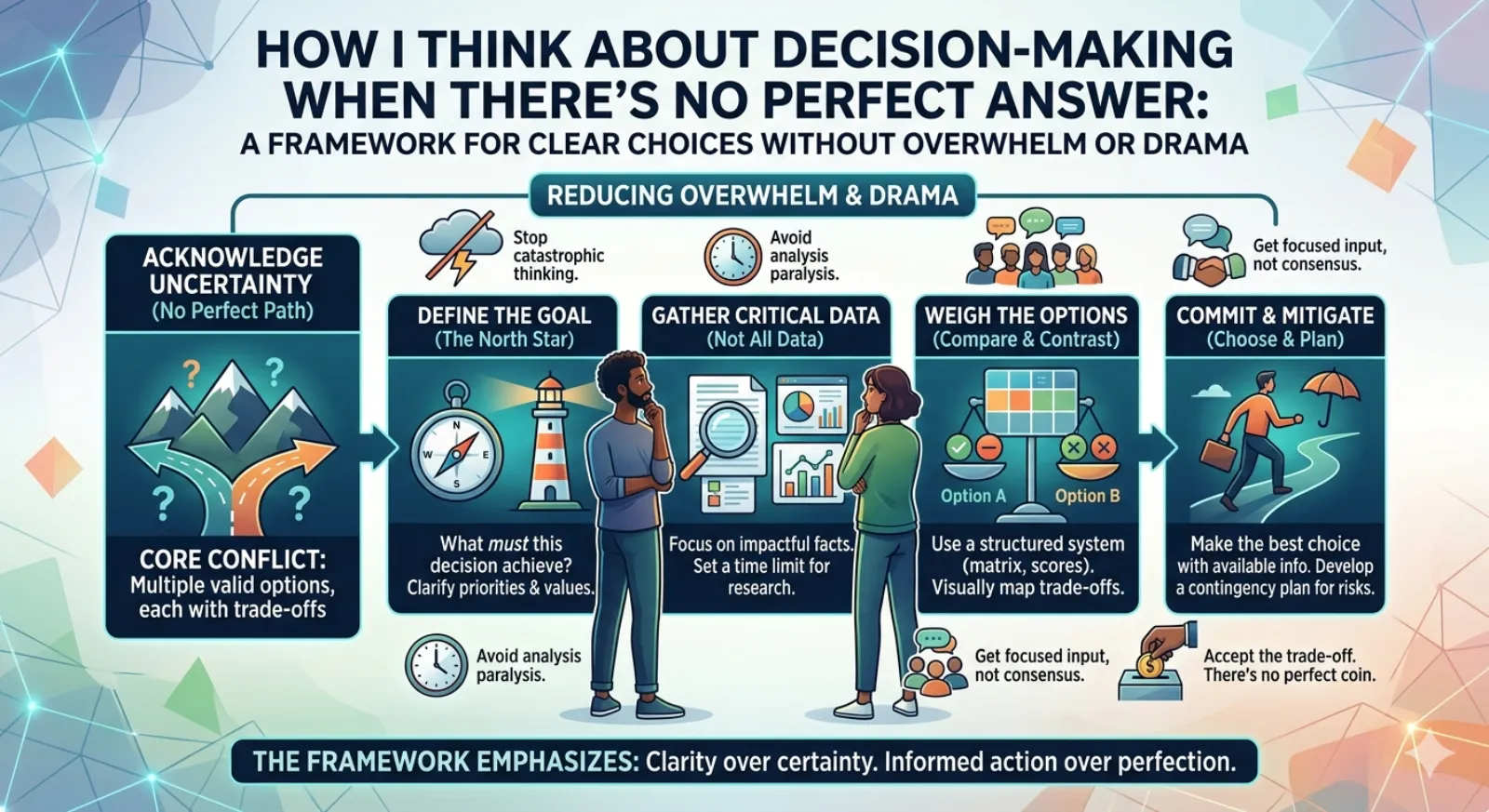
Do you ever feel trapped, staring at a crossroads with no clear signpost, convinced that one wrong turn could derail everything? What if the secret to moving forward isn’t finding the “perfect” path, but rather understanding how to choose confidently when perfection simply doesn’t exist? Imagine a world where critical choices don’t lead to weeks of agonizing doubt, but to decisive, calm action. This isn’t a pipe dream; it’s a learnable skill, especially for the pragmatic small business owner or the individual navigating life’s complex currents.
The Illusion of Perfection in Decision-Making and Why It Holds Us Back
The Myth of the “Right” Choice and Why It Stalls Progress for Ambitious Minds
Many believe there’s one perfect answer, a barrier in effective decision-making. The search for the ‘absolute best’ leads to endless research and inaction. Recognizing decisions exist in shades of gray is the first step. No decision guarantees outcomes; accepting this reality is crucial for confident, forward-moving clear choices.
Understanding the Paralysis by Analysis Trap for Entrepreneurs and Everyday Navigators
An important decision looms, you drown in data – “analysis paralysis.” Information volume prevents decisions. For entrepreneurs, this means missed market opportunities. It masquerades as diligence but is avoidance. Learning when “enough is enough” is vital for making clear choices and maintaining momentum.
My Personal Framework for Navigating Ambiguity with Confidence
Over years, I’ve developed a practical skill. It minimizes drama, maximizes clarity when no perfect blueprint exists. This process encourages continuous learning and refinement with every choice.
Step 1: Clarifying Your Core Values and Ultimate Objectives Before Diving Deep
Before options, reconnect with your ‘whys.’ What are your core values? Choices anchored in values gain meaning and filter misaligned options, building a strong foundation for clear choices.
Step 2: Gathering Just Enough Information, Not All Information, for Informed Choices
Goal is informed, not overloaded. Identify critical info; ask: “What genuinely changes my perspective?” Set a strict time limit. Excessive detail leads to analysis paralysis. Focus on quality over quantity for insights.
Step 3: Mapping Potential Outcomes and Their Probabilities with Realistic Expectations
Project potential outcomes for top options: best, most likely, worst-case. Assign rough probabilities. This offers realistic risk/reward understanding, preparing mentally for various eventualities, fostering a proactive mindset.
Step 4: Embracing the “Good Enough” Principle for Timely and Effective Action
Acknowledge no perfect solution. Aim for a “good enough” decision, sufficiently meeting objectives. Delaying for “perfect” costs more. This principle empowers action and momentum over exhaustive optimization in your decision-making framework.
Step 5: The Power of Reversibility and Adaptability in Your Strategic Choices
Few decisions are truly irreversible. Most are adjustable if new information emerges. Reversibility provides a safety net, reducing fear. This adaptability is key for resilient small businesses, transforming setbacks into insights for confident clear choices.
Actionable Tools and Strategies for Clearer and More Confident Decisions
Beyond the framework, practical tools enhance your decision-making process. These techniques bring structure and clarity, empowering you to make clear choices, reducing overwhelm.
The “Weighted Pros and Cons” List: A Deeper Dive Beyond Simple Tallying
Go beyond simple tallies. A weighted list assigns importance. List pros/cons, assign a numerical weight based on value impact. Multiply weight by applicability score; sum. This provides nuanced understanding of value/pitfalls, guiding strategic clear choices.
The “Future Pacing” Exercise: Visualizing Your Choices and Their Ramifications
Vividly imagine your chosen decision. Fast forward three months, one year, five years. This helps experience potential realities before committing, revealing unforeseen implications or confirming gut feelings, aiding anticipation.
The “Decision Journal”: Learning from Your Past Self and Honing Your Intuition
Keep a simple journal for significant decisions: date, decision, rationale, expected/actual outcomes. Periodically review it. You’ll notice patterns, biases, and successful strategies. This feedback loop refines judgment, building confidence in clear choices.
The Power of External Input: Mentors and Trusted Advisors for Different Perspectives
Seeking advice from trusted sources is invaluable for new perspectives. Choose individuals with experience/expertise. Share your context, options, and thoughts. Their questions reveal blind spots and insights refine your clear choices.
Real-World Scenarios and Relatable Examples for Applied Decision-Making
Theory is useful, but practical application solidifies understanding. This decision-making framework applies to common situations. These examples show how a structured approach leads to confident, clear choices, minimizing overwhelm.
Case Study 1: Launching a New Product Without Guarantees in a Competitive Market
A small bakery considers gluten-free pastries, facing costs and uncertain success.
- Values/Objectives: Expand market, health-conscious segment, quality.
- Information: Research local demand, competitor offerings, costs. Two-week limit.
- Outcomes: Best (high demand), Most likely (moderate sales), Worst (poor sales, minor financial hit).
- Good Enough: If research shows demand/manageable costs, launch small pilot.
- Reversibility: Limited production, gather feedback, adjust. Prioritizes learning, minimal risk.
Case Study 2: Pivoting Your Small Business in Uncertain Times with Limited Resources
A fitness studio struggles, contemplating an online-only model.
- Values/Objectives: Maintain community, provide service, ensure survival, retain staff.
- Information: Survey members, research competitors, assess tech costs.
- Outcomes: Best (thriving online community), Most likely (some transition), Worst (attrition, tech issues).
- Good Enough: Launch limited online program, offer hybrid initially.
- Reversibility: Keep physical space, trial platforms, gather feedback. Balances survival, client needs.
Case Study 3: Making Personal Life Choices with Confidence: A Career Change Dilemma
An individual with a steady but unfulfilling job considers a passion-driven career leap.
- Values/Objectives: Personal fulfillment, creative expression, baseline financial stability.
- Information: Talk to new field professionals, research skills/training, assess financial runway. One-month limit.
- Outcomes: Best (dream career, stable finance), Most likely (initial struggle), Worst (difficulty finding work).
- Good Enough: Start part-time training/freelance in new field while maintaining current job.
- Reversibility: Keep current network active, maintain savings, define “pivot back” point. Encourages calculated risk.
Overcoming Common Decision-Making Pitfalls for Clearer Outcomes
Even with a robust framework, psychological traps like analysis paralysis, fear of regret, and confirmation bias can derail intentions. Counter these by setting firm information boundaries, embracing learning from imperfection, and actively seeking diverse perspectives. This ensures your decision-making process remains robust for strategic outcomes and consistently leads to clear choices.
Your Path to Confident, Clear Decision-Making: Final Thoughts
Embracing the Journey of Imperfect Choices with Strategy and Grace
Making decisions without a perfect answer means navigating uncertainty with skill. Trust your process, understand your values, and accept “good enough” as a strategic path. Every choice refines your decision-making framework, building a resilient, adaptable, and confident you. Embrace learning, celebrate your clear choices, and recognize your decisive action is a powerful asset.
Don’t let fear of imperfection keep you stuck. Apply this decision-making framework today. Clarify your next big choice, gather just enough information, then act with courage. The clarity and momentum gained will transform your business decisions and empower every aspect of your life. Make your next clear choice a powerful one.

Written by Uzair Kharawala
Founder of SF Digital Studios, a Google Premier Partner agency. Uzair has been helping businesses grow with Google Ads since 2002 and teaches it every week on YouTube.
Get our best Google Ads tips by email
New articles and videos, straight to your inbox. Unsubscribe any time.