
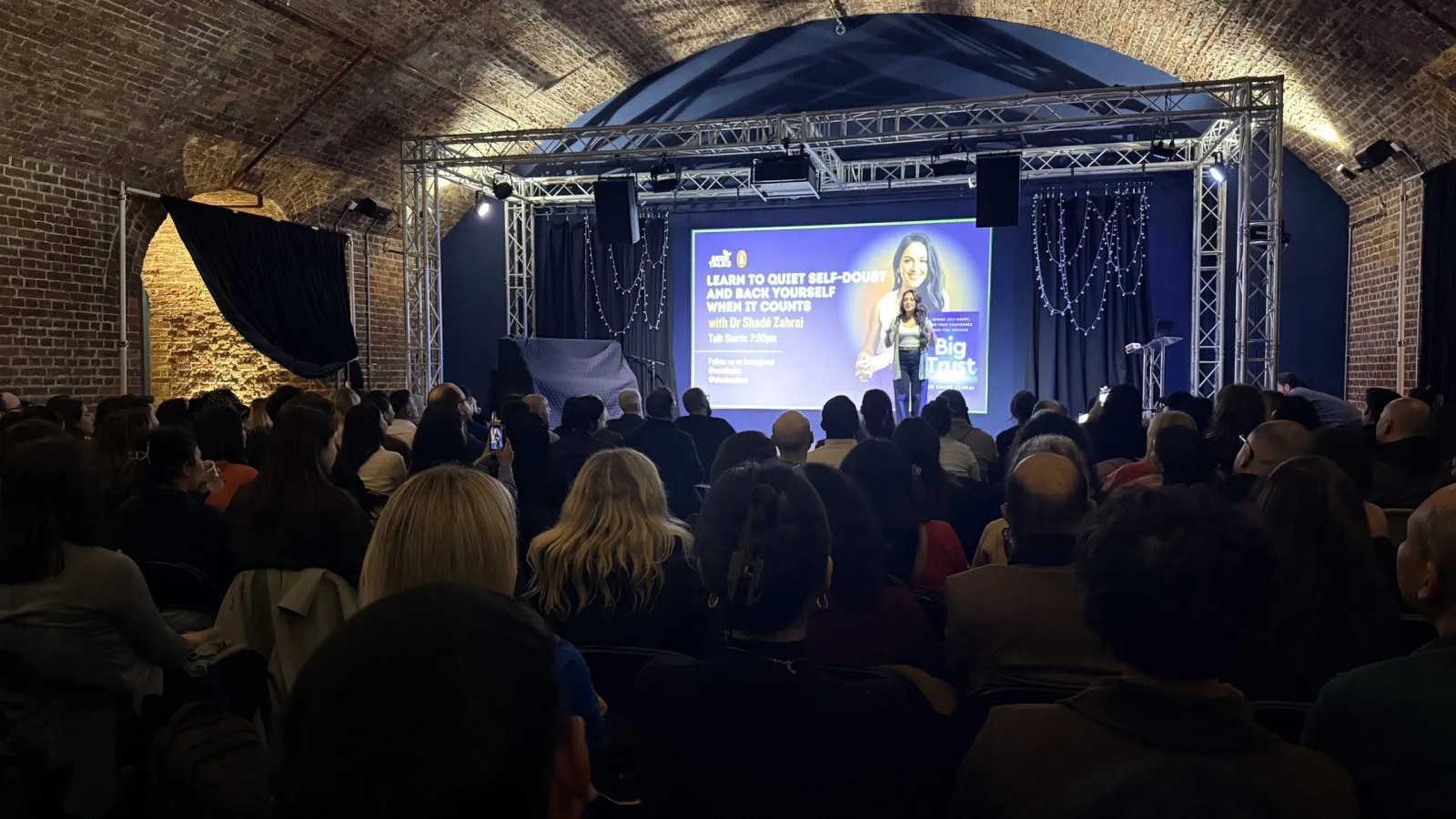
They say that clarity often comes when you step out of your daily routine and into a room full of collective ambition. That was exactly the case last week in London, where I had the privilege of attending an event led by the powerhouse that is Dr. Shadé Zahrai.
Known for her ability to bridge the gap between complex neuroscience and actionable career strategies, Dr. Shadé didn’t just deliver a keynote; she provided a masterclass in mindset shift. Walking out into the crisp London air afterward, I felt less like I’d attended a lecture and more like I’d been handed a roadmap for my next professional chapter.
Get Found, Get Chosen, Get Your Time Back
A free one-day marketing seminar in Milton Keynes · 10 November 2026
You’ve probably heard “don’t worry about perfection – focus on progress.” But what happens when progress isn’t happening? When you’re stuck, when the numbers aren’t moving, when it feels like everyone else is ahead?
Get your free Marketing Action PlanNot sure where to start? Answer a few questions and get your plan in about a minute. No email needed.
Get my plan →The answer isn’t to chase progress. It’s to focus on the process – showing up, doing the work, and trusting that the rest will follow.
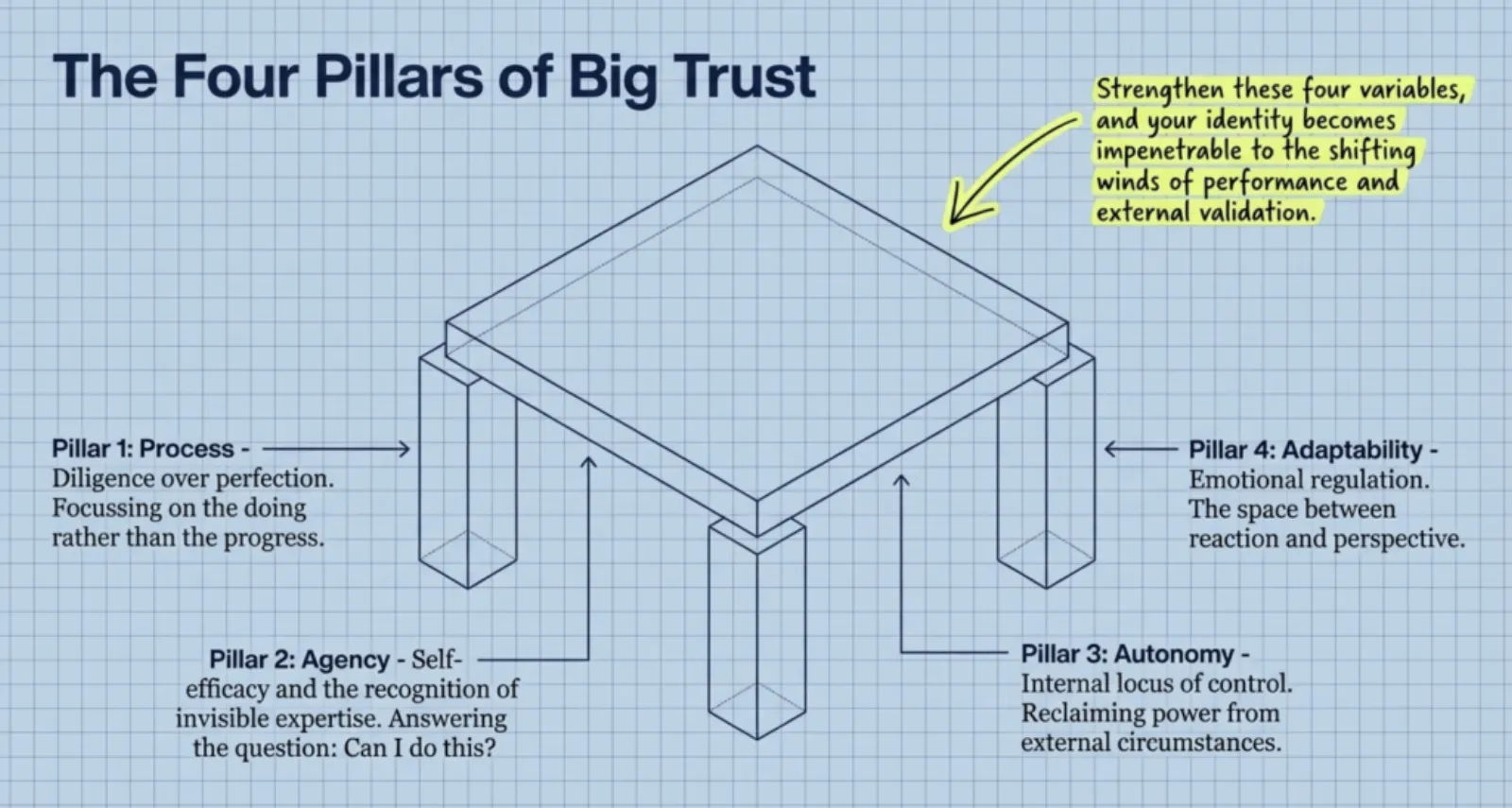
In her compelling London event, Dr. Shadé Zahrai shared a practical framework built around four pillars that strengthen self-trust and make self-doubt less able to derail you. These pillars aren’t about eliminating doubt, they’re about building an identity that can hold doubt without being defined by it.
Pillar 1: Acceptance — Lower Your Standards (Really)
Before Eat, Pray, Love became a movie and an Oprah pick, Elizabeth Gilbert was deep in the messy middle of writing her memoir. A constant voice in her head kept repeating: This sucks. That voice made it almost impossible to move forward.
Then she had a simple but powerful shift: “I never promised the universe I would write brilliantly. I only promised I would write.”
So she lowered the bar. She showed up. She wrote the sentence, then the paragraph. She got it done, good enough for now – knowing she could improve it later.
What this means in practice:
- Don’t aim to find your soulmate; go on the next date.
- Don’t worry about going viral; post consistently and care about who’s there.
- Don’t stress about having the perfect career; take the next visible step.
- Don’t make “succeeding” the goal; make starting the goal. If you don’t start, you can’t succeed.
Process over progress. Process over perfection. Show up and do the doing.
Pillar 2: Agency – “Can I Actually Do This?”
Agency is the belief that you have the skills, ability, or capacity to do the thing. It answers the question: Can I do this? Two obstacles commonly block it: the Dunning–Kruger effect and imposter syndrome.
The Dunning-Kruger Effect
People with very little knowledge often overestimate how good they are – they don’t know what they don’t know. As you learn more, you hit a “valley of despair”: you see how much there is to learn, and confidence drops. If you keep going, competence and confidence rise again. Most people quit in the valley. Agency is what helps you keep going.
Imposter Syndrome
Imposter syndrome is the opposite: you’re skilled, but you don’t feel it. You attribute success to luck, timing, or other people. Your skills have become so automatic that you forget how much you’ve already learned.
Paula Scher and the Napkin
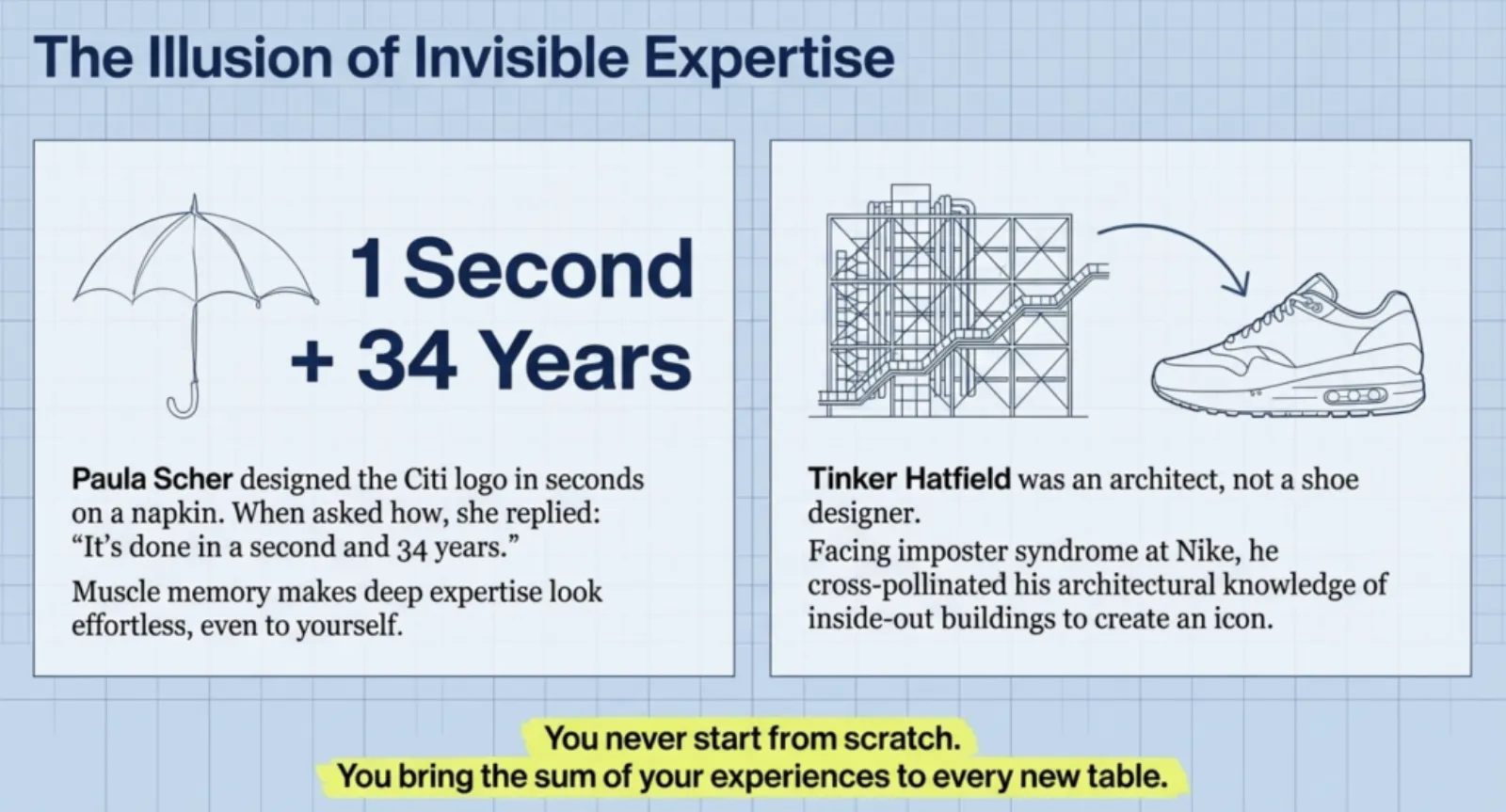
When Citigroup and Travelers merged, they needed a new logo. Paula Scher, a legendary graphic designer – sat in the meeting, drew on a napkin, and slid it across the table. When they asked how she designed a logo in seconds, her answer was disarmingly simple: “It’s done in a second and 34 years.” She wasn’t disqualifying herself; she was owning what she brought to the table.
 LIVE
Live every Tuesday at 2pm UK. Bring your marketing questions.
Get your Google, local SEO and AI questions answered live.
Tinker Hatfield and the Air Max
Hatfield was a corporate architect at Nike, not a footwear designer. When he won a 24-hour shoe design competition, he was thrown into a world he’d never been in. Instead of focusing on what he didn’t know, he asked: What have I already learned that could apply here?
He remembered the Centre Pompidou in Paris, an “inside out” building with its structure on the outside. He applied that idea to a shoe: a visible air pocket. That became the Air Max 1 and helped save Nike.
The reframe:
- “I don’t know how, and everyone will find out” → “I don’t know how and I’ll learn.”
- “I don’t deserve this” → “What an amazing opportunity to learn.”
- Or simply: “I’m here. How do I make the most of it?”
Pillar 3: Autonomy – Where Do You Place Control?
Autonomy is about locus of control: Do you feel that you have power over your life, or that everyone else holds the reins?
With an external focus, you focus on what you can’t control: the past, other people’s actions, others’ opinions. That shows up as complaining, resentment, and the same story on repeat. With an internal locus, you focus on what you can control: your response, your actions, your next move.
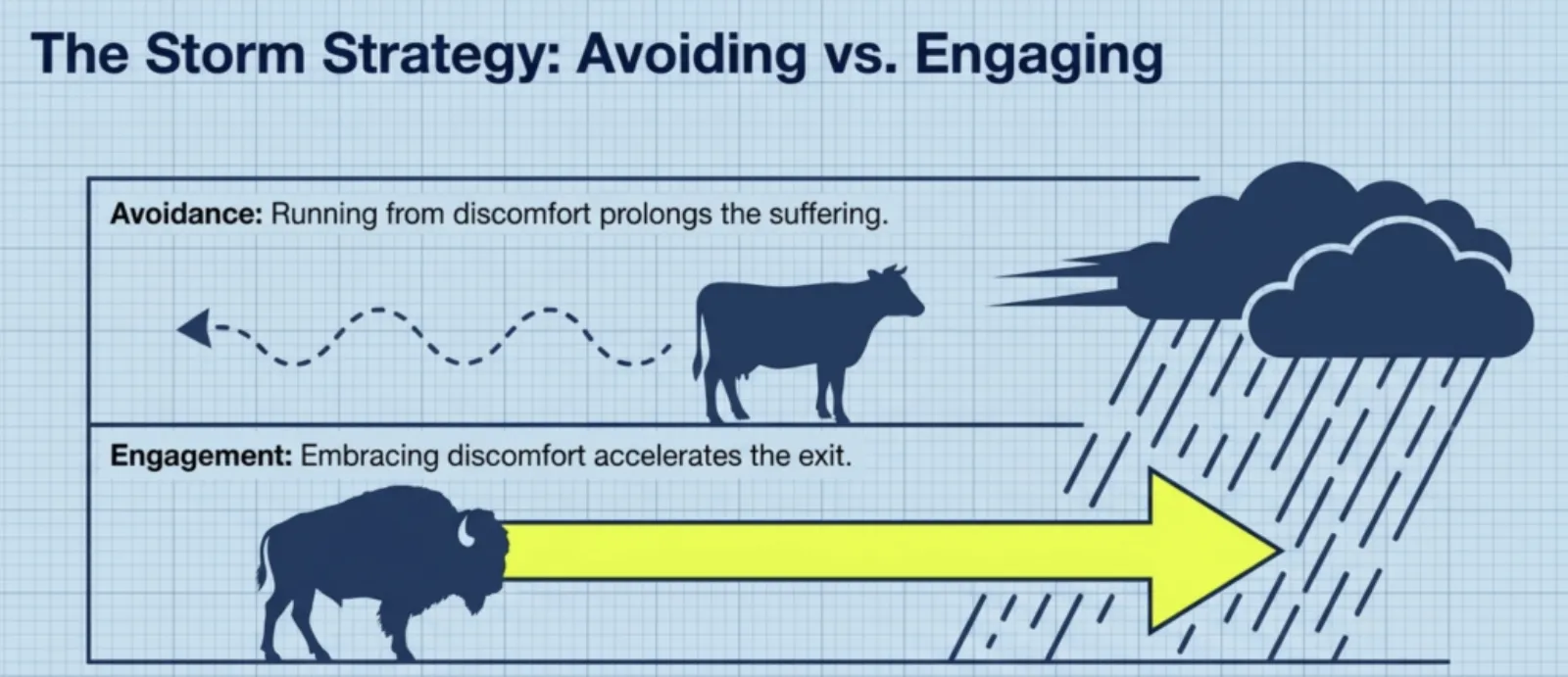
The Cow and the Bison
When a storm comes, cows tend to huddle or run with the wind and often get more of the storm. Bison walk into the storm and pass through it once. The same idea applies to the hard things in life: avoiding discomfort often prolongs it; engaging with it often shortens it. Running away reinforces “nothing good ever comes my way.” Engaging reinforces “I have power.”
Practical shifts to build autonomy:
- “Why me?” → “What now?” It is what it is. What am I going to do in response?
- “I should” → “I could” / “I will” “Should” triggers resistance. List what you could do (no commitment), then choose what you will do. That’s autonomy in action.
- Microdose the hard thing, If you’ve been avoiding something, start tiny, like exposure therapy for a phobia. One small step, then the next. You’re building proof that you can handle it.
When a storm is coming, a deadline, uncertainty, fear, ask: If I were the bison right now, what’s the first step I would take toward this?
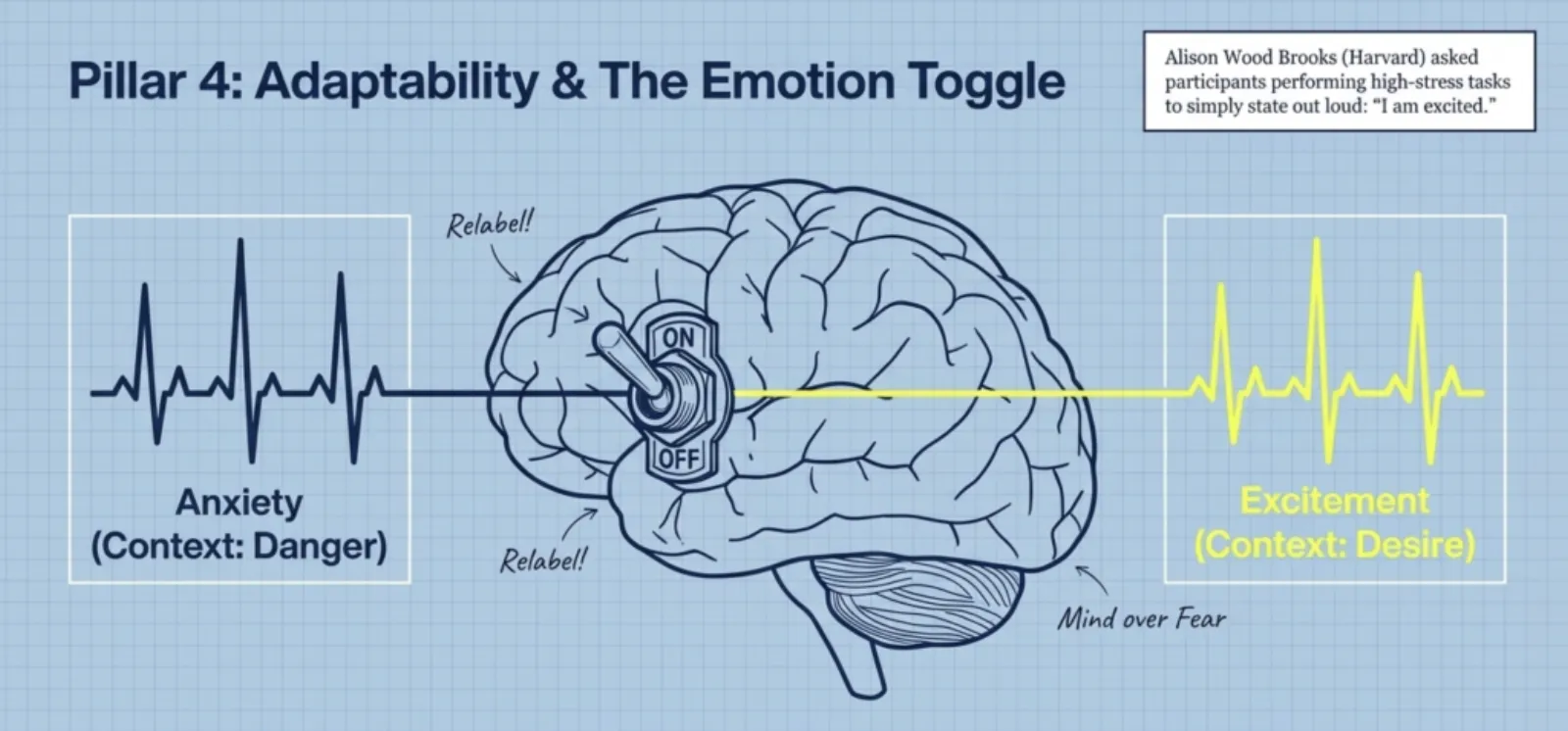
Pillar 4: Adaptability – Can I Handle the Emotions?
Adaptability answers: Can I handle what I’ll feel before, during, and after? If you don’t believe you can handle the emotions, you often won’t take the step, whether that’s leaving a bad relationship, changing jobs, or speaking up.
Anxiety vs. Excitement
Anxiety and excitement are almost identical in the body. The difference is context and how we label them. Research by Alison Wood Brooks at Harvard showed that people who said “I’m excited” before anxiety-inducing tasks, public speaking, singing, math, felt less anxious and performed better. So when you’re nervous about something you care about, try the reframe: I’m not anxious. I’m excited. My body is firing because I care.
Find Your Balcony
In the middle of chaos, we react from the “dance floor”, everything feels urgent and confusing. The “balcony” is a place to step back: a short drive, a walk, five minutes alone. From there you can see the pattern, reflect on your decisions, and choose how you want to show up. Adaptability lives in the space between reaction and perspective.
The Bigger Picture: Self-Trust, Not Self-Doubt Elimination
The goal isn’t to eliminate self-doubt. Doubt can be there. The goal is to strengthen who you are so that when doubt shows up, you can notice it, ask “What’s useful here?” and decide whether to listen. Thoughts are not facts. When we treat them as facts about who we are, that’s when we hold ourselves back.
These four pillars: acceptance, agency, autonomy, adaptability – shape how you see yourself and how you show up.
And perhaps the sharpest shift of all: the key to self-mastery is self-forgetting. The more we fixate on ourselves, how we’re coming across, whether we’re good enough, the louder the inner critic. When we turn our focus outward. How can I help? How can I add value? that voice often quiets. Small things count: a smile, holding the door, a moment of presence for someone else.
You don’t have to wait for permission or the “right” moment. You can start with one thing today: one process you’ll show up for, one standard you’ll lower, one “what now?” you’ll ask, or one moment on your balcony. That’s how unshakeable self-trust is built, not in one big leap, but in the daily choice to focus on the process and trust yourself through it.

Written by Uzair Kharawala
Partner at SF Digital Studios, a Google Premier Partner agency. Uzair has been helping businesses grow with Google Ads since 2002 and teaches it every week on YouTube.
Get our best Google Ads tips by email
New articles and videos, straight to your inbox. Unsubscribe any time.