

Did you know that over 80% of consumers now use AI-powered search engines or chatbots for product research and recommendations? The digital landscape is undergoing a monumental shift, moving beyond traditional keyword searches to embrace conversational AI.
If your business isn’t optimized for this new era, you risk becoming invisible to potential customers. The question isn’t whether AI will impact your online visibility, but how quickly you can adapt to thrive.
The Dawn of Conversational Search: Why AI SEO Matters Now More Than Ever
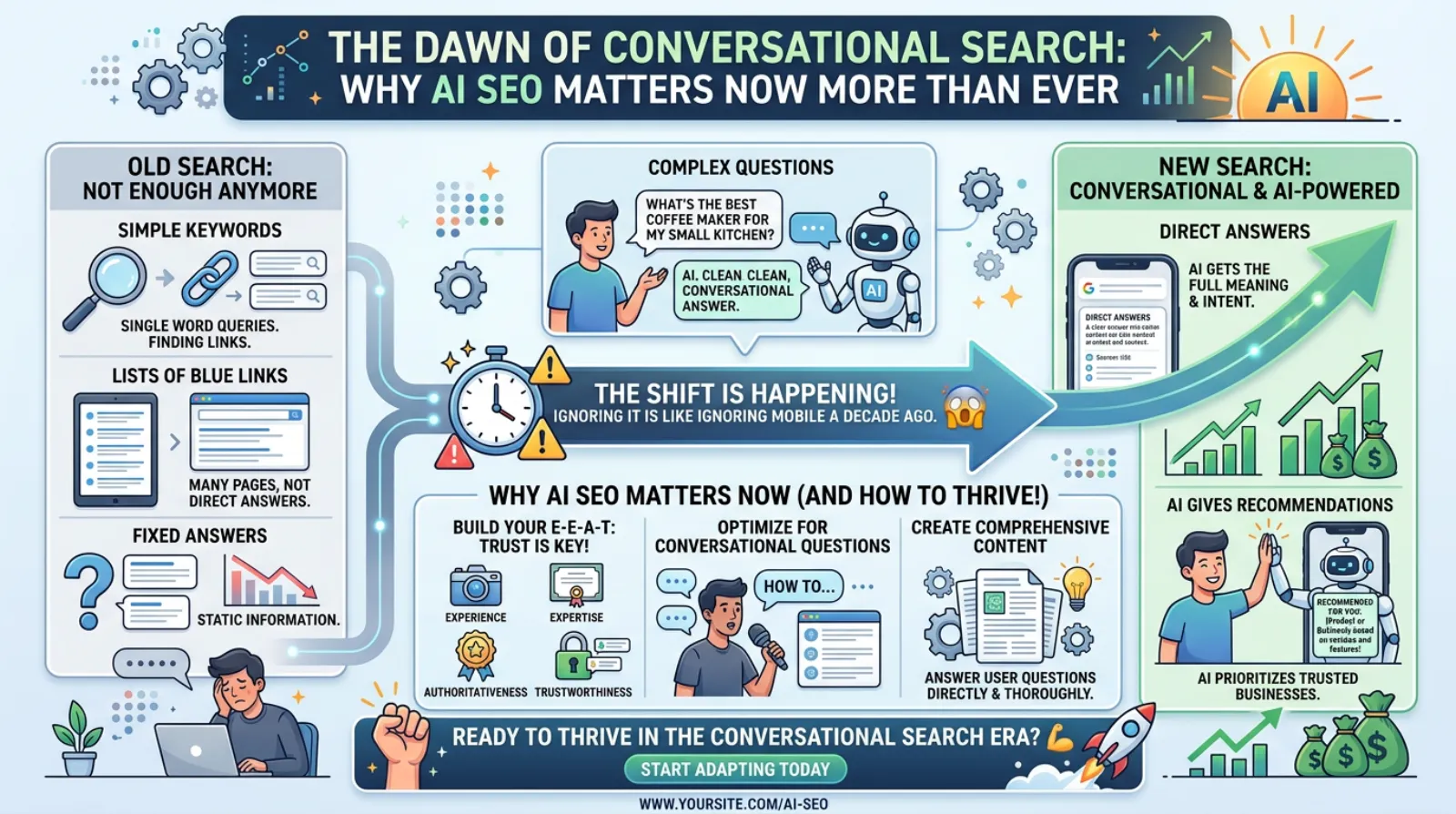
For years, search engine optimization (SEO) focused on keywords and technical adjustments for Google’s algorithms. However, the rise of sophisticated large language models (LLMs) like ChatGPT, Gemini, and Copilot has introduced conversational search. Users now ask full questions, seeking nuanced answers and personalized recommendations directly from AI.
The Shifting Search Landscape: Beyond Traditional Keywords
Customers are asking complex queries like, “What’s the best eco-friendly coffee maker for a small kitchen?” or “Find me a local plumber who specializes in historic homes.” These queries demand a deep understanding of intent and context.
Traditional keyword stuffing falls short when AI synthesizes information to provide a single, authoritative answer. Being recommended by an AI means being the definitive, trusted source for a user’s question, not just appearing in a list of links.
Why Your Business Can’t Afford to Ignore AI SEO
Ignoring AI SEO is a fundamental necessity for future visibility. Small businesses, in particular, stand to gain immensely. AI rewards clarity, trustworthiness, and helpfulness—qualities any business can cultivate. Being recommended by these AI platforms offers unparalleled exposure, positioning your brand as a trusted authority. This builds brand equity and converts curious users into loyal customers.
Understanding the AI Brain: How ChatGPT, Gemini, and Copilot “See” Your Content
To optimize for AI, we need a basic grasp of how these sophisticated models work. Think of ChatGPT, Gemini, and Copilot as advanced conversational agents that process language much like humans do, but on a massive scale. They don’t just match keywords; they understand concepts, relationships, and context.
The Role of Natural Language Processing (NLP)
At the heart of AI SEO is Natural Language Processing (NLP). NLP allows AI models to interpret and derive meaning from human language. When AI processes your website, it analyzes sentence structure, identifies entities, understands sentiment, and recognizes overall topics. This means creating content that flows naturally, answers questions thoroughly, and addresses the broader intent behind a user’s query.
Semantic Understanding: More Than Just Matching Words
Semantic understanding is critical in AI SEO. It means the model understands “apple” in various contexts—as a fruit, a technology company, or a brand of cider. Your content needs to semantically cover the entire topic, addressing related concepts, common questions, and relevant entities. This comprehensive approach signals to the AI that your page is a valuable resource.
User Intent: The Core of AI Recommendations
Ultimately, AI models are designed to serve user intent. Whether a user wants to know something (informational), do something (transactional), or go somewhere (navigational), the AI strives to provide the most accurate response. If your content aims to inform, it should be exhaustive and unbiased. AI tools are adept at discerning intentions, prioritizing content that best aligns with them.
From Keywords to Concepts: Crafting Content for AI Recommendation
The shift to AI SEO changes how we approach content creation. It’s about genuinely serving the user with valuable, well-structured information that AI can easily interpret and trust.
Semantic Keywords vs. Traditional Keywords
Traditional keyword research focused on exact matches. Semantic keyword research delves into broader topics, identifying related terms, synonyms, and common questions. For example, “sustainable fashion” might include “ethical clothing brands” or “slow fashion movement.” AI looks for this rich tapestry of related terms to confirm content depth and relevance.
Creating Comprehensive and Contextually Rich Content
AI models favor thorough, comprehensive answers. Aim for deep-dive “pillar content” that covers all facets of a concept, demonstrating expertise. Ensure your content offers diverse perspectives, real-world examples, and credible sources. When discussing a product, explain benefits, ideal use cases, and comparisons, providing rich context for AI.
Answering User Questions Directly and Clearly
Conversational AI thrives on direct answers. Identify questions your audience asks and incorporate them as headings, providing clear, concise answers. Use straightforward language, avoid jargon, and break down complex ideas. This makes it effortless for AI to extract key information, improving accuracy and readability for human users.
Storytelling for AI: Engaging Both Humans and Algorithms
While AI processes data, it serves human users who respond to stories. Integrating storytelling elements makes content engaging, leading to higher dwell times and lower bounce rates—positive signals for AI. Share customer success stories or business journeys. AI understands narrative flow, making well-told stories valuable for engagement.
Technical SEO in the AI Age: Optimizing for Machine Readability and Trust
Content is paramount, but technical SEO remains the bedrock for AI recommendations. If AI can’t easily access, understand, and trust your website, even the best content will struggle.
Structured Data: Speaking AI’s Language
Structured data, using Schema.org markup, is a universal translator for AI. It explicitly tells AI models what your content is about, identifying product reviews, FAQs, or business hours. Properly implemented structured data boosts machine readability, enabling AI to extract facts and present them directly in conversational answers or rich snippets.
Core Web Vitals and User Experience: A Foundation for AI
Google’s Core Web Vitals (CWV)—loading performance, interactivity, and visual stability—are more crucial than ever. AI models prioritize fast, stable, and user-friendly websites. A strong CWV score signals quality and relevance, acting as a foundational trust signal. Ensure your website is responsive, mobile-friendly, and provides a smooth browsing experience.
Mobile-First Indexing and AI Prioritization
The internet is mobile, and AI models reflect this. Google’s mobile-first indexing primarily uses the mobile version of your content. Optimizing for mobile—with clear navigation, readable text, and fast loading—is non-negotiable for AI visibility. AI models prioritize mobile-friendly content, recognizing frequent user interaction on smartphones.
Ensuring Content Accessibility for All Users and Bots
Accessibility benefits both human users and bots. Use proper HTML headings (H1, H2, H3), alt text for images, descriptive anchor text, and logical content structure. When your content is semantically structured and accessible, AI models can crawl, index, and understand it more effectively. This ensures your information is fully processed by AI.
Building Authority and Trust: E-E-A-T and Beyond with AI
In a world of information overload, trust and authority are invaluable. AI models prioritize content demonstrating high levels of E-E-A-T: Experience, Expertise, Authoritativeness, and Trustworthiness. This is your business’s ultimate advantage.
E-E-A-T in an AI World
E-E-A-T is crucial for AI, which is programmed to favor reliable sources. Showcase Experience through case studies and testimonials. For Expertise, attribute content to qualified individuals. Build Authoritativeness through consistent, high-quality content linked by respected sites. Trustworthiness includes a secure website (HTTPS), privacy policies, and contact information.
Showcasing Your Brand’s Unique Value Proposition
Your unique value proposition (UVP) needs to shine through your content. AI models identify distinct qualities and offerings. Clearly articulate what sets you apart, whether it’s a proprietary process or specialized niche. When AI grasps your UVP, it better recommends your business to users seeking those specific qualities.
Cultivating Brand Mentions and High-Quality Backlinks
Brand mentions, even unlinked, significantly contribute to AI’s assessment of your authority. When reputable sites or influencers discuss your brand positively, it signals recognition and respect. High-quality backlinks remain crucial votes of confidence. Focus on earning mentions and links through genuine outreach and exceptional products.
The Importance of a Strong Online Reputation
Online reviews, testimonials, and social media sentiment are increasingly important for AI SEO. AI models analyze data to gauge public perception. Positive reviews on Google My Business or Yelp signal trust and customer satisfaction. Proactively managing your reputation provides AI with positive data points, enhancing your E-E-A-T.

Actionable Strategies: Getting Your Business Recommended by AI
Let’s dive into practical steps your business can take today to start optimizing for AI SEO.
Step 1: Conduct AI-Driven Keyword Research and Topic Clustering
Move beyond single keywords. Use tools to identify related topics, semantic entities, and common questions. Cluster these into comprehensive content hubs. This approach ensures your content covers a broad, interconnected range of user intent, making it a valuable resource for AI.
Step 2: Optimize for Conversational Search Queries
Think about how people speak, not just type. Use long-tail, question-based keywords in your headings and content. Structure your answers clearly and concisely, using natural language that mirrors AI interactions. This prepares your content for direct inclusion in AI-generated answers.
Step 3: Implement Advanced Structured Data Markups
Go beyond basic Schema.org. Utilize specific markups like ‘Product,’ ‘Review,’ ‘FAQPage,’ ‘HowTo,’ and ‘LocalBusiness.’ For e-commerce, marking up product details is crucial. This provides AI with explicit, unambiguous information, making it easier to extract and present accurate details.
Step 4: Focus on User Engagement Metrics (Dwell Time, Bounce Rate)
AI models pay close attention to user interaction. High dwell time and low bounce rates signal engaging and helpful content. Ensure your content is well-written, visually appealing, easy to navigate, and delivers on its promise. Internal linking and interactive elements can boost engagement.
Step 5: Regularly Update and Refresh Existing Content
Stale content can hurt your AI SEO efforts. Regularly review and update existing articles, adding new insights and expanding on topics for accuracy and comprehensiveness. AI models favor up-to-date, relevant information, and a content refresh signals a dynamic, reliable source.
Measuring Success in the AI SEO Landscape: New Metrics, New Focus
Traditional SEO metrics still hold value, but AI SEO demands a broader approach. It’s about how often you’re cited, recommended, and trusted by AI systems.
Beyond Rankings: Tracking Visibility in AI Answers
The new frontier is being the source for an AI’s direct answer. Monitor if your business is mentioned or quoted in AI-generated summaries from ChatGPT, Gemini, or Copilot. Track appearances in featured snippets and knowledge panels. This broader view gives a more accurate picture of your AI visibility.
Analyzing User Behavior on Your AI-Optimized Pages
Deep dive into analytics beyond traffic numbers. Look at engagement metrics like average session duration, bounce rate, and conversion rates for traffic from AI-driven queries. These metrics indicate that your content is not only found by AI but also effectively meets user intent and drives desired actions.
Monitoring Brand Mentions and Sentiment
Track how often your brand is mentioned across the web, including social media and news sites. Tools for sentiment analysis gauge whether mentions are positive, negative, or neutral. A consistent stream of positive brand mentions contributes to your E-E-A-T, signaling trustworthiness to AI.
Case Study Spotlight: Businesses Thriving with AI-Optimized Content
Let’s look at how one real-world business is leveraging AI SEO to achieve remarkable results.
Local Business Case: From Obscurity to AI Recommendation
“Healthy Pet Treats,” a small, family-owned pet food store, transformed its online presence through AI SEO. They updated their Google My Business profile, implemented ‘LocalBusiness’ structured data, and created blog content around hyper-local queries like “grain-free dog food in [City Name].”
They also encouraged detailed reviews. When local residents asked AI for “organic pet food near me,” Healthy Pet Treats consistently appeared as a top recommendation, leading to a 40% increase in foot traffic and online orders.
Frequently Asked Questions About AI SEO
What is AI SEO and how is it different from traditional SEO?
AI SEO optimizes content for visibility and recommendation by AI models like ChatGPT, Gemini, and Copilot, in addition to traditional search engines. It differs by emphasizing semantic understanding, user intent, E-E-A-T, and comprehensive, conversational content, rather than solely focusing on keyword matching and backlinks.
How do large language models like ChatGPT, Gemini, and Copilot find information?
These LLMs process vast datasets from the internet using Natural Language Processing (NLP) to understand meaning and context. When a user asks a question, the AI sifts through its trained knowledge base, cross-references with web data, and synthesizes information to provide coherent answers. They prioritize clear, comprehensive, trustworthy content.
What is E-E-A-T and why is it important for AI recommendations?
E-E-A-T stands for Experience, Expertise, Authoritativeness, and Trustworthiness. It’s a framework used by AI to assess content quality and reliability. It’s crucial because AI models are programmed to provide accurate and trustworthy information. Demonstrating strong E-E-A-T signals to AI that your content is a reliable source, making it more likely to be recommended.
Final Thoughts: Your Future in AI-Powered Search
The landscape of online visibility is undergoing a profound transformation driven by artificial intelligence. AI SEO is a fundamental shift defining how businesses connect with customers. By embracing semantic understanding, prioritizing user intent, meticulously building E-E-A-T, and implementing smart technical optimizations, your business can be genuinely recommended by AI systems.
This proactive approach ensures your brand remains relevant, trustworthy, and visible in an increasingly intelligent digital world. The time to adapt your SEO strategy for AI is now. Start by auditing your existing content, implementing structured data, and refining your content for conversational queries.

Written by Uzair Kharawala
Founder of SF Digital Studios, a Google Premier Partner agency. Uzair has been helping businesses grow with Google Ads since 2002 and teaches it every week on YouTube.
Get our best Google Ads tips by email
New articles and videos, straight to your inbox. Unsubscribe any time.