

Addressing Modern Visual Communication Challenges
Design professionals across industries face increasing demands for unique visual assets in shorter timeframes. Marketing departments require consistent imagery across campaigns. Educational institutions need accessible visualisations of complex concepts. Startups and small businesses struggle to establish visual identities with limited resources. These challenges have created an environment where traditional illustration workflows often fall short of meeting contemporary needs.
Versatility in Style and Application
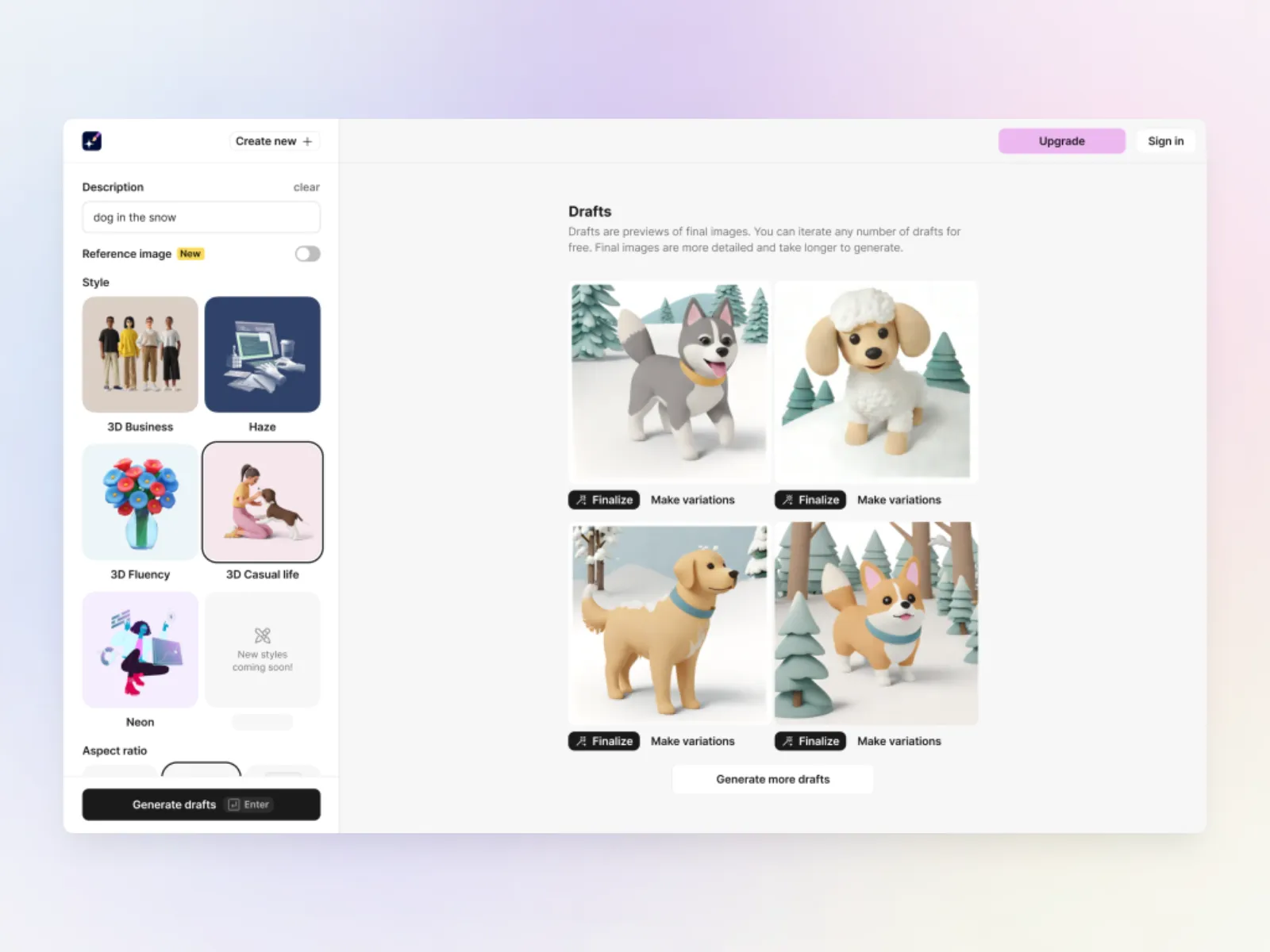
A distinguishing feature of Icons8’s tool is the range of styles available to users. The platform offers various aesthetic directions, including:
- Whimsical and playful illustrations suitable for creative and educational contexts
- Corporate and professional styles appropriate for business communications
- Simplified line art ideal for instructional materials
- Detailed conceptual illustrations for complex idea visualisation
- Character-based illustrations with diverse representation options
This versatility makes the tool applicable across multiple communication contexts, from marketing materials to educational content, product documentation to social media assets. Each style maintains internal consistency while offering customisation options to align with specific brand requirements.
Case Studies: Real-World Implementation
Educational Technology Transformation
When Learnify, an online learning platform, needed to illustrate 200+ scientific concepts for their biology curriculum, they faced a significant obstacle: their design team estimated 6-8 weeks for completion using traditional methods, with costs exceeding $15,000.
By implementing Icons8’s illustration technology, their curriculum development team accomplished the following:
- Reduced production timeline from 8 weeks to 5 days
- Decreased illustration costs by 87%
- Measured 28% higher information retention among students
- Enabled non-designers to create supplementary visuals
The platform’s curriculum director noted: “The ability to rapidly generate conceptual visualisations allowed us to allocate design resources strategically while maintaining consistent quality across all learning modules.”
Startup Identity Development
For early-stage companies, establishing a visual identity often presents a financial dilemma: invest substantially in custom design or compromise with generic stock imagery.
Novus, a financial technology startup, documented its process using Icons8’s tool:
- Created consistent illustration sets for product walkthrough sequences
- Developed unique visual metaphors for abstract financial concepts
- Established visual brand language without specialised design staff
- Maintained visual consistency across marketing materials and product interfaces
Their experience highlights how emerging AI illustrator generator tools have fundamentally altered the economics of visual brand development.
Enterprise Production Workflow Integration
Large organisations have integrated this technology differently, focusing on efficiency rather than cost reduction. Meridian Healthcare incorporated the tool into their patient education workflow with the following results:
- Reduced illustration request-to-delivery time from 7 days to under 2 hours
- Enabled content specialists to generate initial concepts before designer refinement
- Maintained consistent visual language across 12 departments
- Allowed for rapid creation of culturally diverse representation in patient materials
The Technical Architecture Behind the Results
Understanding the tool’s effectiveness requires examining its underlying technology. The Illustration Generator operates through a sophisticated neural network architecture with several key components:
Natural Language Processing Engine
- Processes descriptive text to extract visual concepts
- Identifies relationships between elements
- Translates abstract concepts into visual representations
Vector Rendering System
- Maintains resolution independence
- Enables editing of individual elements
- Ensures compatibility with industry-standard design software
Style Consistency Framework
- Applies consistent visual treatments across multiple generations
- Maintains proportional relationships between elements
- Preserves brand-specific stylistic attributes when specified
Compositional Intelligence
- Applies principles of visual hierarchy and balance
- Arranges elements according to established design principles
- Creates visual flow appropriate to content purpose
This technical foundation enables the system to bridge the gap between textual description and visual output with unprecedented efficiency.
Accessibility and User Experience
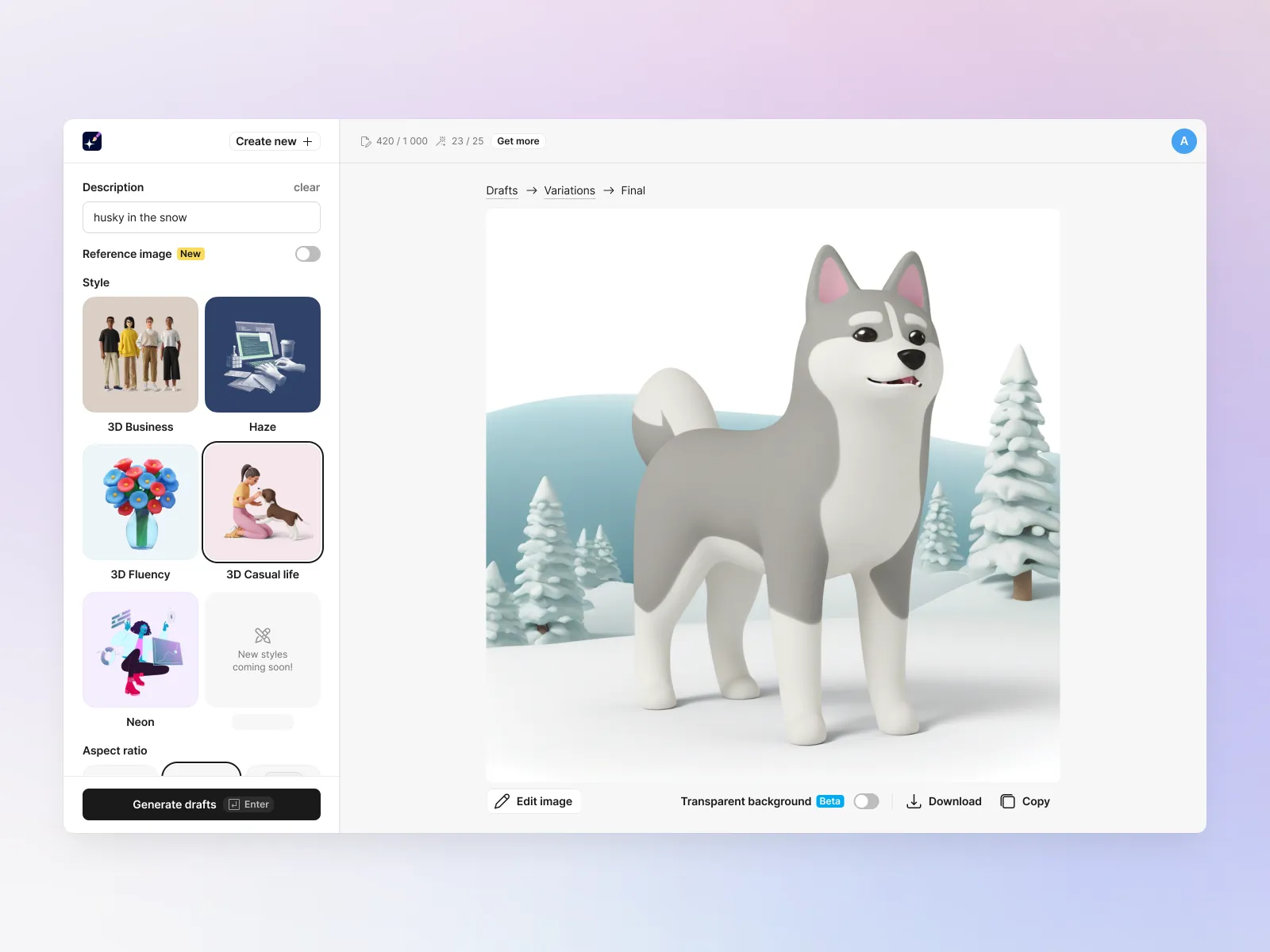
The platform’s design prioritises accessibility for users with varying levels of design expertise. Key interface features include:
- Intuitive prompt construction guidance
- Real-time preview capabilities
- Suggestion system for prompt refinement
- Multiple export options, including PNG, SVG, and editable formats
- History tracking for iteration management
These features support both novice users and design professionals, allowing each to leverage the technology according to their specific needs and expertise levels.
Comparative Analysis: Economic and Workflow Impact
When evaluated against traditional illustration methods, the economic impact becomes clear through several key metrics based on documented case studies across various implementation scenarios:
Production Time: Traditional illustration processes typically require 18-40 hours for completion, while AI-assisted workflows reduce this to just 15-60 minutes—representing a 94-99% reduction in production time.
Cost Efficiency: The financial impact is equally significant, with traditional custom illustrations ranging from $500-2,500 compared to AI-assisted illustrations at $10-50, yielding a 90-98% cost reduction.
Revision Efficiency: Traditional workflows often require 2-3 rounds of revisions, while AI-assisted processes typically need only 1-2 rounds, representing a 33-66% reduction in revision cycles.
Skill Accessibility: Perhaps most significantly, the technical skill requirement has shifted from advanced expertise to basic proficiency, dramatically expanding who can create professional illustrations.
Visual Consistency: Organisations report notably improved consistency across multiple assets when using AI-assisted tools compared to moderate consistency in traditional multi-illustrator projects.
Integration Capabilities
The platform provides multiple integration options for incorporation into existing workflows:
- API access for programmatic illustration generation
- Design software plugins for seamless workflow integration
- Batch processing capabilities for high-volume requirements
- Team collaboration features for enterprise environments
These integration options enable organisations to incorporate the technology into established systems rather than requiring workflow disruption.
Professional Role Evolution
The emergence of AI illustration tools has initiated a transformation in design roles rather than simply eliminating positions. Design professionals report several key shifts:
- Increased focus on strategic direction rather than technical execution
- Greater emphasis on art direction and brand guidance
- Development of prompt engineering as a specialised skill
- Evolution of illustration roles toward refinement and customisation
A senior designer at a major advertising agency notes: “Our illustrators now function primarily as directors and editors rather than producers. They establish visual direction, then leverage the technology to explore variations and produce assets at scale.”
Implementation Framework for Maximum Effectiveness
Organisations that have successfully integrated this technology follow a structured implementation approach:
Assessment Phase
- Identify visual asset requirements across departments
- Document current production workflows and bottlenecks
- Establish quality benchmarks and acceptance criteria
- Define roles and responsibilities in the new workflow
Integration Phase
- Develop organisation-specific prompt libraries
- Create style guidelines for AI-assisted illustration
- Establish approval workflows and quality control processes
- Train team members in effective prompt engineering
Optimisation Phase
- Document successful prompt patterns
- Refine workflow based on production metrics
- Develop hybrid approaches combining AI generation with human refinement
- Create feedback loops for continuous improvement
This structured approach ensures that organisations capture maximum value while maintaining quality standards.
Content Rights and Usage Considerations
An important advantage of the Icons8 Illustration Generator is the clear rights structure it provides. Unlike some AI-generated content that may incorporate elements with unclear provenance, illustrations created through this platform come with defined commercial usage rights. This provides organisations with legal certainty for:
- Marketing materials and advertising campaigns
- Product documentation and commercial publications
- Digital products and interfaces
- Educational and training materials
This legal clarity represents a significant advantage in an environment where AI-generated content rights are often ambiguous.
Addressing Limitations Through Strategic Application
Despite its capabilities, the tool has defined constraints that require acknowledgment and accommodation:
- Complex anatomical illustrations benefit from human refinement
- Highly specific brand elements may require manual adjustment
- Nuanced emotional expressions occasionally need enhancement
- Specialised artistic techniques may be approximated rather than replicated
Successful implementations address these limitations through strategic application—using the tool for appropriate use cases while maintaining traditional approaches where necessary.
Future Development: From Illustration to Visual Communication Systems
Current technological trajectories suggest several emerging capabilities:
- Integration with animation systems for simplified motion graphics
- Connection to design systems for brand-consistent generation
- Development of narrative-aware sequential illustration capabilities
- Enhanced collaboration features for designer-AI workflows
These developments point toward a future where such tools function as comprehensive visual communication systems rather than simply illustration generators.
Conclusion: A Strategic Assessment
The Icons8 Illustration Generator represents not merely an incremental improvement in illustration efficiency but a fundamental shift in how visual assets are conceptualised and produced. The most successful implementations treat this technology not as a replacement for human creativity but as an amplifier—expanding capabilities, accelerating processes, and democratising access to professional-quality visual communication.
Organisations across sectors would benefit from evaluating this technology not simply as a cost-reduction measure but as a strategic asset that can transform visual communication workflows and outcomes. As with any transformative technology, the greatest value emerges not from the tool itself but from the thoughtful implementation strategies that leverage its capabilities within specific organisational contexts.

Written by Uzair Kharawala
Founder of SF Digital Studios, a Google Premier Partner agency. Uzair has been helping businesses grow with Google Ads since 2002 and teaches it every week on YouTube.
Get our best Google Ads tips by email
New articles and videos, straight to your inbox. Unsubscribe any time.