
You have 80 reviews. The plumber above you on the map has 12, and their name on Google is "Emergency Plumber Leighton Buzzard".
Yes, a keyword in your business name still helps you rank on Google Maps in 2026, and Whitespark's expert survey ranks it third of all map factors. But adding one that is not part of your real name breaks Google's rules and can get your profile suspended. The only safe way to get the boost is a real name change.
That's the short answer. The rest of this post shows how big the effect is and where Google draws the line. It also covers what to do when a competitor is gaming it.

Get Found, Get Chosen, Get Your Time Back
A free one-day marketing seminar in Milton Keynes · 13 January 2027
Get your free Marketing Action PlanNot sure where to start? Answer a few questions and get your plan in about a minute. No email needed.
Get my plan →It is one of the most common things owners ask us about.
They see a rival with fewer reviews and a clunky website sitting above them. Then they spot the name, and it all makes sense.
The question is what to do about it. Copy them? Report them? Rename the business? Each one has a cost, and some carry real risk.
We will go through the data, Google's own wording and the UK rules on trading names. Then we'll cover the safer ways to win the map without touching your name at all.
A quick note on where this comes from. SF Digital Studios looks after Google Business Profiles, Google Ads and websites. Our clients are local firms around Leighton Buzzard and Milton Keynes.
The facts below come from Google's help pages, GOV.UK and published studies by Whitespark and Sterling Sky. Where something is our view rather than a fact, we say so.
What Does A Keyword In Your Business Name Actually Mean?
A keyword in your business name means the name on your Google Business Profile contains a word people search for, such as "plumber", "dentist" or "Luton". If that word is part of your real trading name, it is fine. If it's been added on Google only, to rank higher, that's keyword stuffing, and Google bans it.
There are two kinds of match, and the difference matters.
An exact match name contains the whole search phrase. "Leighton Buzzard Roofing" is an exact match for anyone searching "roofing Leighton Buzzard".
A partial match name contains only part of it. "Dave's Roofing & Building" is a partial match. It has the service word but not the town.
Then there is the name with no keyword at all. Think "Hartley & Sons" or "Bluebird".
Lots of good businesses have names like that. They are memorable, but they don't tell Google what you do.
Keyword stuffing is something else again. It's when the real name on the van says "Hartley & Sons", but the Google profile says "Hartley & Sons Plumber Heating Engineer Leighton Buzzard".
The extra words exist only on Google.
That gap between the real world and the listing is the whole issue.
Google does not object to a keyword in a name. It objects to a name that's been dressed up for the map.
Does A Keyword In Your Business Name Still Help You Rank?
Yes, and by a lot. Two separate pieces of research from Whitespark point the same way.
The first is Whitespark's Local Search Ranking Factors report for 2026, published in November 2025. Whitespark asks dozens of local search specialists to score 187 factors.
Keywords in the Google Business Profile name came third for map rankings, with a score of 223. Only two factors scored higher. They were your primary category (227) and how close you are to the searcher (225).
The second is hard data. In September 2026, Whitespark published a study of more than 1.4 million business listings across 17 industries.
It compared how often listings with and without keywords in their names reached the top three.
The gaps were large in some industries. Here are a few of the top-three rates it reported.
- Travel and tourism: 29.5% with an exact match, 6.1% with no keyword
- Retail: 15.1% with an exact match, 3.1% with no keyword
- Beauty and personal care: 15.6% with an exact match, 2.5% with no keyword
- Medical and health: 9.6% with an exact match, 2.9% with no keyword
In travel, an exact-match name reached the top three nearly five times as often. In real estate, the effect was among the weakest in the whole data set.
The study also looked at word order. Names starting with the keyword did better in 15 of the 16 industries it had enough data for. "Plumbing by Andy" beat "Andy's Plumbing", in other words.
There is an important caveat. This is correlation, not proof. Businesses with keyword names may also be older, better known or more focused, and those things help too.
So the third piece of evidence is useful. Sterling Sky, a local search agency, ran a test that Joy Hawkins first presented in 2020 and published in August 2023.
They added "Salad Bar" to the Google name of a restaurant. Its rankings for "salad bar" searches jumped.
They removed it, and the rankings fell back. They added it again, and the rankings jumped again.
Sterling Sky also tracked businesses that had their stuffed names fixed by Google.
One drug rehab centre ranked first for the words in its name. Two days after Google removed those words, it was seventh.
That is about as clear as local search evidence gets. The name works, and it works fast.
Why Does Google Still Reward Keywords In Names?
Because the name is one of the strongest clues Google has about what a business does. As of November 2026, Google's help page on local ranking says results are mainly based on relevance, distance and prominence.
Relevance is how well a profile matches the search. A name that contains the search words looks like a near-perfect match.
Google is trying to help people find things. Someone searching "Luton Tyres" might be looking for a shop called exactly that.
Google can't easily tell a real name from a stuffed one, so it gives the name weight.
There is a human side too, and this part is our view.
A name that says what you do gets clicked. "Hartley & Sons" asks the searcher to work. "Hartley Plumbing" does not.
Google has tried to turn the dial down before. Joy Hawkins wrote in January 2023 that keywords in names "took a huge hit" in a November 2021 update.
She also said it was reversed by March 2022, probably because it upset searches for real brands.
So Google knows about the problem. It just hasn't found a way to stop rewarding the name without breaking searches for genuine businesses.
Why You Need To Know Where The Line Is
You are probably competing with at least one stuffed listing right now. In a lot of trades, it is the norm rather than the exception.
That puts you in a tricky spot. Do nothing, and a rival with weaker reviews can outrank you. Copy them, and you risk losing your profile.
Get it wrong and the cost isn't a slightly lower position. A suspended profile drops off the map completely.
Your reviews stop showing, your calls dry up and the address details in your Google Ads can stop showing too.
Get it right and you have options. You can rename properly, if it suits the business.
You can push the other ranking factors harder. And you can report the rivals who are breaking the rules.
There's also the question of AI search. ChatGPT, Gemini and Google's own AI answers are now recommending local businesses by name.
Whitespark's September 2026 study says plainly that it did not have AI ranking data to test this.
Our view is simple. AI tools read the same signals people do.
A clear, honest name that says what you do will never hurt you there. A name that gets flagged as spam might.
Where Your Business Name Sits On The Risk Map
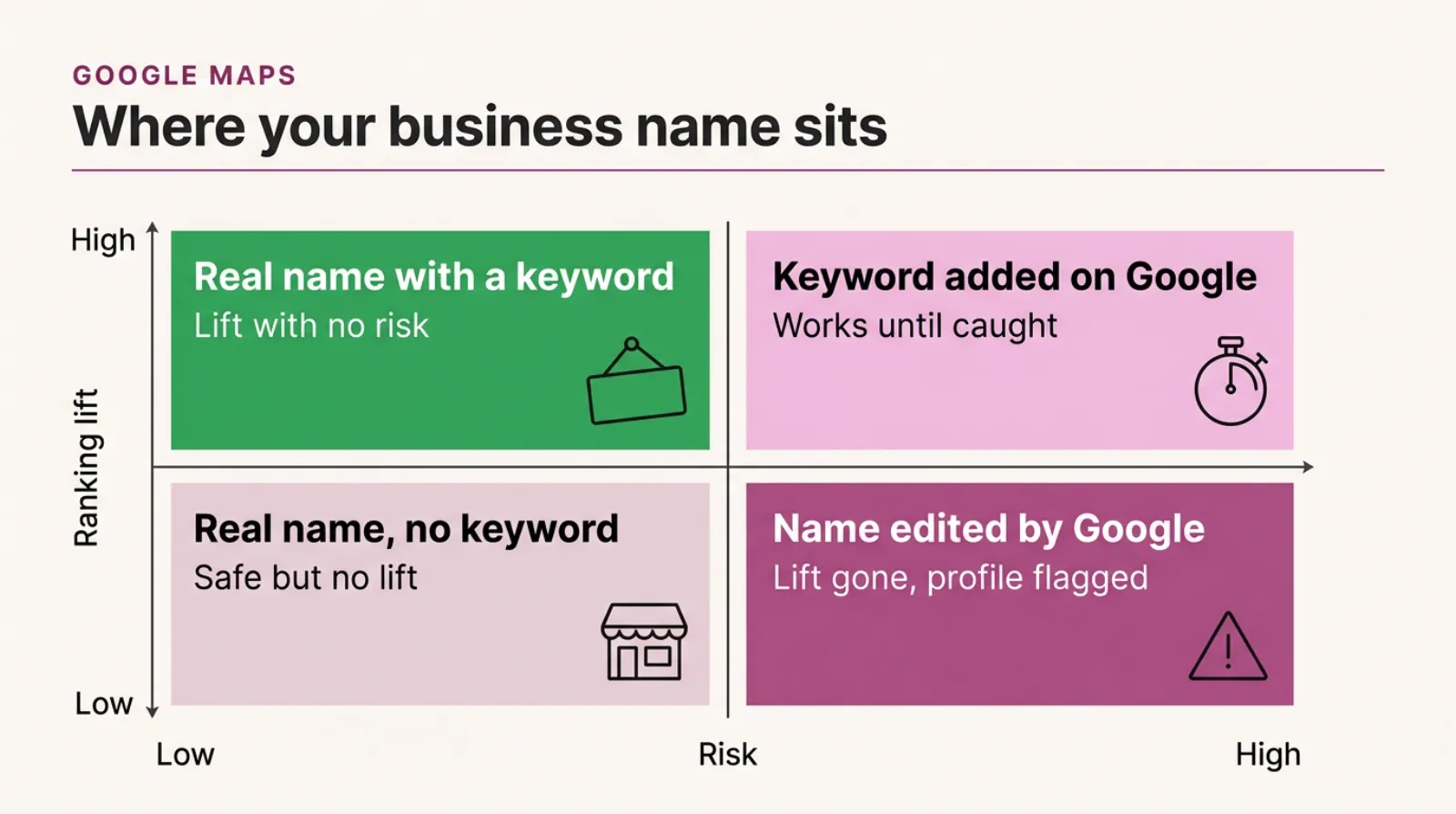
A grid of four business name types plotted by ranking lift and risk: a real name with a keyword gives lift with no risk, a real name with no keyword is safe but gives no lift, a keyword added on Google works until it is caught, and a name edited back by Google loses the lift and gets the profile flagged.
Only one box gives you the lift without the risk. That's a real trading name with a keyword in it.
What Do Google's Rules Say About Your Business Name?
Google's rules say your profile name must match your real-world name, exactly as customers see it. As of November 2026, its guidelines say the name should be "as used consistently on your shopfront, website, stationery and as known to customers".
The same page is blunt about the penalty. Including unnecessary information in your business name "isn't permitted, and could result in the suspension of your Business Profile".
Google then lists what a name must not include. Here is that list in plain English.
- Marketing taglines, such as "the town's most trusted"
- Shop codes or branch numbers
- Trademark or registered signs
- Words in full capitals, unless that is genuinely how the brand is written
- Opening hours, such as "Open 24 hours"
- Phone numbers or web addresses
- Special characters or legal terms like "Ltd", unless you can prove they are part of your name
- Service or product information that is not part of your name
- Location information that isn't part of your name
Google's own examples make the point. "Midas" is fine, but "Midas Auto Service Experts" is not. "Holiday Inn Salem" is fine because that is the hotel's real name.
Read that last pair again. A location or service word is allowed when it's genuinely part of the name. It is banned when it's been bolted on.
That is why some keyword names are completely legitimate. If your van, website, invoices and shop sign all say "Leighton Buzzard Roofing", that's your name. Google expects you to use it.
Here is how the common name types compare.
| Name on Google | Real-world name | Allowed by Google? | Ranking lift | Risk |
|---|---|---|---|---|
| Hartley & Sons | Hartley & Sons | Yes | None from the name | None |
| Hartley Plumbing | Hartley Plumbing, on van, website and invoices | Yes | Partial match | None |
| Leighton Buzzard Plumbing | A registered trading name used everywhere | Yes | Exact match | Low, keep proof |
| Hartley & Sons Plumber Leighton Buzzard | Hartley & Sons | No | Strong, until fixed | Name edit or suspension |
| Hartley & Sons, Open 24 Hours, Best Plumber | Hartley & Sons | No | Strong, until fixed | High |
The first three rows are safe. The last two are the ones you see on the map every day. They're also the ones Google can take away overnight.
What Happens If Google Catches A Stuffed Name?
The mildest outcome is that Google edits the name back and the boost disappears. The worst is a suspended profile that vanishes from Maps until you appeal.
Sterling Sky's examples show how fast the first one bites.
One rehab centre went from first to seventh within two days of its name being fixed. Another slipped from fourth to fifth within three days.
Google doesn't always stop there. Joy Hawkins wrote in October 2026 that Google "has also recently started giving hard penalties for repeat offender keyword stuffers".
Getting back is slow. You have to fix the profile and prove your real name with things like signage and invoices. Then you wait for a review.
It isn't quick, and every week you're off the map is a week of lost calls.
In our view, that is the real maths. A few extra map positions aren't worth the chance of having no map listing at all.
Can You Legally Change Your Business Name To Include A Keyword?
Yes. In the UK, you can trade under a name that is different from your registered company name. That name can include your service or your town. GOV.UK calls this a "business name".
 LIVE
Live every Tuesday at 2pm UK. Bring your marketing questions.
Get your Google, local SEO and AI questions answered live.
As of November 2026, GOV.UK's company formation guide says it plainly: "You can trade using a different name to your registered name." It calls that a business name, and it's open to any limited company.
There are a few rules. A business name must not include "Limited", "Ltd", "LLP" or "plc". It can't contain a sensitive word, like "Royal" or "Council", without permission.
It also mustn't be too close to someone else's trade mark. If it is, GOV.UK warns that you may have to change it if they complain.
Sole traders get the same freedom. You can trade under your own name or choose another one.
You must still show your own name and the business name on invoices and letters.
Limited companies keep some duties. Your full registered name, number and registered office still have to appear on letters, order forms and your website.
So a limited company called "J Hartley Ltd" can trade as "Leighton Buzzard Plumbing". Its website just needs to show the registered details in the footer, as it already should.
This is not legal advice, and it is worth a quick check with your accountant. But the route is open to almost any small business.
The key point for Google is that the name must be real. It has to be on the van, the website, the invoices and the sign.
If it only exists on Google, it isn't a trading name. It is keyword stuffing.
What If You Work From Home Or A Van?
The same rule applies, but your proof looks different. Without a shop front, Google judges your name by your van, your website, your invoices and how customers know you.
That is most trades. Plumbers, electricians, cleaners and gardeners usually show a service area on Google rather than an address. There's no sign above a door for Google to compare against.
So the van does the work of the shop sign. If the side of it says "Hartley Plumbing", that is strong evidence.
Take a clear photo of it and keep it on file.
Your website is the next thing Google looks at. The logo, the page titles and the footer should all show the same name as your profile.
Paperwork backs it up. Quotes, invoices and your email signature should all carry it. If you ever have to appeal a suspension, those are what you'll send.
Here is the trap. Service-area businesses are the ones most tempted to stuff, because there is no sign to contradict them.
They're also, in our view, the easiest to report. A home-based "plumber" with a town in its name and no proof is exactly what spam reports target.
If your proof is thin, fix that first. A sign-written van and a consistent website are worth having anyway, for customers as much as for Google.
How Do You Rename Your Business Without Losing Your Reviews?
Change the real world first and Google last. Your reviews stay with your profile when you edit the name, so they come with you.
The order matters because Google checks the name against what it can see. If your profile says one thing and your website says another, the edit looks suspicious.
Here is the order we'd follow.
- Check the new name is free. Search Companies House and the UK trade mark register, and search Google Maps for anyone nearby using it.
- Make it real. Update your shop sign, van livery, website header, email signature, quotes and invoices.
- Update the places that list you, like Yell, Checkatrade, Facebook and your trade body.
- Take photos of the new signage and keep a copy of an invoice. You may need them as proof.
- Edit the name on your Google Business Profile once, and leave it alone while Google reviews it.
- Watch your calls and map positions for a month before you change anything else.
Google may ask you to verify the business again. That is normal after a name change. It is one reason to do the edit once, cleanly, rather than tweaking it every week.
If you have an established brand that people already search for by name, think hard first. A rename can cost you some of that word of mouth, even as it helps the map.
Is It Worth Rebranding Just For A Keyword?
Sometimes. It depends on how much of your work comes from the map. It also depends on how attached your customers are to the old name.
Here's how we'd weigh it up.
- A town in the name helps in that town and does little anywhere else. If you plan to open in Milton Keynes next year, "Leighton Buzzard Plumbing" may box you in.
- A service in the name travels better. "Hartley Plumbing" works in any town. But it could feel narrow if you also fit kitchens.
- Starting with the keyword did best in Whitespark's data. But a name has to sound right on the phone, too.
- A new business has the least to lose. If you are choosing a name now, a partial match is close to free.
Our view: for most established firms, adding the service word is the sweet spot.
"Hartley & Sons" becoming "Hartley & Sons Plumbing" keeps the brand and adds the relevance. It is a small, honest change.
A full rename to an exact-match town name is a bigger call.
It can pay off for a single-location trade that lives on the map. For anyone else, it's usually better to win on the other factors.
What Should You Do Instead Of Stuffing Your Name?
Push the factors that sit around the name. Whitespark's experts put your primary category first, and a lot more is in your control than you would think.
Start with the category. It is the single biggest lever on the map, and plenty of businesses get it wrong.
A heating engineer listed as "Plumber" is fighting for the wrong searches.
Pick the most specific primary category that matches your main work. Then add secondary categories for the other services you genuinely offer.
Next, fill in your services. Google lets you list them on the profile. Use the words customers search for, like "boiler repair" or "emergency roof repair", not your internal job codes.
Then look at your website. The home page title and main heading should say what you do and where.
"Plumber in Leighton Buzzard | Hartley & Sons" gives Google the relevance your name doesn't.
Reviews matter here too. Google's help page says more reviews and positive ratings can help your local ranking. Ask every customer, every time, with your direct review link.
Photos help customers trust you. Add real pictures of your work, your team and your van, and keep adding them.
Finally, earn some local links and mentions. A write-up in the local paper helps prominence. So does a sponsor page on the football club's site or a listing with your trade body.
None of these will match a stuffed name overnight. But none of them can be taken away by a spam report, and together they last.
Six Safer Ways To Rank Without Touching Your Name
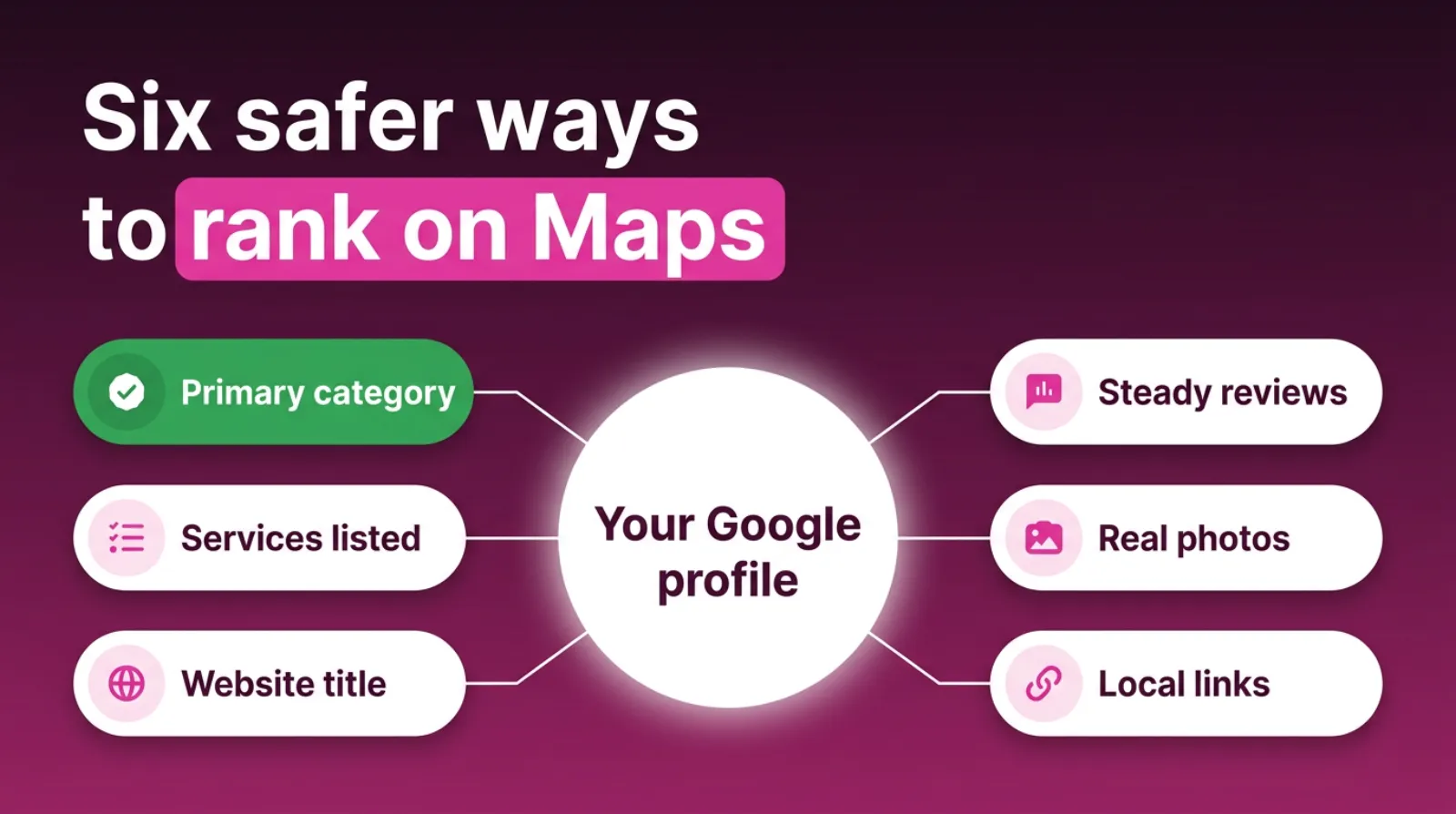
Six safer ways to rank on Google Maps without stuffing your business name: the right primary category, your services listed, a website title with your service and town, steady reviews, real photos and local links, with the primary category highlighted as the biggest lever.
Start with the category, because it is the one most businesses get wrong and the quickest to fix.
What Can You Do If A Competitor Stuffs Their Name?
Report it. Google relies on people flagging spam, and a keyword-stuffed name is one of the easiest things to prove.
First, check it really is stuffing. Look at their website, their van and their shop front on Street View.
If their real sign says "Emergency Plumber Leighton Buzzard", it's their name and you cannot touch it.
If the real name is different, open their listing in Google Maps and choose "Suggest an edit". Change the name to what is on their sign and website, and submit it.
Keep a note of what you sent and when. Sterling Sky's guide says it often takes more than one report before Google acts. Don't give up after one try.
It is worth being calm about this. Reporting a rival can feel petty. But you are not asking for special treatment. You're asking Google to apply its own rules.
And here is the upside. When a stuffed name gets fixed, the business above you often drops. Sterling Sky saw drops within days. That space has to go to someone.
How Do You Check Whether Your Name Is Helping You?
Look at what people searched to find you. Your Google Business Profile performance screen shows the search terms that brought up your listing.
If most of those are your own business name, people already know you. If they are service words, like "plumber near me", your profile is winning discovery searches.
Next, check your position from more than one spot. Map rankings change street by street, so one search from your office tells you very little.
Rank grid tools check your position from dozens of points across a town. They are the clearest way to see whether a change helped, and which areas you are missing.
Run a check before any rename or category change, then again a month later. That's the only fair way to know what made the difference.
And keep an eye on calls. Rankings are only useful if the phone rings. Your profile's performance screen shows calls and website clicks, so watch those too.
Frequently asked questions
Can I add my town to my Google Business Profile name?
Only if the town is part of your real trading name, on your sign, website and invoices. If it is not, adding it breaks Google's guidelines and risks a suspension.
Should I put "Ltd" in my Google Business Profile name?
Usually not. Google treats legal terms like "Ltd" as extra information. The exception is when you can show they're consistently part of your name in the real world.
Will I lose my Google reviews if I change my business name?
No. Your reviews belong to the profile, so they stay when you edit the name. Google may ask you to verify the business again.
Do I need to register a new company to trade under a keyword name?
No. GOV.UK says a limited company can trade under a business name that's different from its registered name. Sole traders can choose a business name too.
How quickly does a keyword in the name affect rankings?
Fast. Sterling Sky saw rankings rise within hours of adding a keyword, and fall within days of Google removing one.
Does a keyword in my website name help Google Maps?
It helps your website rank, and your website feeds your map ranking. Put your service and town in your home page title and main heading.
Can Google change my business name without asking me?
Yes. Google can apply edits from users and its own systems. Check your profile regularly and reject any change that does not match your real name.
Keep Reading
If you're working on your map rankings, these posts pick up where this one stops.
- Local SEO Ranking Factors Reward Proof, Not Technical Polish
- 5 Google Business Profile Tweaks That Push You Into the Local Map Pack
- How to Rank in the Google Maps 3-Pack: A Step-by-Step Guide for Local SME Owners
- 7 Local SEO Myths That Are Quietly Burying Your Google Business Profile On Page 2
- The Google Maps Sandbox: Why Your New Business Isn't Showing Up (And How To Force It Out Faster)
We picked these because they cover the next questions owners ask us. They deal with categories, reviews and why a profile sits on page two.
Sources
The facts in this post come from Google's help pages, GOV.UK and published local search research, checked on 14 November 2026.
- Local Search Ranking Factors
- Guidelines for representing your business on Google
- Tips to improve your local ranking on Google
- Set up a private limited company: Choose a company name
- 2026 Study: How Keywords in Business Names Impact Google Local Rankings and AI
- Google Business Profile: How Much Do Keywords in the Business Name Impact Ranking?
- Google Maps Spam Is Out of Control: Here's How to Fight Back
- Become a sole trader: Choose your business name
So, Should You Rename Your Business?
A keyword in your business name still wins on Google Maps. The data says so, the tests say so and the map in your town probably shows it.
But the win only lasts if the name is real. Stuff it on Google alone and you are one report away from losing the lift, or the whole listing.
If a keyword name suits your business, make it real first. Put it on the van, the website and the invoices, then change Google once.
If it does not suit you, that's fine. Fix your category, list your services, sharpen your website and keep the reviews coming. Then report the rivals who cut corners.
Would you like a second pair of eyes on your Google Business Profile? We can help.
Book a call, and we will look at your profile alongside your Google Ads and your website. We'll tell you honestly what will make the biggest difference.

Written by Uzair Kharawala
Partner at SF Digital Studios, a Google Premier Partner agency. Uzair has been helping businesses grow with Google Ads since 2002 and teaches it every week on YouTube.
Get our best Google Ads tips by email
New articles and videos, straight to your inbox. Unsubscribe any time.