
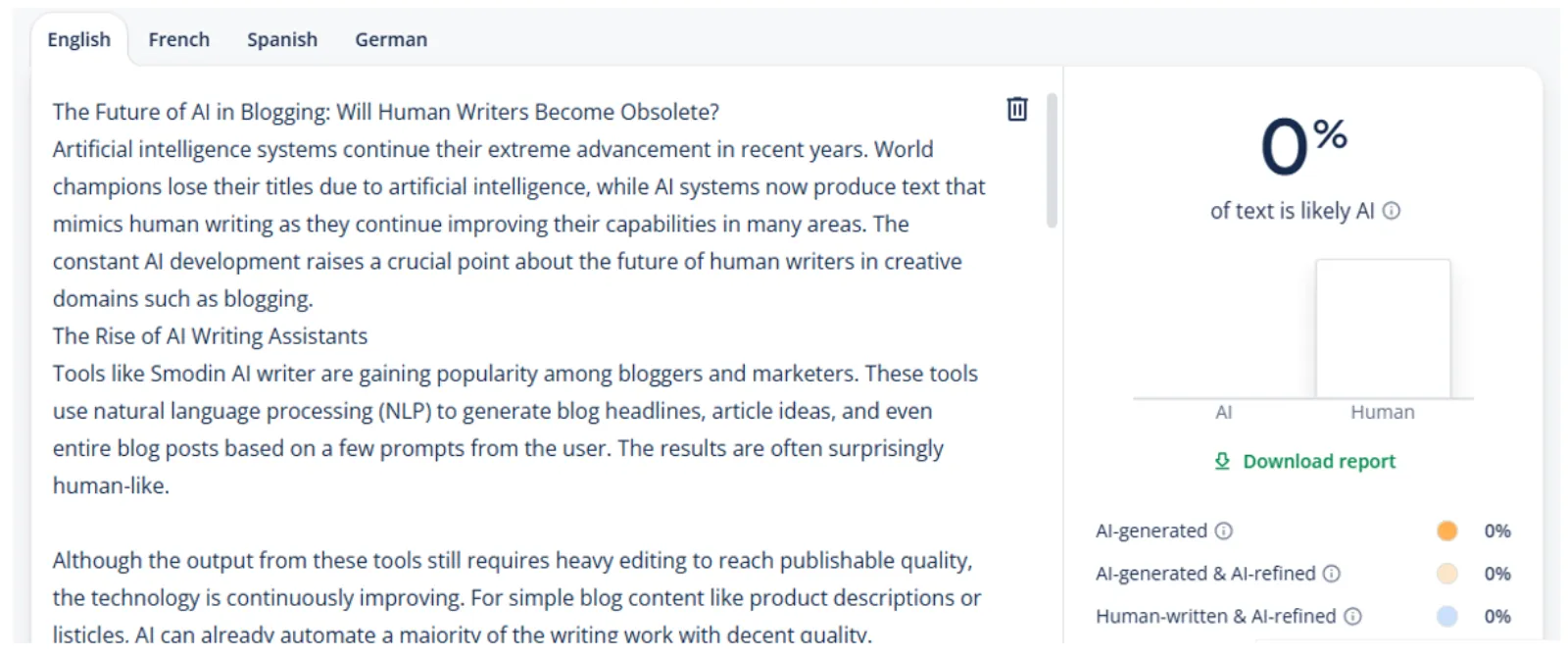
Artificial intelligence systems continue their extreme advancement in recent years. World champions lose their titles due to artificial intelligence, while AI systems now produce text that mimics human writing as they continue improving their capabilities in many areas. The constant AI development raises a crucial point about the future of human writers in creative domains such as blogging.
The Rise of AI Writing Assistants
Tools like Smodin AI writer are gaining popularity among bloggers and marketers. These tools use natural language processing (NLP) to generate blog headlines, article ideas, and even entire blog posts based on a few prompts from the user. The results are often surprisingly human-like.
Although the output from these tools still requires heavy editing to reach publishable quality, the technology is continuously improving. For simple blog content like product descriptions or listicles, AI can already automate a majority of the writing work with decent quality.
Get your free Marketing Action PlanNot sure where to start? Answer a few questions and get your plan in about a minute. No email needed.
Get my plan →As AI writing assistants become more advanced, a larger proportion of blog content creation may become automated. This could significantly reduce the time and effort needed to maintain a blog, allowing bloggers to focus more on high-value creative work. However, it also threatens to make many types of basic blogging work obsolete.
Will AI Ever Match Human Creativity?
Current AI has proven adept at producing reasonably grammatical content by analysing patterns in vast datasets of existing text. However, there is scepticism around its ability to match the creativity and originality of human writers.
Generating truly groundbreaking ideas requires a deeper understanding of language, culture, emotions, and the author’s unique personality and experiences. Achieving human-level language understanding remains an unsolved challenge in AI research.
Moreover, blogging often serves subjective goals related to self-expression, thought leadership, or connecting with niche audiences. Hitting the mark requires subtle, idiosyncratic forms of creativity and emotional resonance that AI struggles to replicate.
As machine learning researcher François Chollet notes, the most profound ideas often come from “misapplying things that made sense in another context”. This type of rule-bending lateral thinking does not come naturally to today’s neural networks, which are fundamentally pattern recognition engines.
So while AI can increasingly help with basic blogging tasks, human creativity, judgment, and cultural intuition still appear essential for impactful blogs that drive trends rather than merely reflect them. The future role of writers may pivot more towards high-level thinking and ideas rather than content production.
AI’s Impact on Blogging Jobs
The rise of automated content creation tools is likely to disrupt several blogging-related jobs and industries:
AI News Anchors. Networks like the Xinhua News Agency in China have already unveiled disturbingly realistic AI news anchors developed by synthesising human images and voices. As technology advances, virtual blogging personalities may become commonplace.
SEO Content Writers. Lower-skilled writers churning out repetitive SEO-focused articles and product descriptions for cheap bulk orders are most vulnerable to automation.
General Blog Writers. Amateur passion bloggers on platforms like WordPress may lean more heavily on AI writing assistants to maintain output with less effort.
Marketing Content Writers. AI can automate simple marketing content like social media posts and press releases. However, the need for human writing likely persists for high-value content like whitepapers.
Ghostwriters. AI could automate simple ghostwriting tasks, providing rough drafts for clients to polish. But ghostwriting often tackles complex niche topics requiring deep expertise. The best ghostwriters may therefore retain their appeal.
So while basic blogging work seems primed for disruption, there remains – at least for now – an artisan class of elite bloggers, journalists and ghostwriters whose jobs depend on the highest levels of creativity, expertise and narrative voice. As with other industries transformed by automation, there may be bifurcation between rote information providers and expert crafters of unique perspectives.
What Should Bloggers Do?
For bloggers worried about being automated out of relevance, the best defence is to focus on uniquely human blogging strengths:
- Leverage Personal Experiences. Share personal stories and viewpoints moulded by your distinctive background and life path – something AI cannot replicate.
- Build Thought Leadership. Rather than reporting on news, provide original analyses and professional opinions on your industry. Own niche perspectives that people can’t get elsewhere.
- Highlight Your Personality. Let your writing style and content choices showcase who you are as an individual. Quirky personalities thrive in the age of AI.
- Interact With Your Audience. Engage commenters and build relationships. Nothing bonds a readership like personal interactions.
Suppose parts of the blogging process do become automated. In that case, the role of bloggers may pivot to designing content strategy, formulating ideas and narratives, interfacing with readers, and bringing uniquely human elements like humour and whimsy to articles physically composed by AI.
Rather than a threat, capable AI writing assistants could empower bloggers to create more content that better leverages their innate talents and interests.
Will AI Transform Blogging?
AI promises to significantly automate and augment content creation within the next decade. Basic blogging work seems likely to be disrupted as a result. However, the core appeal of blogging lies in showcasing authentic human voices and perspectives.
So while AI will become an integral blogging tool, human bloggers can likely retain their relevance by being powerfully, messily, and unpredictably human. There remains – and perhaps always will – a craving for content that resonates emotionally and provides the fresh, rule-bending perspectives intrinsic to people but largely absent (so far) in machines.
Rather than human writers becoming obsolete, blogging may evolve into a man-machine collaboration. AI handles the basic writing, while bloggers bring the soul. If bloggers lean into their comparative advantages – subject matter expertise, unique voice, and human connection with readers – the future of the industry remains vibrant.
Conclusion
Current AI writing tools show impressive fluency but lack deeper originality, emotional resonance and lateral thinking. As a result, expert human bloggers who emphasise unique personalities, niche perspectives, and personal reader connections can likely thrive alongside AI co-creators optimising for productivity. Rather than fully automating blogging, AI promises to augment human writers – if we as an industry take care to develop our creative talents rather than simply compete as content factories.
The details of how human and artificial intelligence balance creative responsibilities remain to be seen. But by complementing algorithmic efficiency with the human heart, the blogger-AI partnership can potentially surpass the capabilities of either group alone. Our uniquely wandering, wildly imperfect minds remain – for now at least – the spark that brings ideas to life. As long as human bloggers light creative fires, rooms full of typing machines can ensure our voices echo farther than ever through the digital sphere.

Written by Uzair Kharawala
Partner at SF Digital Studios, a Google Premier Partner agency. Uzair has been helping businesses grow with Google Ads since 2002 and teaches it every week on YouTube.
Get our best Google Ads tips by email
New articles and videos, straight to your inbox. Unsubscribe any time.