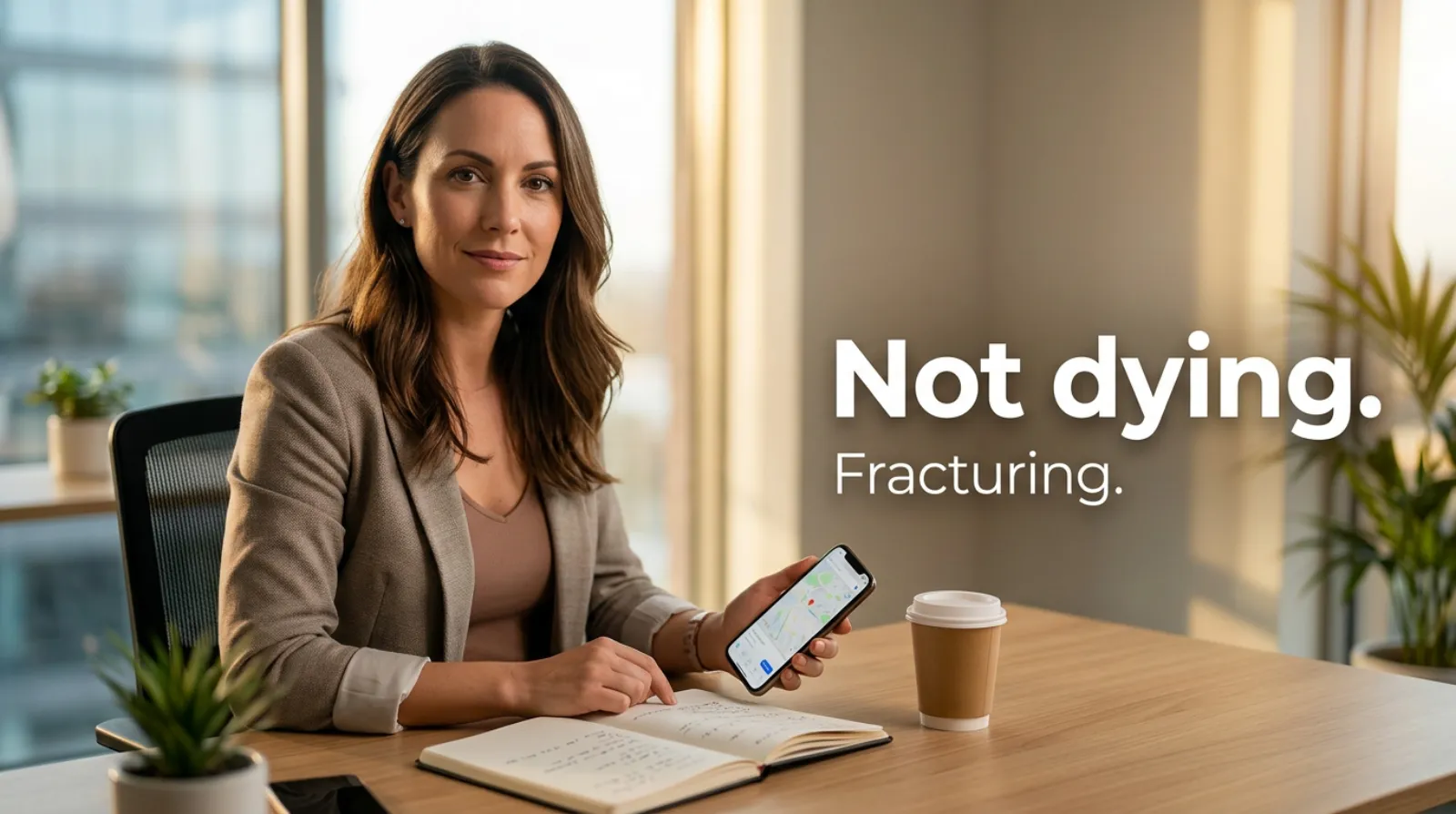
Half the local SEO industry is convinced AI search engines will kill local SEO entirely. Buyers will stop using Google Maps. ChatGPT will recommend the local plumber. Perplexity will book the dentist appointment. The Map Pack will become a museum exhibit.
The other half thinks nothing will really change. Local SEO has survived voice search, mobile-first indexing, the Vicinity update, the Helpful Content update, and a decade of “this is the end of local search” predictions. It’ll survive AI too.
Get Found, Get Chosen, Get Your Time Back
A free one-day marketing seminar in Milton Keynes · 13 January 2027
Both halves are partially right and mostly wrong. AI won’t kill local SEO. It will fracture the way local discovery works in 2026 and 2027 in ways that most SMEs aren’t ready for. The businesses that adapt early will own their categories. The ones who don’t will spend years wondering what changed.
Get your free Marketing Action PlanNot sure where to start? Answer a few questions and get your plan in about a minute. No email needed.
Get my plan →This guide explains what’s actually happening, what it means for SMEs, and the concrete moves to make this quarter before the fracture widens.
What’s Actually Changing In Local Discovery
Three forces are reshaping how buyers find local businesses, and they’re hitting at the same time.
The first force is AI Overviews appearing on local searches. Google now serves AI-generated summaries above the Map Pack on many buyer-intent queries. The summary often names specific businesses by entity, not by ranking position. Being named in the summary is a different optimisation problem from ranking in the 3-pack underneath.
The second force is dedicated AI search engines handling local queries directly. ChatGPT, Perplexity, Gemini and Claude all now answer “best plumber near me” style questions with named recommendations. The buyer might never reach Google Maps. The decision happens inside the AI chat.
The third force is AI agents taking action on behalf of buyers. Google Gemini, OpenAI’s Operator and similar tools can now research, compare and even book local services without the buyer ever opening Maps. The agent reads the equivalent of dozens of profiles in seconds and makes a recommendation.
None of these forces makes Google Maps obsolete. All three reduce their share of the local discovery surface. The Map Pack used to be roughly 70% of how local buyers found businesses. By 2027, it’ll likely be 40 to 50% as the other surfaces grow.
Why Local SEO Doesn’t Die From This
Local SEO survives because the underlying signals that AI engines use to recommend local businesses are largely the same signals Google Maps uses.
- Reviews. Both rely on them. AI engines synthesise reviews to produce summaries and rankings. Google Maps uses them as a ranking factor. Strong review profiles win on both surfaces.
- Entity recognition. Both rely on it. AI engines need to know your business exists, what it does, where it operates and what makes it distinctive. Map Pack ranking factors include the same data points.
- Behavioural signals. Both rely on them. Click-through, calls, direction requests, profile engagement. AI engines weigh similar signals when deciding which businesses to surface.
- Citation network. Both rely on it. Being mentioned consistently across trusted sources matters for both Map Pack ranking and AI recommendation likelihood.
The work that wins local SEO in 2026 is roughly the same work that wins AI-mediated local discovery in 2027. The distribution of where that work pays off changes. The work itself doesn’t.
What Actually Changes For SMEs
Change 1: Review Quality Matters Even More
AI engines synthesise reviews into recommendations. A business with detailed, specific, recent reviews gets summarised differently from a business with 5-star one-word reviews. The synthesis quality depends on the source material.
For SMEs, this means encouraging customers to write specific reviews matters more than ever. “Great service” doesn’t help the AI summary. “Bob fixed our boiler in 90 minutes on a Sunday morning and charged half what we’d been quoted by the national chain” gives the AI material to work with.
Change 2: Entity Signals Become Critical
AI engines need to recognise your business as a clear entity. Brand search volume, Wikipedia presence, consistent NAP, structured data on your website and citations in trusted sources all contribute to entity strength.
For SMEs, this means investing in brand-building activities beyond pure transactional marketing. PR, podcast appearances, guest articles, Wikipedia industry pages and structured data implementation all become higher-priority work.
Change 3: Direct Profile Traffic Becomes The Defence
When AI surfaces reduce Map Pack share, the businesses that have built strong direct profile traffic from their own channels (website, email, social, offline) become more resilient. They’re less dependent on Google Maps organic discovery.
For SMEs, this means treating your Google Business Profile as a destination you actively drive traffic to, not just a passive listing that Google decides to show.
Change 4: Multi-Surface Visibility Matters
Buyers in 2027 will use different surfaces for different stages of the same decision. Discovery on ChatGPT. Comparison on Google. Booking via an AI agent. Final check on Maps. Each surface needs to be optimised.
For SMEs, this means a single-surface optimisation strategy stops working. Profile freshness, AI citation building, website SEO, and review breadth all matter together.
Change 5: Local AEO Becomes A Real Discipline
Just as AEO emerged as a discipline distinct from SEO for general queries, Local AEO is emerging as a discipline distinct from local SEO. It overlaps significantly. It also has unique dynamics around named entity recognition, AI summary placement and AI-mediated booking flows.
For SMEs this means starting to learn Local AEO now rather than waiting until 2028 when it’ll be saturated.
What Doesn’t Change
Reviews matter. Heavily.
NAP consistency matters. Still.
Categories matter. Still.
 LIVE
Live every Tuesday at 2pm UK. Bring your marketing questions.
Get your Google, local SEO and AI questions answered live.
Posts matter. Still.
Photos matter. Still.
Citations matter. Still.
The foundations of local SEO carry over to the AI era almost unchanged. The work isn’t different. The places where that work pays off are.
5 Moves SMEs Should Make This Quarter
Move 1: Audit Your AI Visibility For Local Searches
Run 10 local buyer-intent prompts in ChatGPT, Perplexity and Google AI Overviews. Note where your business appears and where it doesn’t. The gap between where you should appear and where you do is your priority list.
Move 2: Tighten Your Entity Signals
Confirm your business has a complete Wikipedia-relevant industry presence, structured data on your website, consistent NAP across your top 10 directories, and at least 3 mentions in trusted local sources. Each of these contributes to AI entity recognition.
Move 3: Build A Review-Quality Programme
Move from “ask for any review” to “ask for specific reviews”. Brief your team to suggest the customer mention the service performed, the timeframe, and one specific detail. The AI summary quality directly tracks review content quality.
Move 4: Make Your Profile A Driven Destination
Add your Google Business Profile link to your website footer, email signatures, social bios, invoices, business cards and offline materials. Drive direct profile traffic from every touchpoint. Direct profile traffic strengthens your resilience as Map Pack share declines.
Move 5: Start Tracking Multi-Surface Visibility
Add monthly checks to ChatGPT and Perplexity alongside your existing rank tracking. Track when your business appears in AI summaries. The data set you build in 2026 becomes your competitive advantage in 2027 when the surface fracture widens.
3 Mistakes SMEs Are Making Right Now
Mistake 1: Assuming Nothing Will Change
The owners assuming local SEO will look the same in 2027 as it does today are the ones who’ll spend 18 months catching up when the change becomes obvious. The shift is already happening. The smart move is to start adapting before it’s universally adopted.
Mistake 2: Assuming AI Will Replace Everything
The owners assuming Google Maps will be irrelevant by 2026 are equally wrong. The Map Pack will remain a meaningful surface for years. Over-rotating to AI-only optimisation leaves significant discovery on the table.
Mistake 3: Waiting For The Industry To Settle
Local AEO is genuinely new. The best practices will evolve over the next 24 months. Owners waiting for the playbook to settle before they invest are the owners who’ll arrive late. The owners experimenting now will have learned twice as much by the time the playbook is published.
Your 7-Day Multi-Surface Audit
- Day 1. Run 10 local buyer-intent prompts in ChatGPT. Note your appearance rate. Save the screenshots.
- Day 2. Run the same 10 prompts in Perplexity and Google AI Overviews. Compare against ChatGPT. Note the difference.
- Day 3. Audit your Wikipedia industry presence and structured data implementation. Note where the gaps are.
- Day 4. Brief your team on specific review prompts. Update your review request templates to encourage detail.
- Day 5. Add your Google Business Profile link to your top 5 touchpoints if it’s not there already.
- Day 6. Identify 3 trusted local sources you should be appearing on but currently aren’t. Pitch them this week.
- Day 7. Set up a monthly multi-surface visibility tracker. ChatGPT, Perplexity, AI Overviews, Google Maps Map Pack. Run the same prompts each month.
That’s a complete multi-surface foundation. In one week. Most SMEs are still optimising for a single surface that’s quietly shrinking.
Frequently asked questions
Will AI replace local SEO?
No. AI will reduce Google Maps’ share of local discovery but won’t eliminate it. The underlying signals that win Map Pack rankings also win AI-mediated local discovery. The work remains similar. The distribution of where that work pays off changes significantly between 2026 and 2027.
How does AI search work for local businesses?
AI engines synthesise data from reviews, web mentions, structured data, citations and Google Business Profile content to recommend specific businesses when buyers ask local questions. They produce named recommendations, sometimes with rankings, sometimes with summaries. The same buyer might never see Google Maps.
Why should SMEs care about AI search?
Because the share of local buyer journeys that pass through AI surfaces is growing fast, by 2027 it’ll likely represent 40 to 50% of discovery. SMEs that adapt early will be the named recommendations. SMEs that don’t will be invisible on the surfaces buyers actually use.
How do I optimise my local business for AI search?
Run five moves in parallel. Audit your AI visibility on the major engines. Tighten your entity signals via Wikipedia, structured data, citations and PR. Build a review-quality programme. Drive direct profile traffic from your other channels. Start tracking multi-surface visibility monthly.
How long do I have to adapt before AI takes over local search?
You have 12 to 24 months before AI surfaces become the dominant local discovery channel. That window is more than enough to build the foundations. It’s not so long that you can afford to wait until it’s obvious. Start this quarter.
Will Google Maps become irrelevant?
No. The Map Pack will remain a significant local discovery surface for years. Its share of discovery will decline as AI surfaces grow. Treat both as essential rather than picking one to optimise for.
Should I hire an agency or learn this myself?
Either can work. The honest answer is that very few agencies have meaningful Local AEO experience yet because the discipline is new. SMEs willing to learn the basics themselves can match or exceed agency results in 2026. The window for SME-led learning closes by 2027 when the discipline saturates.
The Fracture Is The Opportunity
AI isn’t going to kill local SEO. It’s going to fracture the local discovery surface into multiple connected channels. The businesses that recognise this early and build for it will own their categories on every surface that emerges.
The businesses that assume nothing will change will quietly lose share to competitors who adapt faster. The businesses that assume everything will change will over-invest in surfaces that don’t yet matter at scale.
The smart play is the middle path. Keep doing what works for Map Pack rankings. Add the entity-signal work that wins AI mentions. Build multi-surface visibility tracking. Treat 2026 as the year to learn what’s coming, so 2027 is the year you own it.
Start this week with the 7-day audit. Whatever you find will probably surprise you. Whatever you build over the next 90 days will likely matter for the next decade.
The fracture is real. It’s also the biggest local marketing opportunity of the next 5 years.

Written by Uzair Kharawala
Partner at SF Digital Studios, a Google Premier Partner agency. Uzair has been helping businesses grow with Google Ads since 2002 and teaches it every week on YouTube.
Get our best Google Ads tips by email
New articles and videos, straight to your inbox. Unsubscribe any time.