Every Google Ads account has the same quiet question hanging over it. Should you bid on your own brand name?
The answer the platform wants you to hear is yes. Bid on it, bid heavily, never let a competitor steal a click. The answer most agencies will give you is also yes, because brand campaigns are easy to manage and produce flattering reports.
Get Found, Get Chosen, Get Your Time Back
A free one-day marketing seminar in Milton Keynes · 10 November 2026
The honest answer is that it depends. Sometimes brand bidding is the smartest spend in your account. Sometimes it’s pure profit drainage you’ve been paying for for years without realising. The difference between the two scenarios comes down to one number: incrementality.
Get your free Marketing Action PlanNot sure where to start? Answer a few questions and get your plan in about a minute. No email needed.
Get my plan →This guide walks through when brand bidding genuinely earns its keep, when it doesn’t, and the simple test that tells you which side you’re on.
What “Brand Bidding” Actually Means
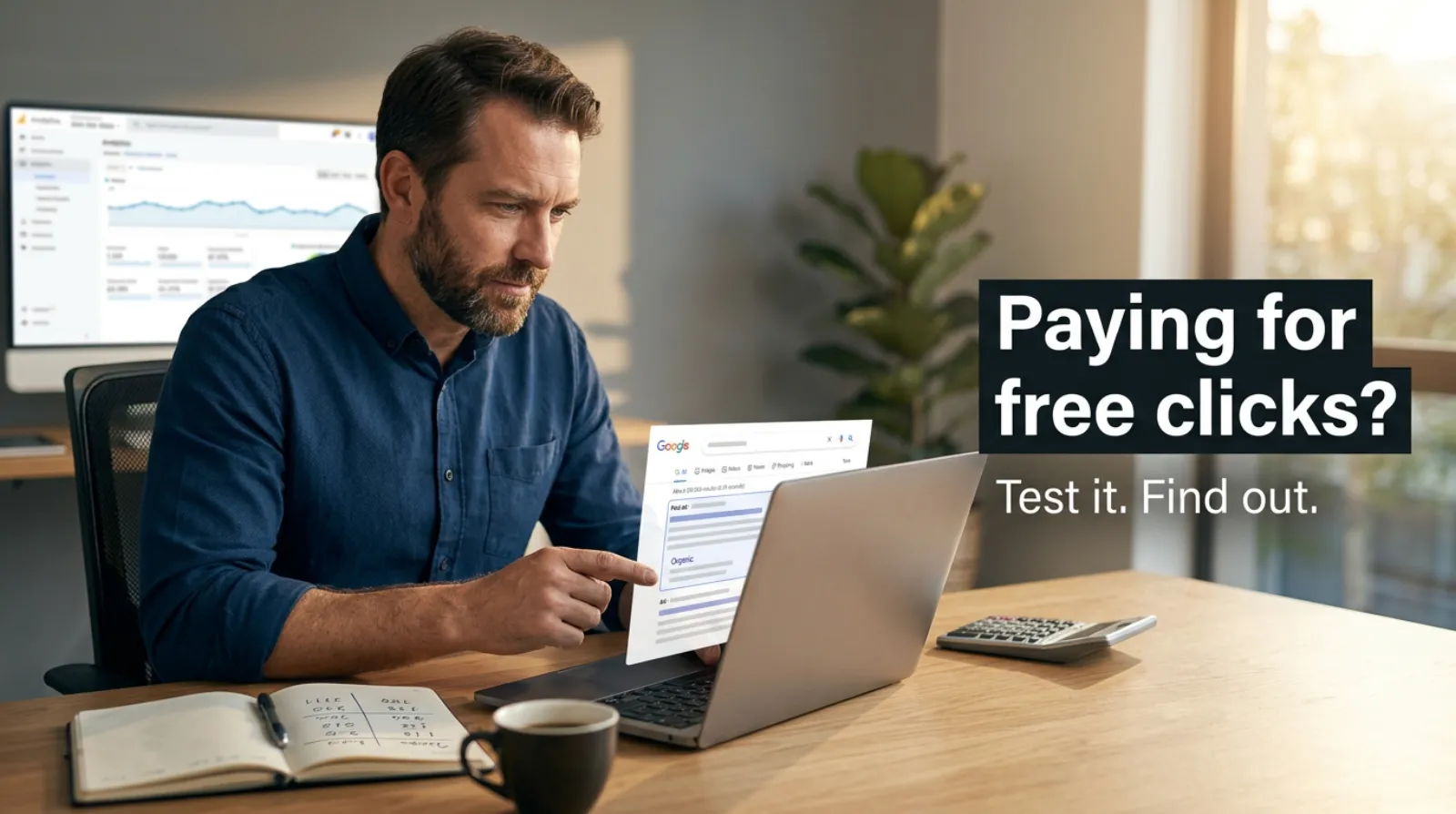
Brand bidding is the practice of running paid Google Ads campaigns targeting your own company name and close variations. When someone types your brand name into Google, your paid ad appears at the top of the results above your organic listing.
The buyer might click the paid ad and you pay for the click. Or they might scroll past and click the organic result. Or in many cases, the buyer would have clicked through to you regardless of which one appeared first.
That last scenario is where the problem lives.
The Pure Profit Drainage Scenario
Most small businesses bidding on their own brand fall into one of three patterns where the spend is producing little to no incremental value.
Pattern 1: You Dominate Organic And No Competitors Bid
Your business ranks position 1 organically for your brand name. The whole results page is yours. Your Google Business Profile sits on the right-hand side. No competitor is bidding on your terms.
In this scenario the paid brand ad sits above an organic result the buyer was already going to click. The vast majority of clicks on the paid ad are pure cannibalisation. Pause it for two weeks and your total brand conversions barely move.
This is the most common form of brand bidding waste. We see it on roughly half the SME accounts we audit.
Pattern 2: Single Landing Page, Single Offer
Your business sends every branded buyer to the same homepage with the same offer. The paid ad and the organic listing both lead to the same place. The buyer has no different experience whether they click the paid ad or the organic link.
If the destination is identical, the paid ad isn’t doing extra work. It’s just billing you for clicks that organic would have delivered anyway.
Pattern 3: Tiny Brand Search Volume
If your brand gets fewer than 100 monthly searches, the brand campaign produces too little data to optimise and too little incremental volume to matter. The administrative overhead of maintaining it exceeds the marginal lift you’d ever see.
Below a certain volume threshold, brand bidding is just admin work that produces nothing.
The Smart Scenario
The other half of accounts genuinely benefit from brand bidding. Three patterns are worth the spend.
Pattern 1: Competitors Are Actively Bidding On Your Brand
If your top competitors are running their ads on your branded search terms, you have a real problem. The buyer types your name. The first thing they see is a competitor offer. Your organic listing appears further down.
In this scenario brand bidding is non-negotiable. The cost of the brand campaign is far less than the cost of letting buyers be intercepted at the moment of highest intent.
Check this monthly. Bidding patterns shift. A new competitor entering your category often starts by bidding on incumbent brands. Catch it early.
Pattern 2: You Need Different Landing Pages For Different Brand Queries
If you have multiple products, services or offers, the brand campaign lets you route specific brand queries to specific landing pages. “Brand name pricing” goes to a pricing page. “Brand name reviews” goes to a testimonials page. “Brand name vs competitor” goes to a comparison page.
Organic can’t do this kind of targeted routing. The brand campaign genuinely does extra work the organic listing couldn’t.
Pattern 3: Weak Organic Position Or Visible SERP Distraction
If your brand search results page has other businesses’ organic listings between your name and your site (this happens with common-word brand names, generic terms in your name, or when you share a name with someone larger), the brand ad pushes you back to the top of the visible page.
This is genuine incremental value. Without the ad, buyers click something else first and may never reach you.
The Incrementality Test
The only honest way to know which side you’re on is to test. Pause your brand campaign for 14 to 21 days. Measure what happens to total brand conversions, total brand traffic and total revenue from branded searches across paid and organic combined.
 LIVE
Live every Tuesday at 2pm UK. Bring your marketing questions.
Get your Google, local SEO and AI questions answered live.
If total brand traffic and revenue drop significantly, the campaign was delivering incremental value. Switch it back on.
If total brand traffic and revenue stay roughly flat, the campaign was cannibalising organic and the spend was waste. Keep it paused and redirect the budget.
If you can’t tell after 14 to 21 days, run a longer test or split your brand traffic geographically and compare regions. Most accounts can land a clear verdict within a month.
The Common Mistakes That Make Brand Campaigns Worse
Even accounts where brand bidding is justified often run the campaign badly. Three patterns waste budget within a smart-brand-bidding setup.
Mistake 1: Bidding Aggressively With No Cost Discipline
The temptation is to set high bids to dominate the brand page. But brand search has minimal competition (usually you, sometimes one or two competitors). You don’t need top-of-page bids. Position 1 with a moderate bid is usually enough. Use Maximise Conversions as the bid strategy, not Maximise Clicks, and let the algorithm settle on the right CPC.
Mistake 2: Letting PMax Cannibalise The Brand Campaign
If you’re running both PMax and a brand Search campaign, you need to actively block PMax from bidding on your brand terms via account-level negatives. Without this, PMax steals credit and inflates its reported ROAS while undercutting the cleaner brand campaign data.
This is one of the most common hidden cost patterns we see in SME accounts.
Mistake 3: Running One Brand Campaign For All Brand Variants
Your main brand name, common misspellings, and brand-plus-modifier queries (like “brand name reviews” or “brand name pricing”) all behave differently. Treat them as separate ad groups at minimum. Different bids, different ads, different landing pages where appropriate.
A single muddled brand campaign loses much of the value the structure could deliver.
5 Decisions To Make About Your Brand Campaign This Quarter
Decision 1: Run The Incrementality Test
Pause for 14 to 21 days. Measure total brand traffic and conversions across paid and organic combined. The data settles the question.
Decision 2: Audit Whether Competitors Are Bidding
Search your brand from an incognito browser. See who appears above your organic. If no competitor is bidding and you dominate organic, the case for brand bidding weakens significantly.
Decision 3: Decide Your Routing Strategy
If you keep brand bidding, what destinations does each brand query type need? Map your top 10 brand-variant searches to specific landing pages.
Decision 4: Block PMax From Brand Terms
Add your brand keywords to PMax account-level negative lists. This single change recovers 10 to 25% of typical SME brand budget waste.
Decision 5: Set A Realistic Brand Spend Cap
Brand spend should usually be no more than 10 to 20% of total Google Ads spend in a healthy account. If it’s significantly higher than that, you’re probably either over-bidding or running into one of the pure-waste patterns described above.
Your 7-Day Brand Campaign Audit Plan
- Day 1: Search your brand from an incognito browser. Document which competitors (if any) are bidding on your brand. Take screenshots.
- Day 2: Check your brand campaign’s last 90 days. Note total spend, conversions and ROAS. Note the share of total account conversions that come from brand.
- Day 3: Run your brand campaign through the cannibalisation check. If PMax is also bidding on brand terms, you have leakage that needs fixing first.
- Day 4: Map your top 10 brand-variant search queries. Note whether each one currently routes to a useful, specific landing page or to a generic homepage.
- Day 5: Calculate your branded organic position. If you’re position 1 with featured snippet or business profile, the case for paid brand bidding weakens. If you’re position 3 or below, the case strengthens.
- Day 6: Plan the incrementality test. Set the dates, agree the measurement, prepare the budget reallocation if the test shows waste.
- Day 7: Launch the incrementality test. Set a reminder for 21 days from now to review the data.
That’s a complete brand bidding audit and test. In one week. Most SME accounts have never genuinely tested whether their brand campaign is justified.
Frequently asked questions
Should I bid on my own brand name in Google Ads?
It depends on whether you have incremental value. Yes if competitors are bidding on your brand, you need different landing pages for different brand queries, or your organic position is weak. No or maybe not if you dominate organic, no competitors bid, and you have a single offer routing to a single homepage.
How do I know if brand bidding is wasting money?
Run an incrementality test. Pause the brand campaign for 14 to 21 days and measure total branded traffic and revenue across paid and organic combined. If total brand outcomes stay flat, the campaign was cannibalising organic and wasting budget.
When should I pause my brand campaign?
Pause when no competitors are bidding on your brand, your organic position is strong, you have a single landing page anyway and your brand spend is over 20% of total account spend. Run the incrementality test to confirm the decision.
How long does it take to test brand bidding incrementality?
14 to 21 days is usually enough for high-traffic brands. Lower-traffic brands may need 30 to 60 days for a reliable signal. Geographic splits (paused in some regions, running in others) can produce faster signal than time-based tests.
How do I run a brand bidding test properly?
Pause the brand campaign for a defined period. Measure total branded organic traffic, total branded conversions across paid and organic, and total branded revenue. Compare to the equivalent period before pausing. The delta tells you whether the campaign was producing incremental value or cannibalising organic.
How much should I spend on brand campaigns?
Most healthy accounts spend 10 to 20% of total Google Ads budget on brand. If you’re significantly above that, you’re probably over-bidding or running pure-waste patterns. If you’re significantly below it and have legitimate brand competition, you may be under-spending and losing intercepted clicks to competitors.
Should brand bidding be separate from non-brand search campaigns?
Yes, always. Mixing brand and non-brand search in a single campaign muddles the data, makes optimisation impossible and usually inflates the apparent ROAS of the non-brand campaign because brand conversions are sneaking in. Keep them strictly separate.
The Honest Answer Is Always Test
Brand bidding isn’t inherently good or bad. It’s contextually useful in some accounts and pure waste in others. The only honest way to know which side your business is on is to run the incrementality test.
Most SME accounts that run the test discover one of two things. Either the brand campaign is genuinely earning its keep and they can leave it running with confidence. Or it’s been quietly wasting budget for years and they recover meaningful spend by pausing it.
Either result is a win. The cost of finding out is 21 days of testing and 30 minutes of analysis. The cost of not finding out is years of unexamined spend that may or may not be working.
Start the test this week. The data will tell you the answer the platform, the agencies and the dashboards won’t.

Written by Uzair Kharawala
Partner at SF Digital Studios, a Google Premier Partner agency. Uzair has been helping businesses grow with Google Ads since 2002 and teaches it every week on YouTube.
Get our best Google Ads tips by email
New articles and videos, straight to your inbox. Unsubscribe any time.