
Let’s be real, running Google Ads can feel overwhelming. With keywords, budgets, targeting, and reports to juggle, it’s easy to jump right into creating ads without really thinking about the structure of your account. But here’s the truth: your account structure isn’t just a setup step. It’s the actual backbone of everything you do in Google Ads.
If your structure is solid, you’re setting yourself up for long-term success. If it’s messy or unorganised, it doesn’t matter how great your ads are, you’ll struggle to make them work. That’s why this post is all about the “boring” part of Google Ads that no one talks enough about: structure.
Get Found, Get Chosen, Get Your Time Back
A free one-day marketing seminar in Milton Keynes · 10 November 2026
What Is Google Ads Account Structure?
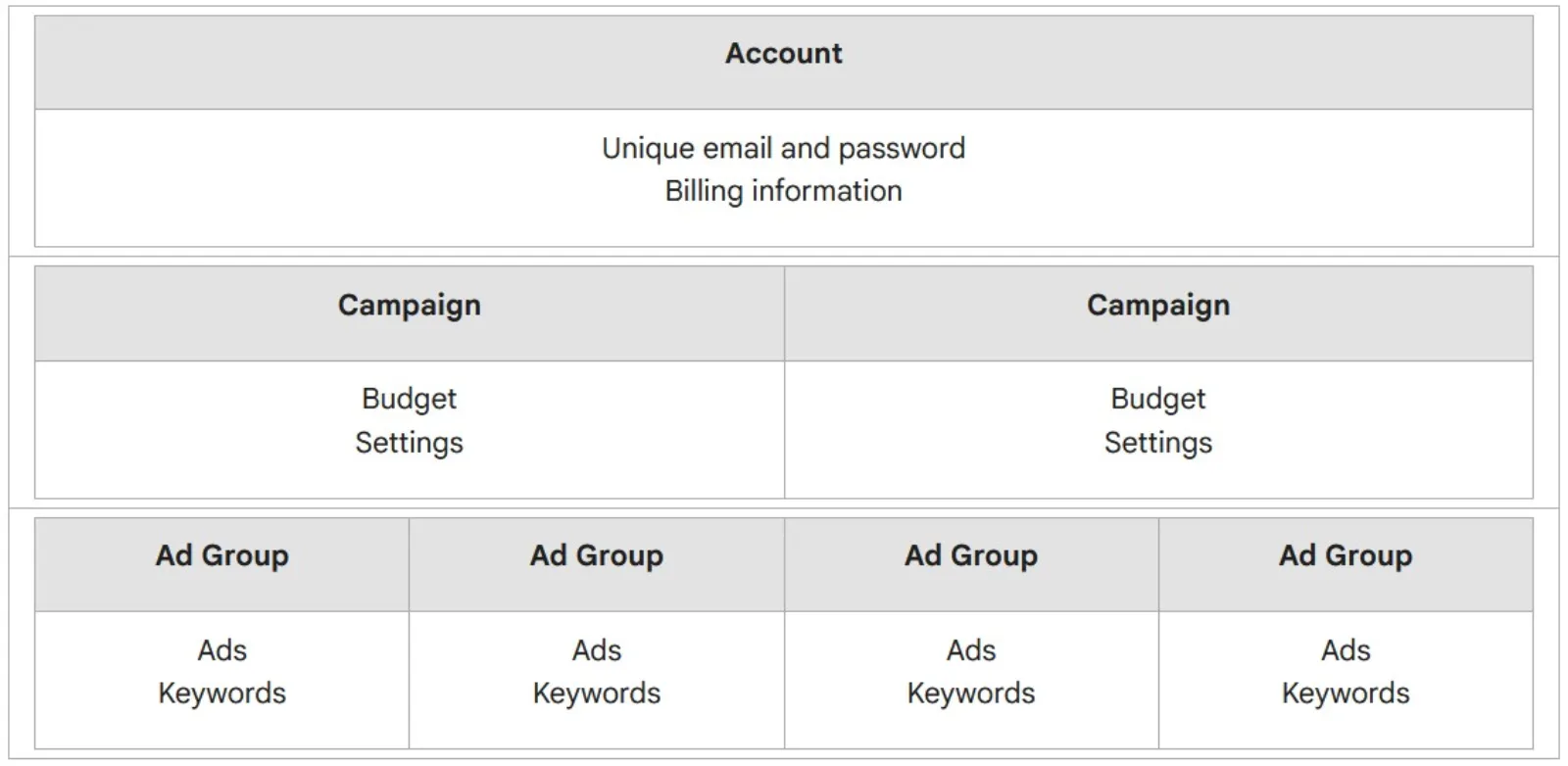
Let’s break it down in simple terms. Google Ads is built on several layers:
Get your free Marketing Action PlanNot sure where to start? Answer a few questions and get your plan in about a minute. No email needed.
Get my plan →- Account
- Campaigns
- Ad Groups
- Keywords and Ads
Your account is the top-level container; think of it like your house. Inside, each campaign is a separate room with its purpose (for example, one for summer clothing, one for winter, or one for a specific location). Then within each campaign, ad groups hold related keywords and ads, kind of like drawers within the room, each containing a different category.
That’s your structure. And it matters a lot.
Why Structure Matters More Than You Think
You wouldn’t build a house without a blueprint. The same goes for your ad account. A clear, logical structure helps you:
- Spend your budget wisely
- See what’s working (and what isn’t)
- Adjust quickly based on performance
- Avoid wasting money on irrelevant clicks
And perhaps the biggest reason? Control. A well-built account gives you levers to pull when things change, like seasonality, trends, or product popularity.
Example: Clothing Store in Different Seasons
Let’s say you sell both summer and winter apparel. A smart structure would look something like this:
Google Ads Account: [Brand Name Clothing Store]
Campaign: Summer Apparel
Ad Group: Men’s Summerwear
- Keywords: men’s shorts, men’s linen shirts, breathable t-shirts
- Ad 1: “Cool Looks for Hot Days”
- Ad 2: “Lightweight Men’s Fashion”
Ad Group: Women’s Summerwear
- Keywords: sundresses, women’s summer tops, beachwear
- Ad 1: “Stay Stylish This Summer”
- Ad 2: “Flowy & Fun Summer Fits”
Campaign: Winter Apparel
Ad Group: Men’s Winterwear
- Keywords: men’s puffer jackets, thermal wear, wool coats
- Ad 1: “Warmth Without Bulk”
- Ad 2: “Winter-Ready Coats for Men”
Ad Group: Women’s Winterwear
- Keywords: women’s trench coats, knitwear, insulated jackets
- Ad 1: “Cozy Meets Chic”
- Ad 2: “Winter Fashion That Warms”
Campaign: Seasonal Sales
Ad Group: Summer Clearance
- Keywords: summer sale clothing, end of season sale, men’s clearance
- Ad 1: “Up to 50% Off Summer Styles”
Ad Group: Winter Clearance
 LIVE
Live every Tuesday at 2pm UK. Bring your marketing questions.
Get your Google, local SEO and AI questions answered live.
- Keywords: winter coats sale, clearance jackets, women’s winterwear sale
- Ad 1: “Winter Deals While They Last!”
Campaign: Brand / Always-On
Ad Group: Branded Search
- Keywords: your brand name, your brand + clothing
- Ad 1: “Shop [Brand Name] Official Store”
Ad Group: Top Categories (All-Season)
- Keywords: best men’s fashion, women’s clothing online
- Ad 1: “Explore Our Full Collection Year-Round”
This setup lets you shift your budget to summer campaigns when the sun’s out, and to winter items when the temperature drops without starting over from scratch. You’re just adjusting the levers.
If everything were in one big campaign? Good luck figuring out what to cut or boost. It would be like trying to turn up the heat in one room while using a single thermostat for the whole house.
Benefits of a Good Google Ads Structure
- Better Budget Control: You can easily move spend around based on what’s performing. If a particular ad group is crushing it, you can push more budget there without touching the rest of your account.
- Clearer Reporting: Want to know if sweaters or jackets are getting more clicks? If they’re in separate ad groups or campaigns, it’s easy. With everything jumbled together, not so much.
- Higher Relevance: Google rewards relevance. If your keywords, ads, and landing pages are tightly aligned, your Quality Score goes up, which means lower costs and better placements.
- Smarter Optimisation: When your structure is clean, you spend less time hunting for data and more time improving performance. You can test ads, pause underperformers, and spot trends without digging through clutter.
Common Mistakes (and How to Avoid Them)
Here are a few things people often get wrong:
- Lumping everything into one campaign: You lose all control and visibility. Split by product category, service, or audience.
- Too many keywords in one ad group: Try to stick to tight themes. Group related keywords together and match your ads accordingly.
- Not considering location or seasonality: If you sell in different regions or your products change with the seasons, structure for that.
- Overcomplicating things: While being organised is great, don’t go overboard. Keep it simple enough to manage.
The goal is to balance detailed enough to give you control, but not so detailed that it becomes unmanageable.
When to Restructure Your Google Ads Account
If you’ve already got a Google Ads account up and running, it might be time for a clean-up if:
- You don’t know where your budget is going
- Your reports are hard to read
- You’re not seeing the results you want
- You’re spending time guessing instead of making data-based decisions
Don’t worry, restructuring doesn’t mean starting from zero. It just means realigning things so they make more sense and give you more power.
The Long-Term Payoff
Here’s the thing about account structure: it might not give you instant wins. You might not see your cost-per-click drop the day after you restructure. But over time, the difference is massive.
When your account is set up the right way, every optimisation becomes easier. Every test has clearer results. Every budget decision is smarter.
Structure gives you the framework to make better choices, and that adds up.
Final Thoughts: Don’t Skip the Foundation
It’s tempting to focus on ad copy, landing pages, and new features. And yes, those are important. But without a strong structure underneath, it’s like putting a fancy paint job on a car with a broken engine.
Take the time to get your account structure right or fix it if it’s off track. It doesn’t have to be perfect, but it does need to be clear, logical, and built around your goals.
Because in Google Ads, structure isn’t just background noise.
It’s the backbone of your success.

Written by Uzair Kharawala
Partner at SF Digital Studios, a Google Premier Partner agency. Uzair has been helping businesses grow with Google Ads since 2002 and teaches it every week on YouTube.
Get our best Google Ads tips by email
New articles and videos, straight to your inbox. Unsubscribe any time.