
Are YouTube ads worth it for a small business? Most owners ask it after a Google rep rings them. Or after a competitor's advert pops up before a cooking video.
The pitch always sounds the same. Millions of viewers, pennies per view, set it up in an afternoon.

Get Found, Get Chosen, Get Your Time Back
A free one-day marketing seminar in Milton Keynes · 10 November 2026
The honest answer is less exciting. YouTube ads work well for some small businesses and burn money for others. The difference is rarely the advert. It is what sits behind it.
Get your free Marketing Action PlanNot sure where to start? Answer a few questions and get your plan in about a minute. No email needed.
Get my plan →I've run Google Ads accounts for almost 15 years. YouTube campaigns live inside the same Google Ads account as search.
So I see both sides every week: the YouTube spend that pays back, and the spend that should never have started.
This post gives you the straight version. What YouTube ads are and what they cost. Who they suit, who should wait, and how to test them without betting the business.
Are YouTube Ads Worth It For A Small Business?
Yes, YouTube ads can be worth it for a small business. But only once your Google search ads already bring in enquiries at a cost you are happy with. YouTube is best at making people remember you, not at catching people ready to buy today. Start it after search works, with a short video and a small test budget.
That's the whole answer in one paragraph. The rest of this post is the detail behind it.
The mistake I see most is the wrong order. An owner has no search ads, no tracking and a £300 budget.
They put it all into YouTube because views are cheap, and three months later they have thousands of views and no idea if a single one turned into a customer.
Cheap views are not the same as cheap customers. Keep that line in your head as you read on.
What Are YouTube Ads, In Plain English?
YouTube ads are short videos you pay Google to show on YouTube. They play before, during or after other people's videos.
Or they sit in the home feed and search results like a normal video, with a small "Sponsored" label.
You don't buy them from YouTube directly. You run them through your Google Ads account, the same place your search ads live.
That matters more than it sounds. It means one login, one bill and one set of conversion tracking. And one place to see whether your video ads and search ads work together.
Think of it like this. Search ads are a shop sign on the high street. People already walking past looking for you see it.
YouTube ads are more like a leaflet through the door. Some people bin it. Some keep it on the fridge and ring you three weeks later.
Both can work. But they do different jobs. You can't judge a leaflet by how many people ring while they're still holding it.
What Kinds Of YouTube Ads Can You Run?
There are a handful of formats. A small business only needs to know four of them.
- Skippable in-stream ads. These play before or during a video. The viewer can skip after five seconds.
- In-feed ads. These sit in the home feed, search results and next to other videos. People choose to click and watch.
- Shorts ads. Upright videos that appear between YouTube Shorts as people swipe.
- Bumper ads. Six seconds, no skip, used to keep your name in front of people.
There is one change worth knowing about if you read older guides. Google stopped letting advertisers create new Video action campaigns in April 2025. It moved them into Demand Gen campaigns instead.
So if an older post tells you to "set up a Video action campaign", that option has gone. For a small business chasing enquiries, there are now two usual choices.
A Video campaign aimed at views and reach, or a Demand Gen campaign aimed at enquiries.
You don't need every format. I'd point most small businesses towards skippable in-stream and in-feed first. Then add Shorts once you have an upright version of the same video.
How Do You Pay For YouTube Ads?
You pay for YouTube ads in one of two main ways: per view or per thousand impressions.
With per-view bidding, you only pay when someone watches enough of the advert, or clicks it. With per-thousand bidding, you pay each time your ad is shown a thousand times.
The per-view rule is the one most owners like the sound of.
As of October 2026, Google's help page on cost-per-view bidding says a view counts when someone watches 30 seconds of your ad. Or the whole ad if it's shorter, or when they interact with it.
So if someone skips at five seconds, you do not pay. Your name and your face still showed for those five seconds, for free.
That's why the first five seconds of your video matter so much. They are the part everyone sees, and the part that's free.
Demand Gen campaigns work differently. You usually bid for conversions or clicks. Google then decides where across YouTube, Gmail and Discover to show you. That is more hands-off, and it needs good conversion tracking to work.
Why Would A Small Business Bother With YouTube At All?
Because your customers are already there, every day. And most of your competitors aren't advertising to them.
Ofcom's Online Nation report, published in December 2025, says YouTube reaches 94 percent of UK adults who go online. The same report says they spend about 51 minutes a day on it.
That is a lot of attention. And most small businesses in your area aren't using it. They're fighting over the same few search ads at the top of Google. Meanwhile YouTube sits there with far less local competition.
Here's the real reason it can pay. Not everyone who needs you is searching yet.
Think of someone planning a loft conversion, a new kitchen or a new accountant. They might be months away from typing it into Google.
Say they've seen your face, heard your voice and watched you explain something useful. Then you're not a stranger when they finally search.
YouTube fills the top of the funnel so your search ads have warmer people to catch. That's the job. Not instant phone calls.
There is a second, quieter benefit. A good video does the selling before the first call.
People who've watched you for 30 seconds already know how you talk, what you charge roughly and whether they like you. Those calls tend to be easier to close.
Is Your Business Ready For YouTube Ads? The Four Signal Test
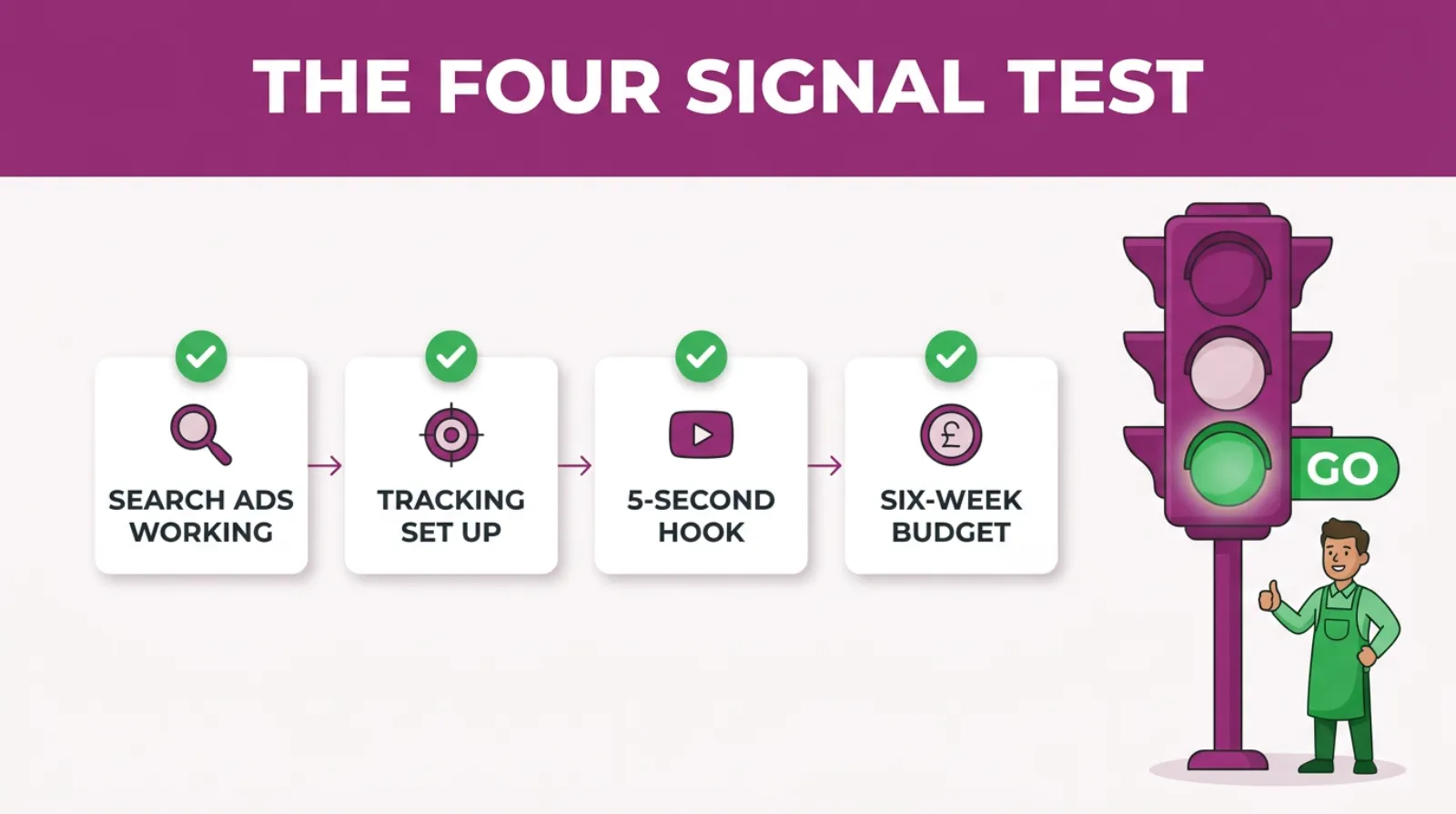
Before you spend a penny, run through these four questions, because if the answer to all four is yes, YouTube is worth a proper test. If one is a no, fix that first.
- Are your Google search ads already bringing in enquiries at a cost you are happy with?
- Is your conversion tracking set up, so Google can see calls and forms?
- Do you have a video, even a phone video, that grabs attention in five seconds?
- Can you spare a test budget for at least six weeks without touching your search budget?
Most owners fail on the first one. And that's fine. It just tells you where the next pound should go.
What Can YouTube Ads Actually Do For You?
Done in the right order, YouTube ads give a small business things search ads cannot. Here are the five I'd point to.
They Put Your Face In Front Of People Before They Need You
Search ads only show up when someone types the right words. YouTube shows up while people are relaxing, learning or killing time.
That is when you can plant the seed. A roofer can show a 40-second clip of a storm-damaged roof and what it costs to leave it, while a financial adviser can answer the one question every new client asks.
When those viewers do need help, your name is the one they remember. People searching for a name they know tend to click it. Not the ad above it.
They Cost Far Less Per Person Reached
A click on a search ad for a local trade can easily cost several pounds, but on YouTube you're often paying pennies per view rather than pounds per click.
That is not a like-for-like comparison, and I'll come back to why, but it does mean a small budget reaches a lot more people. For a brand-new business that nobody's heard of, that reach is worth having.
Just don't confuse reach with results. A view is a chance, not a customer.
They Let You Target Your Patch
You can show YouTube ads only to people in your area. Pick a town, a postcode area or a radius around your address.
For a local business, this is the bit that makes YouTube affordable. You are not paying to reach the whole country. You're paying to reach the people within driving distance who could actually hire you.
You can layer on more. Show ads to people who have searched for your services on Google. Or people into home improvement, or people moving house. Each layer makes the audience smaller and more relevant.
They Bring Back People Who've Already Visited
This is the most underrated use of YouTube for a small business. Remarketing.
Someone visits your website, reads your prices and leaves, and with a remarketing list your YouTube ad can follow them around for the next few weeks. The video answers their doubts.
That audience is small and warm. It's often the cheapest place to start. These people already know who you are.
They Make Your Other Marketing Work Harder
Here is what most people miss when they judge YouTube by its own report: a lot of the value shows up somewhere else, in places YouTube never gets credit for.
People see the video, don't click, and search your business name a week later, so that lead lands in your search campaign or your Google Business Profile. YouTube gets no credit at all.
So the honest test of YouTube is what happens to your whole account, not just the YouTube line. More brand searches, more direct calls, a lower cost per lead on search. That is where it pays.
How A YouTube View Turns Into An Enquiry
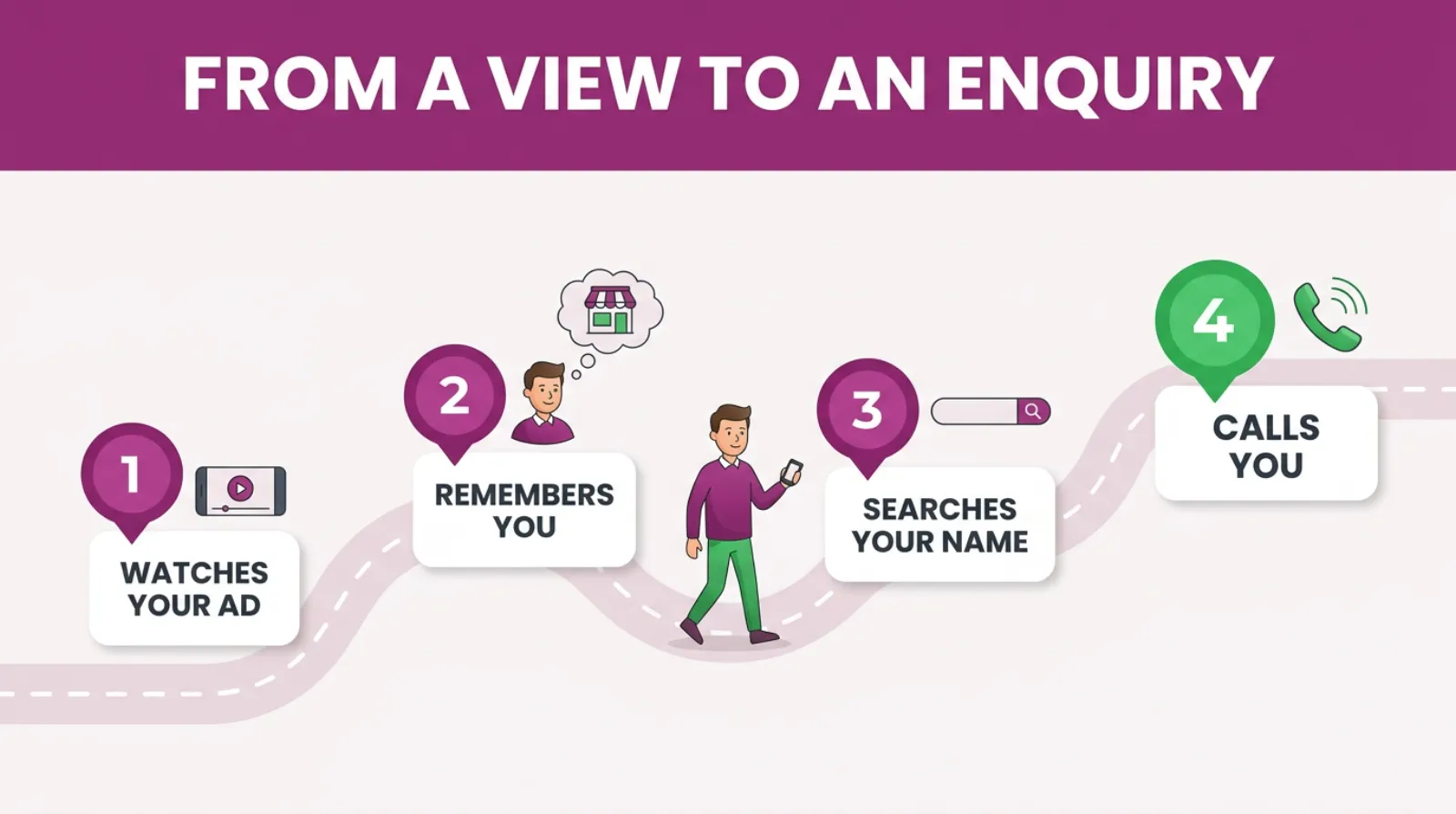
The path is longer than a search click. Someone watches, remembers, searches you later and then gets in touch. Your search ads and your Google Business Profile catch them at the end, which is why you need both.
 LIVE
Live every Tuesday at 2pm UK. Bring your marketing questions.
Get your Google, local SEO and AI questions answered live.
Which Small Businesses Should Skip YouTube Ads?
YouTube isn't right for everyone. Anyone who tells you otherwise is selling it. These are the cases where I would tell an owner to wait.
Emergency Services
If people only need you when something breaks, YouTube is a poor fit. Nobody watches a video about blocked drains and then remembers it three months later when the kitchen floods.
They grab their phone and search "emergency plumber near me". Search ads win that race every time. Put the money there.
Businesses With No Search Ads Yet
If you're not already showing up when people search for what you do, start there. Search catches people who want to buy now. YouTube warms people up for later.
Warming people up is pointless if nobody's there to catch them when they are ready.
Businesses Without Tracking
If Google can't see your calls and form fills, it cannot tell you what's working. On search that is bad. On YouTube it's worse, because the results are already harder to trace.
Set up conversion tracking first. Every time.
Tiny Areas With A Tiny Audience
If you serve one small village, there might not be enough people to show ads to. Google will struggle to spend the budget, or it'll show the same handful of people your ad over and over.
Widen the area to the towns you would genuinely drive to. Or stick with search and your Google Business Profile.
Owners Who Need Leads This Month
YouTube is slow. If cash is tight and you need the phone ringing next week, this isn't the channel. Come back to it once search is paying its way.
How Much Do YouTube Ads Cost A Small Business In The UK?
There is no minimum spend, and you set the budget yourself. As a working rule at SF Digital, we'd want £10 to £20 a day.
Run it for at least six weeks to give the test a fair chance. That's roughly £400 to £850 a month, on top of your search budget, not taken from it.
You can go lower. Google will happily spend £5 a day, but at that level it takes months to learn anything and most owners give up before the data means anything.
Here is how that budget breaks down in practice. It's a hypothetical example with round numbers, not a promise of what you will get.
Say a kitchen fitter spends £15 a day on YouTube in their local area. Over 30 days that's £450.
If views cost around 5p each, that is roughly 9,000 paid views, plus thousands more people who saw the first five seconds and skipped for free.
All of them are local. All of them now know the business exists.
Will that £450 produce nine instant enquiries? Probably not. That's not how it pays back.
So what would you hope to see over the next two or three months? More people searching the business name. A better click rate on search ads.
And a few enquiries that mention the video. That's the return. It is real, but it's slower and harder to see.
Cost per view varies a lot. It depends on your area, your audience, the time of year and how good your video is.
A video people watch tends to get cheaper views. Google rewards ads that viewers do not skip.
YouTube Ads Vs Google Search Ads: Which Should Come First?
Search ads should come first for almost every small business. They catch people who want what you sell right now.
YouTube ads are the next step, once search is working. They build the demand your search ads then catch.
Here's how the two compare side by side.
| Google search ads | YouTube ads | |
|---|---|---|
| What it does | Catches people searching now | Reaches people before they search |
| Typical cost | Pounds per click | Pennies per view |
| Speed of results | Days to weeks | Weeks to months |
| Best for | Getting enquiries this month | Getting remembered |
| What you need | Good keywords and a landing page | A short video and tracking |
| How to measure | Enquiries and cost per lead | Brand searches, view-through enquiries, total cost per lead |
Look at the last row. That is where most owners go wrong. They judge YouTube by the search measures, see a poor number and switch it off.
Judge each channel by the job it was hired to do. Search is hired to catch. YouTube is hired to make people remember you.
How Do You Make A YouTube Ad That Works On A Small Budget?
You don't need a film crew. You need a clear message in the first five seconds and a face people can trust. Phone videos often beat polished ones, because they look like real content, not adverts.
Here is what tends to separate the ads that work from the ones that get skipped.
Hook In The First Five Seconds
Everyone sees the first five seconds. Most people skip after that. So don't waste them on a logo, a jingle or a slow "Hi, I'm" intro.
Open with the problem. Use your customer's own words. "Is your boiler over ten years old?" works. A slow fade-in of your van does not.
Show A Real Person
Small businesses have one advantage big brands can't buy. That advantage is you. Viewers trust a real owner explaining something in plain English far more than a stock-footage advert.
Film yourself. Good light from a window, a phone at eye level and a quiet room are enough.
Say One Thing
A 30-second ad has room for one idea. Not your full service list. Pick the one thing most customers want, say it clearly and stop.
Tell Them What To Do Next
End with one simple action. Search your name, visit your website or call. Say it out loud. Put it on screen too.
Make An Upright Version Too
More viewing happens on phones every year, so film in a way you can crop to upright, so you can run the same ad on Shorts without a reshoot.
How Do You Know If Your YouTube Ads Are Working?
You know YouTube ads are working when your total cost per lead drops across the whole account. Or when your brand searches rise after the campaign starts.
Do not judge them on clicks alone. Most people who act on a YouTube ad do it later, through another route.
Here are the four numbers I'd watch.
- Brand searches. Check how many people search your business name. Google Ads and Search Console both show it. A rise after YouTube starts is a good sign.
- View-through conversions. Google Ads shows enquiries from people who saw your ad and got in touch later without clicking it. Treat these as a hint. They're not proof.
- View rate. If fewer than about one in five people watch to the paid point, your opening needs work.
- Total cost per lead. Add your search and YouTube spend together and divide by all your enquiries. If that number falls, YouTube is earning its keep.
And ask every new customer how they found you. It sounds old-fashioned. But "I saw your video" is the clearest signal you will get.
How Long Should You Test YouTube Ads Before You Decide?
Give a YouTube test at least six weeks, and look at the results over three months. The first two weeks are mostly Google learning who to show your ad to.
The payback often lands weeks after the views, when people finally search for you.
Set a clear date to decide before you start, and write down what good looks like: more brand searches, a lower total cost per lead, or a set number of enquiries mentioning the video.
Then stick to it. There are two common failures. Switching off after ten days, and leaving a campaign running for a year without checking whether it helped.
A Simple 30-Day Plan To Test YouTube Ads
If you've passed the four signal test, here is how I'd start. It is simple on purpose.
- Week one: film a 30 to 45 second video on your phone. Problem in the first five seconds, one clear message, one next step.
- Week one: upload it to your YouTube channel as unlisted, then link YouTube to your Google Ads account.
- Week one: build a remarketing list of website visitors, and check your conversion tracking still works.
- Week two: launch one Video campaign with skippable in-stream and in-feed ads, shown only in your local area.
- Week two: add one audience of people who've recently searched for your services on Google.
- Week three: check where your ad is showing, and exclude any channels or apps that do not fit.
- Week four: look at view rate, brand searches and total cost per lead, and write down what you see.
Then keep going to week six before you make a call. One month is the start of a test, not the end.
Frequently asked questions
What is the minimum budget for YouTube ads?
There's no fixed minimum. Google lets you start from a few pounds a day. As a working rule, we'd suggest £10 to £20 a day for at least six weeks. That gives the test enough data to judge.
Do YouTube ads work for local businesses?
Yes, if you target your local area and already have search ads catching people. Local targeting stops you paying for viewers who could never hire you. Emergency services are the exception, since people search rather than browse when something breaks.
Can I run YouTube ads without a YouTube channel?
You need a YouTube channel to host the video. It does not need subscribers or regular uploads. Upload the advert as unlisted, link the channel to Google Ads and you're ready.
Do people just skip YouTube ads?
Many do, and that is built into the price. On skippable ads with per-view bidding you don't pay when someone skips early, but those first five seconds still put your name in front of them for free.
Are YouTube ads better than Facebook ads for a small business?
Neither is better overall. YouTube suits businesses that need to explain or show something, like trades, health and professional services. Facebook and Instagram suit businesses with visual products and impulse buys. Test one properly before you add the other.
Should I use a professional video or film it myself?
Film it yourself to start. A clear phone video with a real person often beats a polished advert. It looks like the content people came to watch. Spend money on production once you know which message works.
Keep Reading
If you are weighing up YouTube ads, these posts go deeper on the parts that decide whether they pay.
- The YouTube Ad Budget That Pays You Back Three Months Later
- What Is The Minimum Budget For YouTube Ads?
- The First Three Seconds Decide Everything, and Most Business Videos Waste Them on a Logo
- Key Video Campaign Metrics To Track For Better ROI
- How To Create YouTube Remarketing Lists In Google Ads
We picked these because each one covers a step in this post. Budget, the opening seconds, measuring results and remarketing.
Sources
The rule for when a view is charged comes from Google's help page on cost-per-view bidding. The change from Video action campaigns to Demand Gen comes from Google's help page on that upgrade.
The YouTube reach and viewing time figures come from Ofcom's Online Nation report. We checked all three on 16 October 2026.
- About YouTube's cost per view (CPV) bidding - Google Ads Help
- Video action campaigns are being upgraded to Demand Gen - Google Ads Help
- Online Nation - Ofcom
So, Are YouTube Ads Worth It For You?
If your search ads already work, your tracking is in place and you can film a short, honest video, then yes. YouTube is one of the cheapest ways a small business can get remembered in its own area.
If any of those are missing, it's not a no. It is a not yet. Fix the gap first and YouTube will work harder when you get there.
Start small, give it six weeks and judge it on the whole account. That's the honest answer.
Want someone to look at whether your account is ready for YouTube? That's a conversation we have with business owners at SF Digital every week.

Written by Uzair Kharawala
Partner at SF Digital Studios, a Google Premier Partner agency. Uzair has been helping businesses grow with Google Ads since 2002 and teaches it every week on YouTube.
Get our best Google Ads tips by email
New articles and videos, straight to your inbox. Unsubscribe any time.