
Ask an agency what Google Ads costs and you will get a range. "Somewhere between $1,000 and $10,000 a month." That's true, and it is useless.
You can't plan a budget around a range that wide. You need to see what a real account spent, what it got back and how that changed over time.
Get Found, Get Chosen, Get Your Time Back
A free one-day marketing seminar in Milton Keynes · 10-11-2026
So that is what this post does. It shows what Google Ads costs a local business, using real numbers from one account we manage.
Get your free Marketing Action PlanNot sure where to start? Answer a few questions and get your plan in about a minute. No email needed.
Get my plan →The account belongs to a US law firm. It handles property, probate and contract work for clients across one state. We have taken the name out, but every figure is real and comes straight from the account.
It's a US account, so the numbers are in dollars. The clicks in your area will cost a different amount. But the shape of the story is the same for a roofer in Bedfordshire or a solicitor in Milton Keynes.
I have run Google Ads accounts for almost 15 years. This is the account I point to when an owner asks me what it really costs.
How Much Does Google Ads Cost A Local Business?
In the last 12 months, this local business spent $92,409 on Google Ads. That's about $7,700 a month. It bought 29,632 clicks at an average of $3.12 each and 1,914 enquiries at about $48 each. Most local businesses spend less, but the sum that sets your cost is the same one.
That sum has three parts. The price of a click in your trade, the share of clicks that turn into enquiries and how many enquiries you need.
Get those three right and you know your budget before you spend a penny. Get them wrong and no range from an agency will save you.
The rest of this post walks through each part with the real numbers. It also shows how the account got here, because it did not start at $7,700 a month.
Who Is This Account, And Why Look At Just One?
This is a law firm with a handful of lawyers. It sells to homeowners, landlords, families dealing with an estate and small businesses. The firm tells us a typical matter is worth about $5,000.
One account tells you more than an average of thousands. Averages blend a plumber in a village with a lawyer in a city. The result fits nobody.
One account also shows you time. You can see what the first year cost, when it started paying and how the cost of a lead moved over eight years.
There is a catch, and it is only fair to say it up front. Legal clicks are some of the dearest on Google. Your clicks will probably cost less. Your sale will probably be worth less too.
So don't copy the figures. Copy the method. By the end you'll be able to run the same sums for your own business.
What Did The Account Spend, Year By Year?
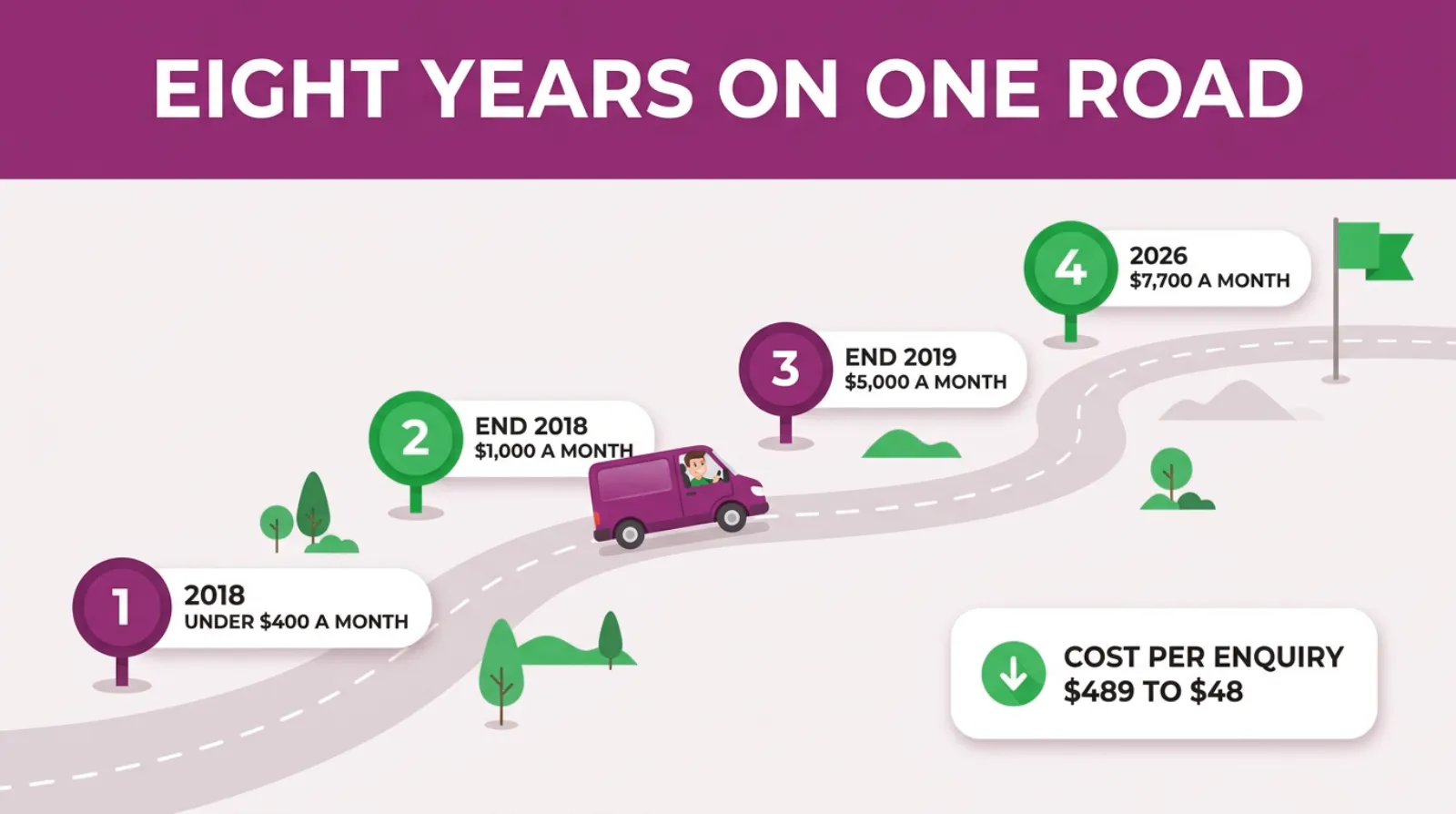
The account spent just under $4,000 in its first year and about $109,500 in its biggest. For the last four years it has settled at around $75,000 to $80,000 a year.
Here is the full picture, straight from the account. The 2026 figures run to 15 October.
| Year | Spend | Clicks | Enquiries | Cost per enquiry |
|---|---|---|---|---|
| 2018 | $3,911 | 1,169 | 8 | $489 |
| 2019 | $38,443 | 10,795 | 162 | $237 |
| 2020 | $76,579 | 10,983 | 475 | $161 |
| 2021 | $91,931 | 7,861 | 679 | $135 |
| 2022 | $109,531 | 38,322 | 1,450 | $76 |
| 2023 | $76,033 | 11,290 | 1,393 | $55 |
| 2024 | $79,868 | 32,824 | 1,885 | $42 |
| 2025 | $78,316 | 27,016 | 2,023 | $39 |
| 2026 so far | $74,314 | 24,895 | 1,477 | $50 |
Across almost nine years that comes to about $629,000 of spend and just over 9,500 enquiries.
Two things jump out. First, the spend grew slowly. Second, the cost of an enquiry fell from hundreds of dollars to under $50.
The account went live in January 2018 with small tests of under $400 a month. By December 2018 it was spending about $1,000 a month. By the end of 2019 that had grown to over $5,000 a month.
Nobody started this account at $7,700 a month. It earned its way there, one step at a time.
Why You Need Real Numbers, Not Industry Averages
Industry averages tell you what a click costs. They don't tell you what a customer costs. And that is the only number that decides whether Google Ads is worth it for you.
Here's why the averages mislead. LocaliQ and WordStream's 2026 search benchmarks say the average legal click costs $9.87.
This firm's search clicks averaged $11.49. That is close. But its average click across the whole account was $3.12, because not every click came from search.
Its cost per lead was $48. The same benchmarks put the average legal lead at $131.63.
If this firm had planned around the averages, it would have expected about a third of the enquiries it got. It might never have started.
The opposite happens too. An owner reads that clicks cost $2, budgets $300 a month and wonders why the phone doesn't ring.
Averages are a starting guess. Your own numbers are the only ones that count. That's why we always build a budget from three numbers you can check, not from a range in a blog.
It also changes the question you ask. "What does Google Ads cost?" is the wrong one. "What does a customer cost through Google Ads?" is the one that pays the bills.
Eight Years On One Road: How The Budget Grew
What Does A Click Actually Cost?
In this account, a click cost $3.12 on average over the last 12 months. But that average hides a big spread. Search clicks cost $11.49, while display and video clicks cost under a dollar.
This is the part most owners get wrong. They see "average cost per click" and think every click costs that.
As of October 2026, Google's help page on cost per click says your maximum bid "is the most that you'll typically be charged for a click, but you'll often be charged less".
So you rarely pay your full bid. But in a busy trade, the going rate is still high.
Here is where the money in this account's search keywords actually went.
- 81 percent went on keywords whose clicks averaged $10 to $20
- 17 percent went on keywords averaging $5 to $10
- About 1 percent went on keywords averaging over $20
- Almost nothing went on keywords under $5
The firm's biggest keyword was a simple one. Someone typing the words for a property lawyer, plus a few close versions. Those searches alone cost over $20,000 in a year.
They were worth it. No other keyword brought in as many enquiries.
Your clicks will sit somewhere else. A carpet cleaner might pay $2. An emergency plumber in a big town might pay $10 or more.
Find your own click price before you set a budget. Google's Keyword Planner will give you a rough range for free.
What Does A Lead Cost, And What Counts As One?
Over the last 12 months, each enquiry cost this firm about $48. An enquiry here means a phone call from an ad lasting 20 seconds or more, a contact form or a booking.
That definition matters more than the price. A cheap lead means nothing if it is counted badly.
Here is how the 1,914 enquiries broke down.
| Type of enquiry | Number | Share |
|---|---|---|
| Calls from the ads, 20 seconds or more | 1,653 | 86 percent |
| Contact form sent | 183 | 10 percent |
| Free consultation request | 42 | 2 percent |
| Appointment booked | 31 | 2 percent |
| Other calls | 5 | Under 1 percent |
Calls make up most of it. That's normal for a law firm, a trade or any local service where people want to talk to someone.
But a 20-second call isn't a signed client. Some callers ask a quick question. Some have the wrong number. Some are just shopping around.
So $48 is the cost of a conversation, not the cost of a customer. The firm closes some share of those calls. We do not see its sales figures, and we don't pretend to.
This is where many accounts fool themselves. Count page visits or button taps as leads and your cost per lead looks brilliant. Your bank balance will not.
Before you judge any cost per lead, check what is being counted. We have written a whole post on tracking mistakes, linked at the end of this one.
Where Does The Money Go Each Month?
Most of the money goes on search ads, the text ads that show when someone types a search. In this account, search took 54 percent of the spend and Performance Max took 37 percent. The rest went on video and display.
Here is the split for the last 12 months.
| Campaign type | Spend | Avg. cost per click | Enquiries | Cost per enquiry |
|---|---|---|---|---|
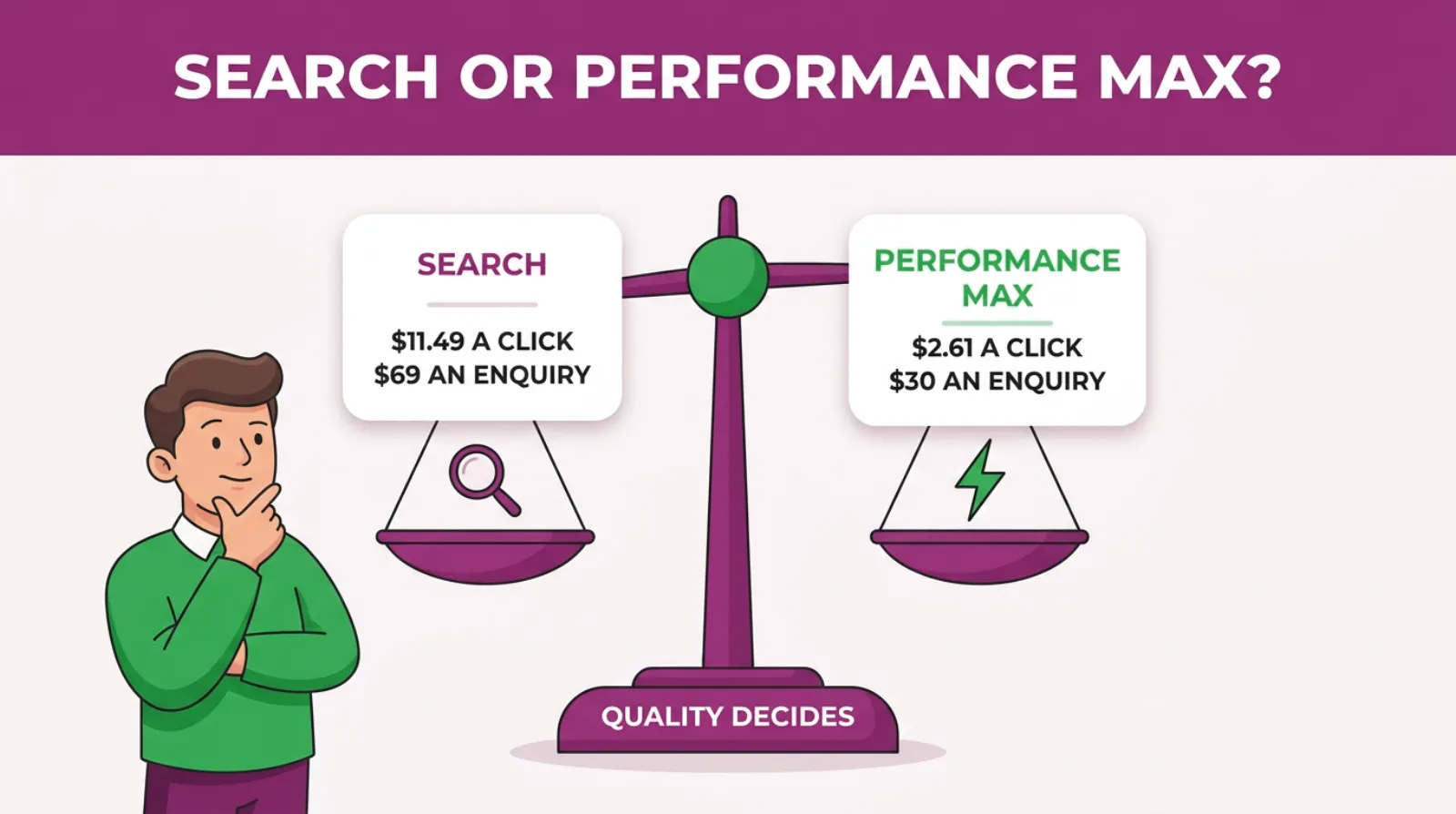
| Search | $50,148 | $11.49 | 731 | $69 |
| Performance Max | $34,188 | $2.61 | 1,128 | $30 |
| Demand Gen | $4,415 | $0.74 | 37 | $120 |
| Display remarketing | $2,559 | $0.45 | 19 | $135 |
| YouTube video | $1,099 | $2.38 | 0 | No enquiries |
On paper, Performance Max looks like the winner. It cost less than half as much per enquiry as search.
But cheaper per enquiry isn't the same as better. A person who types the words for a property lawyer is ready to talk. Someone who saw an ad while browsing may not be.
That's why we do not move all the money to the cheapest line. We look at what each enquiry turns into, then decide.
The video and display lines look poor too. But they do a different job. They remind people who visited the site and didn't call. Judge them on that, not on direct leads.
Each campaign type has a job. Judge it on its own job. A small account should start with search and add the rest later.
Why Did The Cost Per Enquiry Fall From $237 To $39?
The cost of an enquiry fell because the account got smarter, not because clicks got cheaper. More data, tighter targeting and better tracking all played a part. Clicks in this trade cost more now than they did in 2019.
Here is what changed over those years.
- Google had more data. Smart bidding learns from past enquiries. An account with years of them bids far better than a new one.
- The keywords got tighter. Over time, searches that never turned into enquiries were blocked as negative keywords.
- The tracking improved. Calls from the ads were counted properly. Some of the drop is better counting, not just cheaper leads.
- Campaigns got split by service. In February and April 2026 we added separate campaigns for single services, such as probate.
We want to be honest about point three. A drop from $237 to $39 isn't all down to clever management.
Part of it is that the early years counted fewer things. That's the trouble with long-run numbers. The ruler changes over time.
But the trend is real. Look at 2026 on its own. The cost per enquiry rose to $81 in February, then fell to about $40 by June after the new campaigns went in.
An account gets cheaper per lead as it gets older, if you look after it. That is the part no average can show you.
Is It Profitable At $7,700 A Month?
The firm tells us a typical matter is worth about $5,000. At that value, around two new matters a month cover the whole ad spend. Everything after that is profit on the advertising, before the firm's own costs.
Here's the sum, using the last 12 months.
- Monthly spend: about $7,700
- Value of a typical matter: about $5,000
- Matters needed to cover the ads: about 1.6 a month
- Enquiries each month: about 160
So the firm needs roughly one enquiry in a hundred to become a paying client. Anything above that is return.
We do not see the firm's sales records, so we won't give you a return figure we cannot prove. But here's what we can see.
The firm has kept spending at this level for five years. It raised the budget again in 2026. Owners don't keep doing that with money that is not coming back.
Run this sum for your own business. It's the most useful thing in this post.
Take your monthly budget. Divide it by what a new customer is worth to you. That is how many customers you need each month just to break even.
A builder with jobs worth $8,000 needs very few. A café with $12 orders needs a lot. That one sum tells you if Google Ads can ever work for you, before you spend anything.
Search Or Performance Max: Weighing Up The Two Biggest Costs
How Much Should A Local Business Budget To Start?
Start with enough to buy about 15 to 20 enquiries a month in your trade. For most local businesses that's somewhere between $1,000 and $3,000 a month. In the UK, a local service often starts at £20 to £50 a day.
Don't pick a number out of the air. Work it out with three steps.
- Find your click price. Use Keyword Planner, or ask someone who runs ads in your trade.
- Guess your conversion rate. One click in 15 to 20 becoming an enquiry is a fair starting guess for a local service.
- Multiply up. Clicks needed times click price is your monthly budget.
Here is a worked example with round numbers. Say your clicks cost $5 and one in 15 becomes an enquiry.
For 15 enquiries a month you need 225 clicks. At $5 each, that's $1,125 a month.
Now look at this law firm. At $11.49 a search click, the same 15 enquiries from search alone would cost well over $2,000.
That is why it couldn't start small and expect much from search. It had to grow into its budget.
If your sum comes out higher than you can afford, don't spread it thin. Pick your best service and your best area, and put all of it there.
A small budget on one thing beats a small budget on everything.
What Would $1,000 A Month Buy In This Account?
On search alone, $1,000 a month would buy about 87 clicks in this account. About one search click in six became an enquiry, so that is roughly 14 enquiries a month at about $69 each.
That's a real sum from the last 12 months. Search turned 4,365 clicks into 731 enquiries. That's a conversion rate of almost 17 percent, which is high, because people searching for a lawyer usually mean it.
So a smaller firm in the same trade could still get going on $1,000. It just couldn't do everything.
Here is what we'd do with that budget, as a hypothetical walkthrough.
- Run search only, with no video or display yet
- Pick the one service that brings in the most valuable work
- Target the area the firm can actually serve, not the whole state
- Count calls of a decent length and forms, nothing softer
That's it. No Performance Max, no remarketing and no YouTube until search is paying its way.
Once it is, the next $500 goes on the same campaign if it is limited by budget. Only after that does a second campaign make sense.
Spend the first pound where the buyer is already searching. Everything else can wait.
How Do You Know When To Raise The Budget?
Raise the budget when your cost per enquiry has been steady for a couple of months and Google says you're missing searches because the money runs out. If either of those isn't true, more money will not help.
This account grew in steps, not leaps. It went from about $1,000 a month at the end of 2018 to $2,500 in April 2019, then $3,400 in May 2019 and over $5,000 by December.
Each step came after the numbers from the step before had settled. That's the pattern we'd copy.
Here are the three checks we use before adding money.
- Is the cost per enquiry steady? Look at the last two or three months, not the last week.
- Is the campaign limited by budget? Google shows this in the campaign status and in the lost impression share columns.
- Can the business handle more work? There is no point buying calls nobody has time to answer.
If all three say yes, add about 20 percent and wait a few weeks. Then check again.
It sounds slow. But it's how this firm went from a few hundred dollars a month to about $7,700 without wasting money on the way.
What Does The First Year Really Look Like?
The first year is the most expensive per lead. This firm spent $3,911 in 2018 and got 8 enquiries, about $489 each. In 2019 it spent $38,443 for 162 enquiries, at $237 each.
That is a long way from the $48 it pays now. If the firm had judged Google Ads on its first year, it would have given up.
The first months in any account are partly a test. Google has no history of who your buyers are, so it has to find out.
You're paying for that learning. And it's always dearest at the start.
Here is what the early months taught this account, and most accounts like it.
- Small tests of a few hundred a month rarely give clear answers
- Costs fall once there's enough enquiry data to learn from
- The account had to grow before it got cheaper per lead
- Patience paid. The firm kept going through two dear years
We are not saying every account needs two years. A small trade in a quiet market can pay its way in a few months.
But you should plan for a first quarter that costs more than you would like. Budget for it, so it doesn't scare you off.
The first year is the price of finding out. Treat it as an investment, not as the answer.
Why Does The Cost Jump Around From Month To Month?
Monthly costs move because the mix of clicks changes. In this account the average click has ranged from $1.25 to $23.52 in a single month. The spend stayed fairly steady while the type of click swung.
In February 2022 the account bought 10,874 clicks at $1.25 each. In February 2021 it bought 369 clicks at $23.52 each.
Same firm, similar spend, and an average click cost that was almost twenty times higher in one February than in the other, simply because of what the money bought.
The difference was what the money was buying. Cheap months had more display and video clicks. Dear months were mostly search.
So don't panic when the average cost per click jumps. Ask what changed in the mix first.
The same goes for cost per enquiry. In the last 12 months it ranged from $29 in September 2025 to $81 in February 2026.
Seasons play a part. So do changes to campaigns, and other firms spending more in the same weeks.
Judge an account over three months, not three days. One bad month is weather. Three bad months is climate.
The Costs That Never Make It Into The Quote
The ad spend is only part of what Google Ads costs a local business. There are five other costs owners often forget.
- Management. Someone has to run it, either you or an agency. Your time has a price too.
- Call tracking. To count calls properly you need tracking numbers. This firm uses a call tracking service.
- The website. Ads send people to a page. If the page is slow or vague, you pay for clicks that go nowhere.
- Answering the phone. 86 percent of this firm's enquiries were calls. Every missed call is a lead you paid for and threw away.
- The first months. As the numbers above show, early leads cost more. Budget for that learning time.
The phone one is the biggest. It is also the cheapest to fix.
If a call comes in at $48 and nobody picks up, that's $48 gone. Do that ten times a month and you have lost nearly $500 before anyone has said hello.
Google can spend more than your daily budget on a busy day, which surprises people. As of October 2026, Google's help page on average daily budgets says it can spend up to "two times your average daily budget for most campaigns".
It evens that out across the month. You won't be charged more than 30.4 times your average daily budget in a month. So plan in monthly totals, not daily ones.
Frequently asked questions
How much does Google Ads cost per month for a small business?
Most small local businesses spend between $1,000 and $3,000 a month. In the UK, many start between £20 and £50 a day. The right number depends on your click price and how many enquiries you need.
Is $1,000 a month enough for Google Ads?
It can be, if your clicks are cheap and you focus on one service in one area. At $5 a click, $1,000 buys about 200 clicks. That is enough for around 10 to 15 enquiries in many local trades.
Why is Google Ads so expensive for lawyers?
A single client can be worth thousands, so many firms bid for the same searches. In this account, search clicks averaged $11.49. Some legal clicks in big cities cost far more.
Do you pay for Google Ads even if nobody clicks?
Not on search ads. With cost per click bidding, you only pay when someone clicks your ad. Some display and video campaigns can charge for views instead.
How long does it take for Google Ads to pay off?
It depends on your trade and budget. Some local accounts pay their way in a few months. This firm's cost per enquiry took a few years to settle below $100, because legal clicks are dear.
Can a local business spend too little on Google Ads?
Yes. If your budget buys only a handful of clicks a month, Google can't learn and you can't judge it. It is better to spend more on one service than a little on everything.
Keep Reading
If you want to work out your own numbers, these posts take each part further.
- How Much Should A Small Business Spend On Google Ads
- What A £10/Day Google Ads Budget Can Actually Achieve (When You Know What You’re Doing)
- How To Find Cost Per Acquisition (CPA) In Google Ads
- The £4,000-A-Month Conversion Tracking Mistake In 8 Of 10 SME Google Ads Accounts
- The Google Ads Performance Max Trap: How Google’s Smartest Campaign Type Might Be Wasting Your Budget
- 9 Practical Google Ads Tweaks That Lower Your Cost Per Lead Within 30 Days
We picked these because each one covers a number from this post: budget, cost per lead, tracking or campaign type.
Sources
The account figures come from the Google Ads account itself, pulled on 16 October 2026. The quotes on click costs and budgets come from Google's own help pages, checked the same day.
- Cost per click (CPC): Definition - Google Ads Help
- About average daily budgets - Google Ads Help
- The ad auction - Google Ads Help
Start With Your Own Sum, Not Someone Else's Average
Google Ads doesn't have a price. It has a sum. Your click price, your conversion rate and what a customer is worth to you.
This firm started with a few hundred dollars a month. It grew to about $7,700 as the numbers proved themselves, and its cost per enquiry fell from $489 to about $48.
You do not need its budget. You need its patience and its maths.
Work out your three numbers this week. Then start small, on one service, and let the results tell you when to grow.
And if you'd like someone to run those sums with you, that's what we do at SF Digital every day.

Written by Uzair Kharawala
Partner at SF Digital Studios, a Google Premier Partner agency. Uzair has been helping businesses grow with Google Ads since 2002 and teaches it every week on YouTube.
Get our best Google Ads tips by email
New articles and videos, straight to your inbox. Unsubscribe any time.