
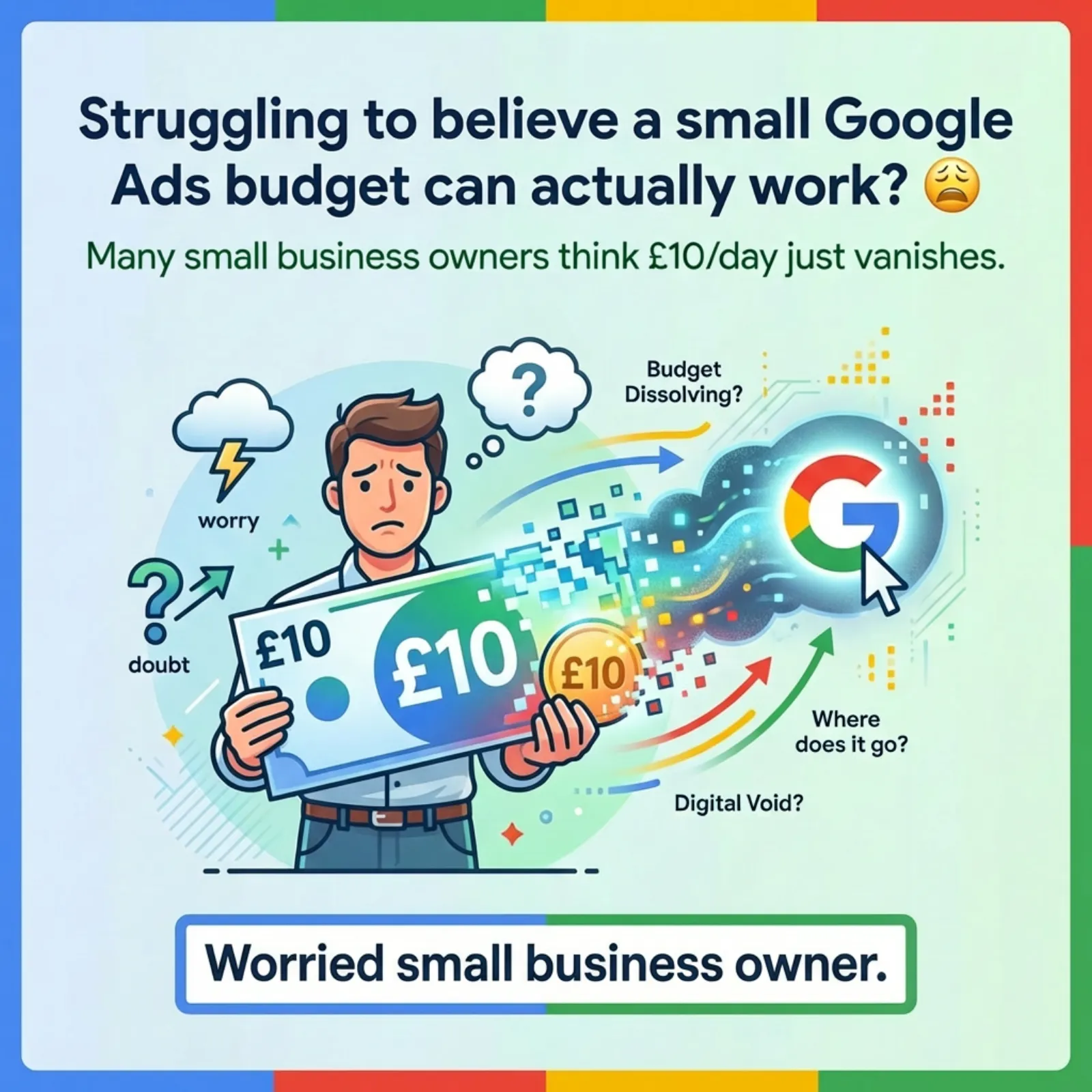
Imagine launching your small business online, brimming with hope, only to be told that advertising costs are astronomical. Many believe that Google Ads is a playground exclusively for multi-million pound corporations, a place where a modest £10/day budget simply vanishes without a trace.
But what if we told you that this widely held belief is not only false but could be costing your business valuable growth opportunities? A seemingly small investment can deliver tangible results, bringing in new customers and driving real growth for your local shop or budding online service.
Get Found, Get Chosen, Get Your Time Back
A free one-day marketing seminar in Milton Keynes · 10 November 2026
Understanding the £10/Day Mindset: More Than Just Clicks
The Common Misconception About Small Budgets
Many beginners approach Google Ads equating larger budgets with guaranteed success, fearing a £10/day investment is too tiny to even compete. This mindset often leads to inaction, preventing businesses from leveraging powerful search advertising. The truth is, a smaller budget forces incredible strategic efficiency, transforming a perceived weakness into a powerful advantage for your small business.
Get your free Marketing Action PlanNot sure where to start? Answer a few questions and get your plan in about a minute. No email needed.
Get my plan →It’s not about the size of your wallet; it’s about the precision of your aim. When you have less to spend, every click, impression, and conversion becomes critically important. This encourages a level of focus and optimization that larger, less scrutinized budgets often lack, teaching you to make every penny work harder for greater long-term profitability.
Shifting Focus: From Quantity to Quality and Intent
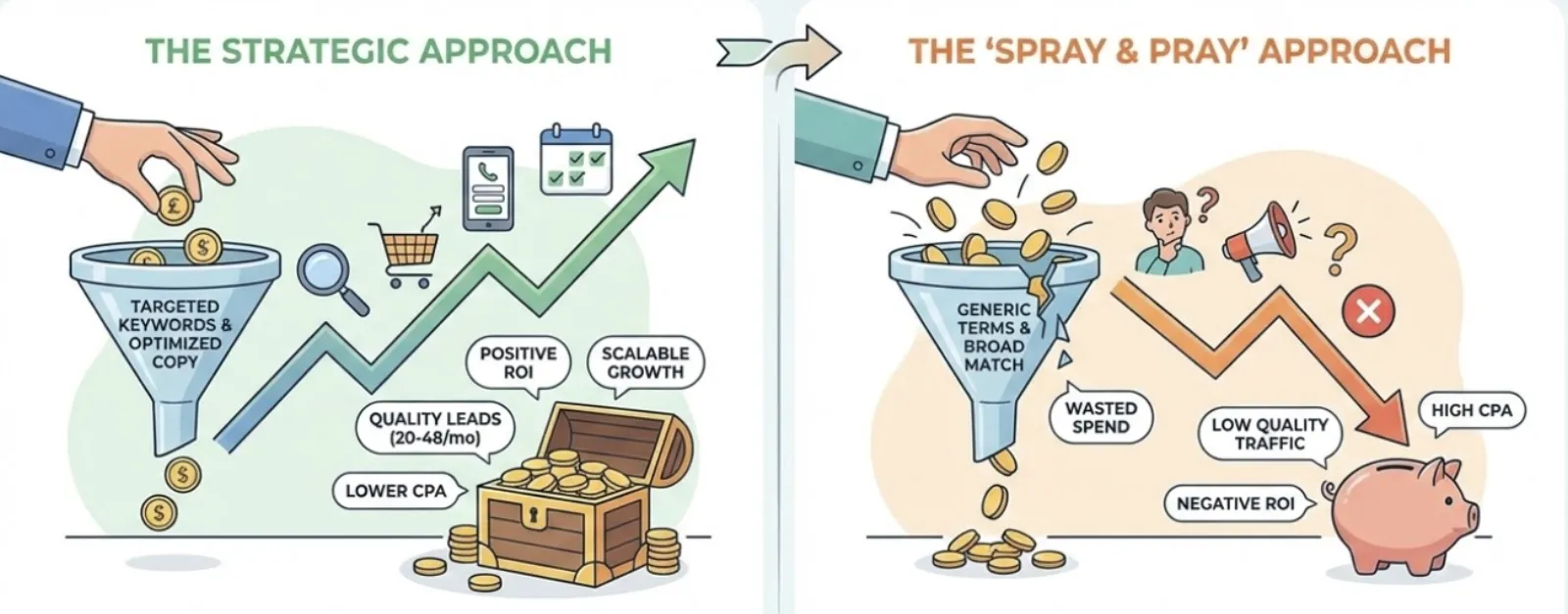
With a limited PPC budget, your primary goal isn’t to get the most clicks possible; it’s to attract the *right* clicks. We’re talking about highly qualified prospects who are actively searching for what you offer, ready to make a purchase or inquiry. This means prioritising quality over sheer volume, targeting users with clear commercial intent rather than broad interest.
For example, a local plumber with a £10/day budget isn’t trying to reach everyone; they target someone in their immediate service area whose boiler just broke. This shift is fundamental: using highly specific keywords, local targeting, and ad copy that directly addresses a user’s immediate need. This approach drastically improves your chances of converting those precious few clicks into valuable leads or sales.
The Foundation: Setting Up Your Google Ads for Success on a Shoestring Budget
Mastering Keyword Research: Precision is Your Power
Effective keyword research is the cornerstone of any successful Google Ads campaign, especially on a tight budget. Instead of broad, generic keywords, which are often expensive and competitive, focus on long-tail keywords. These are more specific phrases users type when they know exactly what they’re looking for, demonstrating higher intent.
For instance, “men’s waterproof hiking shoes UK size 9” targets high-intent users, unlike the broad “shoes” which drains budgets quickly. Use tools like Google Keyword Planner to find these gems, focusing on commercial intent phrases like “buy,” “service,” or “near me.” Crucially, employ negative keywords to filter out irrelevant searches like “used” or “free” to protect your budget marketing.
Structuring Your Campaigns for Maximum Efficiency
A well-organised campaign structure is vital for controlling costs and improving relevance. Avoid putting all your keywords into one ad group. Instead, create tightly themed ad groups, each focusing on a very specific set of keywords and corresponding ad copy. This approach, similar to Single Keyword Ad Groups (SKAGs), ensures high relevance.
For example, an artisanal coffee business might have separate ad groups for “organic espresso beans” and “fair trade coffee subscriptions.” This enhances your Quality Score—Google’s rating of ad relevance—leading to lower CPCs and better ad positions, giving your small budget a significant boost in online advertising.
Strategic Targeting: Reaching the Right People, Not Just Many People
Geographic Targeting: Local Love on a Global Platform
If your business serves a specific local area, geographic targeting is your best friend. Why pay for clicks from someone in another country or city if they can’t become your customer? Google Ads allows precise targeting by country, region, city, postcode, or even a specific radius around your business location, making it perfect for local SEO.
A small cafe, for instance, benefits greatly from targeting a 2-mile radius, ensuring its limited budget reaches potential customers physically able to visit. This precise targeting prevents wasted ad spend, focusing your resources on truly viable leads and enhancing your digital growth.
Demographic and Audience Targeting (Used Wisely)
While often associated with larger budgets, demographic and audience targeting can still benefit small budgets when used strategically. You can refine your audience by age, gender, parental status, or income brackets. For premium baby products, targeting new parents is more effective than targeting a general audience.
Google offers “in-market audiences” (users actively researching specific products) and “custom audiences” (based on search activity). Use these features initially in ‘observation’ mode to gather data on high-performing segments before applying strict targeting or bid adjustments, ensuring your PPC strategy remains efficient.
Crafting Compelling Ads: Making Every Impression Count
Writing Ad Copy That Converts
Every character in your ad copy needs to pull its weight. With a £10/day budget, you cannot afford wasted impressions. Your ad copy must be clear, concise, and highly relevant to the search query. Focus on user pain points and how your product or service provides the solution, highlighting your unique selling propositions (USPs) and including a strong, clear call to action (CTA).
Utilise ad extensions like sitelinks and callouts to provide more information and occupy more screen space. These extensions don’t cost extra and significantly improve your ad’s visibility and click-through rate (CTR). For local businesses, a call extension allowing direct dialing from the ad is incredibly powerful for generating leads.
The Power of Ad Extensions: More for Less
Think of ad extensions as free upgrades for your Google Ads. They let you add extra information without increasing your cost per click, which is invaluable for a small budget. Sitelink extensions direct users to specific website pages, while callout extensions highlight key benefits like “Free Shipping” or “24/7 Support.” Structured snippet extensions showcase specific aspects of your offerings.
A location extension is crucial for local service providers, showing your address and a map link. A call extension enables instant contact. These extensions make your ad larger, more informative, and more appealing, pushing competitors’ ads down and improving your overall ad performance without direct additional cost, driving better digital growth.

Landing Page Optimization: Sealing the Deal on a Budget
Creating a Seamless User Experience
Your ad might get the click, but your landing page secures the conversion. With a limited budget, every visitor to your landing page is precious. Ensure your landing page is fast-loading, mobile-responsive, and visually appealing. A clunky, slow, or confusing page will lead to high bounce rates, effectively wasting your ad spend and hindering your small business success.
 LIVE
Live every Tuesday at 2pm UK. Bring your marketing questions.
Get your Google, local SEO and AI questions answered live.
The landing page must directly continue the message from your ad. If your ad promises a “10% discount,” the landing page should immediately showcase that offer. Keep the design clean, with clear headings, concise copy, and a prominent call to action. Prioritise quick loading (under 3 seconds on mobile) and a mobile-first design for optimal results.
Message Match: The Golden Rule of Conversions
Message match dictates that the message in your ad should perfectly align with the message on your landing page. This seems obvious, but is often overlooked. If your ad promises “Affordable Web Design for Startups” but your landing page talks generally about “Creative Digital Solutions,” users will feel misled and likely leave, wasting your Google Ads budget.
When a user clicks your ad, they have a specific expectation. Your landing page’s job is to immediately confirm they’ve come to the right place and guide them to the desired action. Use the same keywords, phrases, and imagery from your ad on your landing page to build trust, reduce friction, and significantly increase your chances of converting that valuable click into a lead or sale.
Monitoring, Measuring, and Adapting: The Key to Sustained Success
Tracking Conversions: Knowing What Works
If you’re spending money on Google Ads, even just £10 a day, you absolutely must track conversions. A conversion is any valuable action a user takes on your website, such as filling out a contact form, making a purchase, or calling your business. Without conversion tracking, you’re flying blind, unable to discern which keywords, ads, or targeting methods generate actual results.
Google Ads offers built-in conversion tracking, and you can integrate with Google Analytics 4 (GA4). Set up tracking for all key actions. This data is invaluable as it reveals where your money is best spent, allowing you to reallocate your Google Ads budget from underperforming elements to those generating profitable outcomes, essential for small business marketing.
Optimizing for Profit, Not Just Clicks
The ultimate goal of advertising is to generate profit, not just clicks. With a limited budget, it’s easy to focus on CTR or average CPC. While important, the critical metrics are Cost Per Acquisition (CPA) and Return On Ad Spend (ROAS). A keyword with a high CTR that never leads to a sale is a budget drain; one with a modest CTR but low CPA and high ROAS is a winner.
Regularly review your Search Terms Report to identify and add non-performing queries as negative keywords. Adjust bids based on performance, increasing bids for keywords and ad groups that convert well, and decreasing or pausing those that don’t. This constant, iterative optimization is what makes a small budget powerful, driving genuine digital growth.
Real-World Examples: What Small Businesses Are Achieving
Local Service Provider Success Story
Mark, a Bristol electrician, started with a £10/day Google Ads budget. He targeted keywords like “emergency electrician Bristol” and “fuse box repair Bristol,” using specific ad copy and a call extension. Within two weeks, he received 2-3 calls daily, generating significant revenue from his £70 weekly ad spend. By optimizing negative keywords and ad scheduling, Mark successfully scaled his client base.
E-commerce Niche Store Breakthrough
Sophie, running an online store for handmade pet accessories, used a £10/day budget to target long-tail keywords like “personalised dog collar leather UK.” Her Google Shopping campaigns and optimized product pages generated high-intent visitors. Her ROAS consistently exceeded 300%, meaning for every £1 spent, she earned £3 in sales, allowing her to validate her market and confidently increase her budget for sustainable e-commerce growth.
Common Pitfalls to Avoid with a Limited Google Ads Budget
Wasting Budget on Broad or Irrelevant Keywords
The biggest budget killer for small advertisers is using broad, generic keywords. These attract huge traffic, but much of it is irrelevant, quickly depleting your £10/day budget without meaningful results. For “custom jewellery,” bidding only on “jewellery” will attract diverse, often unqualified, searches.
Ignoring Negative Keywords
Negative keywords are as crucial as positive ones, instructing Google when *not* to show your ads. Failing to use them is like leaving a hole in your budget bucket. Regularly review your Search Terms Report to identify and add irrelevant queries (e.g., “free,” “tutorials”) to your negative keyword list, protecting your precious daily budget from wasted clicks.
Sending Traffic to a Poor Landing Page
A brilliant ad with precise targeting can be completely undone by a poor landing page. If your landing page is slow, confusing, or doesn’t deliver on your ad’s promise, users will bounce, wasting your ad spend. Invest time in creating a dedicated, fast-loading, mobile-friendly landing page with a clear call to action that matches your ad’s message.
Not Tracking Conversions (Flying Blind)
This is arguably the most critical mistake. Without conversion tracking, you have no idea if your Google Ads are actually working, which keywords drive sales, or if your £10/day budget generates a positive return. It’s impossible to optimize what you don’t measure. Set up tracking for all primary goals from day one to make data-driven decisions, not guesses.
Frequently Asked Questions About Google Ads on a £10/Day Budget
1. Is a £10/day Google Ads budget really enough to see results?
Yes, absolutely! While it won’t allow for broad, mass-market campaigns, a £10/day budget is enough for significant results for local businesses or highly niche products/services. The key is extreme precision in keyword targeting, geographic focus, and continuous optimization. Many small businesses have built their initial customer base using similar modest investments.
2. How long does it take to see results with a small Google Ads budget?
You can often start seeing initial clicks and impressions within hours of launching your campaign. However, meaningful results, such as conversions and sales, typically take a few days to a couple of weeks to become consistent. Google’s algorithm needs time to learn, and you’ll need time to gather data and make initial optimizations based on real performance.
3. What’s the most important thing to focus on with a limited budget?
Conversion tracking and profitability. It’s not about getting the most clicks, but the most valuable clicks. Ensure you’re tracking exactly which actions (leads, sales) your ads generate, and continuously optimize to lower your Cost Per Acquisition (CPA) and improve your Return On Ad Spend (ROAS). Every pound must work hard.
4. Should I use automated bidding strategies with a £10/day budget?
Initially, it’s often best to start with manual bidding (manual CPC) to maintain tight control and gather data. Once you have sufficient conversion data (15-30 conversions/month), you can experiment with automated strategies like ‘Maximize Conversions’ or ‘Target CPA’ for improved efficiency, but always monitor them closely.
5. Can I compete with larger companies using only £10/day?
Directly competing on broad, high-volume keywords with large companies is difficult. However, you can absolutely compete, and often win, by focusing on niche, long-tail keywords where larger businesses might not be as precise. By targeting specific needs and local areas, you can carve out a profitable space that bigger players overlook, making your £10/day highly effective.
Final Thoughts: Your £10/Day Google Ads Opportunity
The myth that Google Ads is only for businesses with bottomless pockets is just that—a myth. For small business owners, a £10/day budget is not a limitation; it’s an invitation to be incredibly smart, strategic, and efficient. It forces a focus on quality over quantity, precision over broad strokes, driving genuine digital growth.
Don’t let perceived budget constraints hold you back from tapping into Google Search. Your £10/day could be the foundation of your next big business breakthrough, proving that when you know what you’re doing, even a small investment can achieve remarkable things.

Written by Uzair Kharawala
Partner at SF Digital Studios, a Google Premier Partner agency. Uzair has been helping businesses grow with Google Ads since 2002 and teaches it every week on YouTube.
Get our best Google Ads tips by email
New articles and videos, straight to your inbox. Unsubscribe any time.