
Let’s be honest. When you first start with Google Ads, the bid strategies can feel like a foreign language. There are so many options, and it’s easy to get lost in the sea of acronyms. But there’s one in particular that seems simple on the surface but is often misunderstood: the Impression Share bid strategy.
I’ve seen it time and time again. Someone sets up a campaign, sees the option for Impression Share, and thinks, “More impressions, more people see my ad. That’s a good thing, right?” They set a high target—say, 90% or even 100%—and then wonder why their results aren’t what they expected.
Get Found, Get Chosen, Get Your Time Back
A free one-day marketing seminar in Milton Keynes · 10 November 2026
The truth is, Impression Share isn’t a one-size-fits-all solution. It’s a powerful tool, but like any tool, it’s only effective when you use it for the right job.
Get your free Marketing Action PlanNot sure where to start? Answer a few questions and get your plan in about a minute. No email needed.
Get my plan →What is Impression Share?
First, let’s get a clear picture. Impression Share is simply the percentage of times your ad was shown compared to the total number of times it was eligible to be shown. If your ad was eligible to show 1,000 times but only appeared 500 times, your Impression Share is 50%.
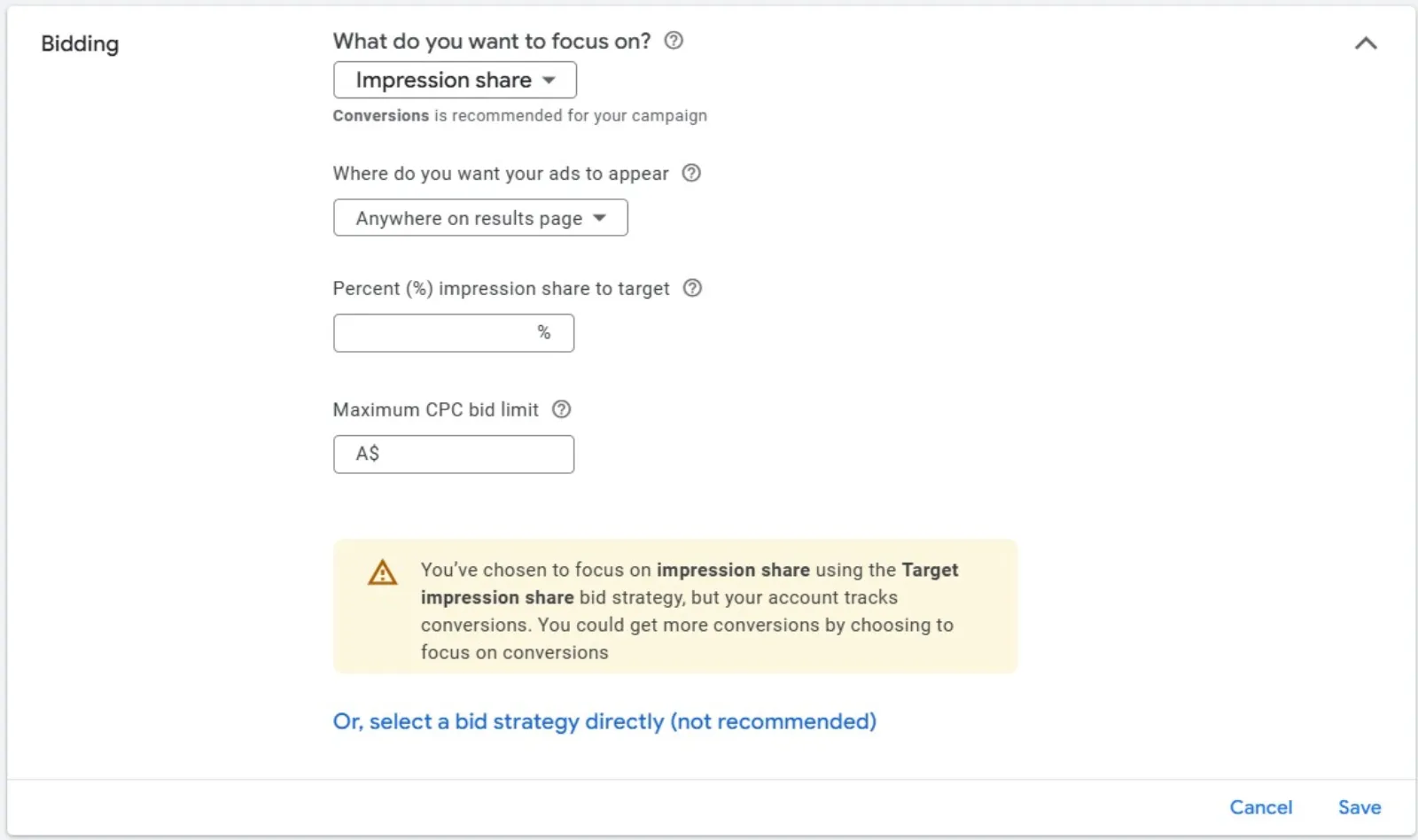
The Target Impression Share bid strategy is designed to automatically adjust your bids to help you achieve a certain percentage of those possible impressions. You can tell Google you want to show up anywhere on the page, at the top of the page, or at the absolute top of the page, and it will try to get you there.
So, where does it go wrong?
The “Vanity” Mistake
The biggest problem I see is that people treat Impression Share as a conversion strategy. They believe that a high target impression share will directly lead to a high number of sales or leads. This is a classic mistake.
 LIVE
Live every Tuesday at 2pm UK. Bring your marketing questions.
Get your Google, local SEO and AI questions answered live.
Impression Share is a visibility strategy, not a performance strategy.
Think about it this way: a billboard on a busy highway gets a ton of impressions. Everyone driving by sees it. But does that mean every person who sees it will buy what’s being advertised? Of course not. That’s because the goal of the billboard is to create brand awareness, not necessarily to drive immediate, trackable conversions.
When you use the Target Impression Share bid strategy, you’re essentially telling Google, “I don’t care what the cost per click is, just make sure my ad shows up a lot.” This can lead to a few issues:
- Sky-high CPCs: To get a high impression share, especially at the absolute top of the page, Google might have to bid very aggressively in the ad auction. This can drive up your cost per click (CPC) and drain your budget much faster than you planned.
- Wasted Spend: Your ad might be showing for searches that are only loosely related to your business, but Google is bidding high to hit that impression target. You’ll get the impression, but you’re paying for clicks from people who were never going to convert anyway.
- Ignoring Conversions: This strategy can make your campaigns “blind” to conversions. Google’s algorithm is focused on hitting the impression target, not on finding the most valuable customers. You might get a lot of clicks and impressions, but your cost per acquisition (CPA) could be through the roof.
So, When Should You Use It?
The Target Impression Share bid strategy isn’t useless. It just needs to be applied to the right campaigns with the right goals. Here’s when it makes perfect sense:
1. Brand Campaigns
This is the most common and effective use case. If someone is searching specifically for your company’s name, you want to be the first thing they see. You don’t want a competitor showing up there instead. For these campaigns, a high Impression Share target is crucial. You’re not looking to discover new customers; you’re protecting your brand and ensuring people who are already looking for you find you.
2. Highly Competitive Niche Keywords
If you’re in a highly competitive market and want to ensure you have a constant presence for a small set of very specific, high-value keywords, Impression Share can be a good choice. This is about establishing dominance and mindshare. The focus isn’t on a direct conversion from this single campaign, but on ensuring your brand is always top-of-mind for your core audience.
3. New Product Launches or Special Promotions
When you’re launching a new product or running a limited-time promotion, a burst of visibility is often more important than cost-efficiency in the short term. Using a high Impression Share can help you get the word out quickly and build initial momentum.
How to Use It Right
If you’ve decided the Target Impression Share bid strategy is right for one of your campaigns, here’s how to avoid the common pitfalls:
- Set a Max CPC: This is a non-negotiable step. If you don’t set a maximum CPC, you’re giving Google an open chequebook. It will bid whatever it needs to hit your impression target, and that could get very expensive, very fast. Set a realistic max CPC to keep your costs in check.
- Don’t Go for 100%: A 100% impression share is often a pipe dream and will likely lead to overspending. Start with a more modest goal, like 80% or 90% for brand campaigns. Google will still work hard to get you there, but it won’t be forced to bid absurd amounts for the last few, very expensive impressions.
- Use It with Care: Only apply this strategy to campaigns where brand visibility is the explicit goal. For everything else—the campaigns where you’re trying to generate leads or sales from generic keywords—use a conversion-focused strategy like “Maximise Conversions” or “Target CPA.”
- Monitor Your Metrics: Don’t just set it and forget it. Keep a close eye on your CPC and your overall cost. If you notice your costs are soaring and your click-through rate (CTR) is low, it might be a sign that you’re bidding too aggressively in a position that isn’t converting.
The Bottom Line
The Target Impression Share bid strategy is not a magic bullet for more business. It’s a specialised tool for specific jobs. It’s a way to increase brand visibility and protect your space in the search results.If your goal is to generate conversions and a positive ROI, you’re probably better off with a different smart bidding strategy. But if you have a campaign dedicated to building and defending your brand, then Impression Share can be a powerful ally. Just remember to set your limits and use it wisely.

Written by Uzair Kharawala
Partner at SF Digital Studios, a Google Premier Partner agency. Uzair has been helping businesses grow with Google Ads since 2002 and teaches it every week on YouTube.
Get our best Google Ads tips by email
New articles and videos, straight to your inbox. Unsubscribe any time.