
If you’re running Google Ads, you’ve likely heard the term ROAS thrown around. But what does it mean, and how do you calculate it? Whether you’re new to Google Ads or working on improving your ad performance, understanding ROAS (Return on Ad Spend) is crucial for making informed decisions about your advertising strategy.
In this blog post, we’ll explain ROAS, how to calculate it, and why it’s an important metric for businesses, especially those running e-commerce campaigns. So, let’s dive in!

Get Found, Get Chosen, Get Your Time Back
A free one-day marketing seminar in Milton Keynes · 10 November 2026
What Is ROAS?
First things first, let’s clarify what ROAS stands for. ROAS, or Return on Ad Spend, is a metric used to measure the effectiveness of your advertising campaigns, specifically how much revenue you earn for each dollar you spend on ads. This is crucial in determining whether your Google Ads campaigns are profitable or not.
Get your free Marketing Action PlanNot sure where to start? Answer a few questions and get your plan in about a minute. No email needed.
Get my plan →To put it simply, ROAS tells you how much revenue you generate for each dollar spent on Google Ads. A higher ROAS means you’re making more money for your ad spend, which is, of course, the goal of any advertising campaign.
ROAS vs. ROI
Before we get into how to calculate ROAS, it’s important to understand the difference between ROAS and ROI (Return on Investment), since people often confuse the two.
- ROI (Return on Investment) typically refers to the return you make on your overall investment, including both direct and indirect costs. It’s often used for lead generation or broader business activities.
- ROAS (Return on Ad Spend), on the other hand, is specific to the return you’re getting from your advertising budget. It’s typically used in e-commerce to measure the direct revenue generated from ad campaigns.
Why Should You Care About ROAS?
ROAS helps you understand whether your Google Ads campaigns are generating a positive return. If you’re running a business, especially one focused on e-commerce, you want to know if the money you’re putting into ads is bringing back more money in sales.
For example, if you’re selling a product for $100, and your ad spend is $50, your ROAS is 2x (meaning you made $2 in revenue for every $1 spent). The higher your ROAS, the more profitable your campaign is.
Now that we’ve clarified the concept, let’s dive into how you can calculate ROAS in Google Ads.
How To Calculate ROAS In Google Ads
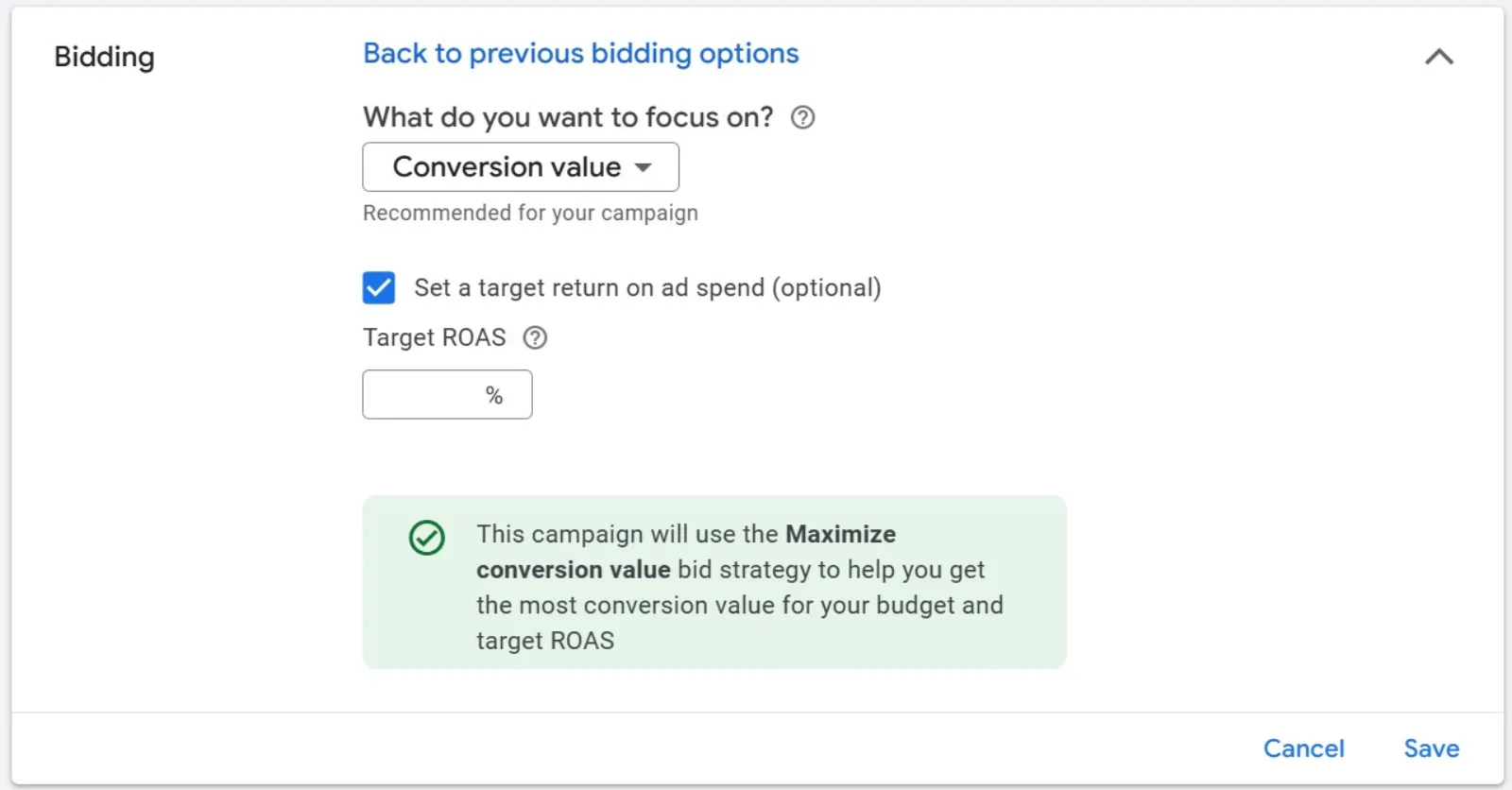
Calculating ROAS is relatively simple. Here’s the formula:
ROAS = Revenue from Ads / Cost of Ads
This formula works for any ad campaign, but let’s break it down further with an example:
Example 1: Simple ROAS Calculation
Let’s say you’re running an e-commerce store selling gadgets, and your Google Ads campaign has generated the following results:
- Revenue from Ads: $1,000 (the sales generated from the ad clicks)
- Cost of Ads: $250 (the amount you spent on your Google Ads campaign)
To calculate ROAS, you just divide the revenue by the cost:
 LIVE
Live every Tuesday at 2pm UK. Bring your marketing questions.
Get your Google, local SEO and AI questions answered live.
ROAS = $1,000 ÷ $250 = 4
This means that for every dollar you spent on ads, you made $4 in revenue. So, your ROAS is 4x. This indicates a successful campaign, as you’re generating more revenue than what you’re spending.
Example 2: ROAS with Different Costs
Let’s take another example where you spent $300 on ads, but your revenue came to $900. Here’s how the math works out:
ROAS = $900 ÷ $300 = 3
So, in this case, for every $1 you spent, you made $3 in return. This might still be a profitable campaign, but depending on your profit margins and other business expenses, you may want to aim for a higher ROAS.
What ROAS Should You Aim For?
A common question is: What is a “good” ROAS?
Unfortunately, there’s no one-size-fits-all answer. The ideal ROAS depends on several factors, including:
- Profit Margins: If you’re selling high-margin products, you might be able to get by with a lower ROAS. For example, a ROAS of 2x might still be profitable if your product has a large margin. On the other hand, if you’re selling low-margin products, you’ll likely need a higher ROAS to be profitable.
- Customer Lifetime Value (CLV): Another factor to consider is the customer lifetime value. If you’re focusing on acquiring new customers, their initial purchase might not give you a huge return on ad spend, but if they return to purchase from you again (through email marketing, remarketing, etc.), your ROAS will improve over time.
Let’s say you sell a product for $100, and the initial sale gives you a ROAS of 1.5x. However, if that customer returns to buy from you again after a few months, your lifetime ROAS might end up being much higher, potentially 4x or more.
Why ROAS Isn’t the Only Metric to Consider
While ROAS is a valuable metric, it shouldn’t be the only one you rely on when evaluating your Google Ads campaigns. Here are a few additional metrics you should consider alongside ROAS:
- Conversion Rate: The percentage of people who click on your ad and make a purchase. A higher conversion rate often means your ads are resonating well with your target audience.
- Cost per Conversion: This tells you how much it costs to get a customer to complete a desired action, like making a purchase.
- Average Order Value (AOV): The average amount of money a customer spends in a single transaction. Increasing your AOV can help improve your ROAS.
Factors That Can Impact ROAS
Several factors can impact your ROAS, including:
- Targeting: The more specific your audience targeting, the more likely your ads will be shown to people who are ready to buy, improving your ROAS.
- Ad Quality: High-quality ads that are relevant to your audience are more likely to convert, resulting in a higher ROAS.
- Bidding Strategy: Your bidding strategy (e.g., manual CPC vs. automated bidding) can affect how effectively your ads perform.
Conclusion
ROAS is a powerful metric for evaluating your Google Ads campaigns, and understanding how to calculate it is key to maximising your return on ad spend. By calculating ROAS, you can make informed decisions about where to allocate your ad budget, optimise your campaigns, and ultimately boost your profitability.
Keep in mind that ROAS should be considered alongside other metrics like conversion rate and customer lifetime value for a more holistic view of your ad campaign’s performance. Additionally, don’t focus solely on the first transaction — the longer-term relationship with your customers can significantly impact your overall ROAS.
By tracking ROAS and adjusting your campaigns accordingly, you’ll be able to create more profitable advertising strategies for your business.

Written by Uzair Kharawala
Partner at SF Digital Studios, a Google Premier Partner agency. Uzair has been helping businesses grow with Google Ads since 2002 and teaches it every week on YouTube.
Get our best Google Ads tips by email
New articles and videos, straight to your inbox. Unsubscribe any time.