
NatWest Accelerator Events Free one-day marketing seminar at the NatWest Accelerator, Milton Keynes · 10 November 2026 Free marketing seminar · NatWest Accelerator, Milton Keynes · 10 Nov 2026 Free seminar · 10 Nov 2026
NatWest Accelerator, MK
Get your free invite →Invite →

Home › Blog › Google Ads

Google Ads

How To Improve Quality Score In Google Ads

How To Improve Quality Score In Google Ads
Read the video transcript

How do I improve my quality score? It's a great question. One of the most commonly asked questions, I should say, because everyone is obsessed about quality score. Yes, you want to keep an eye on it, but you don't need to be obsessive about it because what you don't want to do is to just look at one metric, which is quality score.

There are lots of other metrics as well, like conversions, conversion rate, cost per conversions, and so on. So, you got to look at the whole picture and not just one metric. And a lot of my students and clients, they really get annoyed, upset, frustrated when they see a quality score of 2 out of 10. But then we look at the full picture and we see that that keyword is converting really well.

So why would you mess around with it? So let me first explain what quality score is. So, the quality score is allocated to every keyword in your account or campaign. So, it is at keyword level. So that determines whether a keyword has a good quality score or a bad quality score. A good quality score would be 7 out of 10.

So, every, let me step back a bit. Every keyword is allocated a mark out of 10, 10 being the best, zero being the worst. So, you want to be as high as possible out of 10. So, 9 out of 10. 10 out of 10 would be perfect, but quite often you won't be there. And there are three important components of how a quality score is calculated by Google.

So, the three things which determines your quality score for a keyword is expected click-through rate, ad relevance, and the landing page experience. So, let's go into a bit more detail of each one of them. Google is in the business of clicks. That's how they make money. If nobody clicks on their ads, they're not going to make money.

Neither will you because you are not driving any traffic to your website. Right? You don't get any visitors to your website; you're not going to get any leads or sales. So, this is a fact that you got to get clicks on your website, but you got to get the right click. Not just spammy clicks, irrelevant clicks. Get the right click, few clicks, but the good clicks.

So expected click-through rate is the first component. Obviously, Google doesn't care. Well, they do in a way because they want Google Ads to work for you. But it doesn't hurt them or hurt their pockets if an irrelevant person clicks your ad. So, you need to work out who clicks on your ad by targeting the right keyword, the messaging on your ads and so on.

So, the expected click-through rate is so every keyword will have an expected click-through rate that. Okay, the higher the click-through rate, the better the ad is. If my ad is shown to somebody who's interested in Google Ads or digital marketing, then obviously they will be interested in my ad as long as the message on the ad is good.

So, I'm going to get a higher click-through rate. The next one is the ad relevance. Ad relevance is if somebody is looking for red apples, the ad shows red apples. We don't want to show them green apples or golden apples. Right? So, give them what they are looking for. So quite often you will find that some. Well, I find a lot of advertisers are lazy and they will put all the apples in the same ad.

If you were to sell apples, if I was setting up the campaign, yes. You need to do a bit more work and doing all this groundwork and the homework and a bit more work in the back in the first place will pay you rich dividends in the long run. But this is where a lot of advertisers, they just want to write the ads, set up the campaigns and get the campaign started so that they can start getting sales and leads.

That's not how it works. So, you want to have that right keyword show the right ad or the search term, I should say got to have the keyword on the headline, either 1, headline 1 or headline 2. If you put the keyword in the headline 3. Quite often headline 3 doesn't show up on the ads. So, there's no keyword.

So, my personal preference is that we ought to put one keyword keyword in headline 1. So then if I'm looking for red apples and the ad pops up with the headline saying buy the best red apples here, that is what we mean by add relevance. And the third bit is the landing page. Landing page is or the landing page experience.

Google is recommending you from their platform. So, if I were to ask you a referral, hey, do you know a good accountant? You're not going to refer somebody to me who is not a good accountant, right? So, the same thing happens on Google. So, you're on Google Page, you're looking for something, and then Google says if you click here, you're going to go to this landing page or website and this is what you're going to get.

So, they want to send traffic to high-quality websites and landing pages. So, it's in your best interest to make sure that your website, the first most important is the speed. It has got to be lightning-fast. And one of the most easiest and the simple way to make a website load up fast is not go for the cheap hosting packages, but go for a dedicated one if you can afford it.

Because with that way you are going to get faster page load speeds. Now there is a free tool from Google. If you go to Google and search for Google Page, Page Insights or Page Speed, you'll get that first link and then you can see type in your name or your URL in that, on that page and it will give you a mark out of 100 or your website mark out of 100, one for the desktop version and one for the mobile version.

And if there are any problems, issues or anything like that, Google is going to tell you go and sort this out. And that's what you need to do. Make your website lightning fast so that it's a great user experience. Because as you know, if you set up, load up a page on your mobile or on your desktop and it takes ages to load up, you're going to bounce off, go somewhere else.

You're going to just say, well, it doesn't work. So, these three components will make your quality score go higher. So, if you follow what Google is asking you to do, it rewards you with lower CPC. So, the higher the quality score, the cheaper the cost per click would be. And it's all to do with the ad rank and the bidding as well, but not to go into complications.

And, and to be very scientific, I'll make another video on that as to how the ad rank and how your CPC is calculated and how you can outrank and outbid your competitors by paying less but still showing your ads above your competitors. So, this is really important that you make sure that quality score is as high as possible.

When you first dive into Google Ads, understanding Quality Score can feel overwhelming. But don’t worry, it’s not as complex as it may seem at first glance. Quality Score is a critical metric for advertisers because it directly affects the cost and performance of your ads. Improving it can lead to better ad placements, lower costs per click, and more efficient campaigns.

In this blog post, we’ll break down the key components of Quality Score and offer practical tips to improve it without overcomplicating things.

Free NatWest Accelerator event

Get Found, Get Chosen, Get Your Time Back

A free one-day marketing seminar in Milton Keynes · 10 November 2026

Get your free invite →

What Is Quality Score?

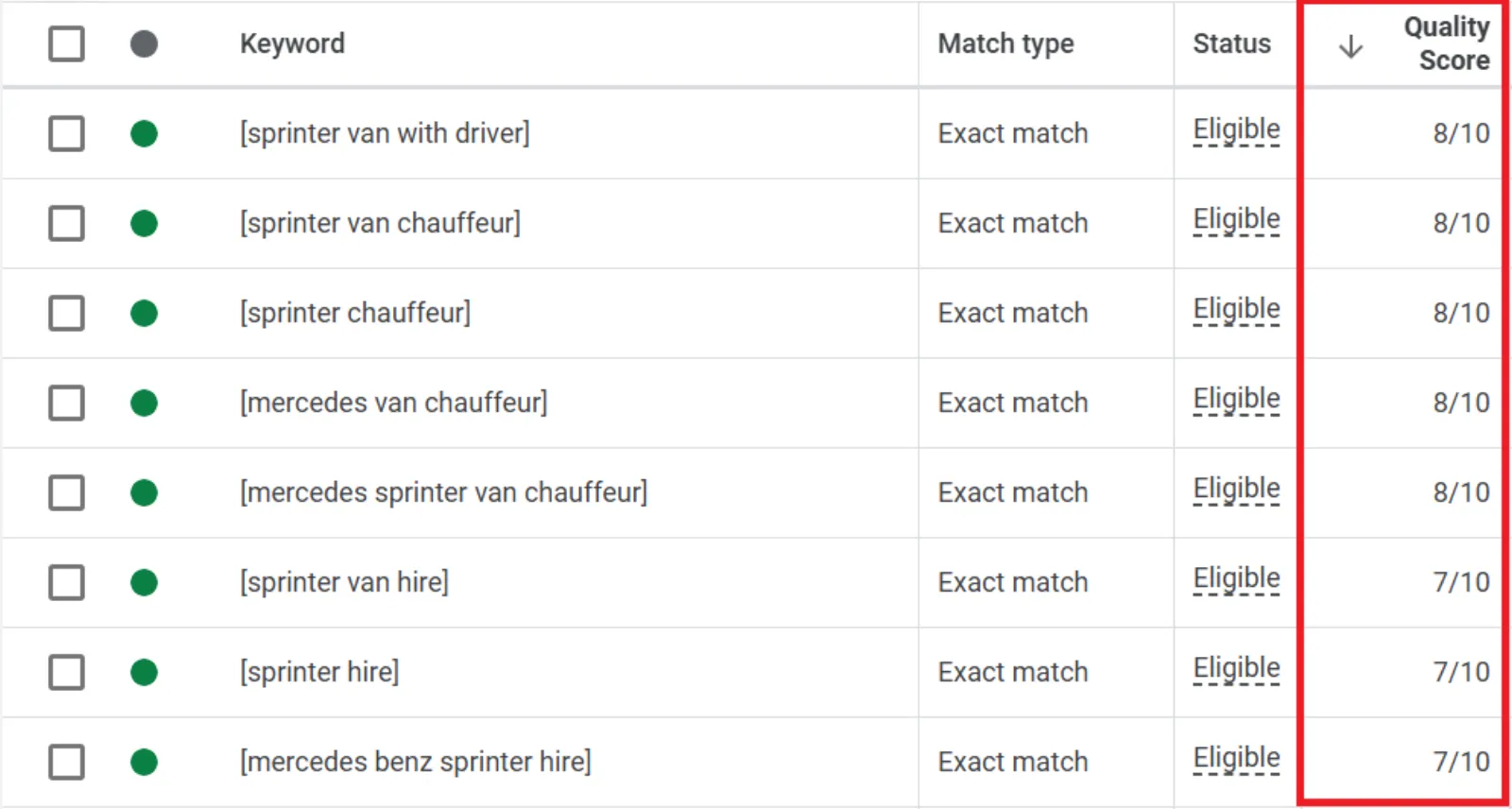
Simply put, Quality Score is Google’s rating of the quality and relevance of your keywords, ads, and landing pages. It’s measured on a scale of 1 to 10, with 10 being the best possible score. A high Quality Score means that Google sees your ads as relevant and high quality, which leads to more favorable ad positions and lower costs per click (CPC).

Get your free Marketing Action PlanNot sure where to start? Answer a few questions and get your plan in about a minute. No email needed.

Get my plan →
What Is Quality Score?

However, while Quality Score is important, it’s crucial to remember that it’s just one piece of the puzzle. Metrics like conversions, conversion rate, and cost per conversion are also essential to evaluate the overall success of your Google Ads campaigns.

The Three Components of Quality Score

Google calculates Quality Score based on three main factors:

  1. Expected Click-Through Rate (CTR)
  2. Ad Relevance
  3. Landing Page Experience

Let’s dive deeper into each of these components and how you can optimise them.

1. Expected Click-Through Rate (CTR)
Expected Click-Through Rate (CTR)

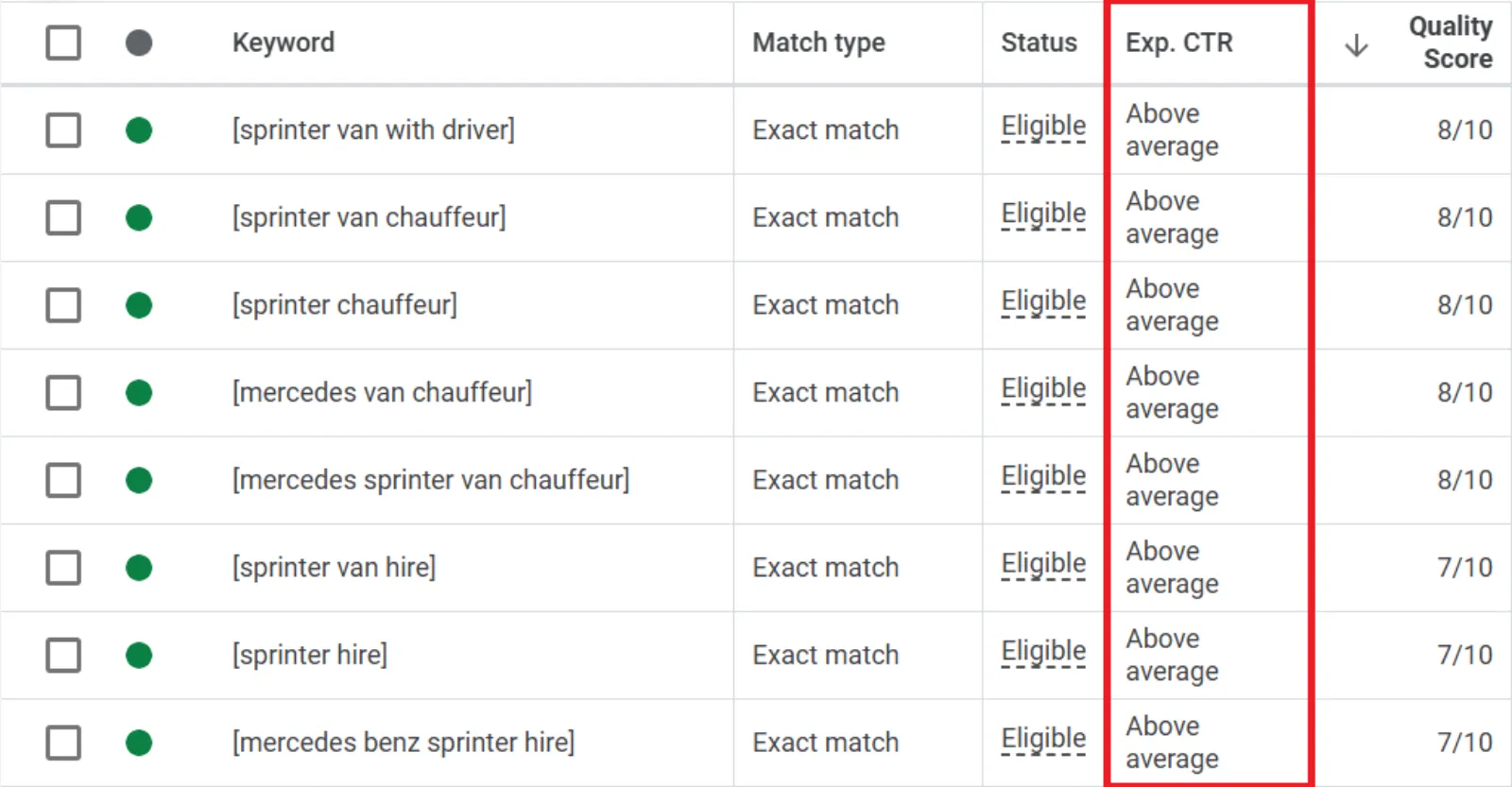
The expected click-through rate is an estimate of how likely your ad is to be clicked on when shown to a user. Google looks at your keyword’s performance in the past, along with the relevance of your ad, to calculate this.

Uzair KharawalaLIVE
Free weekly YouTube live

Live every Tuesday at 2pm UK. Bring your marketing questions.

Get your Google, local SEO and AI questions answered live.

Join for free

How to Improve Expected CTR:

  • Target the right keywords: Make sure you are bidding on keywords that are highly relevant to what you’re offering. If you’re selling red apples, your keyword list should focus on terms like “buy red apples” or “fresh red apples,” not just “apples.”
  • Write compelling ad copy: Your ad should be clear and relevant to the searcher’s intent. Highlight unique selling points, offer promotions, and make your ad stand out from the rest. If your ad directly addresses the user’s need (e.g., “Buy fresh red apples now”), it will be more likely to attract clicks.
  • Use ad extensions: Google provides several types of ad extensions, like site link extensions, call extensions, and location extensions. Using them gives more information to users and increases the chances they’ll click on your ad.

2. Ad Relevance
Ad Relevance

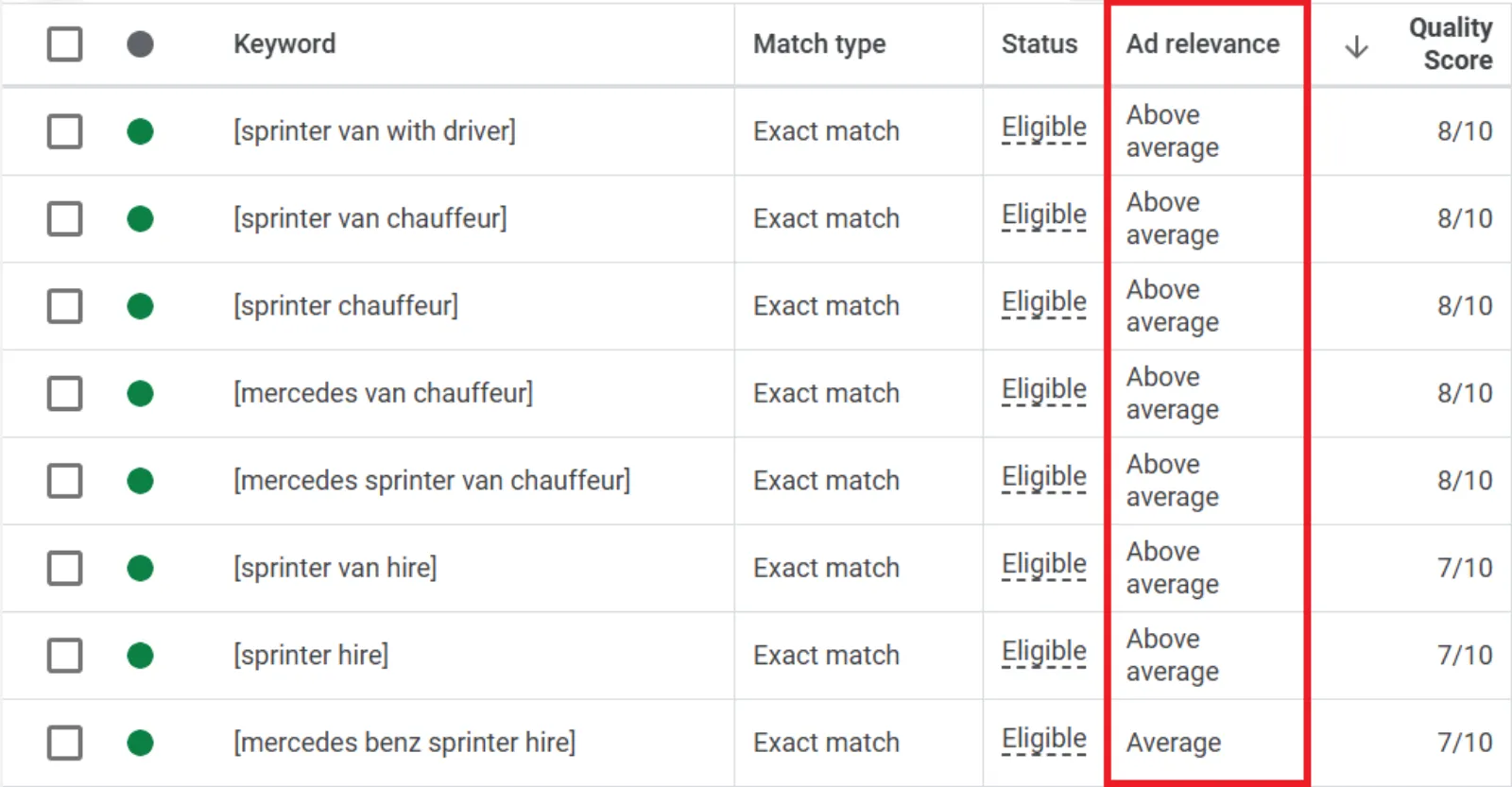
Ad relevance refers to how closely your ad matches the search query. If a user searches for something specific, and your ad provides a relevant answer, it improves your ad relevance.

How to Improve Ad Relevance:

  • Use your keywords in the ad copy: Include your primary keywords in the headline and description of your ads. For instance, if you’re targeting “red apples,” include “red apples” in your headline. This assures Google that your ad matches the user’s intent.
  • Create specific ad groups: Instead of broad or general ad groups, create more specific ones that target a single product or service. This ensures that the ads you display are highly relevant to each keyword.
  • Use dynamic keyword insertion: If you have a large set of closely related keywords, you can use dynamic keyword insertion. This automatically updates your ad text to match the keyword the user searched for, improving ad relevance.

3. Landing Page Experience
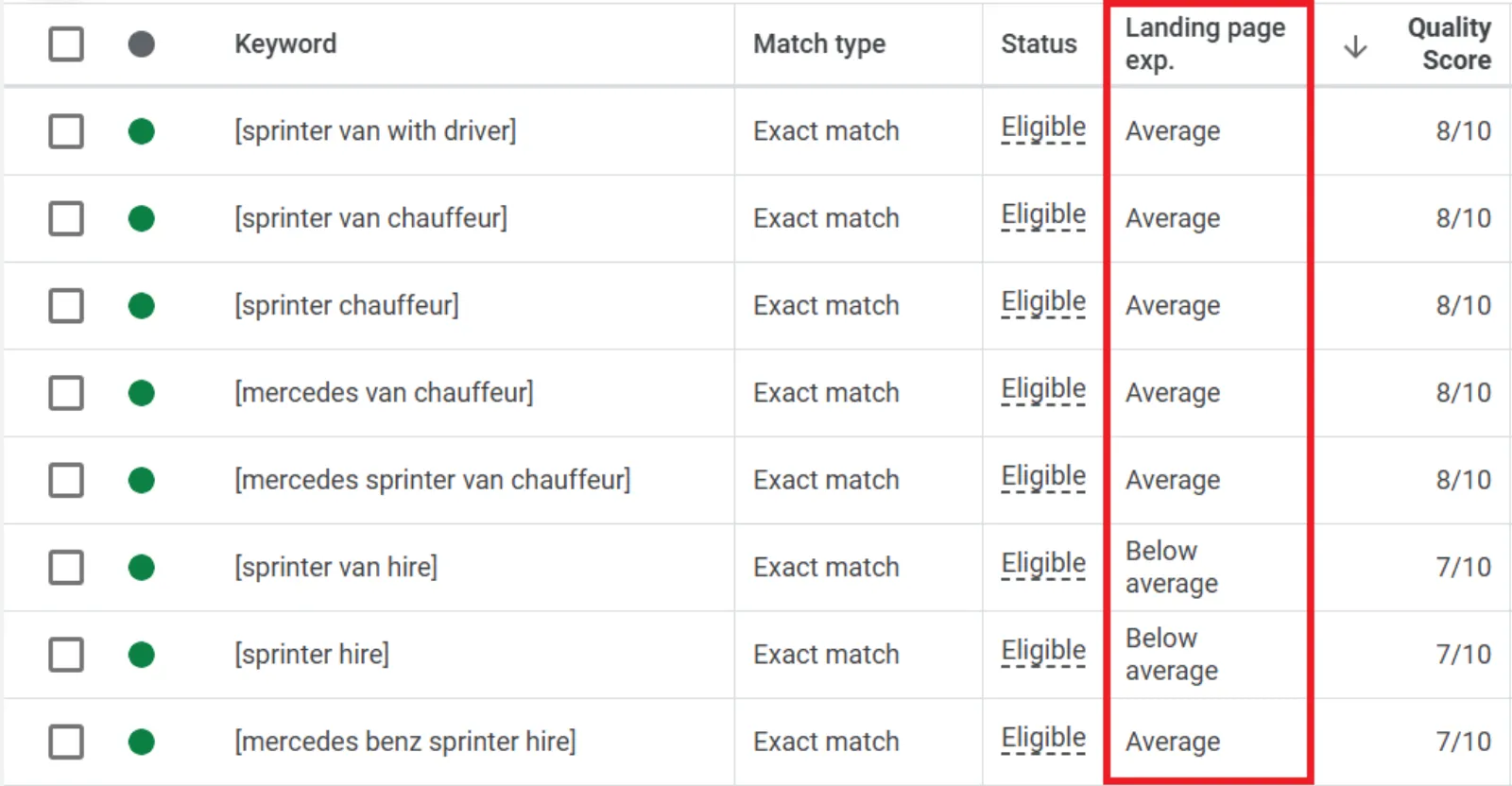
Landing Page Experience

The landing page is where the user lands after clicking your ad. Google wants to ensure that users have a smooth and relevant experience when they click on your ad, so they give high Quality Scores to landing pages that are well-designed, easy to navigate, and closely related to the ad.

How to Improve Landing Page Experience:

  • Ensure fast page load times: A slow-loading landing page can lead to high bounce rates, which is bad for both user experience and your Quality Score. Use tools like Google PageSpeed Insights to analyse your page speed and improve it.
  • Make your landing page relevant: The content on your landing page should be highly relevant to the ad. If you’re advertising red apples, don’t send users to a generic homepage. Instead, send them to a specific page about red apples, where they can easily find the information or products they need.
  • Optimise for mobile devices: Since more users are browsing on mobile, ensure your landing page is mobile-friendly. Test it on different devices to make sure the layout works properly and the page loads quickly.
  • Offer a great user experience: Keep the design clean and intuitive, with clear calls to action. A well-structured page will keep users engaged and reduce bounce rates.

Additional Tips to Improve Your Quality Score

  • Use negative keywords: Negative keywords help prevent your ads from showing up for irrelevant searches, which can reduce the number of irrelevant clicks and increase your CTR.
  • Organise campaigns and ad groups logically: By structuring your campaigns and ad groups in a focused way, you can ensure that your ads match the keywords they target, leading to higher relevance and better Quality Scores.
  • Regularly monitor your account: Keep an eye on your Quality Score and make adjustments as necessary. If you notice a drop in your score, investigate what could be causing it. Sometimes, a change in ad copy, landing page content, or keyword selection can quickly fix the issue.

Why Should You Care About Quality Score?

Improving your Quality Score is essential because it can directly lower your cost per click. The higher your Quality Score, the less you’ll pay for each click on your ads. A better Quality Score also helps you achieve higher ad positions, which means more visibility for your business.

By improving your Quality Score, you essentially make your ad campaigns more cost-effective, helping you get the most out of your advertising budget. It’s a win-win situation where both you and Google benefit.

Conclusion

Improving your Quality Score is not something you can do overnight, but with the right strategies, it’s certainly achievable. Focus on creating ads that are relevant to your target audience, make sure your landing page offers a smooth user experience, and always aim for a high expected CTR. When you align your campaigns with Google’s goals of providing users with the most relevant ads and seamless experiences, you’ll see your Quality Score rise—and your Google Ads campaigns perform better.

Don’t just obsess over the Quality Score number. Instead, aim to optimise all aspects of your campaigns. Keep an eye on your metrics, make data-driven decisions, and continually refine your approach for the best results.

Uzair Kharawala

Written by Uzair Kharawala

Partner at SF Digital Studios, a Google Premier Partner agency. Uzair has been helping businesses grow with Google Ads since 2002 and teaches it every week on YouTube.

Book A Call →Subscribe on YouTube for new videos every weekday →
Free every week

Get our best Google Ads tips by email

New articles and videos, straight to your inbox. Unsubscribe any time.

We respect your privacy at all times. Privacy Policy

You may also like

Read the blog →

Your next customers are out there. Let's go and get them.

Tell us where you want your business to be, and we'll show you how to get there.

Book A Call →or get your free Google Health Check →
Happy clients

Don't take our word for it

4.9 from 157 Google reviews, plus case studies and client videos.

See our happy clients →
"It has now been 3 months since we started and our sales have increased 300%."
Ruhi Latif Rafplay, Dubai
"Uzair and Farzana are two of the most honest, sincere and trustworthy people you will ever meet."
Gavin Morgan GDM Jewellery · Google review
"If I needed a campaign built, this is one of the rare few people IN THE WORLD I would trust to do it properly."
Hemmel Amrania Google Ads professional · Google review
Book A Call →
Chat with us on WhatsApp