I believe we are live. Please give me a moment. I'll make sure everything is working fine and we shall get started. Okay. All is looking good. Let's get the show on the road. Hello. My name is Uzair and welcome to today's YouTube live stream. It is the 1st of October 2020, the last quarter of the year before we know it, Christmas and New Year is going to be here and today I'm going to go through keyword research and how you set up your keywords.
Plan your ad groups in Google Ads and how you can research and target those keywords. Now, the next quarter is the most important quarter of the year. Every business is either...they make a huge profit or a loss depending on how good or bad this quarter goes. Now, what you want to be doing is to make sure that your campaigns are competitive.
You're targeting the right keywords. You're bidding strategy is as it should be ie You're winning all the auctions and your cost per acquisition or the return on ad spend is what you are aiming for and you're on target and once you have all these metrics in place, then there is no reason why Google Ads will not give you a healthy return on ad spent.
Now, I had quite a few emails, messages in the last few weeks, and everybody seems to be panicking a bit as to how the next few months are going to pan out with all this COVID situation. Nobody knows how it's going to go, but one thing's for sure, that everybody will be going online. It is going to get even more expensive, especially the next couple of months or so all the advertisers, all the businesses will be on Google, Facebook.
You will find your cost per clicks have gone high and got a bit more expensive, but what you want to also make sure is that you are profitable. So, as long as your conversions and conversion rates go up as well, then it's all relative. I know we want to pay the least amount to Google to get the most back.
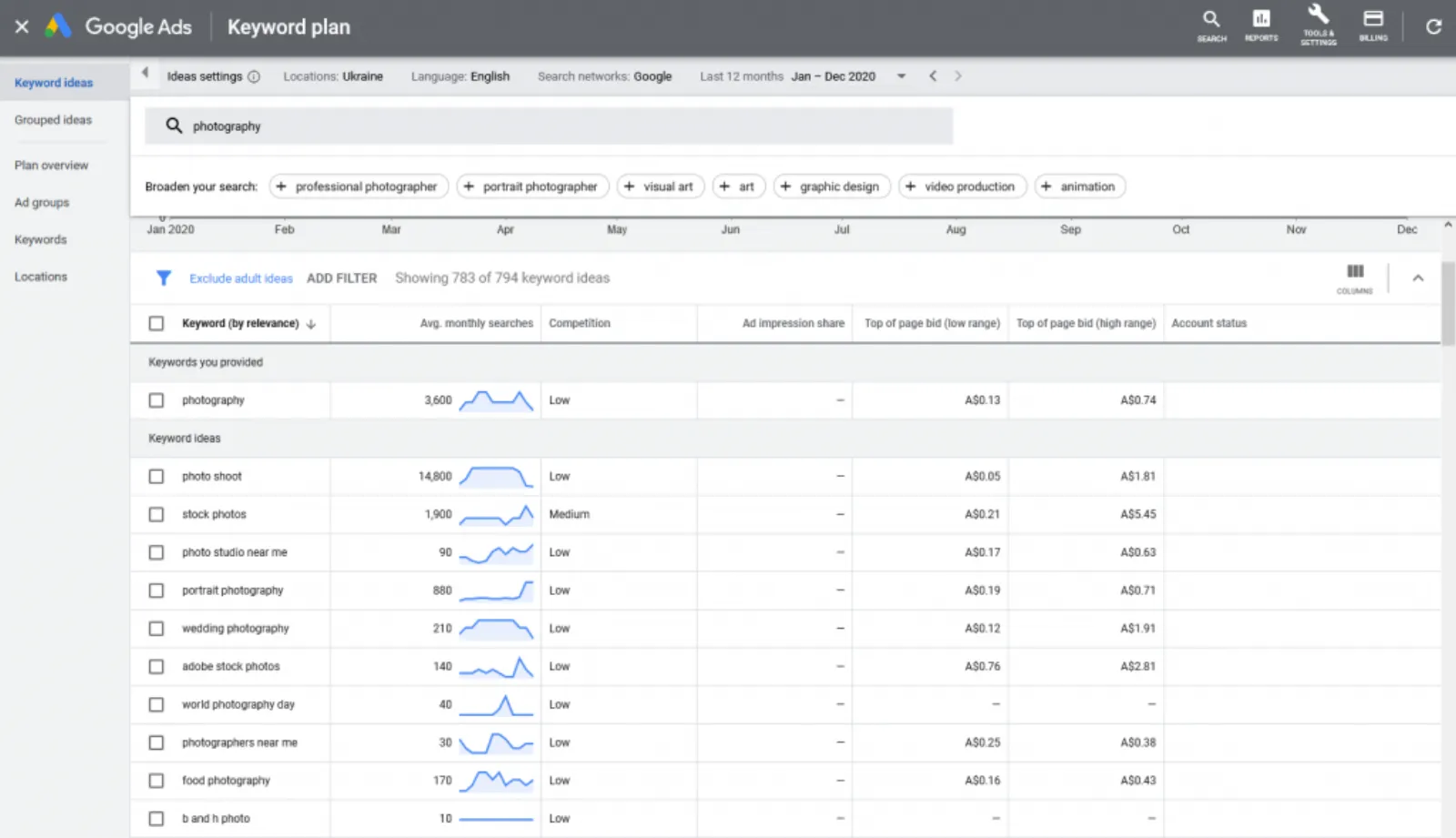
Sometimes it doesn't quite work like that. So, what we want to be doing is making sure that the keywords, which we are targeting are the bullseye keywords, and that's what we are going to go through today. Hi, Emily. Hello. Thanks for being here and we'll hop into our Google Ads account. I'm going to research the niche or the word photography, as you can see.
I had done some before, but I'm going to redo this again. Okay. So, we've got seven hundred and twenty-four keywords here, which you can go through. But what we can also do is to make sure that we have got the ad groups in the right way and the first thing I look over here is on the refined keywords section over here, it gives me a really good idea as to how to structure my ad groups, because let's say you were selling photography books, or you had an art gallery about photography and you are selling portraits or paintings, et cetera.
So, you need to organise these ad groups with these relevant campaigns, right. So, portraits will be a different campaign. It could be a different campaign, but certainly, a different ad group landscapes, black and white, abstract photography, lots of different genres of photography and this is what I will find over here as to what people are searching for and what Google has in here about photography.
So, we've got the non-brand, we've got retailers, nothing much there, contractors. Okay. A graduation moment, photo pro, angel. These look like companies or brands and then we have got other brands, which they call it National Geographic, popular photography, but these are either magazines or like Ansel Adams is a very famous black and white photographer. DE Photography, I believe is a magazine.
So, you get lots of ideas as to how you can sort out your ad groups. But then here is where it gets really interesting. So, we've got all the different kinds of services; we've got portraits, weddings, newborn, family, baby, each one of these is a different genre. It's a different speciality of photography and what you want to do is to have them in a separate ad group.
Like it has come up over here and then has the relevant ads for those keywords and ad groups. Then, we have photographers, as well. So, you've got photography here, but photographers there. Portraits, weddings, events, fashion. Okay, let's go in there. Genre is pretty much the same. The person hasn't got anything...and others... There's not much in here. Okay.
So, I have got a good idea as to what I want to be doing and what I should do to break these services into its own ad group, or you can have them into its own pot, into its own campaign. So, if wedding photography is eating up all the budget, the others aren't getting a look in, then I would take it away from that campaign and make a separate campaign with its own budget.
What you can do is you can either go through this list over here on the left-hand side, sort them out by the average monthly searches. So, you can see, which are the most popular or searched for keywords. I would absolutely stay away from one-word keywords like photography, it's too broad, right. You know, if you bid for photography, it could be, anybody can find and see your ad if they are searching for portraits, weddings, landscape, wildlife, or any other kind of photography.
So, two or more words is good. So, you can see that there's a healthy number of average monthly searches. We can also see over here a range of pricing, for the lower range and the top of the page bid. So, the top page means the top four and the lower end it could be anywhere on the page.
It could come up on the bottom of the page as well. So, what you don't want to do is to pay the most, so if I've got twenty-one as the minimum and seventy-six pence as the maximum, I would bet somewhere in between as a starting point and then see how my impressions are coming up and what's happening.
So, what I want to do is to make sure that we have a decent amount of bids for each one of these keywords. So, like this one, the minimum is fifty-eight and the maximum is four twenty-three. But I would put in somewhere along the lines of two pounds seventy-five or something like that. All right. So, what I do is I download all the keywords and then I go to my spreadsheet over here.
I put them in here, copy and paste them. How many have I got? About six, seven hundred, I think. Yeah. Six hundred and ten-odd keywords and then what the magic, this sheet, Google sheet does is I want to let's say go after landscape photography. What this will do is it's going to search this column A and any word or phrase which has got these two words in it is going to start to populate over here.
Wildlife photography, we knew that there was wedding photography. Street photography. I could have black and white. I could have product photography. Now, you can see how my ad groups are being organised. All of these words have got wedding photography in any order. It really doesn't matter. As long as those two words are on that phrase, in here there's only one.
So, it's not a huge amount, so what I might do is I might try and see if I get a bit more, a few more keywords. Okay. So, we've got all these keywords populating in here. Now, you can see I took photography out because we've got landscape, but instead of photography, we had photos. So, now I can have an ad group for landscape photos or photographers, wildlife again, I've got some more here and I'll just keep on going through.
Aerial, family. So, these are all very good keywords, Aerial. Fine art. I'm going to give you a link to download this spreadsheet for free. All you can do is sign up. Let me dig out that URL before I forget. And you'll be able to do exactly the same, what I'm doing here. So, fine art photography hasn't got measured.
This one has got quite a lot, beach family photography. Let's say newborn. That's a niche. Now, you might find overlapping words because of the newborn. I saw over here, newborn family photos, newborn family photos. Then, you can decide in which ad group you wish to keep it, I would keep it in this one and take it out from this one because this one is all about family photography.
What I also tend to do is freeze the top two rows. So, when I'm scrolling up, my headers are locked now, and I can see what we've got. Photojournalism, glamour, family. We've done, commercial. That's a good word. What this will help you with is to sort out your ad groups, and then you can copy these keywords in one go and put them in your campaign.
Actor headshots. Okay. That's a very good one. Now, you can see how many different niches there are just in photography. That's why you never want to go after one-word keywords. They are going to eat up your budget in no time. Pet Photography. Aerial for drones and stuff like that. Pet. Aerial, I'm going to put in, aerial drone.
Now, we were testing a few, not few. We were testing some new software earlier on, and I think that chat is been switched over to a slow mode. So, that's why your comments may take a bit of time to pop up. So please, if you have got any questions, then start putting them in and I'll come to those once we finish this exercise, okay.
So drone, we've got nothing. That's fun. It's surprising because drone photography is very popular. These days. Everybody wants to shoot with a drone and as you can see over here, I'm still getting a huge, not huge, but a fair amount of searches and I'm going to dig deeper into them, editorial, sunset, local. Okay. Editorial, local. Let's see what we get with sunset.
If you had books or paintings for all of these different types of photographic subjects or topics, you can really sort these out and then advertise in Google when somebody's searching for. Excuse me. Wedding photography books. So, landscape photography books, you can have exactly the right ad for that because each one of them will have its own ad group with its own ads.
That is the key because you don't, what you don't want to do is show someone an ad for wedding photography. When they're searching for street photography it's completely irrelevant to each other. Although they're all photography, they're completely different types. So, it's like sports, you know. Okay. You sell football equipment or kit, but then somebody searching for hockey or cricket or basketball and you're showing your football stuff.
They're not interested. Although it's the same thing, it's the sport completely different and irrelevant. So, this is why we keep them up as separate ad groups. Okay. Night, travel, vintage. Oh God loads. Some of them may not have night, vintage. So, when I'm setting up my ad groups like this, I just keep going and going and then I'll come back to all of them and then I'll see, okay.
Whether this one is worth setting up its own ad group or not. Okay. Slow mode is off. I think Emily, you may have done that. Thank you for that. So, this is how we set up and sort out our ad groups and when we do set right our ads, they will get super high relevancy to your keywords because, in this ad group, the ads will be all about landscape photos and your keywords will be all about landscapes.
This one will be all about wildlife, wedding, street, black and white and so on. So, that's why it is critical and extremely important that you sort this out. If you do this right, you are going to save a ton of money because the right people are going to see the right time. Okay. So, I'm going to go to the comment box now and see if you've got any questions and comments.
So, now's your chance to put them in. Yeah. Sandy you missed the best bit earlier on, we did a live show, extra special live stream today. You missed out. If you snooze, you lose, you know that. I'm just kidding, we were testing some equipment, we were trying to stream to Facebook, Twitter, where else. We can't do LinkedIn at the moment and I think a couple of other places, but it wasn't working very well.
So, we will try again and hopefully, you'll be able to catch us pretty much anywhere, wherever you are on the internet. Okay. (Sandy) "Sir, if I select a hundred plus keywords." Okay. "And I will run my ad for two to three months after getting data after analysing is any need for keyword research, because search term report will give." Yeah, search term report is going to keep giving you all the new search queries.
Every day. There are about fifteen to twenty percent new search terms being searched on Google, which have never been searched before. So, if you are... As I've said before, we use BMM and exact ad groups, the BMM will keep on fishing and searching for new search terms. Whereas the exact one is going to match the exact search term.
If somebody has put the exact match query. So, this is why we have the best of both worlds. So, you don't need to do keyword research, because if it's not showing, coming up in search term report, it's not being searched. It may be searched, but on low volume, but now Google has stopped showing those low volume search queries.
So, we can't see it. So, no point going after those, well, we can't. (Sandy) "Do we add keywords or remove keyword list for every three months?" Not really. Why would you remove keywords every three months or so, if they are performing, if they are working, let it run and run and run? If they're not working, kill them off.
Hi Adam. "It's difficult to add new search term keywords to your keyword lists since Google doesn't show all of them anymore." That's right. Yeah. So, whatever you see in the search term query, you can, because it will be a case of eighty-twenty and once you have got enough data... After three, four months, you should certainly have enough data in your campaigns to go smart bidding and then everything is taken off our hands.
Everything is taken care of. The heavy lifting is done by Google. They are going to bid on search terms, which they feel are going to convert and give you the results you want. So, you don't need to worry about it. The heavy lifting needs to be done in the first two to three months. Work really hard. I'm not saying, what I mean by working hard is not sitting in front of your computer, in your ads account all day long, not at all, thirty-forty minutes.
If it's a fairly small account, that is. It's more than enough. Not even that keep an eye on them and just keep adding negative keywords, add some new ones. If you see them, keep optimising the bids, and once you've got enough conversions, then you go smart and then you leave it to the Google gods to get you those conversions and they do bring the conversions.
That's for sure at the right price as well. Hello, Mohamed, Nikhil. I saw the live stream on Instagram. Really? Okay. I wasn't sure we were going to live on Instagram. Okay. I don't know how that happened, but if you saw us then good. Instagram seems to be working as well, Emily. You might have connected. I'm not sure whether you did or not.
Hi, Mustapha. "I set up a call-only ad four days ago. My initial bid was one pound. Then raise to three then to five, then to seven still haven't got any single impression." Because it really depends on your nature. If you are in the plumbing or for emergency plumbers or locksmiths, you will need to bid thirty, forty, fifty pounds.
Then, you'll probably get some impressions and clicks or a pound a call. You won't get anything. So, keep building up my friend, unfortunately, your bids are too low. You won't get much, especially for call ads. Another way you can do is set up your Google My Business to your Google Ads account and run through smart campaigns. Quite often, it works really well at very low CPC.
Declap. "How to add images on search ads?" You can't, as simple as that only on shopping ads, you'll have the image of your product or display ads or the other responsive display ads, but on search ads, it's only text. You saw from Virgin mobile. Yeah. It's probably some other kind of ad, you've probably seen. Bounce ads. I've not heard.
I don't know what that is. Nikhil. So, I really am not sure what you mean by that. When I'm in my location, there were many keywords which are having a search volume of ten to twenty. The minimum bid I'm making from a client is one hundred rupees even also for my address. So, I'm not, I really don't understand what you are trying to say Vanam.
So, you got a volume of ten to twenty, very low volume keywords. Okay. That's fine. You're bidding a hundred rupees. Okay. Even for my address, I'm not sure what you mean by that. Yeah, really don't understand. My niche is flight. Okay. What do you mean travel flights, airlines? You won't get anything for such low bids. My friend. (Sandy) "Please create FB community." Okay.
So, who's going to man. You can come and be the admin of it, Sandy because I got enough on my plate at the moment to have another community of fans over on Facebook, we were looking at it, to be honest with you. Hopefully very soon, but thank you for that. One of my, honestly, I'm not sure what, what you are referring to or what your question is.
If you can perhaps come back again tomorrow. I'll try my best to answer it for you. Okay. That's it for today. Good. I've got another call to hop on to. So, thank you so much for being here. I won't be here tomorrow. It will be my lovely wife and she will be talking something about marketing or online advertising.
I'm not too sure what it is, but it will be a very interesting topic. So, I shall see you guys on Monday, so have a great weekend, stay safe and yeah. Have a great weekend. Thanks for being here and if you haven't subscribed, subscribe now and give it a little, like and a share as well. So, I'll see you guys on Monday.
Bye for now.

 LIVE