
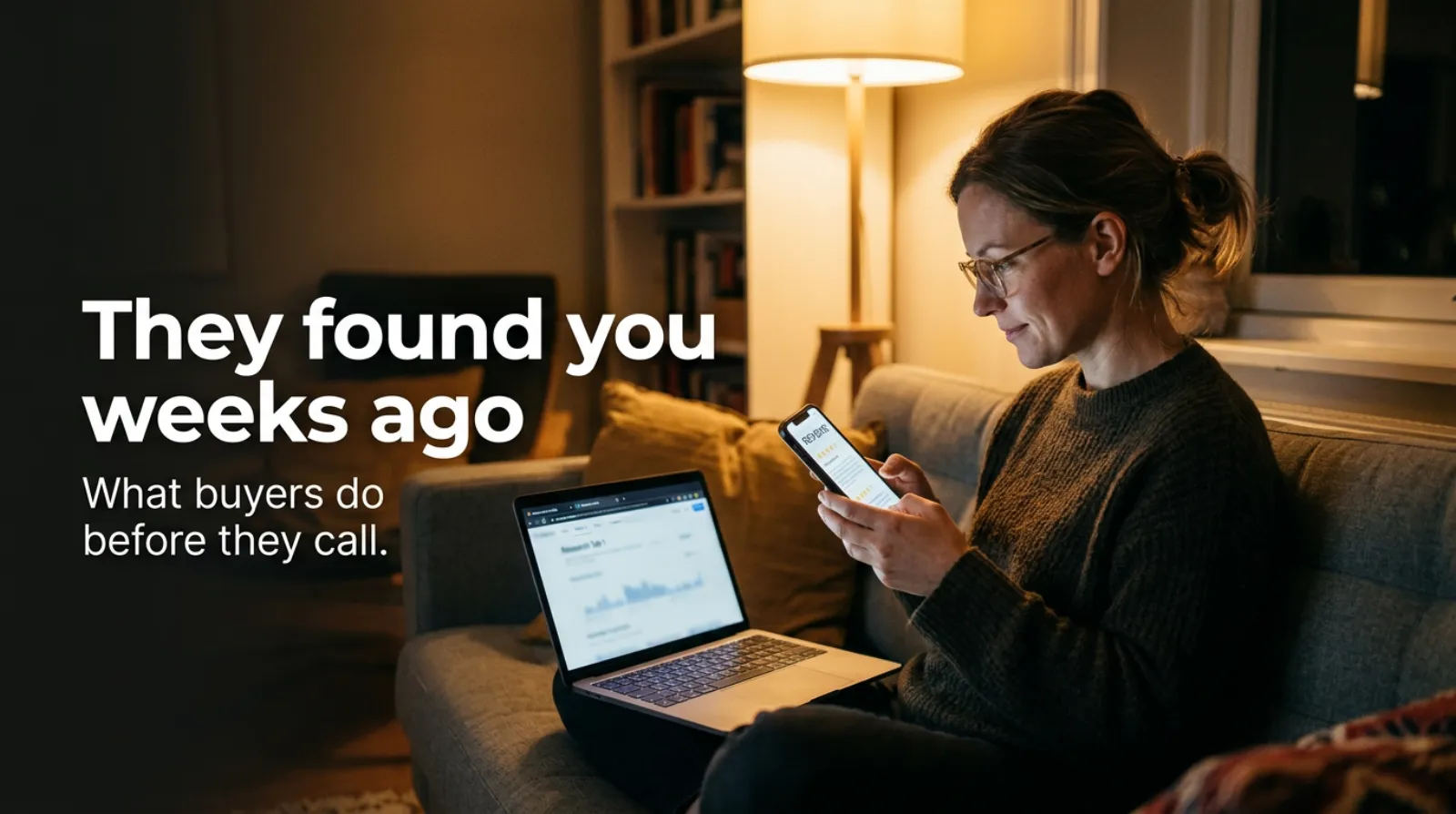
“I Found You on Google” Is Hiding Three Weeks of Research. Ask your newest customer how they found you. Most will say “Google”. That one word hides the real story.
Before they typed your name, they watched a YouTube video about the problem. They asked ChatGPT what a fair price looks like. They read your reviews, then your competitor’s reviews. They visited your website twice and left twice.
The customer buying journey used to be drawn as a straight line. Awareness at the top, decision at the bottom, your ad somewhere in between. In 2026, that straight line is gone.
What replaced it is a loop. Buyers circle between searching, comparing, forgetting and coming back. Google’s own research team calls this the messy middle.
Here is why it matters. Most small businesses still spend money as if the straight line exists. They judge every channel by the last click, then cut the very things that were quietly winning them the sale.
What Is a Non-Linear Customer Journey?
A non-linear customer journey is one where buyers loop between researching and comparing instead of moving through tidy stages. They gather options, weigh them up, get distracted, and return days or weeks later. The loop ends when one business feels like the safe, obvious choice.
Google’s consumer research team studied thousands of real purchases to map this behaviour. They found two modes that repeat over and over: exploration, where people gather options, and evaluation, where people narrow them down. Buyers bounce between the two until something tips them into action.
Think of a supermarket shopper without a list. They wander the aisles, pick things up, put things back, and double back to compare prices. Nobody walks through the store in a straight line. Your customers shop for services the same way.
Two things pull people out of the loop: confidence and ease. Confidence that you can do the job well. Ease of taking the next step with you. Every tactic in this article feeds one of those two.
One Buyer, Fifteen Touchpoints, Three Weeks
Picture Sarah, who wants a new kitchen. On a Wednesday night, she sees a kitchen makeover reel on Instagram. She saves it and forgets about it.
On Saturday, she asks ChatGPT what a new kitchen costs in the UK. She gets a range, plus a list of things to check before hiring a fitter. Now she has questions she did not have before.
The next week, she searches “kitchen fitters near me”. She opens three websites, including yours. She reads for ninety seconds, closes the tab, and gets on with her life.
Then her neighbour mentions their own kitchen. Sarah checks Google reviews for two local firms. She watches one company’s short video on how they handle installation day. She goes back to that company’s website and fills in the form.
Your analytics will log Sarah as one organic visit that converted. The truth is closer to fifteen touchpoints across five channels over three weeks. The form was not the story. The form was the finish line.
Why Last-Click Thinking Burns Your Budget
When you judge marketing by the last click, YouTube looks useless. Reviews look like a nice-to-have. Social media looks like a vanity project. So owners cut them and pile everything into the one channel that gets credited.
Then something odd happens. The “winning” channel starts to weaken because all the assists disappeared. It is like giving the striker credit for every goal, then selling your entire midfield.
The numbers back this up. Research from the US Chamber of Commerce reports that as many as 81% of consumers research online before making a purchase. BrightLocal’s consumer surveys show most people read reviews before choosing a local business. None of that activity shows up as a “conversion”, yet the sale rarely happens without it.
There is a bigger shift coming, too. Gartner predicts traditional search engine volume will fall by 25% as buyers move to AI assistants and other discovery channels. If your marketing only exists inside a search results page, your visibility is shrinking while your costs are not.
One more trap deserves a mention. More enquiries are not the same as more customers. Weak touchpoints attract tyre kickers who fill in forms and vanish. Strong touchpoints attract buyers who arrive half-sold. Judge your marketing on qualified enquiries, not raw counts.
How to Win When You Cannot Control the Route
You cannot force buyers back into a funnel. What you can do is make sure every loop they take passes through you. Five moves do most of the work.
Be present at every checkpoint
List the places a buyer checks before choosing a business like yours. For most local and service businesses, that means Google search, Google Business Profile, reviews, your website, YouTube and one social channel. You do not need to dominate all of them. You need to not be absent from any of them.
Start with the gaps. If your Google Business Profile has three photos from 2021, that is a checkpoint you are failing. If a buyer asks ChatGPT about your trade and you are invisible in the answer, that is another.
Say the same thing everywhere
Buyers see you in fragments, days apart. If your ad promises premium quality and your website leads on low prices, the fragments do not add up. Confusion kills confidence, and confidence is what ends the loop.
Pick one clear message about who you serve and why you are the right choice. Repeat it on every channel, in the same words. Boring for you is memorable for them.
Answer questions before they are asked
Sarah trusted the company that answered her questions without being asked. That trust was built in advance. Build a proper FAQ page around the ten questions customers actually ask you on the phone.
Lead every important page with a direct answer, then expand. This helps rushed human readers first. It also makes you the business AI assistant’s quote when buyers ask them for advice, because AI tools lift clear, direct answers.
Be the easiest to act on
Every buyer exits the loop through one final action, so remove the friction from yours. Answer the phone. Reply to enquiries within minutes where you can, not days. Cut your forms down to name, contact and the one question you truly need answered.
Speed is a trust signal in itself. The business that responds in five minutes feels like the business that turns up on time.
Ask better questions about where customers came from
Your analytics see a fraction of the story, so add a human layer. Put one question on your form: “What made you get in touch today?”. Ask new customers on the phone where they first heard of you, and write the answers down.
Watch your brand searches too. When more people type your business name into Google month after month, your invisible touchpoints are working, even when last-click reports say otherwise.
Questions Owners Ask About the Messy Middle
What is the messy middle in marketing?
The messy middle is Google’s name for the looping phase between a buyer’s first trigger and their final purchase. People cycle between exploring options and evaluating them, often for weeks. Businesses that show up with clear, confident answers during those loops win the sale.
How many touchpoints does it take before someone buys?
More than most owners expect. Even a modest local purchase can involve ten to twenty touchpoints across search, reviews, social media, video and AI tools. Bigger or riskier purchases involve more. Each touchpoint is a small vote for or against you.
Why do people visit my website but never get in touch?
Because a visit is research, not an intent to buy that day. Most first-time visitors are mid-loop, comparing you against others. They leave when a page loads slowly, prices are unclear, reviews are thin, or their question is not answered. Fix those, and more of them will come back to convert.
How do I find out how customers really found me?
Combine three sources. Use analytics for the last click, a form question such as “What made you get in touch today?” for the trigger, and a simple phone question for the first touch. Together, they reveal the steps your reports miss.
Does the marketing funnel still work in 2026?
As a budgeting model, no. Buyers no longer move through neat stages, so funnel-stage budgets misfire. It still has one use: reminding you that some content should attract strangers while other content should convert researchers. Plan coverage, not stages.
How does AI change the way customers find my business?
Buyers now ask ChatGPT, Gemini and Perplexity for shortlists and advice before they ever search. These tools favour businesses with clear answers, consistent details and strong reviews across the web. Gartner expects traditional search volume to fall 25% as this behaviour grows, so being quotable by AI now protects your future enquiries.
Stop Mapping the Route. Start Showing Up.
You will never control the route your buyers take. Nobody can. The businesses winning in 2026 have stopped trying and started making themselves impossible to miss at every checkpoint that matters.
The good news is that your competitors are still staring at last-click reports. While they cut their assists, you can build yours. Presence, consistency, answers, speed, and better questions. That is the whole playbook.
At SF Digital we help small businesses show up at every checkpoint, from the first search to the final call. If your marketing still assumes a straight line, this is the year to fix it.

Written by Uzair Kharawala
Founder of SF Digital Studios, a Google Premier Partner agency. Uzair has been helping businesses grow with Google Ads since 2002 and teaches it every week on YouTube.
Get our best Google Ads tips by email
New articles and videos, straight to your inbox. Unsubscribe any time.