

Key takeaways
- An SEO report summarizes the website’s performance in search engines and how it helps the business.
- Important metrics to track in your report are traffic, conversions, keyword rankings, backlinks, website health score, AI visibility, and share of voice.
- Apart from numbers, an SEO report adds context. It tells what’s happening, what to improve, and what to do next.
- SEO reports should revolve around the client’s specific goals and success metrics.
- SEO reporting tools can help you collect the data, present it clearly, and save time.
You worked hard doubling the traffic, running keyword research, and building backlinks. But when it’s time to share the results, you face a challenge: how do you make your SEO report prove the real impact of search engine optimization?

Get Found, Get Chosen, Get Your Time Back
A free one-day marketing seminar in Milton Keynes · 13 January 2027
That’s what I want to cover in this blog: what should your SEO report show? You’ll find the key metrics to include, and how to present them in a way your clients actually understand.
Get your free Marketing Action PlanNot sure where to start? Answer a few questions and get your plan in about a minute. No email needed.
Get my plan →What is an SEO report?
An SEO report is an overview of a website’s performance in search engines. It shows how well the site meets business goals. An SEO report highlights what matters and why and points to the next steps.
Who is it for?
- CMOs need reports for strategic insights. They want to discover new opportunities, see how SEO traffic impacts KPIs, and identify which campaigns are effective.
- Clients and stakeholders read reports to see ROI, set priorities, and plan budgets.
- SEO specialists track progress, measure the results of their work, and find SEO issues to fix.
Why is quality SEO reporting important?
Without a proper report, your client is left guessing about the real impact of SEO. But with it, your work is easier to understand. Here’s why solid SEO reporting matters:
- Progress tracking. Reports give you proof of growth. You see how rankings, traffic, and conversions change every month and know exactly how you’re doing (even if it’s not what you want to see).
- Transparent communication. Reports make complex SEO work more understandable. Clients or CMOs can see what’s working and what still needs attention. SEO reports build trust and make conversations easier.
- Spotting improvement areas. A site audit points you to what holds the site back. There may be a poor SEO score, gaps in page SEO, weak content, or missed keyword opportunities. It helps you focus on fixes and efforts where they’ll have the most significant impact.
- Competitor analysis. SEO reporting helps you analyze the strengths and weaknesses of your competitors and find ways to outgrow them. It backs you up when you want to change the strategy or ask for more budget.
What makes a good SEO report?
The word “report” may sound intimidating, and many people may think that SEO reports must include tons of information. The truth is, it depends. There are metrics that make up a quality report that will bring value to your client or CMO. In practice, compiling these metrics often means pulling data from multiple SEO tools into a single reporting environment. Using dedicated SEO reporting software, such as SE Ranking, makes this process more efficient by centralizing data in one place.
Organic traffic
Organic traffic is the number of visitors who arrive through organic search results. It shows the direct impact of SEO on website visibility and brand discovery. In reports, traffic should be segmented by landing pages, devices, and locations to analyze the patterns.
Separate branded and non-branded traffic. Non-branded traffic better reflects actual SEO growth. Also, you can show trends across 3–6 months, not just “this month vs. last month,” to see the bigger picture. Lower traffic may signal an algorithm update, a technical issue, or a wrong search intent.
Conversions
Let’s be honest. Website visits are great, but they don’t make much sense if there are no sales, qualified leads, or downloads. The conversion rate shows how many meaningful actions visitors take on the website. They prove to your client that the acquired traffic is valuable. More visits with no conversions usually mean you’re attracting the wrong audience.
Your task here is to show the value. For example, for e-commerce, it can be revenue; for B2B, it can be the number of qualified leads. Add funnel visualization (visits → leads → conversions). This way, stakeholders can instantly see if SEO helps the business.
Keyword rankings
Keyword rankings are an early indicator of visibility. You can group them into categories, such as product keywords, informational, and brand keywords. This way, you can explain which content is more efficient at different funnel stages.
If rankings drop, there may be some deeper reasons. For example, it could be an algorithm change, weakened backlinks, outdated content, or strong competition. Sometimes, new SERP features, such as AI overviews, can pull the content down. In other cases, the search intent can change, and your page may no longer match what the readers are looking for.
Competitor Analysis
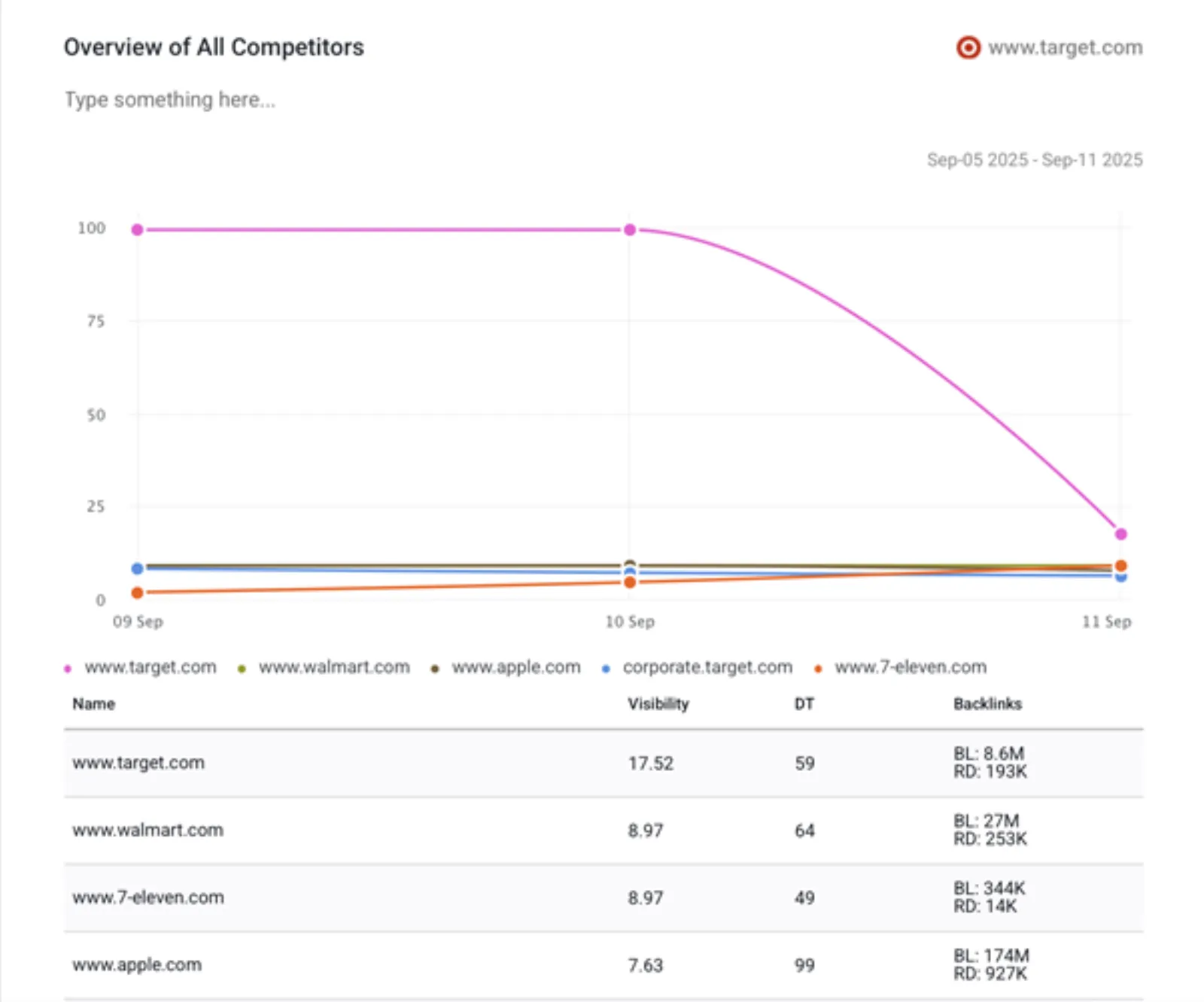
Even strong growth means little if competitors are growing faster. Suppose you compare rankings, traffic estimates, and share of voice. In that case, you can identify where you’re losing visibility and where you can capture market share.
It matters because you must prioritize opportunities and justify strategic changes to stakeholders. Focus on 2–3 main competitors your client cares about, not every possible rival.
Source: SE Ranking Report Builder
Website health score
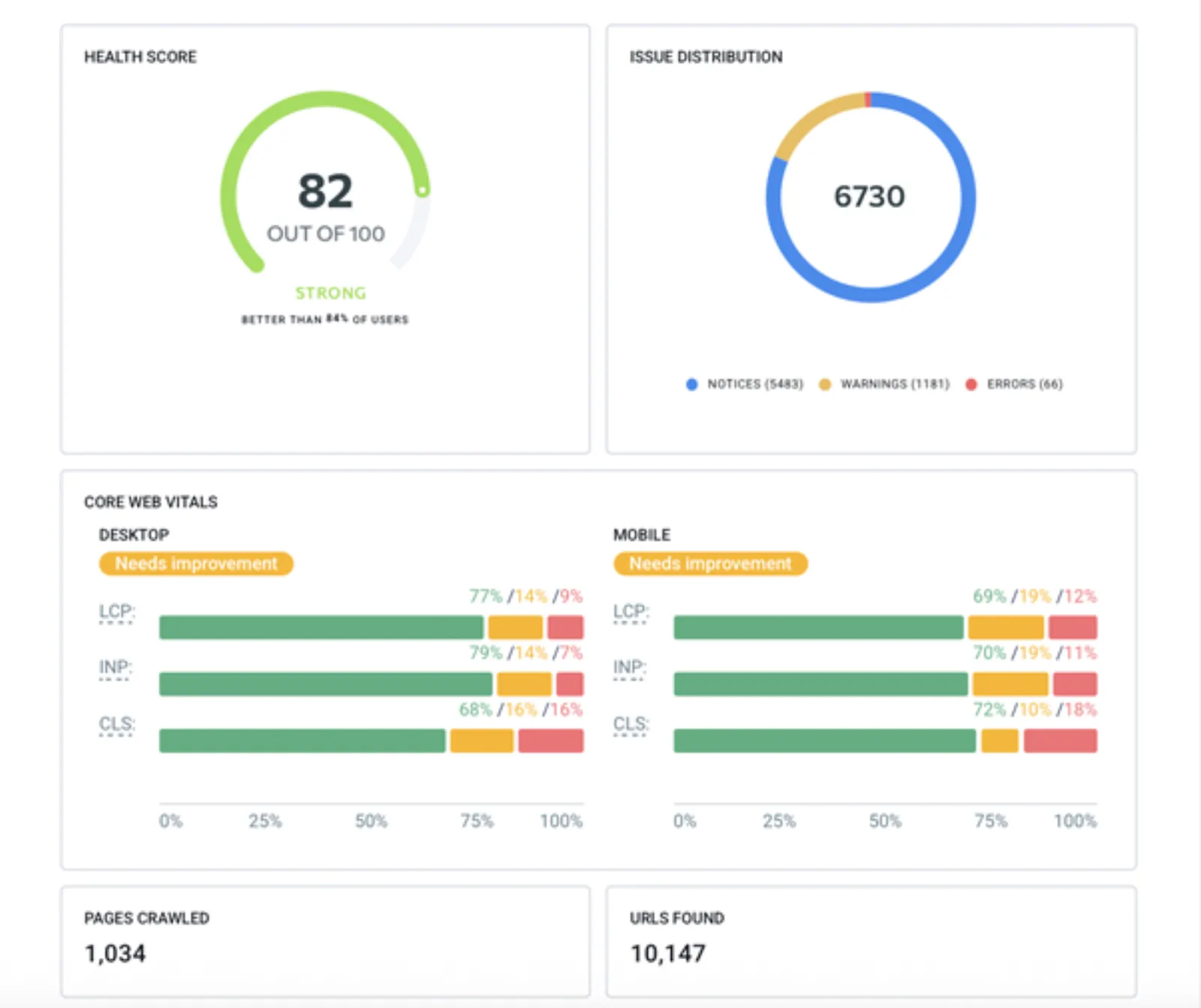
This category summarizes the technical performance, so your client can see how SEO-friendly the website is and any potential issues. Even excellent content won’t rank if your site’s health is holding it back.
Website health score includes technical SEO metrics such as:
- Pagespeed,
- Core web vitals,
- Crawlability,
- Indexation,
- Duplicate content,
- On-page factors.
Health score impacts how fast and smoothly your website feels to users. Google cares a lot about this now because it wants to display results that give people a good experience.
 LIVE
Live every Tuesday at 2pm UK. Bring your marketing questions.
Get your Google, local SEO and AI questions answered live.
List the top 3 technical issues blocking SEO performance to make your report more informative. Also, translate tech terms into business language. For example, “slow mobile load speed” means “visitors bounce before converting.”
Source: SE Ranking Report Builder
Backlinks
Backlinks directly influence website authority. They are the markers that tell Google that your website is trustworthy. But focus on quality backlinks only. These are links from authoritative and relevant websites with suitable anchor text, target traffic, etc.
Instead of tracking all backlinks, monitor unique referring domains. An increase in diverse and high-quality domains strengthens your authority way better than many links from the same source.
Also, monitor new and lost backlinks over time. New links show that your content is noticed and shared. Lost ones may signal that your page is no longer relevant or that the website has removed your mention.
AI Visibility
AI visibility demonstrates how often your website or brand appears in answers generated by LLMs. More users now rely on Chat GPT, Perplexity, AI mode, and other tools to find and consume information. It makes AI visibility an essential metric for measuring performance.
In reports, track if LLMs mention your brand, cite your content, or reference your site as a source. This way, you see your authority and expertise in search engines and AI systems. You can also note which queries or topics trigger those mentions. You will see where your content already performs well and where visibility can be improved.
Be attentive if LMMs tell the updated facts about you. Sometimes, it happens that you change the brand name or add a new industry to your services, but it still shows your old name or the old industry list.
To strengthen AI visibility, write trustworthy content, and use accurate information. Build topical authority and get high-quality backlinks to be cited by AI systems more often.
Share of Voice
Managers and executives care about this metric because it indicates how well the company stands out against competitors. Millions of brands communicate with people daily; your client’s task is to be heard best. Break SOV down by keyword clusters, such as informational and product. Use it to drive strategy conversations: “We own 40% SOV for informational keywords but only 10% for the product cluster. That’s the growth opportunity.”
Go Beyond Metrics. Deliver Insight.
Numbers alone don’t answer the real question clients are asking: “What does this mean for our business?”
Traffic graphs and ranking tables are useful, but without context, they don’t explain impact. Your role isn’t just to report changes — it’s to interpret them.
Explain:
- What changed
- Why it changed
- How it influenced visibility, leads, or revenue
- What should happen next
Start your report with a short executive summary highlighting key developments: major wins, unexpected drops, algorithm shifts, or technical fixes. End with clear conclusions — achievements, gaps, and concrete next steps. This turns your report from a data dump into a strategic document.
What is the best way to create SEO reports?
Start with goals, not metrics. Before building the report, define what success looks like for the client — whether it’s organic traffic growth, keyword visibility, local presence, or conversions. Rankings, traffic, backlinks, and conversions all matter, but the right combination depends on business priorities. A local company may care about Google Maps visibility, while a SaaS brand focuses on demo sign-ups.
Use reporting tools instead of manual spreadsheets to centralize data and reduce errors, so you can focus on analysis rather than copy-paste work. Customize every report based on current objectives, campaign focus, and competitive landscape. Add short comments that explain what changed, why it happened, and what comes next. Keep the layout clean and easy to scan, and automate delivery when reporting regularly to save time while maintaining consistency.
Make Your SEO Report Show Exactly What Clients Care About
SEO reports shouldn’t confuse clients with information or leave them guessing. Focus on the key metrics first: traffic, conversions, keyword rankings, backlinks, website health, etc. Explain what these numbers actually mean. Describe what’s working well, areas that need attention, and the next steps.
Powerful SEO reporting shows progress. It helps clients make business decisions and understand the impact of your work. For example, you optimized the site’s health, which increased traffic and improved on-page SEO, raising conversions.
To make SEO reporting easier, you can use digital tools. Use them to gather the latest data, customize the layout and design, and automate the send out.

Written by Uzair Kharawala
Partner at SF Digital Studios, a Google Premier Partner agency. Uzair has been helping businesses grow with Google Ads since 2002 and teaches it every week on YouTube.
Get our best Google Ads tips by email
New articles and videos, straight to your inbox. Unsubscribe any time.