
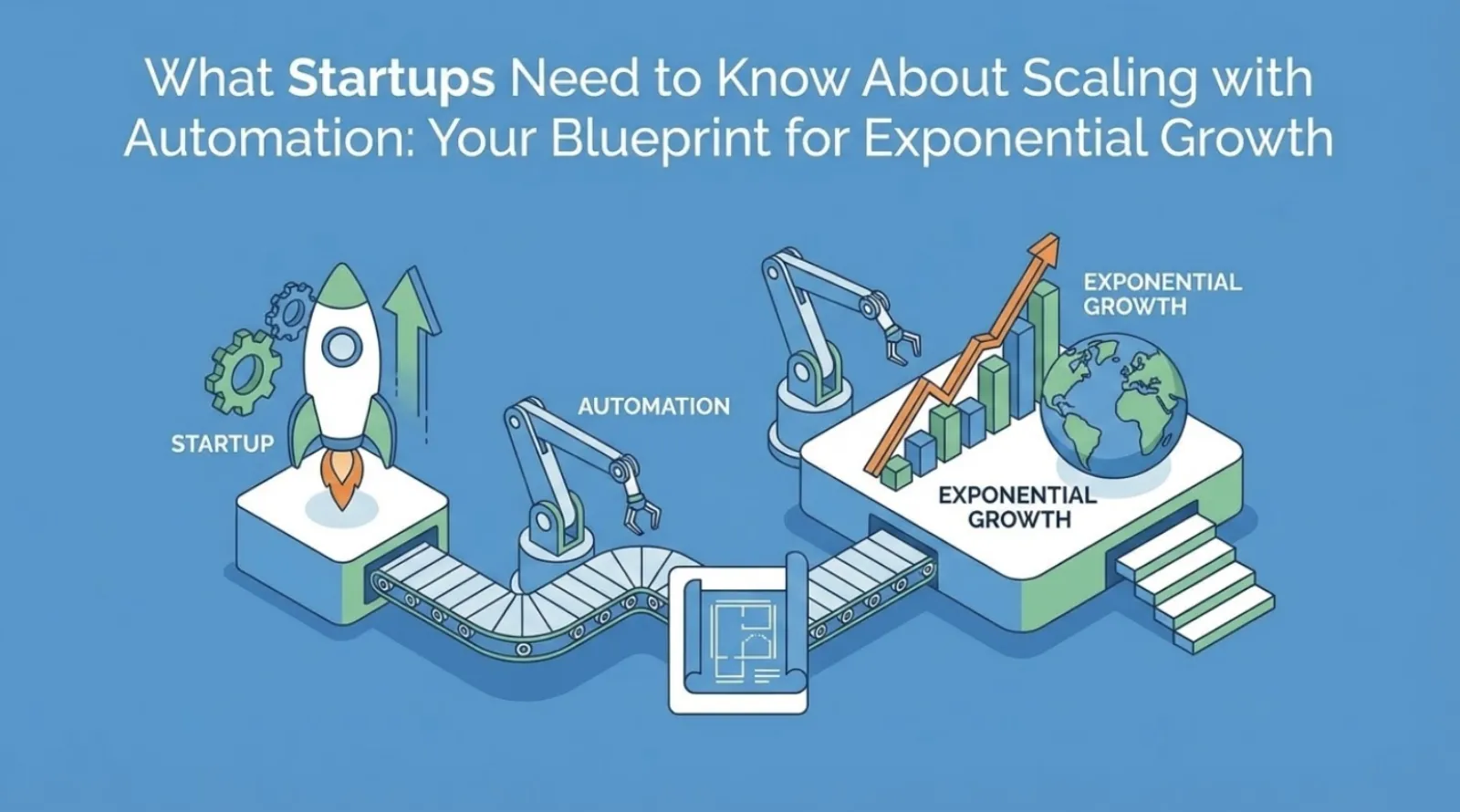
Did you know that 70% of companies report that automation increases productivity? For a startup, where every minute and every dollar counts, this isn’t just a statistic; it’s a lifeline. Many startup founders grapple with the idea of scaling, often fearing the spiraling costs, increased complexity, and the sheer impossibility of doing more with limited resources.
But what if the secret to breaking through these barriers wasn’t about working harder, but smarter? What if it was about leveraging the silent, tireless power of automation to transform your ambitious vision into a tangible, thriving reality?
This guide isn’t just another discussion about technology; it’s a practical playbook designed to demystify automation for founders, small business owners, and non-technical readers.
Get your free Marketing Action PlanNot sure where to start? Answer a few questions and get your plan in about a minute. No email needed.
Get my plan →We’ll explore how integrating intelligent automation into your core operations can be the single most impactful decision you make for sustainable growth, improved efficiency, and a truly competitive edge in today’s fast-paced market.
Get ready to uncover the strategic advantages that automation offers, moving beyond repetitive tasks to unlock your team’s full potential and accelerate your journey to success.
Why Automation is No Longer Optional for Ambitious Startups Seeking Real Growth
In the relentless world of startups, growth is the ultimate goal. Yet, many budding businesses hit a wall, suffocated by the very success they strive for. The endless stream of manual tasks, the growing pile of administrative duties, and the constant need to manage burgeoning customer demands can quickly overwhelm even the most passionate teams. This isn’t a problem of ambition; it’s a challenge of bandwidth.
This is precisely where intelligent automation steps in, not as a luxury, but as a fundamental necessity for any startup aiming to scale beyond its initial stages. Imagine a world where your core operations run smoothly, almost on autopilot, freeing up your valuable human capital to focus on innovation, strategy, and deepening customer relationships. This isn’t a futuristic dream; it’s the present reality automation offers.
The Hidden Costs of Manual Processes: Stifling Innovation and Draining Resources
Many startups operate under the assumption that manual processes are cost-effective, especially in the early days. They believe that hiring more people to handle growing tasks is the only way forward. However, this perspective overlooks the significant hidden costs associated with manual work.
- Time Consumption: Every minute spent on repetitive data entry, scheduling, or report generation is a minute not spent on customer acquisition, product development, or strategic planning. For a startup, time is the most precious commodity.
- Increased Error Rates: Humans are prone to mistakes, especially when performing monotonous tasks. A single error in billing, order fulfillment, or data migration can lead to customer dissatisfaction, financial losses, and a damaged reputation, all of which are incredibly difficult for a new business to overcome.
- Employee Burnout and Dissatisfaction: Constantly battling mundane tasks can lead to disengaged employees. Talented individuals often join startups for the excitement and challenge, not to become glorified data processors. Burnout impacts productivity, morale, and ultimately, employee retention.
- Lack of Scalability: Manual processes simply don’t scale. As your customer base grows or product offerings expand, attempting to keep up manually becomes exponentially more expensive and inefficient, creating bottlenecks that prevent true expansion.
Understanding these true costs reveals that what appears “cheap” in the short term often becomes a significant drain on resources and a formidable barrier to growth in the long run.
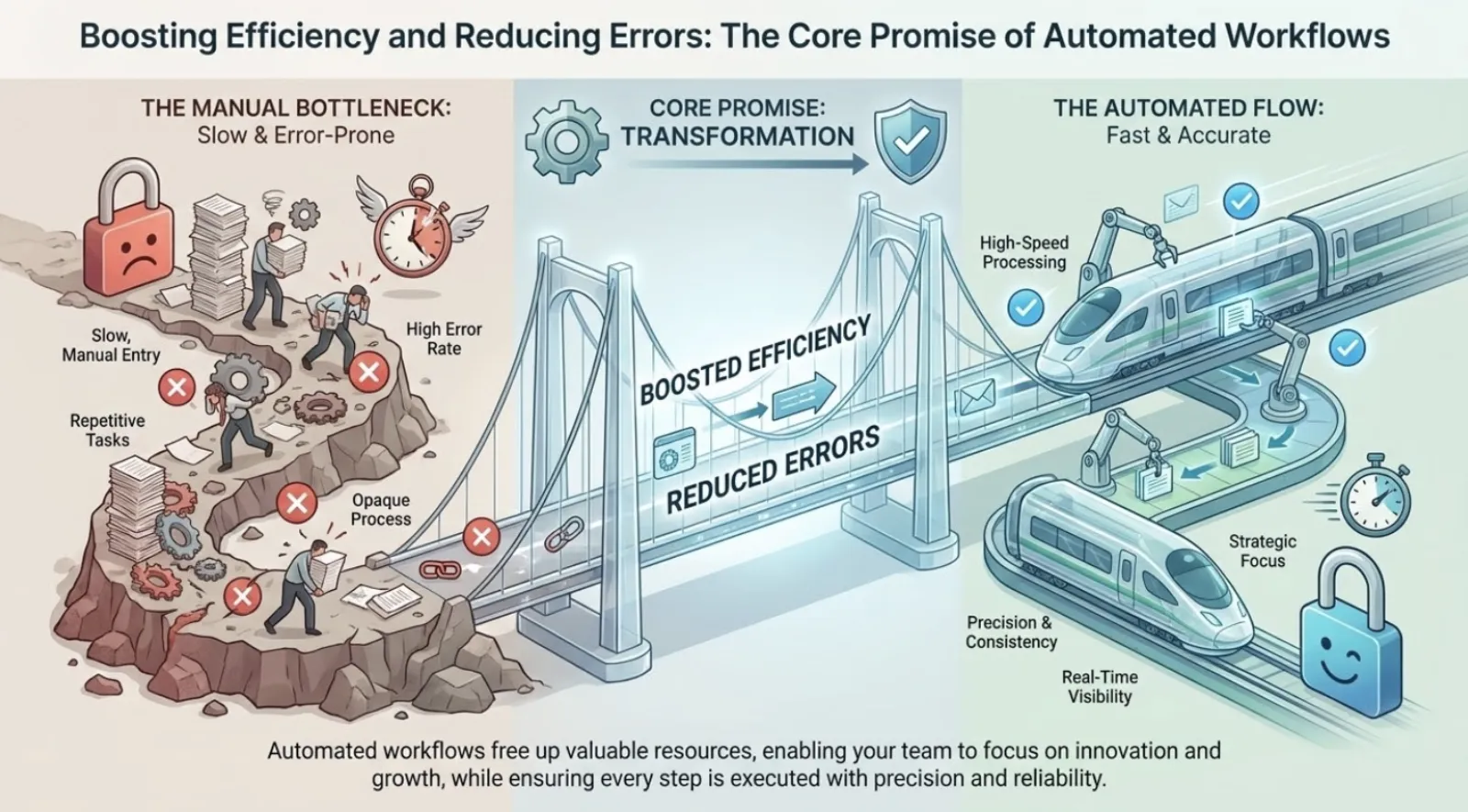
Boosting Efficiency and Reducing Errors: The Core Promise of Automated Workflows
Automation’s core value proposition to a startup lies in its unparalleled ability to boost efficiency and drastically reduce human error. By automating predictable, rule-based tasks, businesses can achieve a level of operational excellence previously unattainable. Think of it as having a tireless digital workforce that executes tasks with precision and speed, 24/7, without complaint or coffee breaks.
Consider the common scenario of onboarding new customers. Manually, this involves multiple steps: sending welcome emails, setting up accounts, assigning a customer success manager, and updating CRM records. Each step is a potential point of delay or error. With automation, a single trigger (like a new signup) can kick off a seamless workflow:
- An automated welcome email is sent instantly.
- A new record is created in your CRM with all relevant details.
- A task is assigned to the sales or customer success team.
- Follow-up communications are scheduled automatically.
This not only speeds up the process but also ensures consistency, a crucial element for delivering a professional and reliable customer experience. Increased operational efficiency translates directly into faster time-to-market, quicker response times, and a more streamlined customer journey, all vital for gaining a competitive edge.
Identifying Your Startup’s Automation Sweet Spots: Where to Begin for Maximum Impact
The idea of automating everything at once can be overwhelming. For a startup with limited resources and often no dedicated IT department, the key is to be strategic. The most effective approach is to identify “sweet spots” where automation can deliver the greatest return on investment (ROI) with the least amount of effort. This involves looking for tasks that are repetitive, time-consuming, prone to error, and occur frequently. By focusing on these areas first, you can demonstrate the value of automation quickly and build momentum for further initiatives. It’s about taking smart, incremental steps rather than attempting a grand, all-encompassing overhaul.
Customer Service Automation: Enhancing User Experience and Boosting Retention
For any startup, customer satisfaction is paramount. Excellent customer service not only retains existing clients but also serves as a powerful marketing tool. However, manually handling every customer inquiry can quickly exhaust your team, especially as your user base expands. Customer service automation offers a powerful solution, allowing you to scale support without proportionally scaling costs.
Imagine a customer reaching out with a common question. Instead of waiting for a human agent, a chatbot or virtual assistant can provide an instant, accurate answer based on your knowledge base. This reduces resolution times significantly, leading to happier customers. Furthermore, automated systems can:
- Triage inquiries: Automatically route complex issues to the correct department or human agent, ensuring customers get help from the right expert faster.
- Provide self-service options: Empower customers to find answers themselves through intelligent FAQs or help centers, freeing up your support team for more nuanced interactions.
- Automate follow-ups: Send automated surveys after an interaction, collect feedback, and even trigger automated check-ins or upsell opportunities based on customer behavior.
Tools ranging from simple chatbot platforms to more sophisticated helpdesk integrations can be deployed, making your customer support both more responsive and more efficient. The result is a seamless customer experience that fosters loyalty and strengthens your brand reputation, even with a lean team.

Streamlining Marketing and Sales Operations: Fueling Growth with Precision
Marketing and sales are the engines of startup growth. Yet, these departments are often bogged down by a myriad of manual tasks, from lead qualification to email outreach and data tracking. Automating key aspects of your marketing and sales operations can transform these functions from laborious efforts into precision-driven growth machines.
Consider the journey of a potential customer:
- Lead Generation and Nurturing: Tools can automatically capture leads from your website, qualify them based on predefined criteria, and then enroll them in personalized email drip campaigns. This ensures every lead receives timely, relevant information, moving them closer to a purchase without manual intervention.
- Email Marketing: Beyond simple newsletters, automation allows for sophisticated segmentation and triggered emails. A customer who views a specific product but doesn’t buy can receive a targeted follow-up email with a discount code, significantly increasing conversion rates.
- CRM Updates: Sales teams often spend valuable time updating customer relationship management (CRM) systems. Automation can automatically log calls, emails, and meetings, ensuring your CRM is always up-to-date, providing a single source of truth for your sales efforts.
- Reporting and Analytics: Instead of manually compiling reports, automated dashboards can provide real-time insights into campaign performance, sales pipeline health, and key metrics. This allows for quicker, data-driven decisions that optimize your spend and strategy.
By offloading these repetitive tasks, your marketing team can focus on creative campaigns and strategic initiatives, while your sales team can dedicate more time to building relationships and closing deals. This optimization of your sales funnel directly translates into more qualified leads, higher conversion rates, and ultimately, accelerated revenue growth.
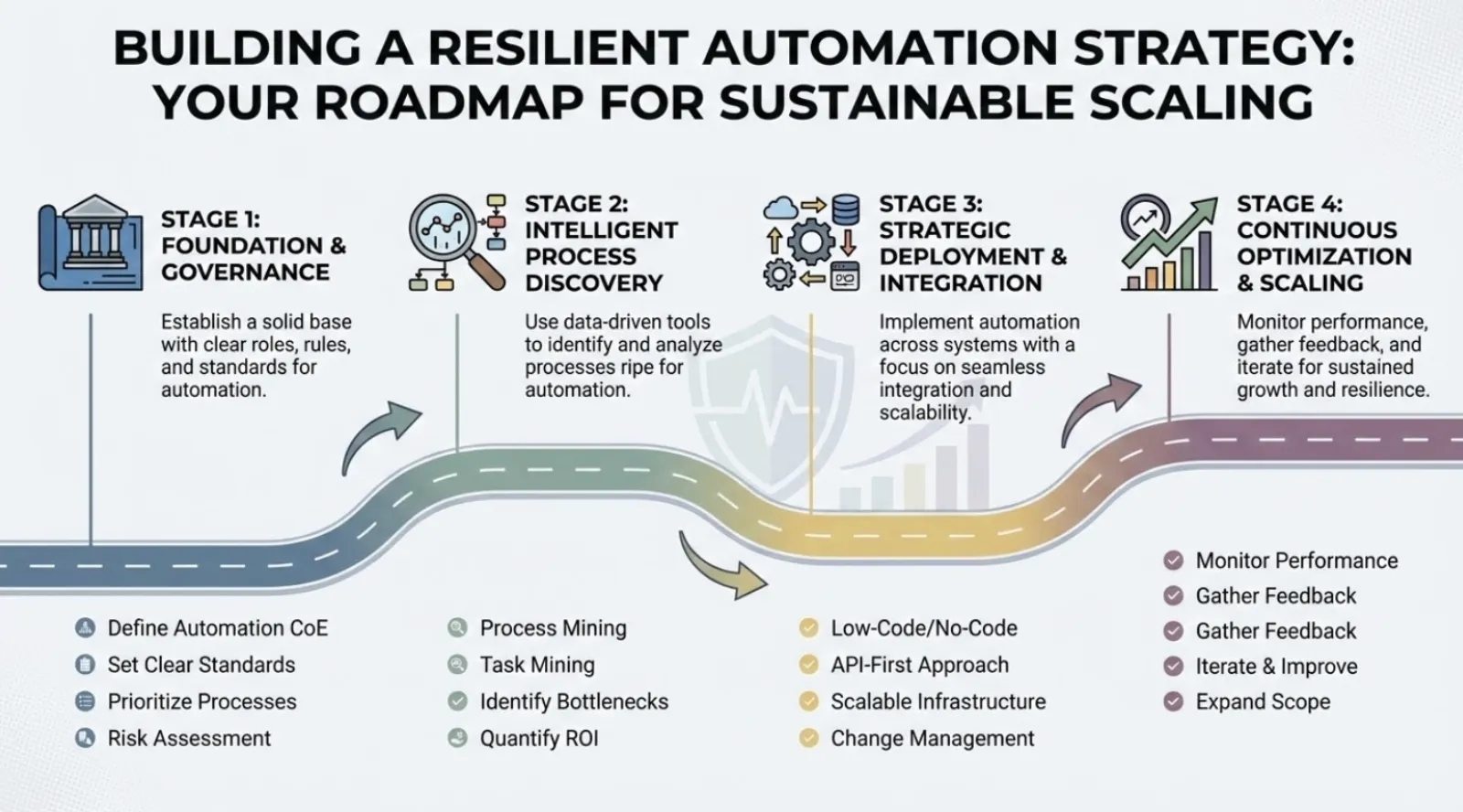
Building a Resilient Automation Strategy: Your Roadmap for Sustainable Scaling
Adopting automation is more than just implementing a few tools; it’s about developing a strategic mindset that embraces efficiency and innovation. For a startup, building a resilient automation strategy means creating a framework that can evolve with your business, adapting to new challenges and opportunities.
It’s about being intentional with your choices, ensuring that every automated process contributes to your overarching business goals, rather than creating new complexities. A well-thought-out strategy protects your budget, maximizes your team’s potential, and lays a solid foundation for long-term sustainable scaling. This isn’t just about what you automate, but how you plan, implement, and manage these changes within your dynamic startup environment.
Starting Small: Prioritizing High-Impact Areas for Quick Wins and Momentum
The biggest mistake a startup can make with automation is trying to automate everything at once. This often leads to analysis paralysis, wasted resources, and ultimately, abandonment of the initiative. A far more effective approach is to start small, identify high-impact areas, and aim for quick wins. This strategy allows you to:
- Prove the Value: Successfully automating a small, yet significant, process provides tangible results that build confidence and buy-in from your team and stakeholders.
- Learn and Adapt: Each small automation project offers valuable lessons about your processes, the tools you’re using, and the best way to manage change. This iterative learning is crucial for refining your strategy.
- Conserve Resources: By focusing on specific, well-defined tasks, you avoid over-committing time and money to complex projects that may not yield immediate benefits.
To identify these high-impact areas, conduct an audit of your daily operations. Look for tasks that:
- Consume a disproportionate amount of time for key personnel.
- Are performed frequently (daily or weekly).
- Involve transferring data between different systems.
- Are highly susceptible to human error.
Examples include automating meeting scheduling, generating routine reports, managing customer feedback surveys, or sending automated onboarding emails. By tackling these “low-hanging fruit” first, you’ll not only free up valuable time but also demonstrate the power of automation, setting the stage for more ambitious projects down the line. Prioritizing these strategic improvements allows your startup to gain significant ground without overwhelming your agile team.
Choosing the Right Tools and Technologies: Navigating the Landscape of Automation Solutions
The market is flooded with automation tools, ranging from simple no-code solutions to complex enterprise-level platforms. For a non-technical founder or small business owner, navigating this landscape can feel daunting. The key is to choose tools that are fit for purpose, scalable, user-friendly, and integrate well with your existing tech stack. You don’t need the most expensive or feature-rich solution; you need the one that solves your specific problems effectively.
Consider these factors when evaluating automation tools:
- Ease of Use: For non-technical users, intuitive interfaces and drag-and-drop functionality are crucial. Look for platforms that require minimal coding or technical expertise.
- Integration Capabilities: Your automation tools shouldn’t exist in a silo. They need to connect seamlessly with your CRM, email marketing platforms, project management software, and other essential systems to create truly interconnected workflows.
- Scalability: Choose tools that can grow with your startup. While starting small is important, ensure the chosen solution can handle increasing volumes of data and more complex workflows as your business expands.
- Cost-Effectiveness: Evaluate pricing models carefully. Many tools offer tiered subscriptions, so choose one that aligns with your current budget and offers flexibility for future growth. Remember to consider not just the subscription cost but also potential implementation and training costs.
- Support and Documentation: Good customer support and comprehensive documentation can be lifesavers when you encounter challenges or need to learn new features.
Popular categories of automation tools include Robotic Process Automation (RPA) for repetitive desktop tasks, Integration Platform as a Service (iPaaS) for connecting disparate systems, and dedicated marketing or sales automation platforms. Research reviews, request demos, and don’t hesitate to start with free trials to ensure a good fit. Making informed decisions about your tech stack ensures that your automation efforts are a strategic investment, not a costly experiment.
Overcoming Common Automation Challenges for Growing Businesses: Strategies for Smooth Implementation
While the benefits of automation are clear, the path to successful implementation isn’t always smooth. Startups often face unique challenges, from limited budgets and technical expertise to potential resistance from team members. Recognizing and proactively addressing these hurdles is crucial for a successful rollout.
Thinking through potential roadblocks before they arise can save significant time and resources, ensuring that your automation initiatives deliver on their promise. It’s about having a proactive approach to change management, anticipating where friction might occur and designing solutions to mitigate it.
The Importance of Team Buy-in and Training: Empowering Your People, Not Replacing Them
One of the biggest misconceptions about automation is that it’s designed to replace human jobs. This can lead to resistance, fear, and a lack of cooperation from your team, ultimately sabotaging your automation efforts. For a startup, where every team member is vital, securing team buy-in and providing adequate training is not just important, it’s essential.
Instead of framing automation as a threat, position it as an enabler. Emphasize how it will:
- Free up time from mundane tasks, allowing employees to focus on more rewarding, strategic, and creative work.
- Improve job satisfaction by removing repetitive, unengaging duties.
- Enhance individual skill sets by introducing them to new technologies and processes.
To foster buy-in:
- Involve employees early: Ask for their input on which tasks are most tedious or error-prone. Their insights are invaluable for identifying effective automation opportunities.
- Communicate clearly: Explain the “why” behind automation – how it will benefit the company, their roles, and their career growth.
- Provide comprehensive training: Don’t just implement a tool and expect everyone to figure it out. Offer workshops, tutorials, and ongoing support to ensure everyone is comfortable and proficient with new automated systems.
- Celebrate successes: Highlight how automation is improving efficiency and freeing up time, attributing these wins to the collective effort of the team.
When employees feel empowered by automation, rather than threatened, they become champions of the new processes, leading to smoother adoption and more impactful results. Investing in your team’s understanding and capability ensures that automation becomes a tool for collective advancement, not a source of friction.
Measuring Success and Iterating Your Automation Efforts: Continuous Improvement for Peak Performance
Implementing automation is not a one-time project; it’s an ongoing journey of continuous improvement. For a startup, this means establishing clear metrics to measure the success of your automation efforts and being prepared to iterate and refine your processes based on real-world data. Without proper measurement, you won’t know if your automation is truly delivering value or simply creating new, perhaps less obvious, inefficiencies.
Key metrics to track include:
- Time Savings: How much time are employees saving on tasks that are now automated?
- Error Reduction: Has the number of mistakes in a particular process decreased significantly?
- Cost Savings: Are you reducing operational costs (e.g., fewer staff hours, less rework)?
- Productivity Gains: Is your team able to accomplish more with the same or fewer resources?
- Customer Satisfaction: For customer service automation, are resolution times faster, and are customers happier?
- Conversion Rates: For sales and marketing automation, are lead conversion rates improving?
Once you have data, don’t be afraid to iterate and optimize. Automation is rarely perfect on the first try. Regularly review your automated workflows:
- Are there bottlenecks?
- Can steps be combined or eliminated?
- Are there new tasks that could benefit from automation?
Use a change log or simple documentation to track modifications, hypotheses, and their impact. This iterative approach allows your automation strategy to evolve alongside your startup’s needs, ensuring that your automated systems remain optimized for peak performance and continue to contribute to your growth trajectory. Regularly reviewing and adapting your automation strategy is crucial for maintaining a competitive edge and maximizing the long-term benefits.
Frequently Asked Questions About Startup Automation
Navigating the world of automation can bring up many questions, especially for startups with unique constraints and aspirations. Here are some common queries that non-technical founders and small business owners often have when considering automation.
1. Is automation only for large enterprises with big budgets?
Absolutely not. While large enterprises certainly leverage automation, there’s a burgeoning ecosystem of affordable, user-friendly automation tools specifically designed for small businesses and startups. Many offer freemium models or low-cost subscriptions, making them accessible even with tight budgets. The key is to start with specific, high-impact tasks rather than attempting a full enterprise-level overhaul.
2. What kind of tasks are best suited for a startup to automate first?
Focus on repetitive, rule-based, and time-consuming tasks that drain your team’s energy or are prone to human error. Good starting points include:
- Data entry into spreadsheets or CRM systems.
- Sending routine emails (welcome, follow-ups, confirmations).
- Scheduling appointments and meetings.
- Generating standard reports.
- Basic customer support inquiries (via chatbots).
- Social media post scheduling.
3. Do I need to hire a technical expert or developer to implement automation?
Not necessarily. Many modern automation tools are “no-code” or “low-code,” meaning they offer intuitive drag-and-drop interfaces that allow non-technical users to build workflows. While a technical background can be helpful for more complex integrations, many initial automation efforts can be handled by a proactive founder or team member after a bit of learning.
4. How do I choose the right automation tools for my specific startup?
Consider these factors:
- Your specific problem: What task do you want to automate?
- Ease of use: Look for intuitive interfaces if you’re non-technical.
- Integration: Does it connect with your existing software (CRM, email, etc.)?
- Scalability: Can it grow with your business?
- Cost: Does it fit your budget, and what are the pricing tiers?
- Support: Is good customer support and documentation available?
Start with free trials and read reviews to gauge user experience.
5. What are the biggest risks or challenges when implementing automation in a startup?
The most common challenges include:
- Lack of team buy-in: Employees fearing job displacement or resisting new processes.
- Poor planning: Automating inefficient processes, making them inefficient faster.
- Choosing the wrong tools: Selecting tools that don’t fit needs or budget.
- Over-automating: Trying to automate too much too soon, leading to complexity.
- Security concerns: Not properly securing automated systems and data.
Addressing these with clear communication, phased implementation, and security best practices can mitigate risks significantly.
Final Thoughts: Embracing an Automated Future for Sustainable Growth
Scaling a startup from a nascent idea to a thriving enterprise is an exhilarating, yet challenging, journey. In an increasingly competitive landscape, simply working harder is no longer enough. The true differentiator for the next generation of successful startups will be their ability to work smarter, leveraging the transformative power of automation to amplify their efforts and accelerate their growth. Automation isn’t just about efficiency; it’s about strategic liberation. It frees your most valuable asset your people from the shackles of repetitive tasks, allowing them to innovate, strategize, and build deeper relationships with your customers.
By embracing a thoughtful, incremental approach to automation, focusing on high-impact areas, securing team buy-in, and continuously measuring your progress, your startup can unlock unprecedented levels of productivity, reduce costly errors, and achieve a sustainable growth trajectory that once seemed out of reach. Don’t let the fear of complexity hold you back. Start small, learn fast, and let automation become the silent, powerful engine driving your startup toward its full potential.
Are you ready to transform your startup’s future? Take the first step today: identify one repetitive task, research an accessible automation tool, and begin your journey toward a more efficient, scalable, and successful business. The future of your startup is automated and ready for you to seize.

Written by Uzair Kharawala
Partner at SF Digital Studios, a Google Premier Partner agency. Uzair has been helping businesses grow with Google Ads since 2002 and teaches it every week on YouTube.
Get our best Google Ads tips by email
New articles and videos, straight to your inbox. Unsubscribe any time.