
One quote says £400. Another says £4,000. A website builder says £16 a month. They are all for "a website", and they can't all be right.
So what does a small business website really cost in the UK? The honest answer is that it depends on what you are paying for, and most quotes don't make that clear.

Get Found, Get Chosen, Get Your Time Back
A free one-day marketing seminar in Milton Keynes · 13 January 2027
This guide breaks the cost down line by line, from the domain to the upkeep. It shows what a realistic first-year budget looks like, where the hidden costs sit and how to compare quotes fairly.
Get your free Marketing Action PlanNot sure where to start? Answer a few questions and get your plan in about a minute. No email needed.
Get my plan →A quick word first. SF Digital builds websites, so we're not neutral. We have kept to published prices from named sources and labelled our own views clearly.
How Much Does A Small Business Website Cost In The UK?
Most UK small business websites cost between a few hundred pounds a year on a DIY builder and several thousand pounds through an agency. ExpertSure's UK guide, with prices verified in October 2026, puts builder sites at about £100 to £350 a year all-in, and freelance brochure sites at £500 to £1,500.
The same guide says UK web design agencies charge £3,000 to £30,000 or more for a small business website in 2026. Smaller boutique agencies sit lower, at around £2,000 to £5,000.
Those are wide ranges, and that's the point. Scope drives price. "A website" can mean a single page you build yourself or a 40-page site with booking, payments and custom design.
The build is only part of the cost. Domains, hosting, email, content and upkeep all add up, year after year.
What Are You Actually Paying For?
You are paying for eight things: the domain name, hosting, business email, security, the design and build, the words and photos, tracking and ongoing maintenance. Some quotes include all eight, and some include two.
Here's what each one is. Tick them off as you read.
Domain name. Your address on the web, such as yourbusiness.co.uk. You rent it yearly. You never own it outright.
Hosting. The server space that keeps your site online. Website builders include it. Designer-built sites usually need it paid separately.
Business email. An address like hello@yourbusiness.co.uk. It's often a separate monthly fee per person.
Security. An SSL certificate, which puts the padlock in the browser bar, plus updates that keep the site safe.
Design and build. The layout, the pages and the technical work to make them function.
Content. The words, photos and sometimes video. This is the part most owners underestimate. By a lot.
Tracking. Analytics, call tracking and form tracking, so you know which pages bring enquiries.
Maintenance. Updates, fixes, backups and small changes over time.
Ask every supplier which of these eight are included. It is the quickest way to make two quotes comparable.
What Does A Domain Name Cost?
A .co.uk domain usually costs around £10 to £15 a year to renew. ExpertSure's guide lists domains at £10 to £15 a year in its ongoing costs, and £8 to £15 a year at a domain registrar.
Many registrars and builders offer the first year cheap or free. Enjoy it, but plan for year two. The renewal price is the one that matters, because you will pay it every year.
Register the domain in your own name. If a designer registers it for you, make sure you are listed as the owner. Moving a domain you don't control can be painful.
If you want both .co.uk and .com, you'll pay for each. It is not essential for most local businesses, but it stops someone else taking the matching name.
What Does Website Hosting Cost?
Hosting for a designer-built small business site typically costs £5 to £30 a month, according to ExpertSure's guide, rising to £20 to £100 a month for agency-hosted sites. Website builders such as Wix and Squarespace include hosting in their monthly plan.
Cheap hosting can be fine for a small, simple site. Many sites run happily on it. But very cheap plans are sometimes slow, and a slow site loses visitors.
Agency hosting usually costs more because it often includes backups, security monitoring and support. Ask exactly what's included before comparing prices.
Speed matters more than the hosting price. A few pounds more each month is worth it if your pages load quickly on a phone.
Do You Need To Pay For Business Email?
You do not have to, but a professional email address on your own domain looks more trustworthy than a free webmail address. Google's UK pricing page, checked in October 2026, lists Google Workspace Business Starter at £5.90 per user per month on a one-year commitment, plus tax.
That's per person. It adds up. A team of three pays three times that.
Some hosting packages include basic email accounts. They can work well for small teams, though they usually come with less storage and fewer extras.
Count email in your yearly budget. It's easy to forget, and it is a cost that grows as your team grows.
Do You Need To Pay For An SSL Certificate?
Usually not. An SSL certificate puts the padlock in the browser bar and keeps visitors' data secure. Free certificates are widely available, and most website builders and hosts include one at no extra cost.
Let's Encrypt, a nonprofit, provides free TLS certificates to more than 700 million websites, according to its own site. TLS is the modern name for SSL.
If someone quotes you a large yearly fee just for a basic certificate, ask why. Push for a clear answer. Specialist certificates exist for some businesses, but most local firms don't need them.
Make sure your site shows the padlock. Browsers warn visitors about sites without one, and that warning costs you enquiries.
Why Do Website Prices Vary So Much?
Prices vary because of five things: how many pages you need, who writes the content, how custom the design is, what features you need and who builds it. A five-page site with your own words costs far less than a 30-page site with professional copy and online booking.
Here is how each one moves the price. Some matter more than others.
Number of pages. A site with a page for every service and every town costs more to plan and build than a short brochure site.
Content. Writing good pages takes time. If the designer writes them, or hires a copywriter, the price rises.
Design. A template adapted to your brand costs less than a design built from scratch.
Features. Online booking, payments, quote calculators and integrations all add cost.
Who builds it. You, a freelancer, a small agency or a large agency. Each has different overheads and different levels of support.
None of these is good or bad. They're choices, and each one should be tied to whether it brings more enquiries.
What You're Paying For, Line By Line
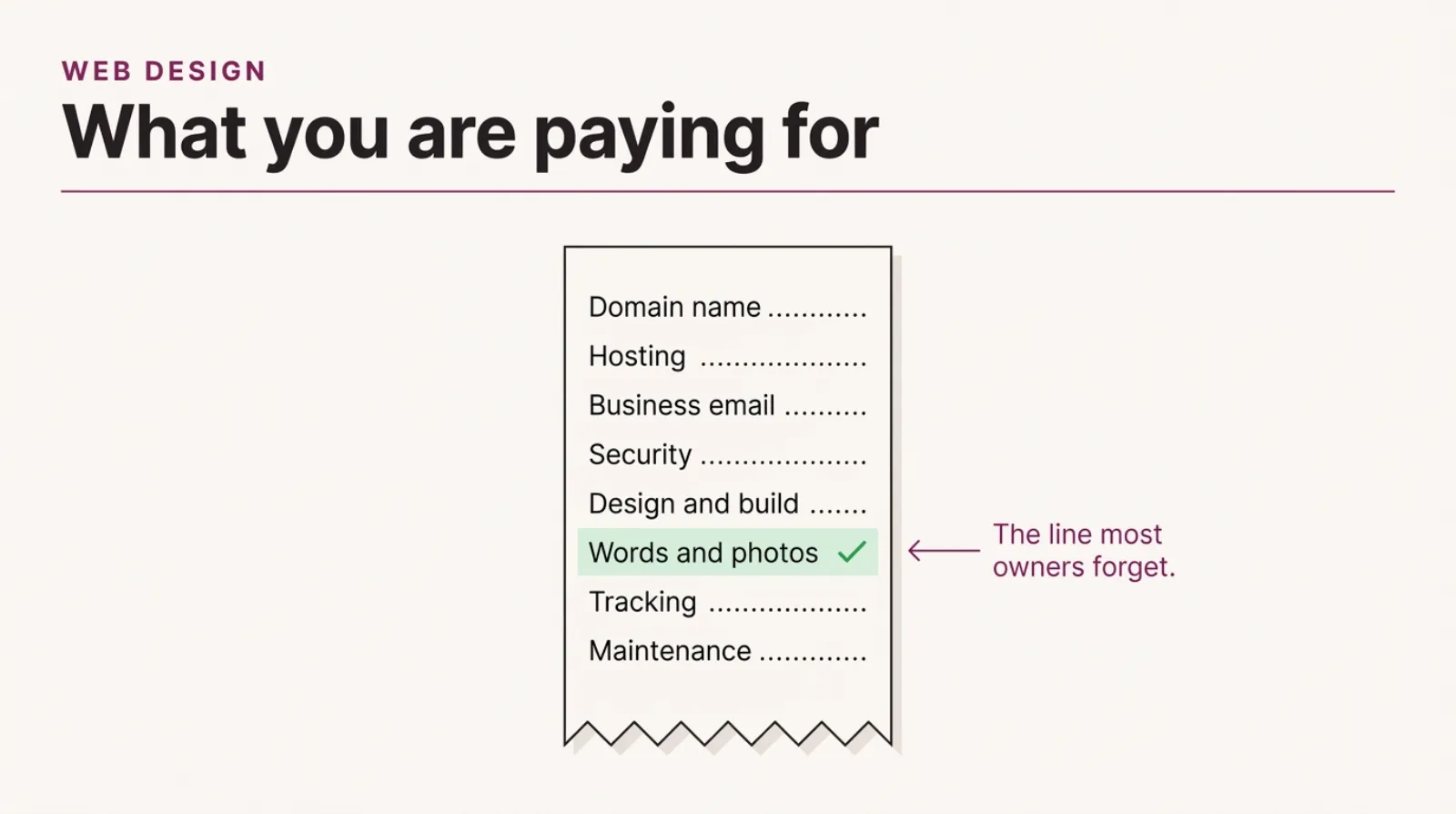
An itemised receipt for a small business website, listing the domain name, hosting, business email, security, the design and build, the words and photos, tracking and maintenance, with the words and photos marked as the line most owners forget to budget for.
What Should A Small Business Budget In Year One?
A DIY builder site might cost a few hundred pounds in year one, a freelance site roughly £1,000 to £3,000 and an agency site several thousand. Your own figures depend on scope, but the table below shows how the costs stack up.
These ranges draw on ExpertSure's October 2026 guide and Google's published email price. They're illustrations to plan with, not quotes.
| DIY builder | Freelancer | Small agency | |
|---|---|---|---|
| Build | Your time | £500 to £1,500 for a basic brochure site | £2,000 to £5,000 at a boutique agency |
| Platform or hosting | Included in about £100 to £350 a year | £5 to £30 a month | £20 to £100 a month |
| Domain | Often included in year one | £10 to £15 a year | £10 to £15 a year |
| Business email | £5.90 per person per month, plus tax | £5.90 per person per month, plus tax | £5.90 per person per month, plus tax |
| Maintenance | Your time | £50 to £150 a month if you want support | £100 to £500 a month |
| Who writes the content | You | Usually you, or extra cost | Sometimes included, often extra |
The monthly costs matter as much as the build. A £1,000 site with £100 a month of support costs £2,200 in year one.
Remember to check whether each price includes VAT. It's easy to miss. Many quotes and plans do not.
Three Price Points, At A Glance
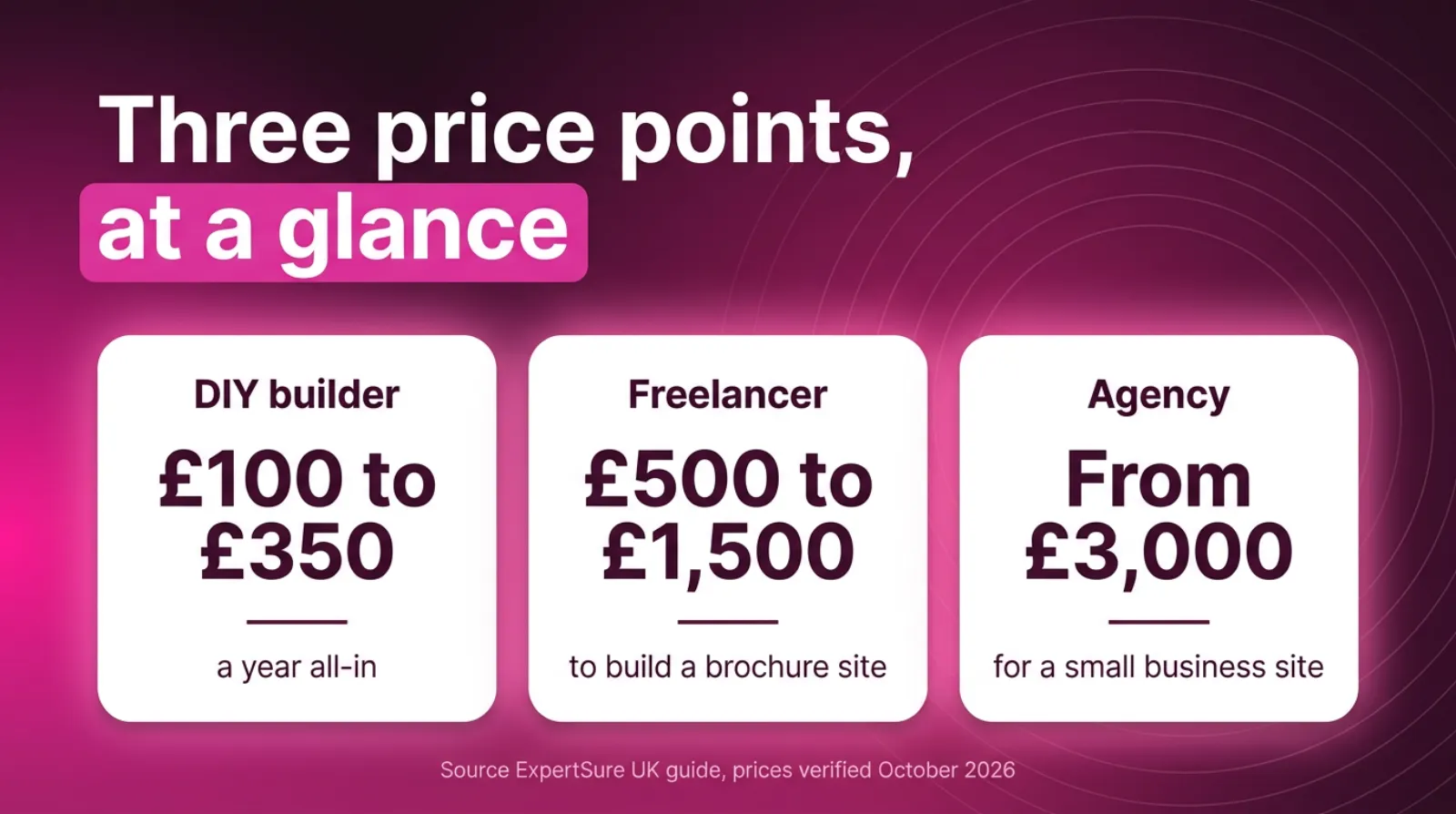
Three price points for a small business website in the UK: a DIY builder at about £100 to £350 a year, a freelance brochure site at about £500 to £1,500 to build, and an agency site from about £3,000, with the right choice depending on how much the website needs to bring in.
What Does A Website Builder Really Cost Over Three Years?
A website builder costs its monthly plan multiplied by the months you use it, plus extras. ExpertSure's UK guides, updated in August 2026, put Wix's main plans at £9 to £25 a month and Squarespace's at £12 to £29 a month, paid yearly.
Over three years, that's roughly £324 to £900 on Wix and £432 to £1,044 on Squarespace, before VAT, apps or email. The sums are simple multiplication from those monthly prices.
That's often less than a designer's build fee. But it doesn't include your time, which is the real cost of the DIY route.
Count your hours honestly. If building and maintaining the site takes 40 hours over three years, what is that time worth in your business?
Builders suit many small businesses perfectly. The point is to compare like with like: three years of a builder against three years of a designer-built site, including hosting, updates and your time.
Is A Cheap Website A False Economy?
A cheap website is a false economy only if it fails to bring enquiries. A simple, low-cost site that explains what you do and makes it easy to call can be excellent value. A cheap site that hides your phone number and ranks for nothing costs you jobs every month.
The price of a website matters less than what it brings in. Results decide value. A £300 site that brings two jobs a month is a bargain. A £3,000 site that brings none is not.
Cheap sites tend to fall short in the same places. The pattern repeats. Thin content, one page for all services, slow loading and no tracking.
Every one of those can be fixed without a big budget. It just takes time and a clear plan.
Judge your site on results, not on what you paid. That's true whether it cost £100 or £10,000.
What Hidden Costs Should You Watch For?
The most common hidden costs are copywriting, photography, renewal price rises, paid add-ons, VAT and the cost of moving later. Ask about each one before you sign, so the final bill matches the quote.
Copywriting. If the quote assumes you'll supply the words, budget your time or a writer's fee.
Photography. Good photos of your work and team make a big difference. A photographer for half a day is often worth it.
Renewal prices. Introductory deals on domains, hosting and builders often rise after year one.
Add-ons and apps. Booking tools, forms, galleries and plugins can each carry their own monthly fee.
VAT. Many prices are quoted before VAT. If you're not VAT registered, that is an extra fifth.
Moving later. Changing platform usually means rebuilding pages rather than copying them across. Budget for that if you expect to grow.
 LIVE
Live every Tuesday at 2pm UK. Bring your marketing questions.
Get your Google, local SEO and AI questions answered live.
Ask for a written list of everything you'll pay in year one and year two. Good suppliers can give you one in minutes.
What Ongoing Costs Come After Launch?
After launch, expect to pay for your domain, hosting or platform, email and any maintenance or support each year. Many owners also pay for occasional updates, new pages and small design changes.
On Wix or Squarespace, the platform fee covers hosting and security. You handle the content yourself, at no extra cost except your time.
With a designer-built site, ongoing costs depend on your agreement. Some designers include updates in a monthly fee. Others charge per change or by the hour.
ExpertSure's guide lists freelance maintenance retainers at £50 to £150 a month and agency retainers at £100 to £500 a month.
Decide who updates the site before it's built. If you want to change prices or photos yourself, make sure the site lets you.
Should You Pay Monthly Or Upfront For A Website?
Both can work. Paying upfront means a larger one-off cost but lower monthly fees afterwards. Paying monthly spreads the cost, but you'll usually pay more over time and should check what happens if you stop paying.
Some designers and agencies offer a website for a fixed monthly fee with no big build cost. It is increasingly common. These packages often include hosting, updates and support.
They can be a good fit for businesses that want predictable costs. But read the terms carefully. The detail matters.
Ask who owns the website if you stop paying. Some monthly packages mean the site is switched off or kept by the supplier when the agreement ends.
Also ask about the minimum term. A monthly plan with a two-year lock-in is closer to a loan than a subscription.
What Does An Online Shop Cost?
An online shop costs more than a brochure site because it needs product pages, payments, stock management and delivery options. ExpertSure's guide puts an eCommerce store at £3,000 to £35,000, depending on product count and features.
At the lower end, a small shop on a builder like Wix or Squarespace can sell a modest range of products well. Their higher plans include payments and stock tools.
At the higher end, a custom shop with hundreds of products, integrations with your stock system and complex delivery rules takes far more work.
Payment fees add up too. Most payment providers take a percentage of each sale, so build that into your pricing.
Start with what you actually need to sell in the first year. You can always add features as orders grow.
How Can You Keep Website Costs Down?
Keep costs down by writing your own content, supplying your own photos, choosing a template over a custom design, starting with fewer pages and adding more over time. Spend where it brings enquiries, and save everywhere else.
Here are the savings that rarely hurt results. Start with the first.
- Write the first draft of every page yourself. Even a designer will work faster with it.
- Take your own photos on a modern phone in good daylight.
- Choose a well-made template and adapt it to your brand.
- Start with your main services and towns, then add pages as you grow.
- Skip features you will not use in the first year.
- Pay annually where it saves money and you're sure you'll stay.
Do not save on the things that bring calls. A clear phone number, fast pages and pages for each service are worth paying for.
How Long Should A Website Last Before You Replace It?
A well-built small business website usually lasts several years before it needs a full rebuild. Most need regular small updates rather than frequent redesigns. Replace the whole site only when it can't be fixed, can't be edited or no longer reflects the business.
Rebuilding too often is one of the most expensive habits in small business marketing. Each rebuild costs money, and a badly handled move can lose the rankings you've earned.
Here are the signs a rebuild might really be due. Check each one.
You can't edit it. Every small change needs a developer and a bill.
It is slow and can't be fixed. The platform or theme makes it impossible to speed up.
It looks broken on phones. Old sites built before mobile browsing can be hard to rescue.
The business has changed. New services, new areas or a new brand that the old structure can't handle.
If none of those apply, improve what you have. New pages, better photos and clearer headlines often do more than a rebuild.
When Is It Worth Spending More?
It's worth spending more when your website has a big job to do, such as winning searches in a competitive area or turning paid ad clicks into calls. A site that brings even one or two extra jobs a month can pay back a higher price quickly.
Here are the situations where a bigger budget usually makes sense. Be honest about which apply.
Search brings most of your work. More service and area pages, planned around real searches, help you get found.
You run Google Ads. Every click costs money, so a page that converts better saves money every day.
You compete with strong local firms. A basic template may not stand out against well-built competitors.
You need specific features. Online booking linked to your diary or quoting tools take more work to build properly.
Judge the cost against the return. If a site costs £2,000 more but brings one extra £500 job a month, it pays for itself within a few months.
How Do You Compare Website Quotes?
Compare quotes by asking each supplier for an itemised list: what is included, how many pages, who writes the content, the monthly costs, who owns the domain and site, and what happens if you part ways. Then compare the total cost over two years, not just the build price.
Here are the questions to put to every supplier, including us. Use all eight.
- How many pages are included, and which ones?
- Who writes the words, and who supplies the photos?
- What will I pay each month, and for what?
- Will the domain and website be in my name?
- Can I edit text and photos myself?
- Is tracking for calls and forms included?
- What happens if I want to move the site later?
- What's the total cost over two years, including VAT?
Lay the answers side by side. The cheapest quote often looks very different once the monthly costs and extras are included.
It also helps to ask each supplier for two or three examples of sites they've built for similar businesses. Look at them on your phone. Check how fast they load, how easy it is to find the phone number and whether the pages say clearly what the business does.
Then, if you can, ask one of those businesses how the site has worked for them. A two-minute call can tell you more than any proposal. Ask whether the site brings enquiries, how easy it is to update and how quickly the supplier responds when something needs changing.
What Return Should A Website Bring?
A website should bring enough enquiries and jobs to cover its yearly cost several times over. Work out its cost per enquiry the same way you would for advertising, and judge it on jobs won, not on how it looks.
Here's a simple way to think about it. Keep it rough. Add up the website's yearly cost, including build costs spread over three years. Then count the enquiries it brings each year.
Say a site costs £1,500 a year all-in and brings 60 enquiries. That is £25 an enquiry.
If one in three becomes a job, each job cost £75 to win. These figures are illustrative, not a promise.
Compare that with what each job is worth to you. Most owners are pleasantly surprised. For most local businesses, a working website is one of the cheapest sources of enquiries they have.
Track it to know it. Without call and form tracking, you can't tell whether your website is your best salesperson or your most expensive brochure.
A Worked Example: One Florist, Three Quotes
Picture a florist in Milton Keynes. The business and the quotes here are illustrative, not real clients or real suppliers.
The first quote is a DIY builder plan at about £16 a month. The florist would build it, write it and take the photos over several weekends.
The second is a freelancer at £1,200 for a seven-page site, plus £15 a month hosting. The florist supplies the words and photos.
The third is a small agency at £3,500 for a 15-page site with wedding, funeral and delivery pages for nearby towns, plus £60 a month for hosting and updates. A copywriter and a half-day photoshoot are included.
The florist asks each the same eight questions and works out the two-year totals. The DIY route is cheapest, but takes the most time.
The agency route costs the most, but includes the content the florist would struggle to write.
The florist thinks about it for a week. Then the florist picks the freelancer, hires a photographer for a morning and writes the pages with help from a friend. It is not the cheapest option, and it is not the most expensive.
It fits the business.
There's no single right price. There is only the right price for what your website needs to do.
Frequently asked questions
How much does a small business website cost in the UK?
It ranges from about £100 to £350 a year on a DIY builder to several thousand pounds through an agency. ExpertSure's UK guide, with prices verified in October 2026, puts freelance brochure sites at £500 to £1,500 and agency sites from £3,000.
How much does website hosting cost in the UK?
ExpertSure's guide puts hosting for freelancer-built sites at £5 to £30 a month and agency-hosted sites at £20 to £100 a month. Website builders such as Wix and Squarespace include hosting in their plans.
How much is a domain name per year?
Expect to pay roughly £10 to £15 a year for a .co.uk name once any introductory deal ends. Always check the renewal price, not just the first-year offer, and register it in your own business's name so you stay in control of it.
Do I need to pay for an SSL certificate?
Usually not. Free certificates are widely available, and most builders and hosts include one. Let's Encrypt, a nonprofit, provides free certificates to hundreds of millions of websites.
How much does a website cost to maintain each year?
It depends on who looks after it. On a builder, it's mostly your time plus the plan. ExpertSure's guide lists freelance maintenance at £50 to £150 a month and agency retainers at £100 to £500 a month.
Are website prices quoted with VAT?
Often not. Many plans and quotes are shown before VAT, so check. If you are not VAT registered, add a fifth to compare fairly.
Keep Reading
These posts go deeper on making a website earn its cost.
- Why Your Website Gets 1,000 Visitors a Month and Almost None of Them Pick Up the Phone
- If Your Landing Page Isn’t Converting, It’s Probably Because Of THIS (Not Your Design)
- The ‘One Sentence’ Fix That Instantly Makes Your Landing Page More Persuasive
- Local SEO Ranking Factors Reward Proof, Not Technical Polish
- 6 Local SEO Fixes That Get SMEs Into the Google Maps 3-Pack Faster
We picked these because each one covers a next step: turning visitors into calls, writing pages that persuade and getting found locally.
Sources
Build, hosting, domain and maintenance ranges come from ExpertSure's UK website cost guide, with prices verified in October 2026. The email and certificate facts come from the providers' own pages, checked on 25-10-2026. Prices change, so check them before you buy.
So, What Should You Spend?
Start with the job your website needs to do. Write down how customers find you now and how many enquiries you'd like the site to bring.
Then get two or three quotes, ask the eight questions and compare the two-year totals. Budget for the words and photos as well as the build.
If your website is mainly a calling card, keep it simple and cheap. If it needs to win searches or convert ad clicks, invest in the plan and the content.
And if you'd like an honest view on a quote you have been sent, book a call. We'll go through it with you and tell you straight whether it looks fair, even if it's not from us.

Written by Uzair Kharawala
Partner at SF Digital Studios, a Google Premier Partner agency. Uzair has been helping businesses grow with Google Ads since 2002 and teaches it every week on YouTube.
Get our best Google Ads tips by email
New articles and videos, straight to your inbox. Unsubscribe any time.