Three agencies quote you for the same job. One wants £400 a month. One wants 15% of your ad spend. One wants £1,500 a month plus a setup fee. They all say they'll get you more leads.
So what does Google Ads management cost in the UK, and which quote is the good one? The answer depends less on the number and more on how the fee is built.
Get Found, Get Chosen, Get Your Time Back
A free one-day marketing seminar in Milton Keynes · 13 January 2027
A word of honesty first. SF Digital manages Google Ads for a living, so we are not neutral.
Get your free Marketing Action PlanNot sure where to start? Answer a few questions and get your plan in about a minute. No email needed.
Get my plan →But this guide explains the fee models, the red flags and the questions to ask, including the ones you should ask us.
How Much Does Google Ads Management Cost In The UK?
Most UK agencies charge a monthly management fee on top of your ad spend. One UK pricing guide, updated in June 2026, puts typical fees at £750 to £3,000 a month, or 10 to 20% of ad spend, plus a setup fee of £500 to £2,500. Freelancers often charge less.
Those figures come from Advertizingly's guide to UK Google Ads agency pricing. It doesn't say where its ranges come from, so treat them as a rough guide rather than market research.
There's no official price list for this work. Agencies set their own. Every agency sets its own fees, and two quotes for the same account can be miles apart.
The fee is never the whole cost. You also pay Google for the clicks. That's your ad spend, and it is separate from what you pay the people who manage it.
A local plumber spending £1,000 a month on clicks might pay £300 to £800 on top for management. A larger firm spending £10,000 a month might pay £1,500 or more.
These are illustrations, not quotes.
What Are You Actually Paying For?
You're paying for someone's time, skill and attention on your account. Good management covers research, setup, tracking, weekly checks, testing and clear reporting. Poor management covers a monthly login and a PDF.
Here's what a good management fee usually includes. Use it as a checklist.
Research. Finding the searches your customers actually use, and the ones to avoid.
Setup and structure. Campaigns, ad groups, keywords, ads and assets organised so you can see what works.
Conversion tracking. Calls, forms and bookings counted properly. Without this, nothing else can be judged.
Weekly housekeeping. Reading the search terms report, adding negative keywords, adjusting budgets and fixing disapprovals.
Testing. New ads, new landing pages and new bidding approaches, one at a time.
Reporting and advice. Plain-English updates on enquiries, cost per enquiry and what is changing next.
Ask any agency which of these are included. Two fees that look similar can cover very different amounts of work.
What Are The Main Google Ads Fee Models?
There are five common ways UK agencies charge for Google Ads management: a percentage of ad spend, a flat monthly fee, an hourly rate, a one-off setup fee and some form of performance-based pricing. Many agencies combine two or more.
Percentage of ad spend. You pay a share of what you spend on clicks, often 10 to 20%. It is simple and scales with your budget.
Flat monthly fee. You pay a fixed amount each month, whatever you spend on ads. It's predictable and easy to budget for.
Hourly rate. You pay for the time spent. It suits occasional help, audits or coaching more than ongoing management.
Setup fee. A one-off charge for building campaigns and tracking at the start. It's common alongside a monthly fee.
Performance-based. You pay per lead, per sale or a bonus when targets are hit. It sounds attractive, but it needs very careful definitions of what counts.
Hybrid. A base fee plus a percentage above a certain spend, or a flat fee with a performance bonus.
None of these is wrong. Each has a place. What matters is whether the model rewards the agency for the same thing you care about.
Why Does The Fee Model Matter So Much?
The fee model matters because it shapes what the agency is rewarded for. A percentage fee rewards more spending. A flat fee rewards efficiency. A per-lead fee rewards more leads, not better ones. Pick the model whose incentive matches your goal.
Think about a percentage fee. It's the most common. If the agency earns 15% of your ad spend, their income rises when your budget rises.
Most agencies are honest about this. But the incentive points towards spending more, not spending better.
Now think about a flat fee. The agency earns the same whether you spend £1,000 or £2,000.
So there's no reason for them to push your budget up, and every reason to make each pound work harder.
Per-lead pricing has its own trap. If the agency is paid for every form fill, junk enquiries still count.
Unless "lead" is defined tightly, you can pay for quantity and get no quality.
Ask yourself one question. If this agency makes more money next month, will I have made more money too?
How Each Fee Model Works
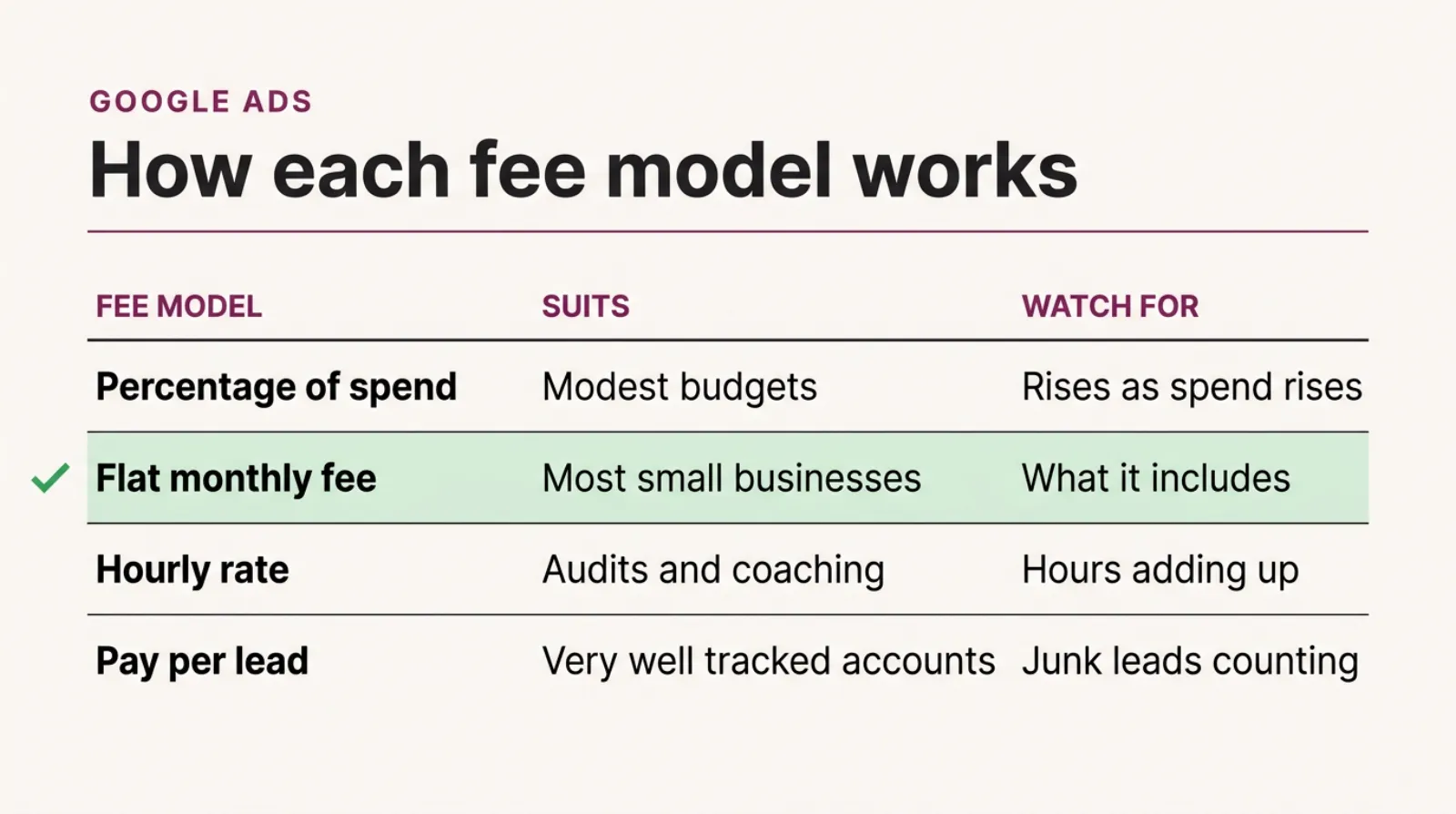
A comparison of four Google Ads fee models for a small business: a percentage of ad spend, a flat monthly fee, an hourly rate and pay per lead, showing how each is priced, who it suits and what to watch out for, with the flat monthly fee marked as the usual best fit.
Which Fee Model Is Best For A Small Business?
For most small businesses, a flat monthly fee with a clear list of what is included is the fairest model. It's predictable, it does not reward higher spending, and it makes it easy to judge value against enquiries.
Here's why it tends to suit smaller accounts. Three reasons stand out.
You know the cost in advance. No surprises when your spend changes with the seasons.
There is no reason to inflate your budget. The agency's income does not rise when your spend does.
It's easy to judge. You compare one fixed number with the enquiries and jobs it brings.
Percentage fees can work well too. They are common and often fair at modest budgets. Just ask for a cap, so the fee doesn't keep climbing if your spend grows.
Hourly pricing suits owners who manage their own account and want expert help now and then. A monthly or quarterly review can catch costly mistakes without a full management fee.
Performance-only pricing rarely suits a small local business. Tracking has to be perfect, and arguments about which leads "count" can sour the relationship quickly.
Six Things To Check Before You Sign
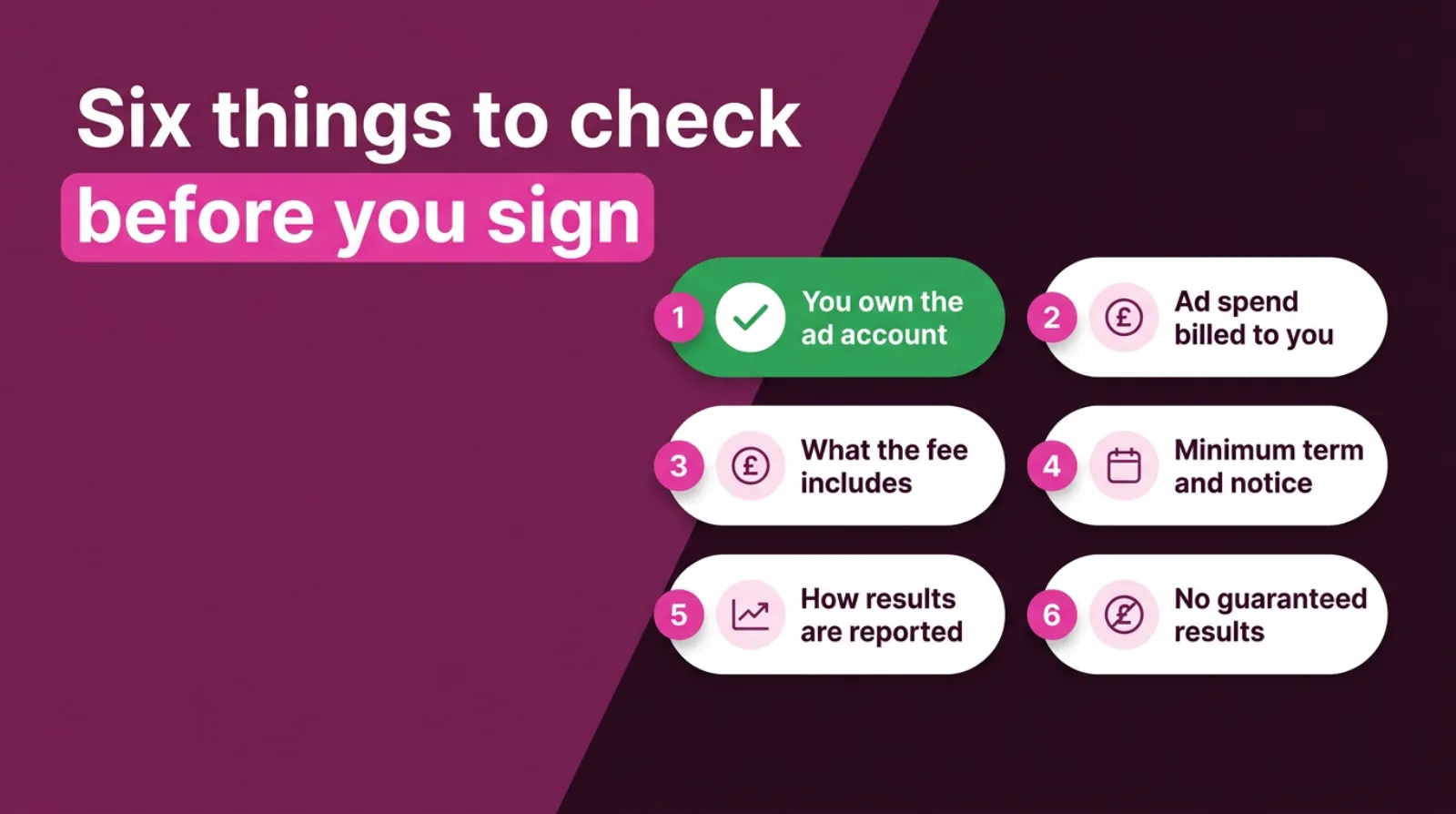
Six things to check before signing a Google Ads management contract: you own the ad account, ad spend is billed straight to you, what the fee includes, the minimum term and notice period, how results are reported, and that nobody guarantees rankings or results.
Why Do Some Agencies Charge So Little?
Some agencies charge very little because they spend very little time on each account. A low fee usually means a template setup, monthly check-ins and little testing. That can be fine for a simple account, but it's rarely enough for a competitive local market.
Think about the maths. It's revealing. If an agency charges £150 a month and wants to make a profit, it can only spend an hour or two on your account.
That's barely enough to read the search terms report once.
Low fees also sometimes hide other costs. The ad spend might be paid through the agency with a margin added, or the contract might lock you in for a year.
None of that makes cheap agencies dishonest. Some are efficient specialists with a simple service. Just make sure you know what the low fee buys.
Ask how many hours a month go into your account. A clear answer tells you more than the price.
Are There Hidden Costs Beyond The Management Fee?
Yes, there often are. Beyond the fee and the ad spend, you may pay for landing pages, call tracking software, design work, extra campaigns on other platforms and VAT. Ask for every cost in writing before you start.
Here are the extras that most often surprise owners. Ask about each one.
Landing pages. Some agencies build dedicated pages for your ads, which can cost extra.
Call tracking. Specialist call tracking tools carry their own monthly fee.
Creative work. Images and videos for display, YouTube or Performance Max may be charged separately.
Other platforms. Microsoft Ads, Meta ads or LinkedIn are usually separate fees.
VAT. Most agency quotes are quoted before VAT. If you're not VAT registered, that is an extra fifth on top.
None of these are unreasonable. They just need to be visible from the start.
How Much Should You Spend On Ads Before Paying For Management?
Paying for management makes most sense when your ad spend is large enough that better management changes the result. If the fee is close to or higher than your monthly ad spend, look hard at whether coaching or a lighter service would serve you better.
There's no fixed rule. Use judgement. But here's a simple way to think about it.
If you spend £300 a month on ads and pay £500 for management, most of your budget goes on management. Even a brilliant agency has little room to make a difference.
If you spend £2,000 a month and pay £500, the fee is a quarter of your spend. Good management only needs to improve your results by a modest amount to pay for itself.
Compare the fee with the profit from extra jobs, not with the ad spend. If one extra job a month is worth £800 to you, a £500 fee that brings two extra jobs is a bargain.
 LIVE
Live every Tuesday at 2pm UK. Bring your marketing questions.
Get your Google, local SEO and AI questions answered live.
For very small budgets, a brand campaign and a tight local search campaign, managed yourself with an occasional expert review, is often the sensible start.
Agency, Freelancer Or Do It Yourself?
An agency suits businesses that want a team, cover for holidays and broader marketing help. A freelancer suits those who want one experienced person at a lower price. Doing it yourself suits small budgets and owners with time to learn.
Here is how the three compare for a typical local business.
| Agency | Freelancer | Do it yourself | |
|---|---|---|---|
| Typical cost | Monthly fee plus setup | Often lower monthly fee | Your time, plus any training |
| Who does the work | A team | One person | You |
| Cover for holidays and illness | Usually yes | Depends | No |
| Breadth of skills | Ads, tracking, landing pages, reporting | Depends on the person | Whatever you learn |
| Best for | Larger budgets and busy owners | Smaller budgets wanting expert help | Very small budgets and keen learners |
| Watch out for | Junior staff doing the work | Single point of failure | Costly beginner mistakes |
Ask who will actually work on your account. Some agencies sell with a senior person and hand the work to someone in their first job.
What Does A Google Partner Badge Tell You?
A Google Partner badge tells you a company meets Google's minimum standards for spend, certification and account set-up. A Premier Partner badge means it ranks in the top 3% of Partners in its country. Neither badge guarantees results for your account.
As of October 2026, Google's help page sets out the Partner requirements. A company needs an optimisation score of at least 70% in its registered manager account and $10,000 of ad spend across managed accounts over 90 days.
At least half of its account strategists must be certified in Google Ads.
Premier Partner status goes to the top 3% of participating companies in each country, decided annually. Google says it looks at existing client growth, new client growth, client retention, product diversification and annual ads spend.
Here's the nuance most owners miss. Google describes optimisation score as an estimate of how well an account is set to perform. It's not a measure of your leads or profit.
So a badge tells you an agency is active, certified and reasonably established. It doesn't tell you whether they'll understand your business. You still need to ask the questions below.
SF Digital is a Google Premier Partner, so we are happy that badge exists. But we'd still tell you to judge any agency on the conversation, not the logo.
What Should Be In A Google Ads Management Contract?
A good Google Ads contract says that you own the ad account, that ad spend is billed straight to your card, exactly what the fee includes, the minimum term and notice period, and how results will be reported. If any of those are missing, ask before you sign.
Here's what each one means. Check every line.
- You own the ad account. The account should be in your business's name, with the agency given access. If you part ways, you keep your history and data.
- Ad spend goes straight to Google. Your card or invoice account pays Google directly. That way you can see exactly what was spent, with no hidden markup.
- The fee and what it covers. A clear list of tasks, how often they happen and anything that costs extra.
- Minimum term and notice. Many agencies ask for a few months to set up and learn. That is reasonable, but know the notice period before you start.
- Reporting. How often you will hear from them and which numbers they'll report. Enquiries and cost per enquiry should be on the list.
- Access. You should be able to log in to your own account at any time.
If an agency will not let you own your account, walk away. It's the single most important point in any contract.
Ten Questions To Ask Any Google Ads Agency
Ask who owns the account, what the fee includes, who does the work, how results are reported and how you can leave. The best agencies answer every one of these clearly and without hesitation.
Here's the full list we'd want any owner to use, including with us.
- Will the ad account be in my business's name?
- Will my card or invoice account pay Google directly?
- What exactly does the monthly fee include?
- Who will work on my account day to day, and how experienced are they?
- How many hours a month will go into my account?
- How will you track calls and enquiries?
- What will your monthly report show?
- What's the minimum term and the notice period?
- Are there any other costs, such as setup, landing pages or VAT?
- What happens to my account and data if we part ways?
Write the answers down. Comparing three agencies on the same ten answers makes the decision much easier.
Should You Sign A Long Google Ads Contract?
A short minimum term of around three months is reasonable, because the first weeks go on setup and learning. Twelve-month lock-ins with no exit are rarely in the client's interest. Look for a sensible minimum, then a rolling monthly agreement with a clear notice period.
Agencies ask for a minimum term for a fair reason. Setting up tracking, structure and testing takes real work up front, and results take time to settle.
But a long lock-in shifts all the risk onto you. If the results don't come, you're still paying.
Ask what happens if the agency misses the agreed goals. A confident agency will usually offer a review point, not just a long contract.
What Red Flags Should You Watch For?
The biggest red flags are an agency that owns your ad account, ad spend paid through the agency with no breakdown, guaranteed results, long lock-ins with no exit, and reports full of clicks but no enquiries.
Here are the ones we'd want every owner to recognise.
- The agency creates the ad account in its own name.
- You pay your ad spend to the agency, not to Google, and can't see the real amount Google charged.
- Someone guarantees first place on Google or a set number of leads.
- A twelve-month contract with no way out if results are poor.
- Reports that focus on impressions and clicks rather than enquiries.
- A percentage fee with no cap as your spend grows.
- Nobody can explain, in plain English, what they did for you last month.
Guarantees are the clearest warning sign. Google's own advice on hiring help says no one can guarantee a number one ranking. Paid ads are no different. Nobody controls the auction.
How Do You Know If You are Getting Value?
You're getting value when the enquiries and jobs from your ads are worth clearly more than your ad spend and management fee combined. Judge it on cost per enquiry and booked work, not on clicks or impressions.
Start with three numbers each month. Keep them simple.
Total cost. Ad spend plus the management fee.
Enquiries. Tracked calls, forms and bookings from the ads.
Jobs won. How many of those enquiries became paying work.
Divide total cost by jobs won. That is your real cost per job, and it's the number to compare with the profit from each job.
If the number improves over the first few months, the management is earning its fee. If it does not, ask for a clear plan, then a deadline.
Clicks don't pay wages. An agency that reports only clicks is reporting the easy number, not the useful one.
It also helps to sit down properly every quarter. Ask the agency to walk you through what they tested, what worked, what didn't and what they'll try next. A good agency enjoys that conversation, because it's where they show their value.
Bring your own numbers to that meeting too. Jobs booked, average job value and any feedback from customers about how they found you. The best decisions come from putting both sides together.
How Long Before Google Ads Management Shows Results?
You should see early signs within the first month, such as cleaner search terms and tracked enquiries. Meaningful, steady results usually take two to three months, while campaigns gather data and the agency tests and refines.
The first few weeks are about foundations. Patience pays. Tracking goes in, wasted searches get blocked, and the account starts collecting reliable data.
Smart bidding strategies also need time to learn. Google needs enough conversions to understand which clicks are likely to turn into enquiries. Changing too much too early resets that learning.
By month three, you should be able to see a trend in cost per enquiry. If nothing has improved by then, ask for a clear explanation and a plan.
Be wary of anyone who promises a big jump in week one. Quick wins happen, but steady results come from patient, careful work.
What If Your Budget Is Too Small For An Agency?
If your budget is too small for full management, you still have good options. Run a simple brand and local search campaign yourself, get an expert review every few months, or pay for coaching so you learn to manage it properly.
Google's own guidance on hiring search help makes a related point. It says that if you run a small local business, you can probably do much of the work yourself.
The same is often true for a small, simple ads account.
Here's a lean approach that works for many owners. It's cheap to run.
- Start with a brand campaign to protect searches for your business name.
- Add one tight search campaign for your main service in your area.
- Set up call and form tracking from day one.
- Check the search terms report every week and add negative keywords.
- Book an expert review every three months to catch what you've missed.
A good review can save more than it costs. One wasted keyword spending £10 a day costs about £300 a month.
A Worked Example: Two Quotes, One Kitchen Fitter
Picture a kitchen fitter in Leighton Buzzard spending £1,500 a month on Google Ads. The business, the quotes and the figures here are illustrative, not real clients or real agencies.
The first quote is 20% of ad spend, so £300 a month, with no setup fee. It sounds cheap.
But the contract does not say what is included, and the agency will create the ad account in its own name.
The second quote is £550 a month plus a £500 setup fee. It lists weekly search term checks, call tracking, monthly reporting on enquiries and a three-month minimum term.
The account stays in the fitter's name.
The fitter asks both agencies the same questions. Who owns the account? What is included? How will you report results? They write down both sets of answers.
The first agency is vague. The second answers clearly and shows a sample report with cost per enquiry on the first page.
The fitter picks the second. It costs more each month, but every pound is accounted for, and the account stays theirs either way.
The cheapest quote didn't win, and neither did the most expensive. The clearest answers won.
Frequently asked questions
How much does a Google Ads agency charge in the UK?
Fees vary widely. One UK pricing guide, updated June 2026, puts typical agency fees at £750 to £3,000 a month, or 10 to 20% of ad spend, plus a setup fee. Freelancers and smaller agencies often charge less.
Is a percentage of ad spend a fair way to pay?
It can be, especially at modest budgets. But it rewards higher spending, so ask for a cap. Many small businesses find a flat monthly fee easier to budget for and to judge.
Should I pay a setup fee for Google Ads?
A setup fee is reasonable if it covers real work, such as research, campaign structure and conversion tracking. Ask exactly what it includes and whether the account will be built in your name.
Who should own my Google Ads account?
You should. The account should be in your business's name, with your agency given access. That way you keep your data and history if you change agency.
Can a Google Ads agency guarantee results?
No. Nobody controls the Google Ads auction, and Google's own guidance says no one can guarantee a number one ranking. Treat any guarantee of rankings or lead numbers as a warning sign.
Is it worth paying for Google Ads management?
It's worth it when better management brings enough extra jobs to cover the fee comfortably. If your budget is very small, a simple self-managed campaign with occasional expert reviews may give better value.
Keep Reading
These posts go deeper on getting good value from Google Ads, whoever runs it.
- What A Milton Keynes Business Should Expect From A Google Ads Agency
- The Optimisation Score Is A Sales Target, Not A Health Check
- How Much Should A Small Business Spend On Google Ads
- Negative Keywords Are The One Google Ads Job Google Will Not Do For You
- The £10 A Day Google Ads Brand Campaign Every Local Business Should Run
We picked these because each one covers a next step: choosing an agency, reading the optimisation score, setting a budget and doing the core work yourself.
Sources
The Google facts in this post come from Google's own help pages, which we checked on 25-10-2026. The fee ranges come from Advertizingly's guide to UK Google Ads agency pricing, updated June 2026, which does not cite a source for them.
- How to become a Google Partner or Premier Partner
- About optimisation score
- Do You Need an SEO? Tips for Hiring an SEO
So, Which Quote Should You Pick?
Start with ownership. Make sure the ad account will be in your name, whoever you hire.
Then look at the fee model, not just the number. Choose the model whose incentive matches yours, and ask for a clear list of what's included.
Finally, judge the agency on its answers. The best ones explain what they'll do, how they'll report and what happens if it does not work.
And if you'd like a second opinion on a quote you have been sent, book a call. We'll go through it with you and tell you straight whether it looks fair, including if it's from someone else.

Written by Uzair Kharawala
Partner at SF Digital Studios, a Google Premier Partner agency. Uzair has been helping businesses grow with Google Ads since 2002 and teaches it every week on YouTube.
Get our best Google Ads tips by email
New articles and videos, straight to your inbox. Unsubscribe any time.