
Google Will Now Charge You Per Lead, Not Per Click. Is That Better For A Local Trade?
For years, Google Ads has worked one way. Someone clicks your advert, and you pay. Whether they call you, buy from you or leave after three seconds, the click costs the same.
Now Google is bringing a second way of paying into the same account. You pay when someone gets in touch, and not before. It's called pay per lead.
Pay per lead isn't brand new. Google has sold it for years through a separate product called Local Services Ads.
Get your free Marketing Action PlanNot sure where to start? Answer a few questions and get your plan in about a minute. No email needed.
Get my plan →What is new is that Google is moving it inside Google Ads, where most businesses already advertise. For a plumber, an electrician or a roofer, that makes it much harder to ignore.
So the real question isn't what it is. It's whether paying per lead is a better deal for a local trade than paying per click.
I've run Google Ads for almost 15 years, and my honest answer is that it depends on three things: the kind of job you do, how fast you answer the phone and what a customer is worth to you. This guide walks through all three.
What Has Actually Changed
On 20 July 2026, Google confirmed it is closing the separate Local Services Ads dashboard. Those adverts are moving into Google Ads as a new kind of campaign with a pay-per-lead goal.
The move is happening in stages. Businesses in the United States go first, starting in August 2026. Accounts outside the United States, which includes the UK, are due to follow in 2027.
A few things stay the same. You still pay per lead, not per click. The adverts still show at the top of Google Search and on Google Maps. And you still don't choose keywords.
A few things change. The old dashboard goes away. Weekly budgets become daily ones. Some of the manual bidding options are being retired. And Google has said your old performance reports will not move across with you.
If you already run Local Services Ads, download your reports before your account moves. If you don't, you have about a year to decide whether you want to.
What Pay Per Lead Means
With a normal Google advert, you bid on searches. Your advert shows, someone clicks and lands on your website. You pay for that click. Turning the visitor into an enquiry is your job.
With pay per lead, there is no website visit. Your business shows in a panel at the very top of the results. It carries your name, your review score and a badge. The customer taps to call or message you directly from Google.
You pay when that contact happens. You don't pay for people who only look.
On paper, that sounds like the better deal every time. You only pay for people who want to talk to you. But a lead is not a customer, and what Google counts as a lead matters a great deal. We'll come to that.
Why It Matters To A Local Trade
Most small trades tell me the same thing about pay per click. They don't mind paying for results. They mind paying for clicks that go nowhere.
Pay per lead speaks directly to that worry. It moves some of the risk from you to Google. If nobody contacts you, you pay nothing.
It also removes most of the set-up work. There are no keywords to pick, no adverts to write and no landing page to build. You tell Google what you do and where you work, and Google decides when to show you.
For a busy sole trader, that is a real advantage. A well-run pay-per-click account takes skill and weekly attention. Pay per lead asks for much less.
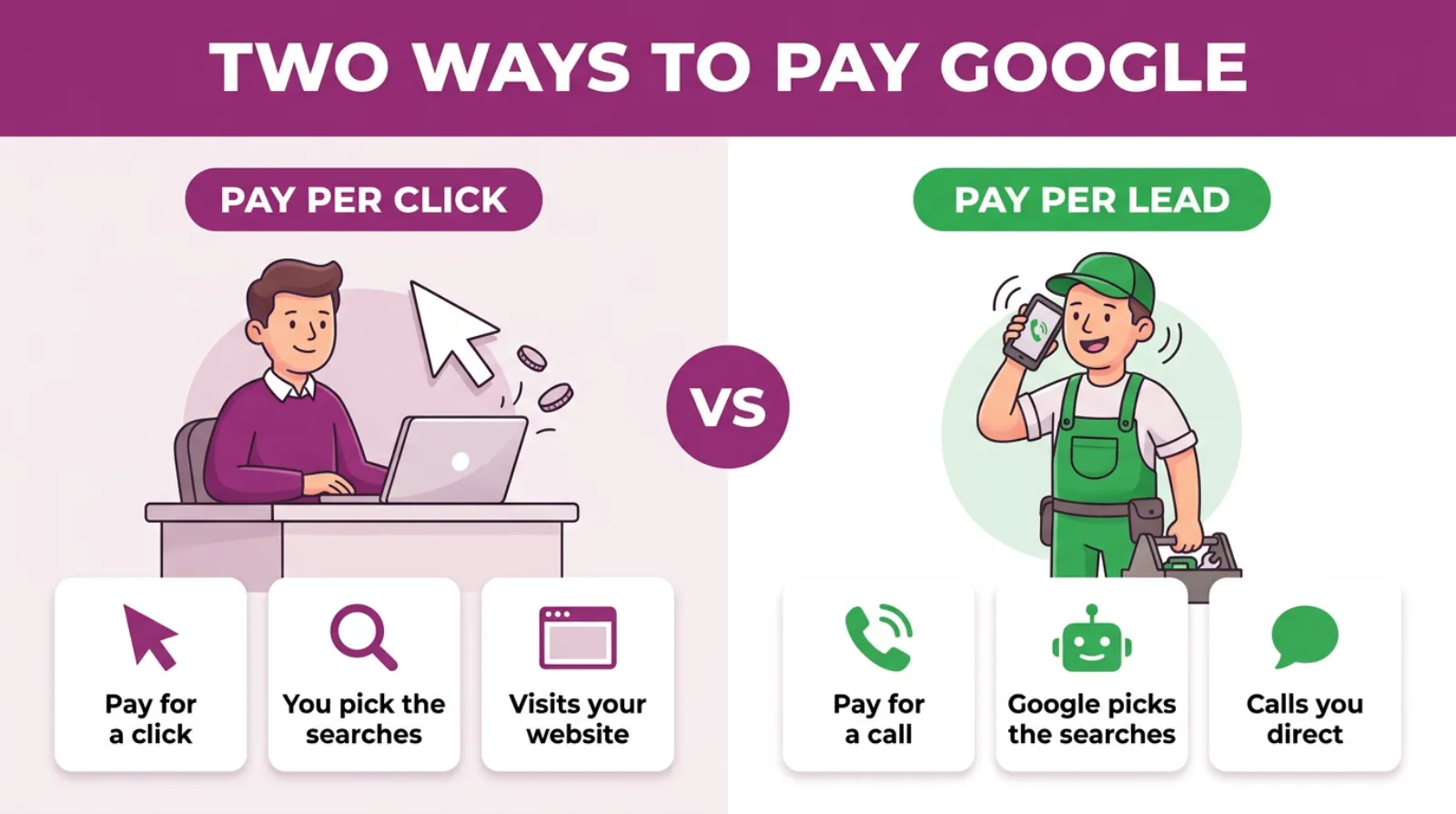
The trade-off is control. With pay per click you steer everything. With pay per lead, Google steers and you pay for what arrives.
Whether that's a good trade depends on what arrives.
What Counts As A Lead, And What Does Not
Most guides skip this part. It decides whether the numbers work. Google's own help page spells it out.
You Are Charged For
- A phone call you answer, or a call you return where you speak to the customer.
- A missed call during your opening hours, if the caller stays on the line for more than 20 seconds.
- A message or email from a customer.
- A voicemail.
You Are Not Charged For
- A second contact from the same number or email within 15 days.
- A missed call outside your opening hours or advert schedule.
- Spam and duplicates that Google's systems catch.
- A caller who hangs up at your phone menu without pressing a key.
Look closely at the second item on the first list. You pay for a missed call in opening hours if the caller waits more than 20 seconds. Say you're up a ladder and your phone rings out. That's a charged lead. You may never speak to the person.
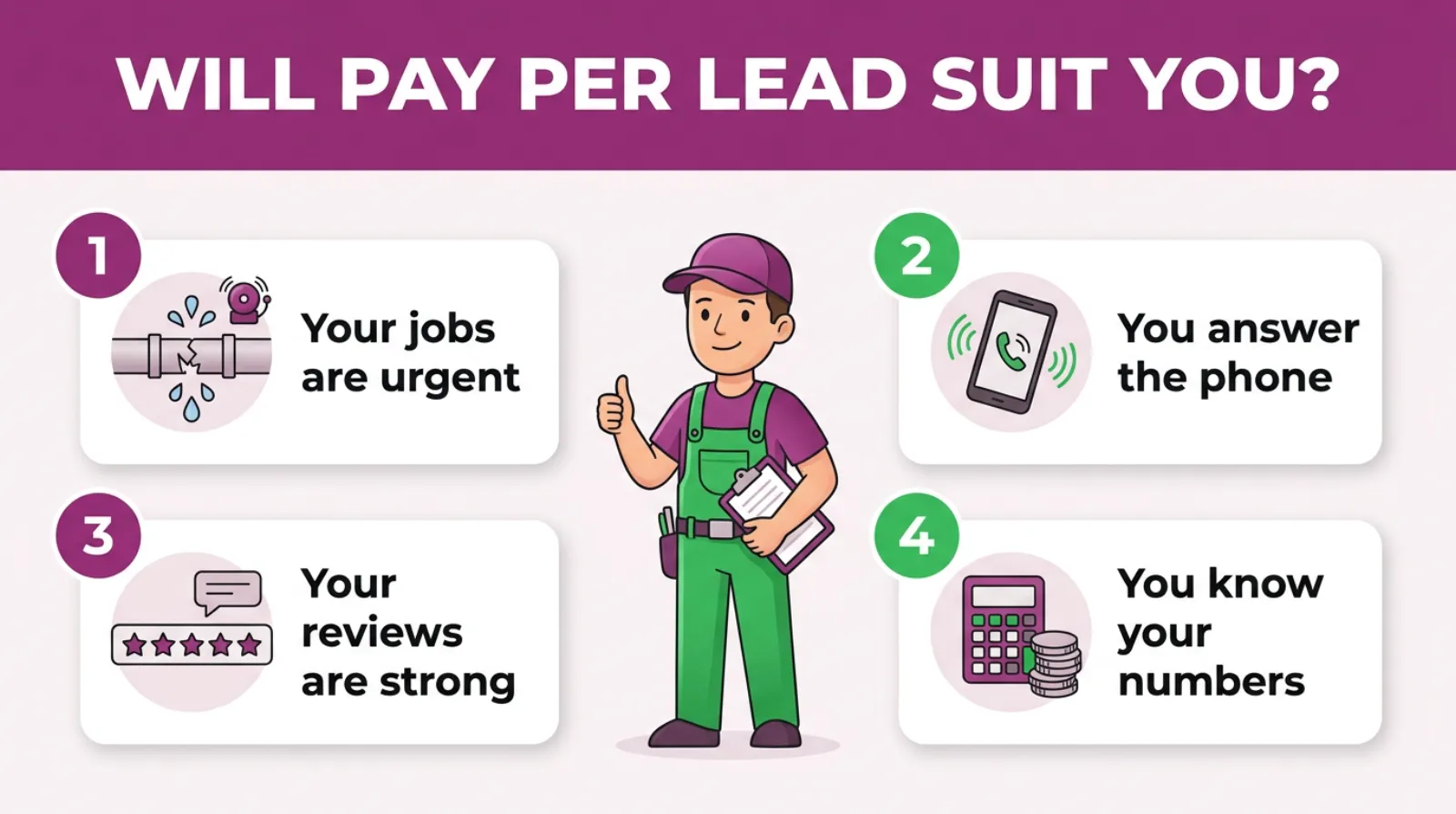
That single rule tells you who pay per lead suits. It suits businesses that answer the phone.
What You Get, And What You Give Up
Here is the honest list on both sides.
What You Get
- The top spot on the page, above the normal adverts.
- A badge showing Google has checked your business.
- Your review score shown to every searcher.
- No charge for people who only browse.
- Very little set-up, and very little weekly work.
What You Give Up
- Choice over which searches you show for.
- Your own wording. Google builds the advert from your profile.
- The visit to your website, where you could explain your prices and show your work.
- Fine control over where and when you appear.
- Detail in the reports. You see leads, not the searches behind them.
Neither list is a deal-breaker on its own. For an emergency plumber, the first list wins easily. For a kitchen fitter with a long sales process, the second list matters more.
What The Customer Sees
It helps to look at this from the other side of the screen.
Someone searches for an emergency electrician on their phone. Before any website appears, they see a short row of local businesses.
Each one shows a name, a star rating and the number of reviews. There's a badge, and a note saying whether the business is open now.
They do not see your prices, your van or your story. They see proof that others trusted you, and a button to call.
At that moment, your reviews and your opening hours are your whole advert. It's why two businesses can pay the same and get very different results.
If your rating is lower than the names beside you, fix that first. More budget will not make up for it.
It is worth doing this check once a month, and it takes two minutes. Search for your main service on your phone, as a customer would.
Note who shows above you, how many reviews they have and what their rating is. That is the gap you are closing. It costs nothing to look, and it tells you more than any report.
Pay Per Lead Compared With Trade Directories
Many trades already pay for leads through directory sites. So it's fair to ask how this differs.
With most directories, the same enquiry is sold to several firms at once. You pay for the lead, and then race three other businesses to the customer.
With Google's version, the customer chooses you from the list and contacts you directly. Nobody else is sent the same call. That makes each lead warmer. The customer may still ring the next name down if you don't answer.
The other difference is intent. Someone searching Google for a locksmith at midnight needs one now. Someone filling in a form on a directory may only be collecting prices.
Neither is right or wrong. But they aren't the same kind of lead, so do not compare them on price alone. Compare them on how many become paid jobs.
The Catch For UK Businesses
There's one line on Google's help page that every UK trade should read before spending a penny.
In some countries, Google reviews charged leads for up to 30 days. If a lead turns out to be poor quality, it puts a credit back on the account automatically.
Google's page says those lead credits aren't available for advertisers in EMEA. That is Europe, the Middle East and Africa, and it includes us.
Google still filters spam and duplicates before you're charged. You can still report a bad lead through the feedback form. But in the UK, you should not build your budget on the idea that bad leads will be refunded.
In the UK, treat every charged lead as money spent, and judge the channel on the leads that turn into jobs.
Several guides aimed at UK readers say disputed leads are credited. That may be how it works elsewhere. Check the status column in your own account, and trust that over any article, including this one.
Who Can Use It In The UK
Pay per lead is not open to every business. Google keeps a list of supported categories for each country.
In the UK, the list is mostly home-service trades. It includes plumbers, electricians, heating engineers, roofers, locksmiths, cleaners, pest control and painters and decorators, among others. A few professional services are supported in some areas.
The list changes, and it isn't the same in every postcode. The only reliable way to find out is to start the sign-up. You'll see whether your trade and area are accepted.
If your trade is not on the list, the decision is made for you. Pay per click remains your route, and a well-run campaign still works very well for local trades.
Getting Verified
Before your advert can show with the badge, Google checks your business. Expect to prove three things.
- That the business is properly registered.
- That you hold insurance suited to your trade.
- That you hold any licence or qualification your trade needs, such as Gas Safe registration for gas work.
You'll also need reviews. An advert with no reviews, sitting next to competitors with fifty, will not get many calls.
Google now shows a single badge called Google Verified. It replaced the older Google Guaranteed and Google Screened badges.
Verification is the main reason pay per lead feels different to a customer. A badge and a strong review score sit at the very top of the page. They do a lot of selling before the phone rings.
How Google Decides Who Shows First
With pay per click, you can often buy your way up the page. With pay per lead, the budget matters less than you would think.
Google looks at how close you are to the customer, how many reviews you have and how good they are, and how reliably you respond to leads. A business that answers quickly tends to be shown more often than one that lets calls ring out.
That creates a loop. Answer well, and you're shown more. Miss calls, and you pay for the missed ones and get shown less.
So the work that wins here is not advertising work at all. It's answering the phone, replying to messages the same hour and asking every happy customer for a review.
Pay Per Lead Or Pay Per Click, Which Is Better
Neither is better for everyone. They solve different problems, and the right choice comes down to the job.
When Pay Per Lead Wins
It wins for urgent, simple jobs. A burst pipe. A lockout. A boiler that won't fire. The customer wants someone now. They don't want to read a website. The first trusted name they see gets the call.
It also wins when you have strong reviews and someone always answers the phone.
When Pay Per Click Wins
It wins for considered, higher-value work. A new bathroom, a rewire, a loft conversion.
The customer wants to see your past work, read about how you do things and compare a few firms. Your website does that job, and pay per click is what sends people to it.
It also wins when you want to choose. You can pick the profitable jobs and block the searches you don't want. You can show in one town but not the next.
Why Most Trades Should Run Both
For most eligible trades, the answer is both. Pay per lead catches the urgent calls at the top of the page. Pay per click covers the services, areas and bigger jobs that pay per lead can't target.
Run them side by side, and count the jobs each one brings in, not the leads. That's the only fair comparison.
How To Work Out What A Lead Is Worth
You will find plenty of articles quoting a typical cost per lead for UK trades. The figures disagree with each other, and many are American numbers with a pound sign in front. I wouldn't plan around any of them.
Work it out from your own business instead. You need three numbers.
- What an average job is worth to you in profit, not turnover.
- How many leads out of ten become a paid job.
- How much of that profit you are willing to spend to win the job.
Multiply the first two, and you have what one lead is worth. If an average job makes you £200 and three leads in ten become jobs, a lead is worth £60 to you before you spend anything on winning it.
Now you have a ceiling. If leads cost well under that, the channel is working. If they cost more, it isn't, however busy the phone is.
Know your ceiling before Google tells you its price. Most trades do this the other way round. Then they can't tell whether they're winning.
Setting A Budget
With Local Services Ads you set a budget and Google spreads it across the month. Some weeks it spends more than your average, and some weeks less. It won't pass your monthly limit.
Google suggests a budget big enough for around ten leads a week. It says the system takes about two weeks to settle.
That is a sensible guide. A budget that buys two leads a week gives Google little to learn from. It gives you little to judge, too.
Start with an amount you could lose without it hurting. Run it for a full month. Then look at how many leads became paid jobs and what each job cost you in leads.
One more point on timing. Some trades are seasonal.
A heating engineer is busier in the first cold week of autumn than in July, and leads usually cost more when every competitor wants them at once. Judge the channel over a busy spell and a quiet one. A single month can mislead you.
If you cannot answer the phone for part of the week, set your opening hours to match. Calls outside those hours aren't charged, and you avoid paying for leads you were never going to pick up.
What To Do Before The Move In 2027
If you don't use pay per lead yet, there is no rush. But there are four things worth doing now, because they help whichever way you advertise.
- Build your reviews. They decide how often you're shown and how often you are chosen. 2. Get your documents in order. Insurance, registration and trade certificates, all in date and all in the business name. 3. Tidy your Google Business Profile. Same name, address and phone number everywhere. 4. Sort out how calls get answered. A second number, a call-answering service or a simple rule about who picks up.
If you already use Local Services Ads, add two more.
- Download your reports before your account moves, because the old performance figures won't come with you. 6. Check your bidding. Some manual options are being retired, so read the emails Google sends before the switch.
Five Mistakes That Waste A Pay-Per-Lead Budget
The same few problems come up again and again.
Not Answering The Phone
A missed call in opening hours can still be charged. This is the most expensive mistake by far.
Opening Hours That Are Too Generous
If your profile says you're open until 8pm and you stop answering at 5pm, you pay for three hours of missed calls. Every day.
Too Many Job Types Switched On
Google lets you tick the services you want leads for. Tick only the jobs you want. Leave the low-value ones off.
A Service Area That Is Too Wide
A lead forty minutes away costs the same as one round the corner. It is far less likely to become a job.
Counting Leads, Not Jobs
Twenty leads that produce two jobs are worse than eight leads that produce four. Keep a simple list of which leads you won.
How To Judge It After A Month
A month in, sit down with your lead list and answer four questions.
- How many leads did you pay for?
- How many did you actually speak to?
- How many became paid jobs?
- What did those jobs earn you in profit?
Divide what you spent by the number of jobs won. That is your real cost per job, and it's the only number that matters.
Then look at the leads you didn't speak to. If a third of your charged leads were missed calls, the problem is not Google's price. It's how the phone gets answered, and that is much cheaper to fix.
Look also at what the leads asked for. Did most want a job you don't enjoy or don't make money on? Switch that job type off, and run another month.
Give it two full months before you decide. One month is too short. The system is still learning who to show you to.
Where An Agency Helps, And Where It Does Not
It would be easy for me to say every trade needs an agency to run this. That would not be true.
Pay per lead is simple enough that most owners can set it up and run it themselves. The work is answering quickly, collecting reviews and keeping the profile accurate. Nobody can do that better than you.
Where help is worth paying for is the other half. Running pay per click well takes skill: choosing searches, blocking the wrong ones, writing adverts and building pages that turn visitors into enquiries. It also takes someone to measure both channels fairly, so you know which jobs came from where.
So if you only plan to run pay per lead, try it yourself first. Planning to run both, or spending a serious amount each month? That's when a specialist earns their fee.
A Worked Example
Here is a made-up example to show the thinking. Picture a heating engineer working alone, covering a few towns around a small city.
Most of the work is boiler repairs and annual services. Now and then there's a full boiler replacement, which is worth far more.
The engineer answers the phone between jobs, but not during them. So the first step is honest opening hours, and a call-answering service for the times in between.
For repairs, pay per lead is a good fit. The customer has no heating and wants a trusted name fast. The badge and the reviews do the selling.
For boiler replacements, pay per click fits better. The customer will compare quotes over a week or two. A page showing recent installations, brands fitted and how the quote works does much more than a phone number.
After two months, the engineer compares jobs won from each. Repairs come mostly from pay per lead. Replacements come mostly from pay per click. Both stay switched on, each doing the job it's suited to.
The two ways of paying were never rivals. They were two tools for two kinds of job.
Frequently asked questions
What are Google Local Services Ads?
They are adverts shown at the very top of Google for local service businesses, with a badge and your review score. Customers call or message you directly from the advert, and you pay for each lead, not for each click.
How much do Google Local Services Ads cost in the UK?
There's no fixed price. The cost of a lead depends on your trade, your area and how many competitors want the same customers. Work out what a lead is worth to you first, then judge Google's price against that.
Can I get a refund for a bad lead in the UK?
Google's help page says lead credits are not available for advertisers in EMEA, which includes the UK. Spam and duplicates are filtered before you're charged. You can report poor leads, but don't rely on getting money back.
Is pay per lead better than pay per click?
Not for everyone. Pay per lead suits urgent, simple jobs where someone always answers the phone. Pay per click suits bigger, considered jobs, and gives you control over searches, areas and the page people land on.
Do I need a website for Local Services Ads?
No. Customers contact you straight from the advert. A good website still matters for bigger jobs, where people want to see your work before they call.
When do Local Services Ads move into Google Ads in the UK?
Google has said accounts outside the United States are due to move in 2027. The dates are windows, so watch for Google's emails, and download your old reports before your account moves.
Keep Reading
These five pick up where this guide stops.
- Your Conversions Went Up And Your Diary Did Not
- Negative Keywords Are The One Google Ads Job Google Will Not Do For You
- Your Ad Budget Isn't Too Small. Your Map Is Too Big
- 5 Google Business Profile Tweaks That Push You Into the Local Map Pack
- How To Lower Your Google Ads Costs Without Sacrificing Results
The first explains why a lead is not the same as a customer. The second and last are for the pay-per-click side. The middle two help with the local basics that decide how often you're shown.
Pay For What You Can Answer
Paying per lead sounds like the obvious choice. You only pay when someone gets in touch.
But it only works if you can answer, if your reviews are strong and if you know what a lead is worth to you. Without those three, you pay for a full phone log. The diary stays empty.
Start with the numbers. Work out your ceiling. Fix how calls get answered. Then test pay per lead next to pay per click for a month or two. Let the jobs won decide.
We look after Google Ads for trades and service businesses across the UK. Our office is on Grovebury Road in Leighton Buzzard. Want a straight answer on which way of paying suits your business? Get in touch. We'll look at your numbers with you.

Written by Uzair Kharawala
Partner at SF Digital Studios, a Google Premier Partner agency. Uzair has been helping businesses grow with Google Ads since 2002 and teaches it every week on YouTube.
Get our best Google Ads tips by email
New articles and videos, straight to your inbox. Unsubscribe any time.