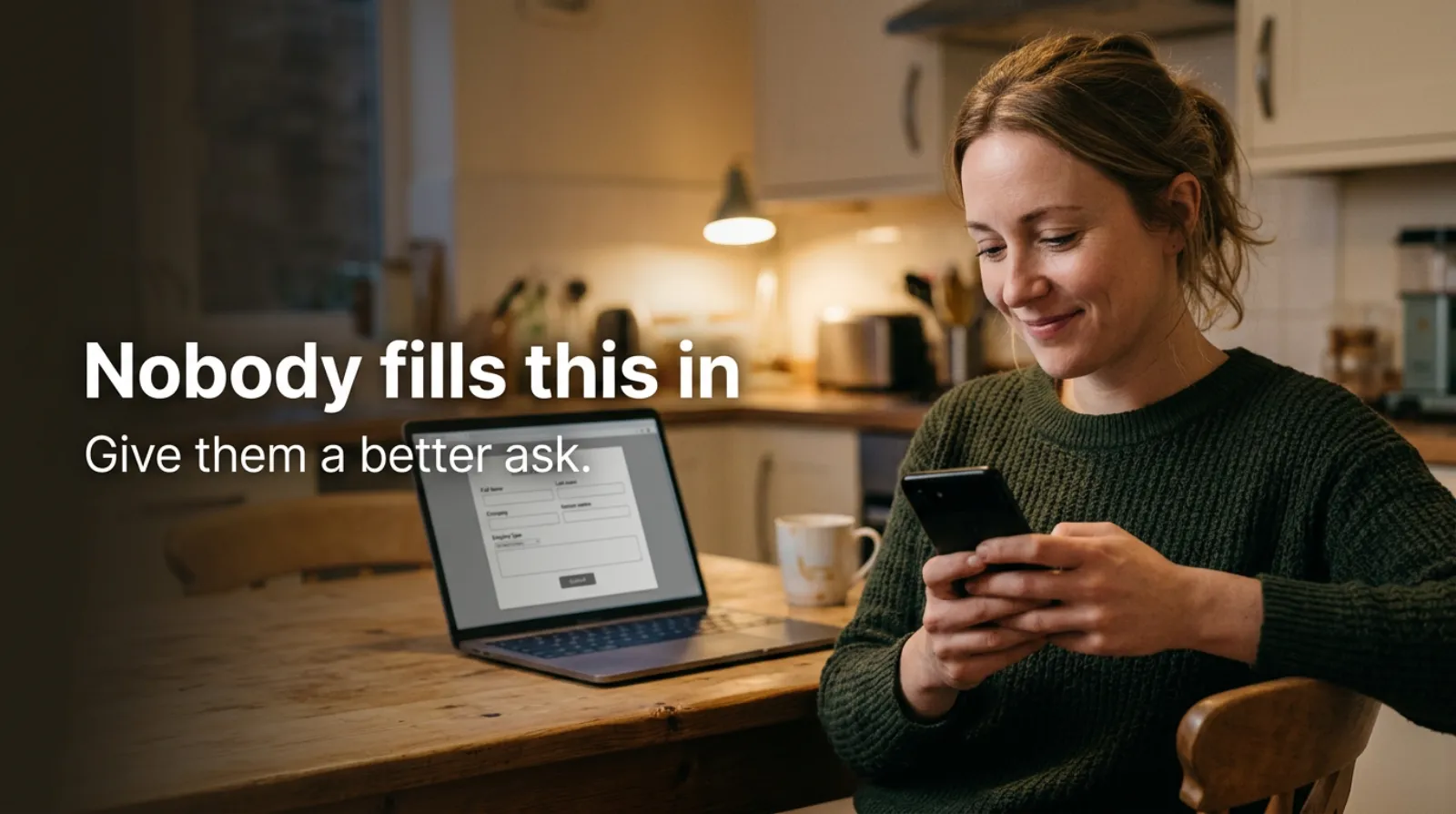
Your contact page is probably the best-mannered part of your website. It smiles, offers a form, and promises someone will be in touch. And almost everyone who sees it leaves without typing a word.
The numbers are stark. Generic contact forms convert at around 1-3%, the lowest of any form type on the web, according to benchmarks from Digital Applied. Meanwhile, a simple downloadable checklist converts at around 23%, and quote request forms sit at 5-10%.
Same visitors. Same website. The only difference is the ask.
Get your free Marketing Action PlanNot sure where to start? Answer a few questions and get your plan in about a minute. No email needed.
Get my plan →“Contact us” is not really an offer. It is a request for the visitor to do the selling. They must decide what to say, guess what happens next, and hope the reply is not a pushy sales call. Most people, faced with that homework, close the tab.
The fix is not a prettier form. It is a better ask. This article walks through the specific asks people actually complete, and the rules that make any of them work.
Why Visitors Avoid Contact Forms
A contact form fails for one core reason: it asks for effort and offers nothing specific in return. The visitor cannot see the outcome, the timeline, or the consequence of pressing send. Uncertainty kills action.
Put yourself behind their screen for a moment. Filling in “Contact Us” means writing a message to a stranger with no agenda. Will the reply take an hour or a week? Will it answer the question or start a sales pitch? Will the inbox just swallow it?
None of those questions has visible answers on a generic contact page. So the visitor does the sensible thing. They leave, and they try the competitor who offered something clearer.
There is a second, quieter problem. “Contact us” attracts the wrong completions. Because the ask is vague, it collects support queries, sales pitches and spam, the exact junk-lead problem that makes conversion counts lie.
The Asks People Actually Complete
Every strong ask does the same three jobs: it names a concrete outcome, it shows the next step, and it lowers the fear of pressing send. Here is the menu, roughly in order of commitment.
The quote with a deadline
“Request a quote” is fine. “Get your quote within 24 hours” is better, because it answers the timeline question before it is asked. Quote forms convert at 5-10%, several times the generic contact rate, because the visitor knows exactly what they are getting.
If you can, show the quote process in three steps right beside the form. People complete journeys they can see the end of.
The instant calculator
A cost calculator or instant estimate tool is the strongest ask for price-driven services. It gives value immediately, before asking for anything. The visitor plays with numbers, gets a realistic range, and hands over their details to receive the detailed version.
It also quietly qualifies. Someone who has seen a realistic range and still enquires is a serious buyer.
The genuinely useful freebie
Lead magnet downloads convert at around 23% when they solve a specific problem. The keyword is specific. A one-page “what to check before hiring a roofer” checklist beats a 50-page industry report, because it promises five minutes of value, not homework.
Match the freebie to the job you want. A buyer downloading “10 questions to ask your accountant” is telling you exactly where they are in their decision.
The WhatsApp button
This is the fastest-growing ask, and the numbers explain why. Across 22 markets, 73.3% of consumers prefer messaging a business over any other channel, according to WhatsApp’s own business messaging research. And 72.4% say they are more likely to buy from a business they can message.
A message feels smaller than a form. No fields, no formality, no sales call to dodge. The conversation starts on the buyer’s terms, which is exactly why they start it.
The bookable slot
For quoted and consultative work, “book a free 15-minute call” beats “get in touch” comprehensively. The visitor picks a time, gets a calendar invite, and stops shopping around. The uncertainty that kills contact forms is gone: they know precisely what happens next and when.
The Rules That Make Any Ask Convert
The menu matters less than the mechanics. Whichever asks you choose, four rules do the heavy lifting.
Name the outcome, not the action. “Get your drainage survey quote” beats “Submit enquiry”. The button should describe what the visitor receives, not what the form does.
Say what happens next. One line under the button: “We’ll reply within 2 working hours with your quote.” That sentence removes the fear doing most of the damage. Then honour it, because the reply speed is the promise.
Match the message all the way through. If the ad said free audit, the page must explain the audit and the button must say “Request your free audit”. Message match produces a 1.5 to 2x conversion lift over generic pages in the Digital Applied benchmarks. Sending paid clicks to a generic contact page burns money at both ends.
Ask for less, but ask one smart thing. Name, contact details, one qualifying question such as postcode or timeframe. Fewer fields lift completion, and the one sharp question keeps the junk out, so the extra enquiries are worth having.
Keep the Contact Page. Demote It.
None of this means deleting your contact page. Existing customers need it, suppliers need it, and its absence looks odd. The mistake is treating it as your main way in.
Think of your website as a shop. The contact page is the customer service desk at the back. Necessary, but nobody walks in because of it. The specific asks are the window display and the friendly person at the door.
Audit your site with that lens. If “Contact Us” is the primary button on your homepage, your ads and your service pages, you are pointing every visitor at the service desk.
Questions Owners Ask About Calls to Action
Why does nobody fill in my contact form?
Because the ask is vague and the outcome is invisible. Visitors cannot see what they will get, when they will get it, or whether a sales call follows. Generic contact forms convert at 1-3%, the lowest of any form type. Specific asks with visible outcomes convert several times higher.
What should I use instead of a “contact us” page?
Lead with one specific ask per page: a quote with a stated turnaround, an instant estimate calculator, a genuinely useful checklist, a WhatsApp button, or a bookable 15-minute call. Keep the contact page for existing customers and suppliers, but stop making it your primary call to action.
How many fields should a contact form have?
Three is the sweet spot for most service businesses: name, one contact detail, and one qualifying question such as postcode or timeframe. Every extra field cuts completion, while the single qualifying question filters time-wasters without deterring real buyers.
Does WhatsApp work for business enquiries in the UK?
Yes, and increasingly it is expected. Research across 22 markets found 73.3% of consumers prefer messaging businesses, and 72.4% are more likely to buy from businesses they can message. A WhatsApp button suits buyers who want answers without forms or phone calls.
What makes a good call to action?
Three things: a named outcome, a visible next step, and low fear. “Get your quote within 24 hours, no site visit needed” does all three. “Submit” does none of them. Write the button text as the thing the visitor receives.
How do I test which call to action works best?
Change one ask at a time and give each a month. Track completions, but also track quality: how many became quotes and jobs. A calculator that doubles enquiries but halves quality is not a win. The best ask produces the most booked work per hundred visitors, not the most form fills.
Give Them a Better Yes
Your visitors are not lazy, and they are not uninterested. They are standing in front of a door marked “knock and see what happens”, and they would rather use the door marked “quote in 24 hours” next door.
Every page on your site should offer one specific, low-fear, outcome-shaped yes. Build that, honour the promise behind it, and the enquiries arrive warmer, better qualified and in far greater numbers.
At SF Digital, we design the whole path, from the ad to the ask to the reply, so paid clicks land on pages that convert instead of contact pages that apologise. If your main button still says “Contact Us”, start there.

Written by Uzair Kharawala
Partner at SF Digital Studios, a Google Premier Partner agency. Uzair has been helping businesses grow with Google Ads since 2002 and teaches it every week on YouTube.
Get our best Google Ads tips by email
New articles and videos, straight to your inbox. Unsubscribe any time.