
You looked at a new sofa once. For the next three weeks, that sofa followed you around the internet. You did not buy it.
That's remarketing done badly. Done well, it is the gentle reminder that brings a nearly-customer back to finish the job.

Get Found, Get Chosen, Get Your Time Back
A free one-day marketing seminar in Milton Keynes · 13 January 2027
So what does remarketing cost a small business, and how do you tell good spend from wasted spend? This guide covers the costs, the settings that stop waste and the clear signs it is time to stop.
Get your free Marketing Action PlanNot sure where to start? Answer a few questions and get your plan in about a minute. No email needed.
Get my plan →A quick note first. SF Digital runs Google Ads for local businesses, remarketing included. We have kept to Google's own published rules and labelled our own views clearly.
How Much Does Remarketing Cost A Small Business?
For most local businesses, a remarketing test costs around £5 to £10 a day. Display clicks are cheap, often well under £1, but the real cost is what you pay per enquiry. Small lists also cap how much you can usefully spend before the same people see you too often.
That daily figure is our working range for local firms, not an industry statistic. It's enough to reach a small list without bombarding it.
For context on click prices, Whito's UK pricing guide, updated July 2026, puts the average display click at about £0.48. It calls the figure indicative, and so do we.
The click price is not the cost that matters. A cheap click from someone who'll never buy is still wasted money.
What Is Remarketing, In Plain English?
Remarketing shows your ads to people who have already visited your website or interacted with your business. You're reminding people who know you, rather than introducing yourself to strangers.
Someone looks at your bathroom fitting page and leaves. Over the next few days, they see your advert while reading the news, watching YouTube or searching on Google.
They already know your name. The ad nudges them back. Simple.
That is why remarketing often works better than reaching new people. It is also why it can waste money quickly if it's set up carelessly.
You will hear it called retargeting too. For a small business, the two words mean the same thing.
How Does Remarketing Work In Google Ads?
You add Google's tag to your website, which builds lists of people who visit. Google calls these your data segments. Once a list is big enough, you can show display, YouTube or search ads to the people on it.
As of October 2026, Google's help page sets a minimum size. A list needs at least 100 active visitors or users in the last 30 days to serve on the Display Network, the Search Network or YouTube.
So a site with very little traffic may not qualify yet. That's useful to know before you plan a campaign.
You can build different lists for different behaviour. All visitors, visitors to a service page, people who started a form but did not finish, and people who did convert.
The last list matters most. It is the one you will use to stop showing ads to people who have already bought.
Why Can Remarketing Be Money Down The Drain?
Remarketing wastes money when it shows ads to people who have already bought, people outside your area, people who bounced in seconds, or the same people far too often. Long, stale lists and missing conversion tracking make it worse.
Here are the leaks we see most often in small accounts. Check yours against them.
Showing ads to customers. If people who've already booked stay on the list, you pay to remind them of something they've done.
The wrong area. Visitors from far outside your service area still join the list unless you limit the campaign's location.
Accidental visitors. Someone who landed for two seconds by mistake is not a warm prospect.
Too many views. Seeing the same ad twenty times a day turns a reminder into an irritation.
Old lists. Someone who looked at your site a year ago has probably moved on.
No tracking. Without conversion tracking, you cannot tell whether any of it worked.
Every one of these can be fixed with settings. None of them needs a bigger budget.
Where Remarketing Money Leaks
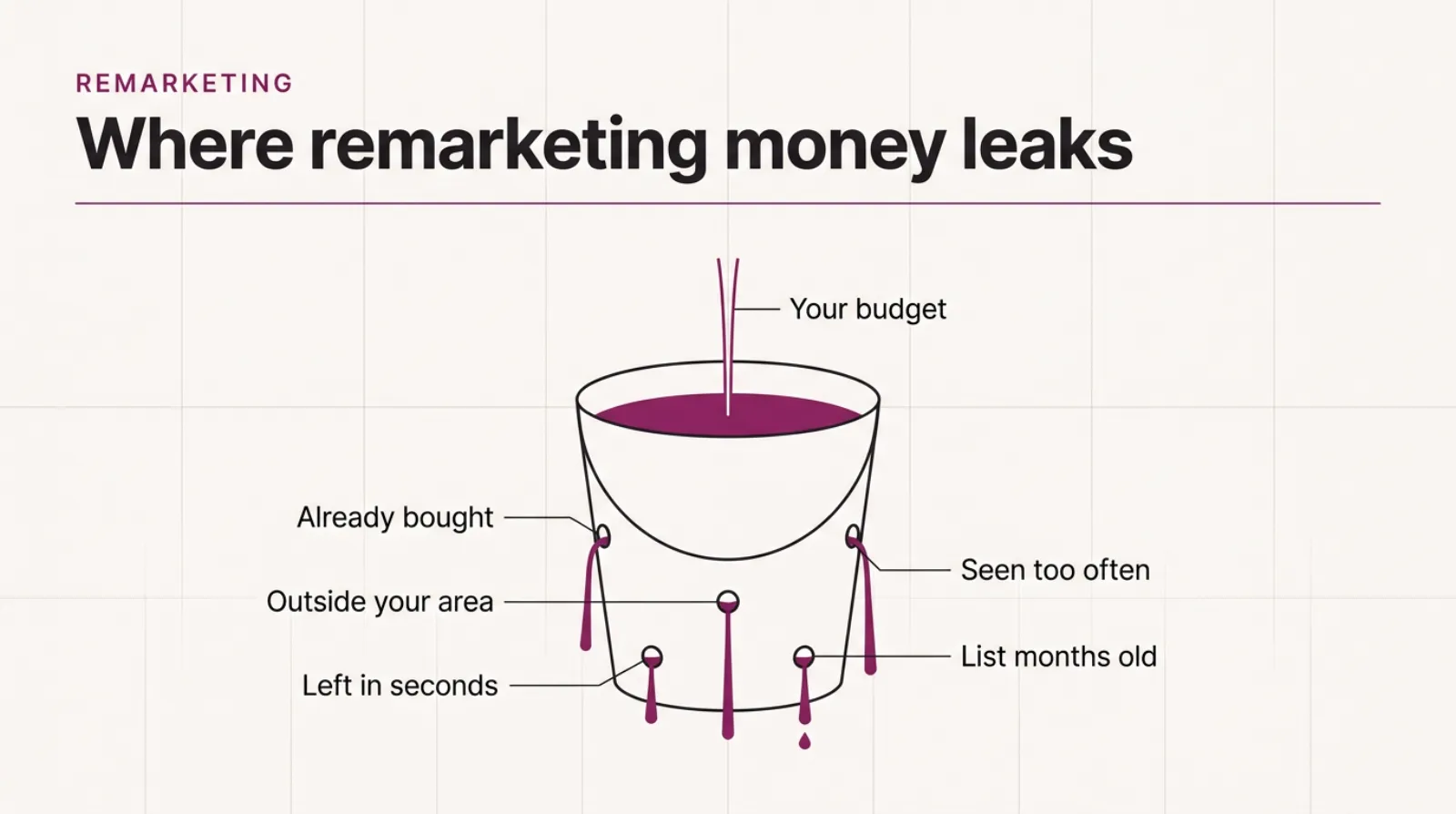
A leaky bucket showing where remarketing budget leaks away for a small business: ads shown to people who already bought, to people outside the service area, to visitors who left in seconds, to the same people too often and to people from lists that are months old.
When Is Remarketing Worth The Money?
Remarketing is worth the money when people take time to decide, the job is worth a lot, or visitors often leave before getting in touch. It suits kitchens, extensions, solar panels, wedding venues, private healthcare where allowed, and any service people compare carefully.
Here's when we'd expect it to earn its keep. Most local firms fit at least one.
High-value jobs. If one job is worth thousands, a small daily spend reminding interested people is easy to justify.
Long decisions. People researching for weeks forget who they looked at. Remarketing keeps your name in front of them.
Quotes that go quiet. People who requested a quote but did not book can be reminded gently.
Forms left unfinished. Someone who started your contact form showed real intent. A reminder can bring them back.
Seasonal peaks. A heating engineer in the first cold snap can remind recent visitors before they call someone else.
Search remarketing. You can also use your lists on Google search, bidding more when a past visitor searches again. This often brings the strongest results, because the person is both familiar and actively looking.
A Remarketing Test, Week By Week
How Does Remarketing Work On Google Search?
On search, your remarketing lists tell Google that a searcher has visited your site before. You can show these people different ads, or let Google's automated bidding treat them as more likely to convert. It reaches past visitors at the moment they're actively searching again.
There are two common ways to use lists on search. Both are worth knowing.
As an observation. You add the list to your search campaign without narrowing it. You keep reaching everyone, and Google reports how past visitors behave compared with new ones.
As a target. You run a separate campaign shown only to past visitors. This suits broader keywords you'd never bid on for strangers, because the visitor already knows you.
One technical note matters here. If your campaign uses Smart Bidding, such as Maximise Conversions, manual percentage bid adjustments for audiences are ignored. Google's system already uses the audience signal itself.
Search remarketing often beats display remarketing for local firms. The person is familiar with you and looking for help right now.
What Does Remarketing Cost On Each Platform?
There is no single price, because each platform runs its own auction. Display remarketing usually has the cheapest clicks, search remarketing the most valuable ones, and YouTube and Meta sit in between, depending on your audience and goals.
Here is how the main options compare for a typical local business. This is our general view, not published pricing.
| Google display | Google search | YouTube | Facebook and Instagram | |
|---|---|---|---|---|
| Where ads show | Websites and apps | Google search results | Before and during videos | Facebook and Instagram feeds |
| Typical click cost | Lowest | Highest | Low to medium | Low to medium |
| How ready people are | Browsing | Actively searching | Watching | Scrolling |
| Best use | Gentle reminders | Winning repeat searches | Showing your work on video | Social reminders with photos |
| Main risk | Too many views, app placements | Small lists, slow to fill | Needs a decent video | Separate tracking needed |
Search remarketing is the one most small businesses miss. It reaches past visitors at the exact moment they search again.
Should You Use Remarketing On Facebook And Instagram Too?
You can, and many local businesses do. Meta lets you build audiences from your website visitors and show them ads in Facebook and Instagram feeds. It's a separate setup with its own tracking, so treat it as a separate test with its own budget.
Social remarketing suits businesses with strong photos. Pictures do the work. Kitchens, gardens, salons and restaurants often do well, because a good image stops the scroll.
It is less useful for businesses whose customers rarely use those apps, or whose work doesn't photograph well.
Don't run both at full speed on day one. Start with one platform, learn what it costs per enquiry, then add the second if it makes sense.
What Is Dynamic Remarketing, And Do You Need It?
Dynamic remarketing shows people the exact products they looked at, pulled from a product feed. It's mainly for online shops. Most local service businesses don't need it, because they don't have a catalogue of products to show.
If you sell products online, it can work very well. It is powerful for shops. Someone who looked at a particular lamp sees that lamp again, with its price.
If you sell services, standard remarketing with a few strong ads is usually enough. You can still tailor ads by building separate lists for each service page.
Separate lists by service are the local business version of dynamic remarketing. Someone who looked at bathrooms sees a bathroom ad, not a generic one.
How Big Does Your Audience Need To Be?
Your list needs at least 100 active visitors or users in the last 30 days before Google will show ads to it on Display, Search or YouTube, according to Google's help page in October 2026. In practice, bigger lists give the campaign more room to work.
If your site gets a few hundred visitors a month, you will qualify. But the campaign will be small, and that's fine.
If your site gets fewer visitors than that, remarketing will struggle. Spend on search ads first to bring people to the site, then add remarketing later.
Check your list sizes before you build a campaign. Google Ads shows the size of each list in the audience manager.
How Do You Stop Remarketing To People Who Already Bought?
Build a list of people who converted, such as those who reached your thank-you page or booked online, and exclude it from your remarketing campaigns. That stops you paying to chase people who have already said yes.
This is the single most common waste we see. By far. It is also one of the easiest to fix.
Here's how it usually works. It takes minutes.
- Make sure your thank-you page or booking confirmation has its own address.
- Create a list of visitors to that page.
- Exclude that list from every remarketing campaign.
Check it every few months. If your website changes, the thank-you page can change too, and the exclusion quietly stops working.
How Often Should People See Your Ads?
A few times a day at most. On a small list, three or four views per person per day is plenty. Display campaigns let you set a frequency cap, and it is one of the most useful settings for a small business.
Without a cap, a small list can see your ads again and again. That costs money and annoys the very people you are trying to win.
Think about how you'd feel as the customer. Be honest. A reminder is helpful. Being followed is not.
Set the cap before the campaign starts. It is much easier than calming down a customer who feels hounded.
How Long Should People Stay On Your List?
For most local services, 30 to 90 days is a sensible window. Keep it shorter for quick decisions, like an emergency repair, and longer for big projects, like an extension or a wedding.
You choose the duration when you create each list. Match it to how long your customers usually take to decide.
A plumber's customer decides in hours. Speed is everything. A kitchen customer might take months.
 LIVE
Live every Tuesday at 2pm UK. Bring your marketing questions.
Get your Google, local SEO and AI questions answered live.
Shorter lists stay warmer. The longer someone's been on a list, the less likely they are to remember you.
How Does Remarketing Fit With Performance Max?
Performance Max can use your remarketing lists as signals to help it find people likely to convert. It decides where to show ads across Google's channels, so it can reach past visitors and new people in the same campaign.
That can work well with good conversion tracking. But it makes it harder to see how much of the result came from remarketing alone.
If you want a clear read on what remarketing costs, a separate, simple remarketing campaign is easier to judge. You can always fold it into Performance Max later.
Clarity is worth a lot on a small budget. Knowing exactly what each pound did helps you decide where the next pound goes.
Can You Remarket To People Who Called But Didn't Book?
Sometimes. Google's Customer Match lets you upload a list of customer email addresses or phone numbers, with consent, and show ads to those people. It's useful for reminding past enquirers or bringing back old customers.
The rules matter here. Follow them carefully. You need people's permission to use their details this way, and Google has its own Customer Match policy and account requirements.
Uploaded lists also need enough matched users to serve, just like website lists.
For most small businesses, a simpler first step is a follow-up call or email. It's personal, free and often more effective than an ad.
Use Customer Match for scale, not as a replacement for picking up the phone. A friendly follow-up wins more quotes than any advert.
Which Businesses Can't Use Remarketing?
Businesses in sensitive categories cannot use remarketing lists in Google Ads. Google's personalised advertising policy says advertisers promoting products in sensitive interest categories are unable to use advertiser-curated audiences, which include your data segments.
Google's policy page, checked in October 2026, lists categories such as health, gambling, alcohol, birth control, clinical trial recruitment and negative financial status, among others.
So a clinic treating a medical condition, a debt advice service or a gambling business cannot follow visitors around with personalised ads. That is to protect people's privacy.
If you're in one of these areas, check the policy before planning a campaign. Search ads and broader targeting are often still available.
Is Remarketing Creepy, And What About Cookie Consent?
Remarketing only feels creepy when it's overdone or too specific. Keep the frequency low, the message helpful and the list short. In the UK, your cookie banner also matters, because people who decline advertising cookies may not join your remarketing lists.
That's one reason UK list sizes can look smaller than your visitor numbers. It's normal. Not everyone who visits is added.
It's also a reason to make sure your cookie banner works properly and asks clearly. A broken banner can stop lists building at all.
Respect wins customers. A gentle reminder from a local business feels like good service. Being followed everywhere feels like the opposite.
How Do You Know If Remarketing Is Working?
Remarketing is working when it brings tracked enquiries at a cost per enquiry you are happy with. Impressions and clicks alone do not tell you that, and view-through conversions need careful reading.
Start with conversions that people completed after clicking a remarketing ad. That is the strongest evidence.
Google also reports view-through conversions. These count people who saw an ad, did not click and converted later. Some were helped by the ad. Many would have called anyway.
So treat view-through numbers as a hint, not proof. Clicks tell you more.
Compare cost per enquiry with your other campaigns. If remarketing costs double what search costs per enquiry, it's not pulling its weight.
How Long Before Remarketing Shows Results?
You'll usually see early signs within two to three weeks, once your lists have filled and the campaign has had time to run. A fair verdict takes four to six weeks, because remarketing reaches people who are still deciding.
Lists need time to build first. If your site gets a few hundred visitors a month, it can take a couple of weeks for lists to reach a useful size.
Then the campaign needs time to show ads and for people to come back. Someone who looked at your kitchen page might not return for another fortnight.
Don't judge it in week one. Early numbers swing around and rarely tell you much.
Set a review date before you start. That keeps you from switching off too soon, or leaving a poor campaign running for months.
When Should You Switch Remarketing Off?
Switch remarketing off when it has not brought tracked enquiries after four to six weeks, when your lists are too small to serve properly, or when your search campaigns are short of budget. Any one of those is enough.
No enquiries after a fair test. If tracking works and remarketing has brought nothing, more time rarely fixes it.
Lists too small. If your lists keep dropping below the minimum, the campaign cannot run properly. Grow your traffic first.
Search is limited by budget. People searching for you now usually matter more than people who visited last month.
You are paying mostly for view-throughs. If the campaign only ever claims credit for people who never clicked, look hard at whether it is really helping.
Switching off is not failure. It's moving money to where it works harder, and you can switch back on when your site has more visitors.
What Should Your Landing Page Do For Returning Visitors?
It should make the next step easy. Returning visitors already know who you are, so skip the long introduction. Lead with the offer, the proof and a clear way to get in touch.
A page built for first-time visitors often explains everything from scratch. That's helpful the first time, but returning visitors want to act.
So send remarketing clicks to a page that opens with what they came back for. A booking form, a quote request or a phone number they can tap straight away.
Match the page to the ad. If the ad mentions a free survey, the page should open with the free survey.
What Remarketing Mistakes Cost The Most?
The costliest remarketing mistakes are forgetting to exclude customers, leaving lists open for months, skipping the frequency cap and running remarketing before the site has enough visitors. Each one quietly drains a small budget.
Here's the full list we check in small accounts.
- No exclusion for people who already converted.
- Lists left at long durations for quick-decision services.
- No frequency cap on display remarketing.
- Location left open, so distant visitors see your ads.
- One generic ad shown to every visitor, whatever they looked at.
- Judging the campaign on view-through conversions alone.
- Starting remarketing before the site gets steady traffic.
Fix the first three this week. They're quick settings, and together they stop most of the waste.
What Should A Remarketing Ad Say?
A remarketing ad should speak to someone who already knows you. Remind them what they looked at, give them a reason to come back now and make the next step easy.
Here's what tends to work for local firms. Keep it human.
Mention what they viewed. "Still thinking about that new boiler?" works because it is relevant.
Give a reason to act. A booking slot this week, a free survey or a seasonal check.
Show proof. A short review quote or a photo of a finished job builds trust.
Keep it simple. One message, one button, one landing page that matches the ad.
Avoid ads that feel like they know too much. Gentle and helpful works better than pushy.
A Worked Example: One Kitchen Showroom, Six Weeks
Picture a kitchen showroom in Luton. The business and the figures here are illustrative, not a real client.
The showroom gets around 1,500 website visitors a month. Most look at kitchen styles and leave without booking a design visit.
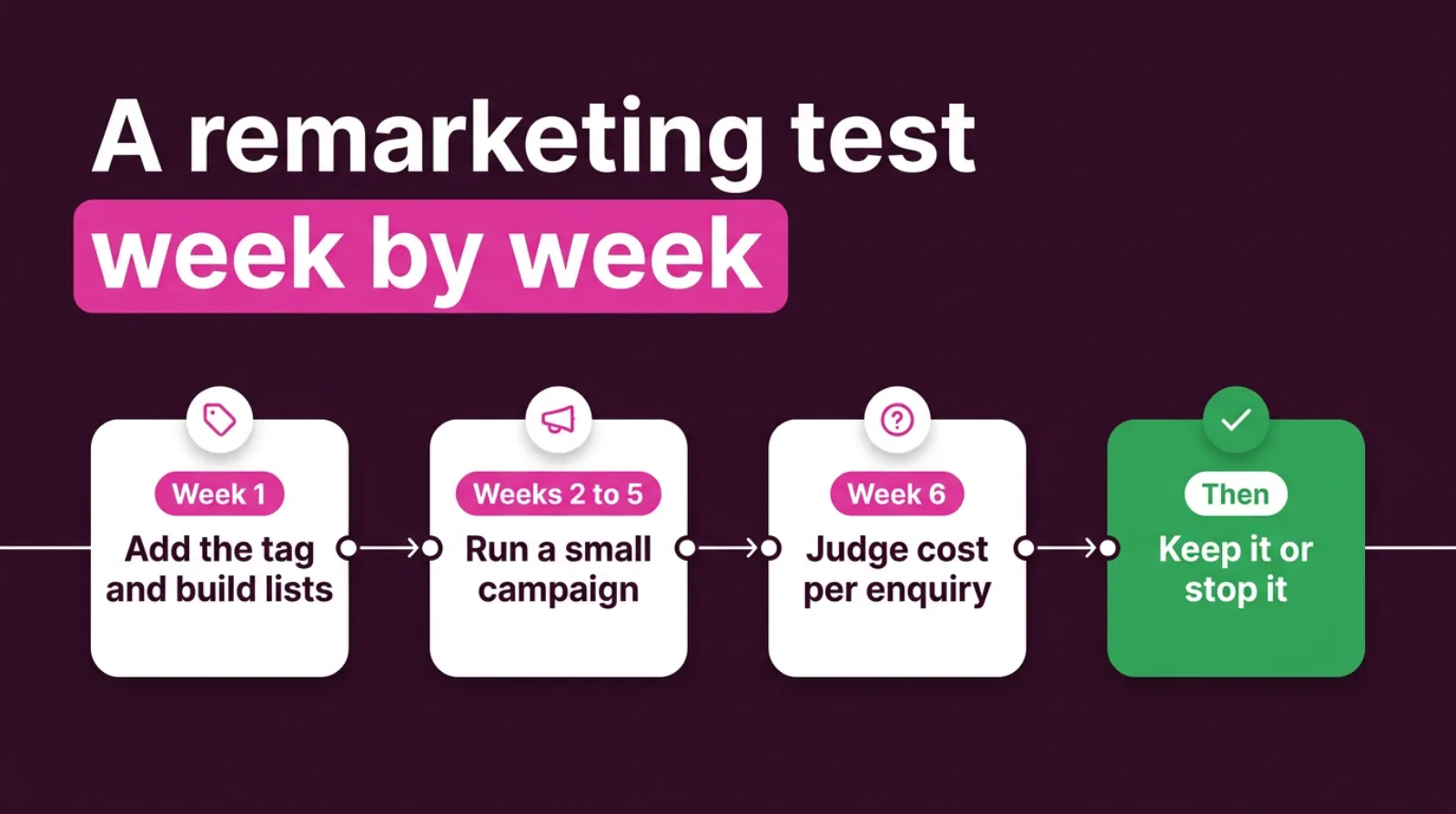
In week one, they add Google's tag, build lists for all visitors, kitchen page visitors and people who booked a visit, and set the location to their real service area.
In weeks two to five, they run a small display remarketing campaign at £8 a day, excluding people who have already booked. They cap views at three a day and use photos of real kitchens they've fitted.
They also add their lists to their search campaigns, so past visitors who search again see a stronger bid.
In week six, they compare costs. The display remarketing brings a few design visits. The search remarketing brings more, at a lower cost per enquiry.
So they keep both, but move most of the remarketing budget into search. It is a small change that makes every pound work harder.
The best part was the exclusion. Before the test, nobody had stopped ads chasing customers who'd already booked.
That one setting stopped a slice of the budget going on people who'd already said yes. It cost nothing to fix, and it made every other number in the test more honest.
Frequently asked questions
How much should I spend on remarketing?
For a local business, £5 to £10 a day is usually enough for a first test. Small lists can't use much more without showing the same people the same ad too often.
How many visitors do I need for remarketing?
Google's help page, checked in October 2026, says a list needs at least 100 active visitors or users in the last 30 days to serve on Display, Search or YouTube. More visitors give the campaign more room to work.
Is remarketing worth it for small businesses?
It can be, especially for high-value jobs and services people take time to decide on. Judge it on cost per enquiry after four to six weeks, and switch it off if it does not compete with your other campaigns.
Why am I seeing remarketing ads after I have bought something?
The business probably hasn't excluded people who completed a purchase or booking. It is a common setting to miss, and fixing it saves money.
Can every business use remarketing?
No. Google's policy stops advertisers in sensitive categories, such as health, gambling and alcohol, from using remarketing lists. Check the personalised advertising policy before planning a campaign.
What is the difference between remarketing and retargeting?
For most small businesses, there is no practical difference. Both mean showing ads to people who've already visited your website or interacted with your business.
Keep Reading
These posts go deeper on remarketing and getting more from your ad spend.
- Do Google Ads Remarketing Campaigns Work For Local Businesses?
- Google Ads Retargeting 101: Bring Back Lost Customers
- Where Half Your Display Budget Quietly Goes
- The £10 A Day Google Ads Brand Campaign Every Local Business Should Run
- Clicks Came In, Customers Did Not: Where A Google Ads Account Actually Breaks
We picked these because each one covers a next step: whether remarketing suits you, setting it up, cleaning display spend, brand search and tracking.
Sources
The Google rules in this post come from Google's own help and policy pages, which we checked on 25-10-2026. Rules change, so check them before you plan a campaign.
So, Should You Run Remarketing This Month?
Start with your traffic. Do you get enough visitors to build a list of at least 100 active people a month? If not, spend on search first.
If you do, set up the tag, build your lists and exclude people who have already bought. Cap the views, limit the area and keep the budget small.
Give it four to six weeks and judge it on enquiries, not clicks. Keep what works and switch off what does not.
And if you'd like a second pair of eyes on your remarketing, book a call. We will check your lists, exclusions and settings with you and tell you straight whether it's earning its keep.

Written by Uzair Kharawala
Partner at SF Digital Studios, a Google Premier Partner agency. Uzair has been helping businesses grow with Google Ads since 2002 and teaches it every week on YouTube.
Get our best Google Ads tips by email
New articles and videos, straight to your inbox. Unsubscribe any time.