
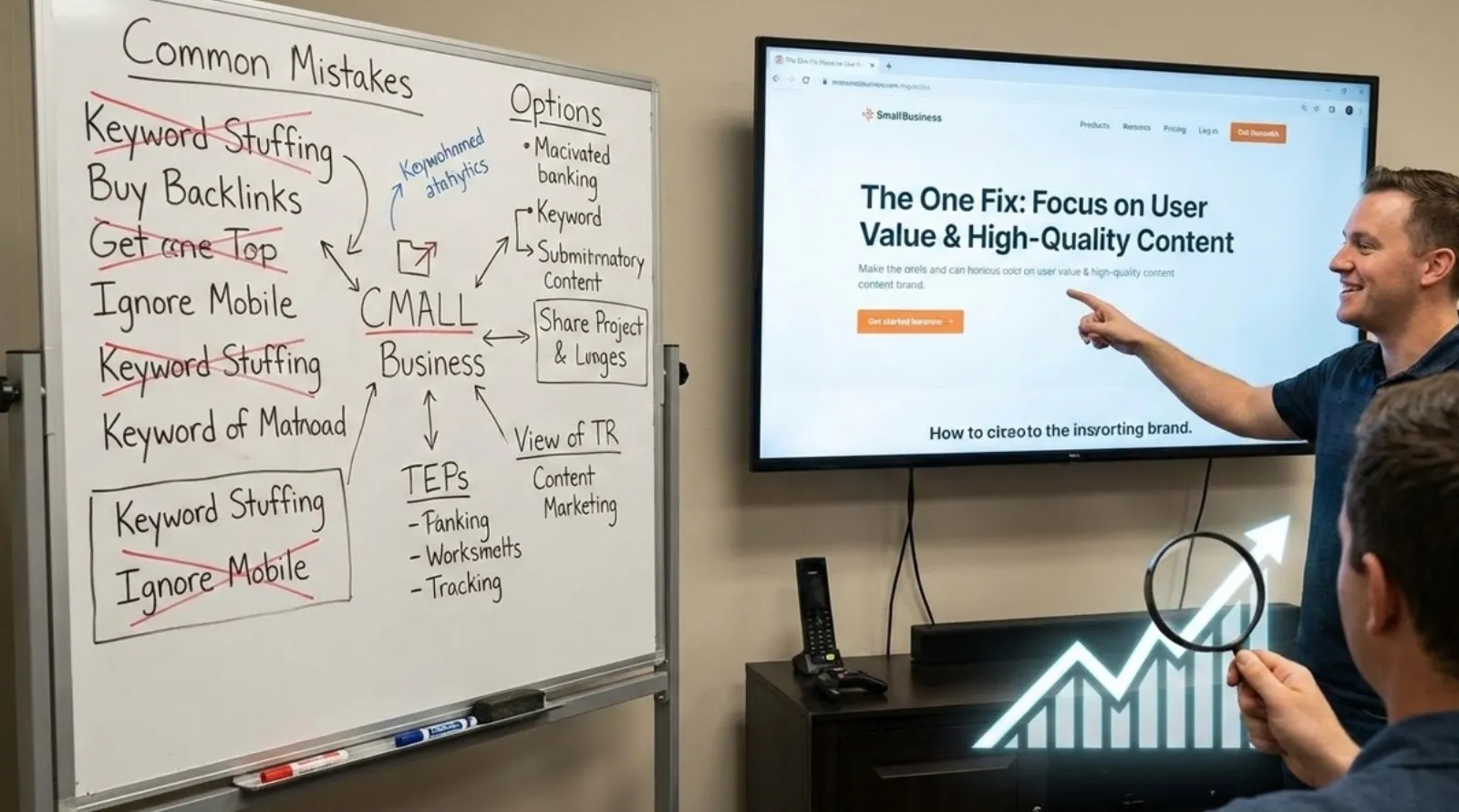
Did you know an astonishing 75% of small businesses struggle with online marketing and search engine optimization (SEO)? Are you pouring precious time and money into SEO tactics that feel like shouting into a void, leaving your website frustratingly buried in search results?
Countless small businesses inadvertently make fundamental mistakes that actively undermine their efforts to rank. But what if a single, powerful, yet often overlooked, shift in perspective—a straightforward fix—could genuinely unlock sustainable growth? Imagine driving a steady stream of eager, ready-to-buy customers directly to your digital doorstep.

Get Found, Get Chosen, Get Your Time Back
A free one-day marketing seminar in Milton Keynes · 13 January 2027
The Frustrating Cycle: Why Small Business SEO Often Misses the Mark
For many small business owners, SEO can feel like a complex labyrinth of ever-changing rules. This often leads to common pitfalls preventing the online visibility needed to compete and thrive. Understanding these missteps is the first step toward correcting them and building a robust online presence.
Get your free Marketing Action PlanNot sure where to start? Answer a few questions and get your plan in about a minute. No email needed.
Get my plan →The Illusion of Keyword Stuffing: More Isn’t Always Better
One pervasive myth in small business SEO is that jamming as many keywords as possible into your content will catapult you to the top. This outdated tactic, known as keyword stuffing, not only fails to impress search engines today but actively harms your website’s performance. Search engine algorithms are sophisticated, designed to understand context and user experience, making unnatural content counterproductive.
Ignoring the Locals: Why Google My Business is Your New Best Friend
For businesses with a geographic footprint, neglecting local SEO is leaving money on the table. Many small businesses overlook the unparalleled power of a properly optimized Google My Business (GMB) profile. This free tool is absolutely critical for local visibility, as Google heavily relies on it for “near me” searches.
Chasing Algorithms Over Customers: The Real Search Intent Story
A common misstep is focusing too heavily on what small businesses think Google wants, rather than understanding what their customers actually need. This manifests as creating content based on broad keywords without considering the underlying “intent” of the searcher. If your content doesn’t align with user intent, they’ll leave, signaling to Google that your page isn’t helpful.
The “Set It and Forget It” Trap: SEO is an Ongoing Marathon
Many small business owners view SEO as a one-time project. This “set it and forget it” mentality leads to stagnation in the ever-evolving digital landscape. Search algorithms change constantly, competitors emerge, and user behaviors shift, demanding continuous monitoring and adaptation for sustained rankings.
Technical Debt: When Your Website Actively Undermines Your Efforts
Even with excellent content and local optimization, a technically flawed website can severely hinder your SEO performance. Many small businesses unknowingly operate on websites burdened by technical debt: slow loading, lack of mobile-friendliness, broken links, or poor site structure. Google prioritizes user experience, and these issues frustrate users and search engines alike.
The Game-Changing Solution: Mastering User Intent with Strategic Content
So, what is the one fix that actually moves the needle for small business SEO? It’s not an algorithm hack or an expensive tool. It’s a fundamental shift: relentlessly focusing on understanding and serving user intent with high-quality, relevant, and engaging content. This is the core principle of Google’s algorithm and your most powerful ally.
What is User Intent, Really?
User intent refers to the underlying goal a person has when typing a query into a search engine. It’s about figuring out “why” they’re searching. There are typically four main types of search intent:
- Informational Intent: Seeking information (e.g., “how to fix a leaky faucet”).
- Navigational Intent: Trying to find a specific website (e.g., “Facebook login”).
- Commercial Investigation Intent: Researching products/services (e.g., “best laptops for graphic design”).
- Transactional Intent: Ready to buy or take action (e.g., “buy running shoes online”). For a small business, understanding these nuances means creating content that precisely matches what potential customers seek at every journey stage.
Why Understanding Intent is Your SEO Superpower
When your website content perfectly aligns with a user’s intent, powerful things happen. Google recognizes your page as highly relevant, rewarding it with higher rankings. Users who land on your page are more likely to stay, engage, and ultimately convert because you’ve given them exactly what they sought. This alignment is a cornerstone of effective SEO strategy.
The One Fix in Action: Crafting Content That Converts
The practical application of this “one fix” is to develop a content strategy that systematically addresses various user intents relevant to your small business. This means moving beyond simple product descriptions and creating comprehensive, valuable content pieces serving your audience throughout their journey. Think of your website as a helpful resource hub, not just a digital brochure.
Implementing the Fix: A Practical Framework for Small Businesses
Putting this intent-driven approach into practice doesn’t require a massive budget. It requires focus, empathy for your customers, and a systematic approach. Here’s a framework to guide your small business:
 LIVE
Live every Tuesday at 2pm UK. Bring your marketing questions.
Get your Google, local SEO and AI questions answered live.
Step 1: Deep Dive into Keyword and Intent Research
Go beyond simple keyword lists. Uncover your customers’ questions and problems. Use free tools like Google Keyword Planner or Search Console, and observe Google’s “People Also Ask” sections. Focus on long-tail keywords (e.g., “eco-friendly cleaning services Brooklyn”) which reveal clear intent and have less competition. Map these keywords to the four intent types.
Step 2: Optimize Your On-Page Elements for Clarity and Relevance
Ensure your website’s on-page elements reflect your chosen user intent and keywords. Your title tags, meta descriptions, and headings should clearly communicate your page’s purpose. Use your primary keyword phrase naturally in your main heading (H1) and sprinkle related terms throughout. Ensure content is readable, clear, and directly answers user questions. Don’t forget image alt text for context and accessibility.
Step 3: Elevate Your Local SEO Game
For local businesses, a comprehensive local SEO strategy is crucial. Your Google My Business (GMB) profile is the cornerstone. Claim, verify, and meticulously optimize it with accurate information, services, and photos. Actively encourage and respond to customer reviews. Ensure consistent Name, Address, Phone (NAP) information across all online directories (local citations). Consider location-specific landing pages if you serve multiple areas.
Step 4: Create Compelling, Intent-Driven Content
Based on your keyword and intent research, produce high-quality content. This includes blog posts answering customer questions, detailed service pages, engaging product descriptions, or “how-to” guides. Every piece should have a clear purpose tied to user intent. Focus on demonstrating Expertise, Authoritativeness, and Trustworthiness (E-A-T). Showcase your unique value proposition; a baker might write “The History of Sourdough” (informational) or have an online ordering page (transactional).
Step 5: Don’t Forget the Technical Foundations
Even the best content needs solid technical foundations. Regularly audit your site for speed using tools like Google PageSpeed Insights. Ensure it’s fully responsive and looks great on all devices, especially mobile phones. Secure your site with HTTPS. Check for broken links, optimize image sizes, and ensure a clear, logical navigation structure. A solid technical foundation allows your brilliant, intent-driven content to shine.
Relatable Success Story: From Overlooked to Overbooked
Consider “Maria’s Boutique Blooms,” a small flower shop initially overlooked in local search results. Maria had a basic, slow, and mobile-unfriendly website with an incomplete Google My Business profile, using only generic keywords.
After embracing intent-driven content, Maria fully optimized her GMB profile, added photos, and actively sought reviews. She researched local searches beyond “flowers,” discovering “wedding flower packages [city],” “sympathy arrangements delivery,” and “best local florists for corporate events.”
Maria then created specific landing pages and blog posts for these intents: a “Wedding Flower Consultations” page, “Guide to Choosing Sympathy Flowers,” and “Corporate Gifting Program.” These pages were fast-loading and mobile-friendly.
Within six months, Maria saw a 300% increase in calls from Google Search, a significant boost in wedding bookings, and new corporate clients. Her commitment to understanding and delivering what customers wanted transformed her online presence and business.

Frequently Asked Questions About Small Business SEO
Here are common questions about optimizing your small business for search engines:
Q1: How long does it take to see SEO results for a small business?
SEO is a long-term strategy. Expect noticeable improvements in rankings and organic traffic within 6 to 12 months of consistent effort, depending on industry competitiveness and implementation quality.
Q2: Do I need a professional SEO agency, or can I do it myself?
Many essential SEO tasks, especially focused on user intent and local optimization, can be handled by a dedicated small business owner using free resources. However, if time or expertise is limited, an agency can provide faster, more comprehensive results.
Q3: What’s the most important factor for local SEO?
Optimizing your Google My Business profile is paramount for local SEO. Ensure accurate, complete, and regularly updated information, and actively acquire and respond to customer reviews for maximum impact on local search visibility.
Q4: How often should I create new content for my website?
Consistency is key. For small businesses, aiming for one to two high-quality, intent-driven content pieces (like blog posts or updated service pages) per month is a realistic and effective starting point. Focus on genuine value.
Final Thoughts: Your Path to Sustainable Online Growth
The journey of small business SEO doesn’t have to be a frustrating guessing game. By shifting focus from chasing algorithms to genuinely understanding and serving your potential customers’ intent, you unlock the most powerful lever for sustainable online growth.
This “one fix” is about empathy, clarity, and consistently delivering value through your content. Begin today: Ask what questions your customers truly have, what problems they need solved, and craft content speaking directly to these needs. Embrace this intent-driven approach, and your business will rise in search rankings, flourishing with a steady stream of engaged, ready-to-convert customers.

Written by Uzair Kharawala
Partner at SF Digital Studios, a Google Premier Partner agency. Uzair has been helping businesses grow with Google Ads since 2002 and teaches it every week on YouTube.
Get our best Google Ads tips by email
New articles and videos, straight to your inbox. Unsubscribe any time.