
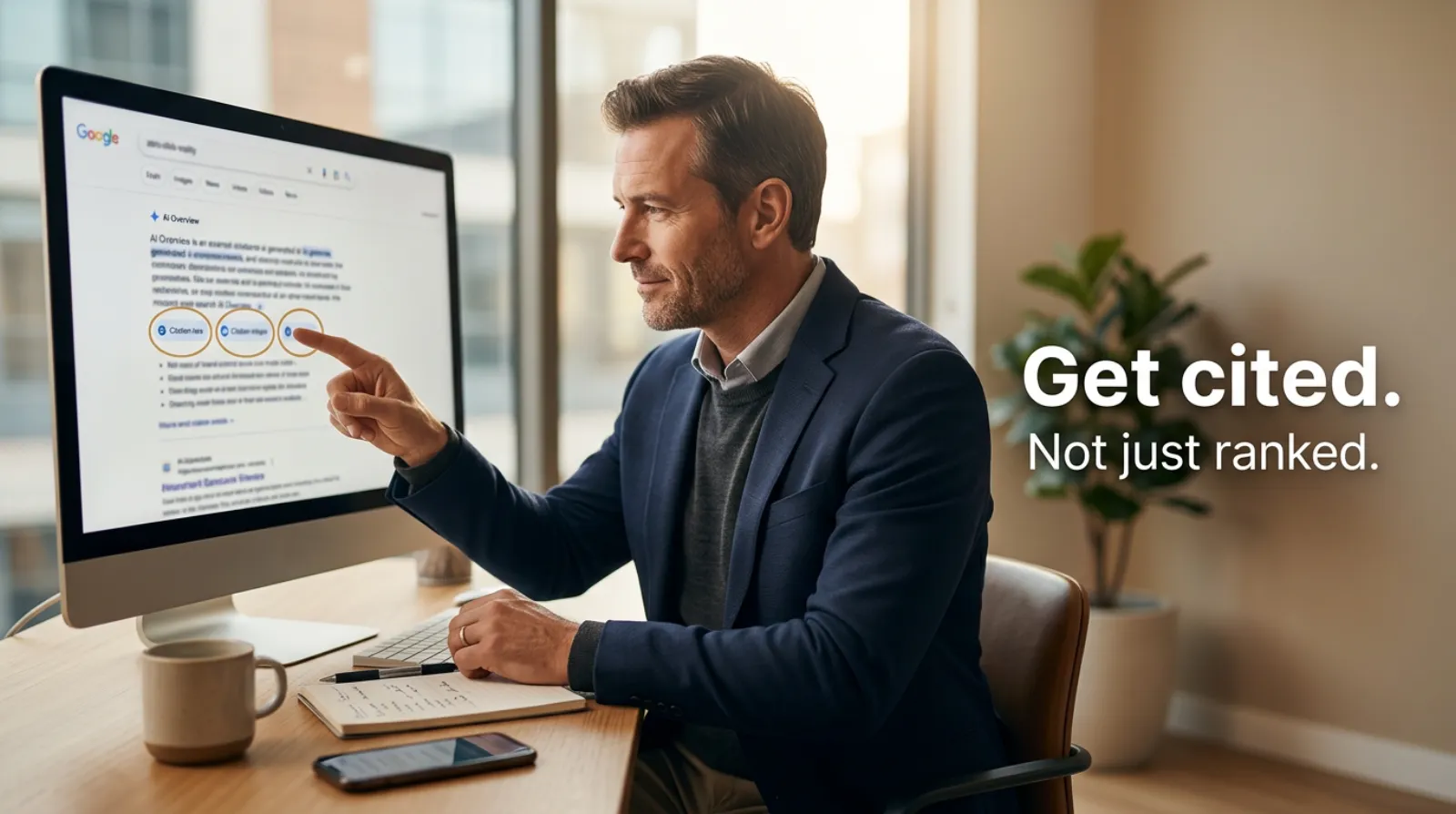
For 20 years, the success metric for SEO was simple. Rank on Google, get the click, count the traffic. The model worked because Google sent users to your website.
That model is breaking down. AI Overviews now answer most informational queries directly on the results page. The buyer reads the answer, learns what they need, and never clicks through. SimilarWeb’s 2026 data shows that roughly 60% of Google searches now end without a single click to any website.
Get Found, Get Chosen, Get Your Time Back
A free one-day marketing seminar in Milton Keynes · 13 January 2027
This is the zero-click reality. And it changes everything about how a smart business approaches content.
Get your free Marketing Action PlanNot sure where to start? Answer a few questions and get your plan in about a minute. No email needed.
Get my plan →The brands that adapt aren’t fighting for clicks any more. They’re fighting to be the named source in the AI Overview itself. Cited authority replaces click-through traffic as the primary win condition.
This guide explains what zero-click really means, how AI Overviews choose their citations, and the structured approach to becoming the source AI engines name.
What Is The Zero-Click Reality?
Zero-click search is the term for searches where users get their answer directly on the results page without clicking through to any source website. AI Overviews are the primary driver. Featured snippets, knowledge panels and people-also-ask boxes also contribute.
The shift has been building since 2020 and accelerated sharply through 2025. Across the queries SF Digital tracks for client accounts, the zero-click rate has roughly doubled over the past 18 months.
The implication is significant. If your SEO success is measured purely on click-through traffic, your performance will quietly decline even as your visibility increases. The brand that gets cited in the AI Overview wins the buyer’s awareness. The brand that ranks #4 in the blue links below gets ignored.
Why Citation Matters More Than Ranking In 2026
The blue-link ranking model rewarded one thing. Position 1 vs position 2 vs position 10. Whichever ranked highest got the click.
The AI Overview model rewards a different thing. Whichever sources the AI engine cites in its synthesised answer are named to the user. A site cited in the AI Overview is named even when it’s ranked #15 in the underlying blue links.
This matters because citation now generates three measurable outcomes that ranking alone never produced.
First, named brand awareness. The buyer reads “according to SF Digital” or “as discussed by [Brand]” inside the AI Overview. That’s brand placement at the moment of buyer research.
Second, direct citation traffic. When the buyer wants the full source, they click the citation link. Citation clicks convert at much higher rates than standard SERP clicks because they signal a buyer who specifically wanted your perspective.
Third, transitive trust. Being cited by an AI engine signals authority to other AI engines. ChatGPT, Perplexity and Claude increasingly use Google AI Overview citations as a signal of source authority for their own synthesis.
This is why citation strategy now matters more than ranking strategy. A page cited in the AI Overview earns brand placement and authority that no #1 blue-link ranking can match.
How AI Overviews Choose Their Citations
Google has been relatively transparent about the AI Overview citation logic. Across the documentation, patent filings and observed behaviour, five signals consistently drive citation.
- Signal 1: Direct, well-structured answers to the buyer’s query. AI Overviews lift content that directly answers the question. Pages with clean, self-contained answer paragraphs near the top get cited disproportionately.
- Signal 2: E-E-A-T signals on the source page. Expertise, Experience, Authoritativeness and Trustworthiness. Pages with clear author bios, named expertise, real-world examples and credentials earn citation preference.
- Signal 3: Specific data and named sources. Vague claims get skipped. Numbers, dated studies, named businesses and quantified claims earn citations.
- Signal 4: Structural markup. Schema.org markup helps AI Overviews understand and lift content. FAQPage, Article, Person and LocalBusiness schemas materially improve citation rates.
- Signal 5: Source diversity. AI Overviews tend to cite 3 to 6 sources per overview. Being the 5th or 6th cited source is still a win. The strategy is not to be the only cited source. The strategy is to be one of the cited sources.
Optimising for citation means optimising for all five of these signals together. The brands that do this systematically appear in AI Overview citations across an increasing share of their target queries.
The 6-Lever Citation Strategy
Through the audit and rewrite work SF Digital has run across client accounts in 2025 and 2026, six levers consistently produce citation appearances. Applied together, they materially shift citation rates within 60 to 120 days.
Lever 1: Direct-Answer Openings
Every section of every content page should open with a 1 to 3 sentence direct answer to the buyer’s question. Quotable. Self-contained. Authoritative.
The AI engine lifts the opening paragraph as the citation. The human reader gets the depth underneath.
Lever 2: Question-Based H2 Structure
H2 tags should be written as the exact questions buyers ask, not as the keyword phrases the old SEO playbook recommended. “How long does local SEO take?” is a question. “Local SEO Timeline” is not.
The question-based H2 matches how buyers query the AI engine and how the AI engine indexes content for retrieval.
Lever 3: Expertise And Real-World Citations
Pages with clear author bios, real-world case studies, named clients (with permission) and quantified results earn citation preference. AI engines lift content that demonstrably comes from someone with first-hand experience.
“In the 47 audits we ran across local trades accounts in 2025, we observed that…” cites cleanly. “Most experts recommend…” does not.
Lever 4: Structured Markup
Add appropriate schema markup to every page. FAQ page on FAQ sections. Article on blogs. LocalBusiness on service pages. Person on author bios. Review of testimonials.
 LIVE
Live every Tuesday at 2pm UK. Bring your marketing questions.
Get your Google, local SEO and AI questions answered live.
Schema markup gives AI engines structural cues they use when deciding what to lift. Pages with proper schema get cited noticeably more often than equivalent pages without it.
Lever 5: Source Triangulation
Where you make a quantitative claim, include at least one named external source alongside your own data. AI engines prefer content that cites authoritative external sources because it triangulates the claim’s reliability.
“Our 2025 audit data aligns with the Search Engine Land report from August showing that…” reads as triangulated. A standalone claim does not.
Lever 6: Update Cadence And Date Signals
AI engines heavily favour recently updated content for time-sensitive topics. Add visible “last updated” dates to every page. Update high-value pages quarterly. The freshness signal alone can move citation rates by 20 to 40% for fast-moving topics.
The 30-60-90 Implementation Plan
The full citation strategy compounds over a quarter. Here’s the structured rollout SF Digital uses with clients.
Days 1 to 30: Audit And Baseline
Pull a list of your top 30 buyer-intent queries. Run each through Google to see whether an AI Overview appears, and if so, which sources are cited.
Categorise each query into three buckets. AI Overview present, and you are cited. AI Overview present, and you are not cited. No AI Overview shown.
The middle bucket is your priority. These are queries where the AI Overview exists, your category is being summarised, and you are losing brand placement to competitors.
Days 31 to 60: Rewrite The Priority Pages
For each priority query, identify the page on your site that should rank. If no page exists, write one. If a page exists, rewrite it using the six levers above.
The rewrite typically takes 90 minutes per page. Eight pages in a week is realistic for someone who’s familiar with the levers.
Submit each rewritten page to Google Search Console for recrawl as you complete it.
Days 61 to 90: Track And Iterate
Recheck citation status for each priority query monthly. New AI Overview citation appearances typically start landing in weeks 8 to 12. The compound effect kicks in around months 3 to 6.
For each page that’s not earning citations by month 3, identify the gap. Usually, it’s one of three things: insufficient expertise signals, missing schema, or a competitor with materially better citations and authority.
Iterate on the gap and resubmit.
Common Mistakes To Avoid
Most brands trying to optimise for AI Overviews fall into one of three traps.
Mistake 1: Treating It As Pure Keyword SEO
The old “rank on keywords, get the click” playbook does not apply to AI Overview optimisation. Pages can rank well on keywords and still not get cited. The citation logic is different. Optimise for citation, not just ranking.
Mistake 2: Producing New Content Instead Of Rewriting Existing
The fastest citation appearances come from rewriting existing high-traffic pages, not from producing new content. The existing page already has authority, links and freshness signals. Adding the six citation levers earns citations within weeks, not months.
Mistake 3: Ignoring Citation Rate As A Metric
Most SEO dashboards track rankings, traffic and conversions. Few track the AI Overview citation rate. If you don’t measure it, you can’t improve it. Add citation rate as a tracked metric across your top 30 buyer-intent queries.
Frequently asked questions
What is the zero-click reality?
Zero-click search is the share of Google searches that end without a click to any website. AI Overviews are the main driver. Roughly 60% of searches in 2026 now end zero-click. The implication is that ranking traffic is shrinking even as visibility increases. The win condition shifts from click to citation.
How do AI Overviews choose their citations?
AI Overviews cite sources based on five signals. Direct answers to the query, E-E-A-T signals, specific data and named sources, schema markup and source diversity. Pages that optimise for all five appear in citations across a high share of relevant queries.
How long until my page gets cited in AI Overviews?
Citation appearances typically begin 4 to 12 weeks after a rewrite and recrawl. Meaningful citation share lands at 3 to 6 months. The compound effect is strong. The first citation is the hardest to earn. Subsequent citations follow much faster.
Should I stop optimising for rankings?
No. Rankings still drive a meaningful share of click traffic and remain a citation signal. The right approach is dual optimisation. Apply the citation levers while continuing to optimise for rankings. Most pages can win on both.
How do I track AI Overview citations?
Manually check your top 30 buyer-intent queries monthly. Several tools now offer AI Overview citation tracking, including Semrush, Ahrefs and AlsoAsked. Track citation rate as a primary metric alongside rankings and traffic.
The Citation Era Is Already Here
The zero-click reality is not a 2028 prediction. It’s the operating environment your SEO is competing in right now. The brands that adapt their content to optimise for AI Overview citation will compound brand placement and direct citation traffic for years. The brands that keep optimising purely for ranks and clicks will quietly lose share to competitors who shifted earlier.
The work is structured and repeatable. The six levers apply to every page. The 30-60-90 plan gives you a clear rollout. The window to act is open right now.
Start this quarter with the audit. By month three, your priority pages will be earning AI Overview citations. By month six, the compound effect will be visible across your traffic and brand awareness data.
Ranking was the metric that mattered. Citation is the metric that matters now.

Written by Uzair Kharawala
Partner at SF Digital Studios, a Google Premier Partner agency. Uzair has been helping businesses grow with Google Ads since 2002 and teaches it every week on YouTube.
Get our best Google Ads tips by email
New articles and videos, straight to your inbox. Unsubscribe any time.