
It is a quiet week. The diary has gaps. You have seen other tradespeople talk about Bark, a mate swears by Checkatrade, and someone at the networking breakfast says you should be running your own Google Ads.
So should you use Bark or Checkatrade, or put your money into your own ads instead? Each one works differently, costs differently and suits a different kind of business. None of them is magic.

Get Found, Get Chosen, Get Your Time Back
A free one-day marketing seminar in Milton Keynes · 13 January 2027
A quick note before we start. SF Digital runs Google Ads for local businesses, so we have a view on own ads.
Get your free Marketing Action PlanNot sure where to start? Answer a few questions and get your plan in about a minute. No email needed.
Get my plan →We have kept to each company's own published facts and labelled our opinions as opinions.
Should You Use Bark, Checkatrade Or Your Own Ads?
Use Checkatrade if trust and reviews matter most in your trade. Use Bark for occasional extra leads you can pick and choose. Use your own ads, such as Google Ads, for a steady flow of enquiries that come only to you. Many local businesses do best with a mix.
The right answer depends on three things. How busy you are, how much trust your customers need before they call, and whether you want leads you share or leads you own.
Most owners don't need to pick one forever. The smart move is to start with one or two, track where your jobs come from and move money towards whatever wins work at a sensible cost.
How Does Bark Work?
Bark is a lead marketplace. Customers post what they need, and businesses pay to contact the customers they want. You buy credits, and each lead costs a set number of credits to respond to.
Here is how Bark describes it on its UK pricing page, checked in October 2026. You buy a credit pack and use the credits to contact the customers you're interested in.
There's no commission, and you know the cost in credits before you respond.
Bark says it calculates the cost of contacting a customer based on the service, the value of the job and the supply and demand in the area. So a large building job in a busy area costs more credits than a small one somewhere quiet.
There's an important detail in Bark's terms. A customer can send a general request to up to five professionals.
That means you may be competing with several other businesses for the same job.
Bark's terms also say that credits bought on or after 1 November 2025 are valid for three months. Unused credits expire at the end of that period.
Bark offers a guarantee too. Its pricing page says that if you do not win business with your first credit pack, it will return all your credits.
The key point is choice. You decide which leads to pay for. That makes Bark flexible, but it also means time spent reading leads and chasing customers who may have contacted others.
How Does Checkatrade Work?
Checkatrade is a directory of vetted tradespeople with customer reviews. You pay a monthly membership, and customers find you by searching the directory. Higher plans add more visibility and a steady flow of enquiries.
Checkatrade's pricing page, checked in October 2026, lists three plans. Free costs £0 a month and gives you a profile to collect reviews.
Approved costs £30 a month and adds the Checkatrade tick and a listing in the directory.
Growth starts from £59 a month. Checkatrade says it adds a steady stream of customer enquiries, direct bookings and higher placement in search results.
The same page says its fixed plan memberships run for 12 months. That's worth knowing before you sign, because it is a year-long commitment.
Checkatrade puts members through a set of checks before approval. Its own page lists checks such as identity, trading address, qualifications and county court judgments.
Customers often see the tick as a sign of trust. That reassurance has real value, particularly for jobs inside the home, where people worry about who they're letting through the door.
The key point is trust. Checkatrade's value comes from its reputation with homeowners. For trades where people worry about letting someone into their house, that can matter a lot.
How Do Your Own Ads Work?
Your own ads are campaigns you run, or pay someone to run, on platforms such as Google. You pay Google for clicks or leads, and every enquiry comes to you alone. You also own all the data about what works.
There are a few kinds worth knowing about.
Google search ads. You appear when people search for your service in your area. You pay per click, and you choose the searches, the area and the budget.
Google Local Services Ads. These appear at the very top of some searches, with a Google badge. You pay per lead rather than per click. They're available for certain trades and services.
Your Google Business Profile. It's free, and it is how you appear on the map. It isn't advertising, but it's often the best source of local enquiries.
Own ads take more setting up than a directory. But the enquiries aren't shared, and you can see exactly which searches, pages and areas bring work.
The key point is ownership. You own the account, the data and the customer relationship from the first call.
Why Does Where Your Leads Come From Matter?
It matters because the same price per lead can mean very different costs per job. A lead shared with several businesses wins less often than one sent only to you. A long contract adds risk. And a platform you do not control can change its rules at any time.
Think about three questions for every lead source. Write the answers down.
Is the lead shared or exclusive? If several businesses contact the same customer, you'll win fewer of those jobs. That raises your real cost per job, even if each lead looks cheap.
Who owns the relationship? On some platforms, the customer remembers the platform, not you. With your own ads and profile, they remember your name.
How dependent are you? If most of your work comes from one platform, a price rise or a rule change hits your whole business. Spreading your sources protects you.
None of these makes a platform bad. They are simply the trade-offs you're buying into.
The Real Cost Of A Lead Is Below The Surface
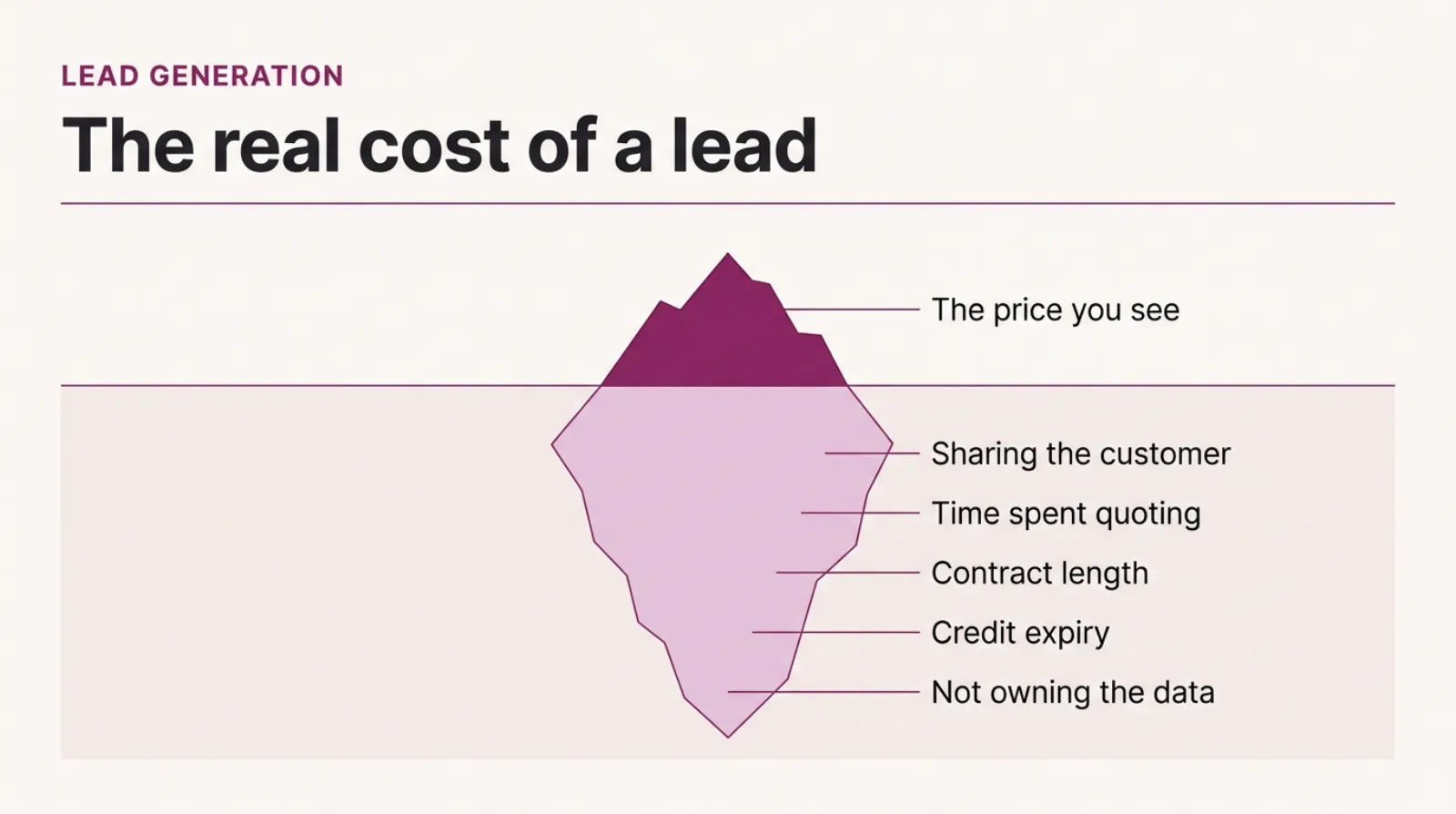
An iceberg showing the real cost of a lead: the price you see above the waterline, and below it the costs you don't see straight away, such as competing with other businesses for the same customer, time spent quoting, contract length, credit expiry and not owning the data.
What Does A Lead Really Cost On Each Route?
The real cost is the total you spend divided by the jobs you actually win, not the price of each lead. A cheap lead that rarely turns into a job can cost more than an expensive one that usually does.
Here's a simple way to compare any source. It takes ten minutes a month.
- Add up everything you spent with that source in a month, including fees and your time if you value it.
- Count the enquiries it brought.
- Count the jobs you won from those enquiries.
- Divide the total spend by the jobs won.
That's your cost per job. It's the only number that lets you compare Bark, Checkatrade and your own ads fairly.
Here's an illustration, not a real business. Say you spend £200 on Bark and win two jobs. That's £100 a job.
You spend £300 on Google Ads and win five jobs. That is £60 a job, even though you spent more.
Win rate matters as much as lead price. Shared leads usually win less often, so track your win rate for each source.
Don't forget your time either. It's the hidden cost. Reading leads, calling back and quoting all take hours. A source that brings fewer but better enquiries can save you a lot of evenings.
What Makes A Lead A Good Lead?
A good lead is a real person, in your area, wanting a job you do, at a budget that works, within a timescale you can meet. If any of those is missing, the lead is worth less, however cheap it was.
Here's a quick checklist to run on every enquiry.
Location. Is the job somewhere you actually want to drive to?
Job type. Is it work you are good at and make money on?
Budget. Does the customer's expectation match a realistic price?
Timing. Do they need it when you can do it?
Contactable. Did they give a working phone number and answer when you called?
Track how many leads from each source pass all five. That tells you more about quality than any sales pitch.
Which Route Suits Which Business?
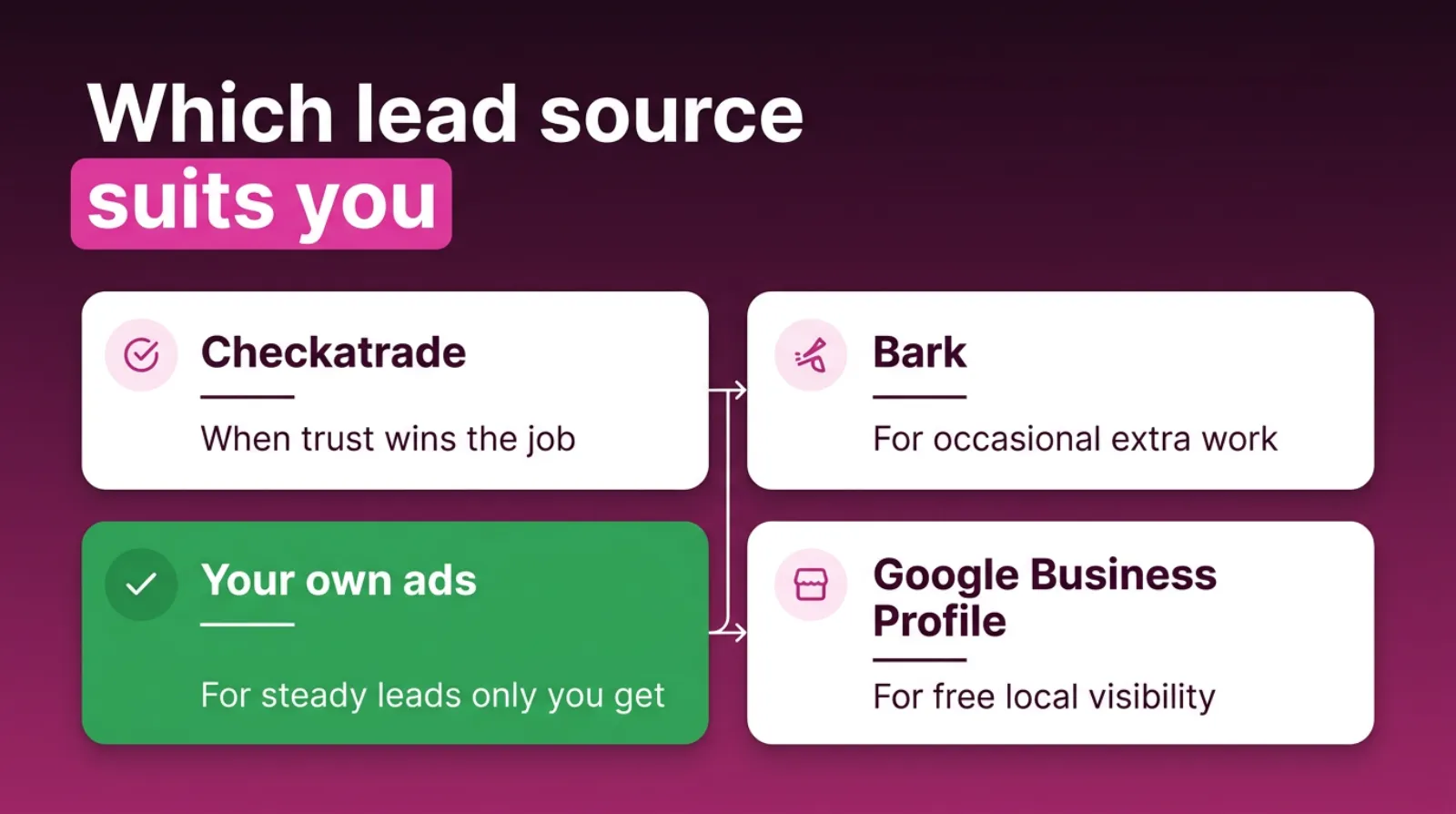
A guide to which lead source suits which need: Checkatrade when customers need trust and reviews, Bark for occasional extra work you choose, your own ads for steady leads that come only to you, and a Google Business Profile for free local visibility, with your own ads marked as the route for steady exclusive leads.
Bark Vs Checkatrade Vs Your Own Ads: How Do They Compare?
Bark charges per lead you choose to contact, Checkatrade charges a monthly membership, and your own ads charge per click or per lead. They differ most on whether leads are shared, who owns the data and how long you're committed.
Here's how the three compare, based on each company's published information in October 2026 and our own view of own ads.
| Bark | Checkatrade | Your own ads | |
|---|---|---|---|
| How you pay | Credits to contact leads you choose | Monthly membership, from £0 to £59 or more | Per click or per lead, set by you |
| Shared or exclusive | A general request can go to up to five businesses | Customers choose from listed members | Enquiries come only to you |
| Commitment | Credits last three months | Fixed plans run for 12 months | No minimum with Google itself |
| Main strength | Choose only the jobs you want | Trust, reviews and the tick | Steady leads you own and control |
| Main watch-out | Competing with others for each job | Year-long commitment | Needs setting up and tracking |
| Best for | Topping up a quiet diary | Trades where trust decides the job | Building a steady, predictable flow |
There is no single winner. Each one is the right answer for some businesses at some stages.
Is Bark Worth It For A Local Business?
Bark can be worth it if you respond quickly, choose leads carefully and treat it as a top-up rather than your main source. It's less worth it if you're slow to reply, or if your trade attracts lots of competing businesses for each request.
Because a general request can go to up to five professionals, speed matters. Minutes count. The first business to call often wins.
Choosing well matters too. Be picky. Since Bark prices leads by the service, the job value and local demand, some leads are better value than others. Skip the ones that don't fit your business.
Track your win rate from the start. If you win one job in every ten leads, work out what that means per job before buying more credits.
And plan around the three-month credit expiry. Buy packs you will actually use in that time.
Is Checkatrade Worth It For A Tradesperson?
Checkatrade can be worth it for trades where customers want reassurance before letting someone into their home, such as plumbers, electricians and roofers. It is less valuable if your customers mostly find you through referrals or if you work mainly for businesses.
The tick and the reviews do much of the selling. For a homeowner choosing between two unknown names, a vetted profile with good reviews can tip the decision.
The 12-month term is the main thing to weigh. Before you sign, think about whether you will still want the listing in a year and what a realistic number of jobs from it would be.
Ask for the exact Growth price for your trade and area. Checkatrade shows it as "from £59 a month", so the figure that matters is the one quoted for you.
And keep collecting reviews elsewhere too, especially on Google. Reviews in your own name on your own profile stay with you whatever you decide.
 LIVE
Live every Tuesday at 2pm UK. Bring your marketing questions.
Get your Google, local SEO and AI questions answered live.
Are Your Own Google Ads Worth The Effort?
Your own Google Ads are worth the effort if you want a steady flow of enquiries that come only to you, and you're willing to set up tracking and check the account each week, or pay someone to. They're less suitable for very small budgets with no time to manage them.
The big advantage is control. You set every dial. You choose the searches, the towns, the hours and the budget. Every enquiry is yours alone, and you can see which searches bring jobs.
The big demand is attention. Weekly checks matter. A Google Ads account needs tracking, weekly checks and a decent landing page. Left alone, it can waste money quickly.
Start small and tight. One campaign for your main service in the area you really cover, plus a small campaign for your own business name, is plenty to begin with.
Local Services Ads are worth checking too. If they are available for your trade, you pay per lead rather than per click, with a Google badge on your listing.
How Fast Should You Respond To A Lead?
As fast as you possibly can, ideally within minutes. When customers contact several businesses at once, the first one to call back often wins the job. That's true on any platform, and it's especially true for shared leads.
Think about how customers behave. They're busy too. They send a request, get a few replies and book whoever seems helpful and available first.
If you're on a roof all day, that's hard. But there are ways to speed up.
Turn on notifications for new leads on your phone.
Use a short, friendly first reply you can send in seconds, then call properly when you're free.
Block out two short slots a day to work through enquiries if you cannot respond instantly.
Consider an answering service if missed calls are costing you work.
Fast replies don't just win more jobs. They make every lead source look better on your spreadsheet.
What Should Your Profile Say On Any Platform?
Your profile should say exactly what you do, where you work, why customers choose you and what happens when they get in touch. Real photos, recent reviews and a clear list of services do more than any slogan.
Whether it's Bark, Checkatrade or your Google Business Profile, customers skim. Give them what they need quickly.
Lead with your main services. "Boiler repairs, servicing and bathroom installs" beats "All aspects of plumbing".
Name the towns you cover. Customers want to know you'll come to them.
Show real work. Before and after photos of your own jobs build trust fast.
Explain your process. How quickly you respond, whether quotes are free and how you're paid.
Keep it current. Add new photos and services every few months, so the profile never looks abandoned.
A strong profile improves your win rate on every platform. That lowers your cost per job without spending a penny more.
How Do You Get More Reviews, Whichever Route You Choose?
Ask every happy customer, straight after the job, with a direct link that makes it easy. Reviews on your Google Business Profile help you whichever lead source you use, and they stay with you if you change platforms.
Reviews are the common thread across all three routes. Checkatrade relies on them, Bark profiles show them, and Google uses them on the map and in Local Services Ads.
Here's a simple habit that works. It takes two minutes per job.
- Finish the job and check the customer is happy.
- Send a text the same day with a short thank you and a direct review link.
- Follow up once, a few days later, if they haven't left one.
- Reply to every review, good or bad, politely and briefly.
Don't put all your reviews on one platform. If you leave that platform, those reviews may not come with you. Reviews on your own Google profile do.
Can You Use More Than One At Once?
Yes, and most local businesses should. A mix spreads your risk, fills gaps in the diary and lets you compare sources on real numbers.
A common pattern looks like this. Your Google Business Profile and reviews bring free enquiries.
A small Google Ads campaign brings steady, exclusive leads. And Bark or Checkatrade tops things up, depending on your trade.
Every few months, look at the cost per job from each source. Move money towards the best performer and trim the weakest.
Avoid relying on one source for most of your work. If that platform raises prices or changes its rules, your whole diary feels it.
How Do You Track Which Source Brings The Best Jobs?
Ask every new customer how they found you, write it down and match it to the job value. Add call tracking to your ads and website if you can. After two or three months, you'll know which source really pays.
You don't need fancy software to start. Paper works. A simple spreadsheet works well.
- Date of enquiry.
- Source, such as Bark, Checkatrade, Google Ads, Google profile or referral.
- Whether it became a job.
- Value of the job.
At the end of each month, total the jobs and value by source, and set them against what you spent.
Ask the question on every call. "Where did you find us?" takes five seconds and gives you the most valuable marketing data you will ever collect.
What About Rated People, MyBuilder And Other Platforms?
Other platforms such as Rated People and MyBuilder also help tradespeople find work. They typically charge per lead, by subscription or through a mix of both. The same questions apply: are leads shared, how long are you committed and what's your real cost per job?
We haven't compared their terms in detail here, so check each one's current pricing and terms directly before you sign up.
The method for judging them is the same as for Bark and Checkatrade. Track every enquiry, count the jobs you win and divide what you spent by those jobs.
Try one at a time. If you join three platforms in the same month, you won't know which one is working.
How Do You Build Enquiries You Own Over Time?
Build enquiries you own by growing the channels nobody can take away: your website, your Google Business Profile, your reviews, your customer list and your own ads. Platforms can fill gaps, but owned channels give you long-term stability.
Every job is a chance to strengthen your own channels. Use it. Ask for a Google review.
Add the job to your website's gallery. Keep the customer's details, with permission, for a reminder next year.
Over time, more of your work comes from people who already know your name. That's the cheapest kind of lead there is.
Treat platforms as rented space and your own channels as property. Renting is useful, but owning builds value.
What Should You Ask Before Signing Up To Any Lead Platform?
Ask how long you are committed, how you cancel, whether leads are shared, what happens to unused credit or budget, and who keeps the customer data. Get the answers in writing before you pay.
Here are the questions we'd want any owner to ask. Ask them all.
- How long is the minimum term, and how do I cancel?
- Are leads shared with other businesses, and with how many?
- What happens to unused credits or budget?
- Can I get credits back for leads that turn out to be fake?
- How exactly is the price of a lead or plan worked out?
- Who owns the reviews and customer details if I leave?
- What results do similar businesses in my area typically see?
Good providers answer these clearly. Vague answers are worth noticing.
A Worked Example: One Plumber, Three Routes
Picture a plumber in Bedford. The business, the spending and the results here are illustrative, not a real client.
In month one, the plumber buys a Bark credit pack and responds to a handful of leads. Two turn into small jobs.
Several customers had already booked someone else by the time they rang.
In month two, the plumber joins Checkatrade on a Growth plan. Enquiries arrive steadily, and the reviews from past customers help win two larger bathroom jobs.
In month three, the plumber adds a small Google Ads campaign for boiler repairs within ten miles. It brings regular calls, and every one comes only to them.
After three months, the spreadsheet tells the story. Google Ads brings the most jobs per pound. Checkatrade brings the biggest jobs. Bark is useful for quiet weeks.
So the plumber keeps all three, but in different amounts. Most budget goes to Google Ads, Checkatrade stays for trust, and Bark becomes an occasional top-up.
The answer came from the numbers, not from anyone's sales pitch.
The plumber also keeps asking every customer where they found them. Six months later, a growing share of calls say "a friend recommended you" or "I saw your reviews on Google". Those are the cheapest jobs of all, and they come from doing the work well and asking for reviews every time.
Frequently asked questions
Is Bark worth it for tradespeople?
It can be, if you reply quickly, choose leads carefully and track your win rate. Because a general request can go to up to five professionals, speed and selectivity make a big difference to your real cost per job.
How much does Checkatrade cost per month?
Checkatrade's pricing page, checked in October 2026, lists a free plan, an Approved plan at £30 a month and a Growth plan from £59 a month. Fixed plan memberships run for 12 months.
How much does a Bark lead cost?
Bark doesn't publish a fixed price per lead. It says the cost depends on the service, the value of the job and supply and demand in the area. You see the cost in credits before you respond.
Is Google Ads better than Checkatrade?
Neither is better for everyone. Google Ads gives you exclusive enquiries and full control, while Checkatrade gives you trust and reviews. Many trades use both and compare the cost per job from each.
Do Bark credits expire?
Yes. Bark's terms say credits bought on or after 1 November 2025 are valid for three months from purchase, and unused credits expire at the end of that period.
What is the best way for a local business to get leads?
The best way is usually a mix: a strong Google Business Profile with reviews, a small, well-tracked Google Ads campaign and, where it suits your trade, a directory or marketplace. Track the cost per job from each and adjust.
Keep Reading
These posts go deeper on getting steady, good-quality enquiries from your own channels.
- Google Will Now Charge You Per Lead, Not Per Click. Is That Better For A Local Trade?
- Your Ad Budget Isn't Too Small. Your Map Is Too Big
- The £10 A Day Google Ads Brand Campaign Every Local Business Should Run
- 6 Local SEO Fixes That Get SMEs Into the Google Maps 3-Pack Faster
- Clicks Came In, Customers Did Not: Where A Google Ads Account Actually Breaks
We picked these because each one covers a next step: pay-per-lead ads, local targeting, brand search, the map and tracking.
Sources
The facts about Bark and Checkatrade in this post come from their own published pages, which we checked on 25-10-2026. Prices and terms change, so check them before you sign up.
So, Where Should Your Next Lead Come From?
Start with your own Google Business Profile and reviews. They're free and they work alongside everything else.
Then pick one paid source that fits your trade. Track every enquiry for three months, and let the cost per job decide what comes next.
If trust wins your jobs, look closely at Checkatrade. If you want occasional extra work, try Bark. If you want steady enquiries that come only to you, build your own ads.
And if you'd like help setting up tracking or a lean Google Ads campaign, book a call. We'll look at where your work comes from now and tell you straight what we'd do next.

Written by Uzair Kharawala
Partner at SF Digital Studios, a Google Premier Partner agency. Uzair has been helping businesses grow with Google Ads since 2002 and teaches it every week on YouTube.
Get our best Google Ads tips by email
New articles and videos, straight to your inbox. Unsubscribe any time.