
A coach stops you at the school gate. Would you put your logo on the under-11s' shirts for £500?
Sponsoring a local sports team is worth it when you treat it as marketing, not a donation. A kit deal costs most firms £300 to £850 for a season or two. It pays back through local trust, word of mouth and a warm audience of parents. If you track it and use it, it can pay for itself. If you just send the money, it rarely does.
That's the short answer. The rest of this post shows what you get back, what it costs, how the tax works and how to tell if it paid off.
Get Found, Get Chosen, Get Your Time Back
A free one-day marketing seminar in Milton Keynes · 13 January 2027
Get your free Marketing Action PlanNot sure where to start? Answer a few questions and get your plan in about a minute. No email needed.
Get my plan →Most owners say yes for good reasons. They want to help, the club needs the money and it feels like the right thing to do.
That is fine. But £500 is still £500, and you'd want to know what it bought.
The trouble is that nobody tells you. The club sends a sponsorship pack with a price list. Nobody explains how a shirt logo turns into a phone call.
A quick note on where this comes from. SF Digital Studios looks after Google Ads, websites and local marketing for small firms around Leighton Buzzard, Milton Keynes and beyond.
Local owners ask us about sponsorship all the time, usually right after a club has asked them.
The prices below come from real UK club sponsorship pages. The tax rules come from HMRC's own manuals. Where something is our view rather than a fact, we say so.
What Do You Actually Get When You Sponsor A Local Team?
You get your name in front of local families every week, in a setting where people feel good about you. Most deals include a shirt logo, a team photo, a spot on the club website and a few social posts. What you do not get is a stream of ready-made leads. Those only come if you do something with the deal.
Think of it as rent on a small patch of local attention. The club gives you the patch. What you grow there is up to you.
Here's what a typical grassroots package includes. These come straight from club sponsorship pages for the 2026/27 season:
- Your logo on the team's match shirts
- A team photo of the players wearing your kit
- Your name, logo and a link on the club website
- Posts on the club's Facebook and Instagram pages
- Sometimes a banner by the pitch at first-team games
That is the deal on paper. In practice, the value sits in three places.
The first is the audience. Every Saturday, parents stand on the touchline for an hour and a half. They're local, they own or rent homes and they talk to each other.
The second is the feeling. People remember who helped their kid's team. It is one of the few kinds of advertising that people actually thank you for.
The third is what you build on top. An offer for club families, a link from the club's website, a photo for your own social pages. This is where most sponsors leave money on the table.
How Much Does It Cost To Sponsor A Local Sports Team?
Most UK grassroots kit deals cost between £300 and £850 a season. Smaller add-ons start from as little as £5 a month. The price depends on the age group, what's included and how long the deal runs.
Here are real prices from three clubs, checked in November 2026.
Redhill FC in Surrey charges £500 a season for a development team (under-7s to under-11s).
A competitive team (under-12s to under-18s) costs £750 a season. Both include the match kit, a team photo, a website listing, social posts and a pitch-side banner.
Knebworth FC in Hertfordshire prices by age group. A match kit deal runs from about £450 for an under-6 to under-8 team up to about £800 for under-13s and older. That deal covers two years.
Southwater Royals in West Sussex sells a two-year gold sponsorship for £725.
That puts your logo on the front, back and sleeve of the shirts and on the shorts. A front-of-shirt silver deal costs £320 for two years.
So the real cost per season can be lower than the headline price. A two-year deal at £725 works out at about £360 a year.
Most owners guess high. As of July 2026, Starling Bank's research found small business leaders thought kit sponsorship cost £1,144.50, when it actually cost about £845.
There are cheaper ways in too. Knebworth's bronze package costs £5 a month and puts your logo on the website and in match programmes. That is £60 a year.
Bigger semi-professional clubs charge more. Pitch-side boards, programme adverts and match-day sponsorship all come with their own price list.
Whatever the price, the kit deal is the cheapest part. The real cost is the time you spend making it work.
Why Do Local Businesses Sponsor Teams At All?
Because local customers buy from people they trust, and trust is hard to buy. A sports team puts you in front of the same families every week, in a good mood, for months.
That repeat exposure matters. Someone who sees your name on 15 Saturdays is far more likely to call you than someone who saw one leaflet.
It also reaches people who never see your ads. Plenty of parents ignore Facebook adverts and bin leaflets. They don't ignore the name on their child's shirt.
And they talk. A touchline is a small, chatty network. One family needs a new boiler, an accountant or a dentist, and someone says, "Our sponsor does that."
Interest is high, too. Starling Bank's July 2026 survey found 62% of small business leaders would be interested in sponsoring a girls' or women's team.
Plenty of businesses want in. Few of them have a plan for what happens next.
There is a darker side to ignore at your peril. A sponsorship that does nothing for your business still costs real money. If cash is tight, that £500 might do more work elsewhere.
That's why the rest of this post focuses on getting it back.
What A £500 Kit Deal Actually Buys
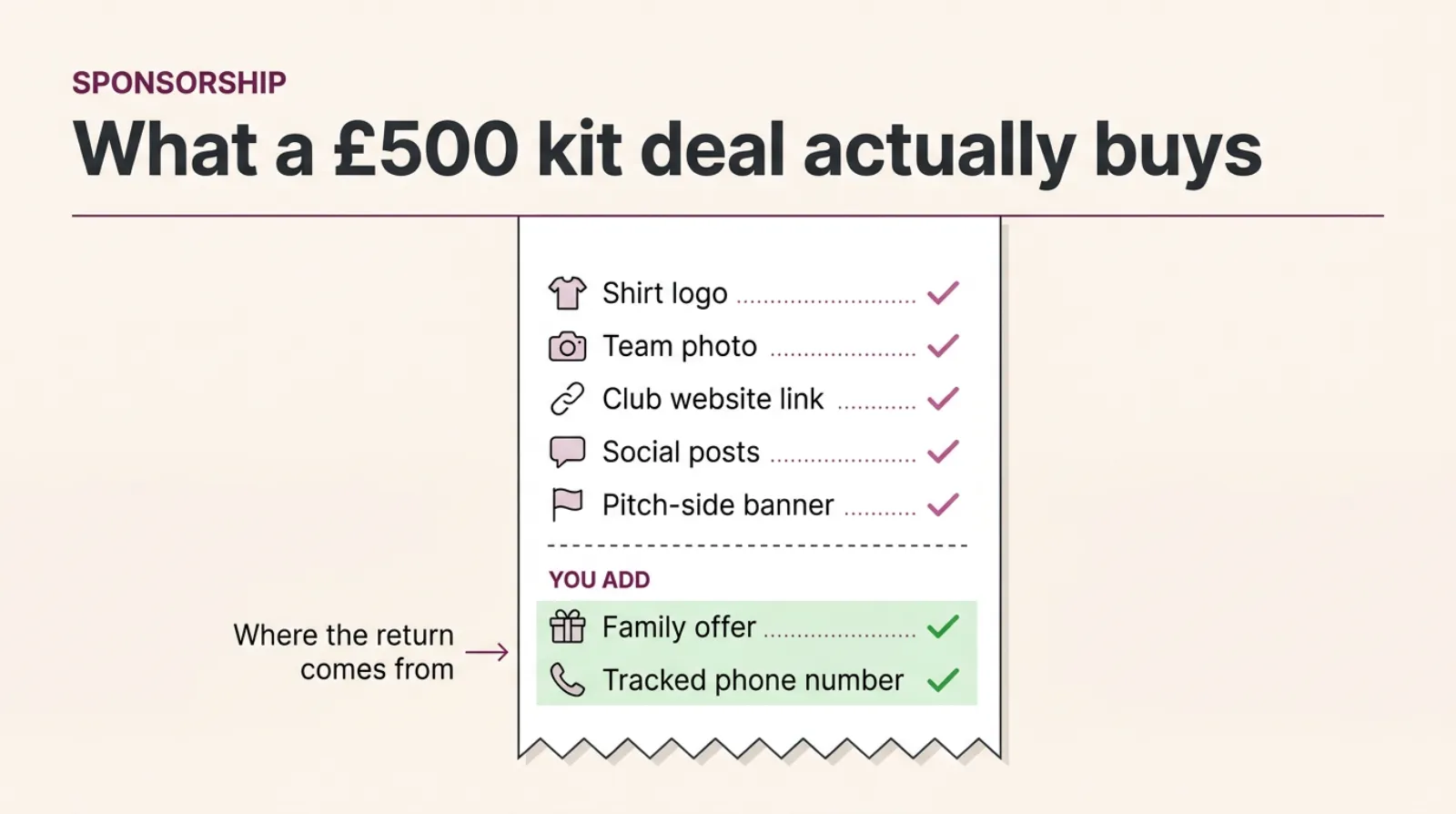
An itemised receipt for a £500 grassroots kit sponsorship, listing the shirt logo, team photo, club website link, social posts and pitch-side banner, with the extras you add yourself, an offer for club families and a tracked phone number, highlighted as the part that brings the return.
The kit deal buys the visibility, and the return comes from the tracked offer and follow-up a sponsor adds on top.
What Comes Back From Sponsoring A Local Sports Team?
The return comes in six forms.
Local trust, word of mouth, a warm audience, content for your pages, a link from the club and goodwill with your staff. Direct leads come last, and only if you ask for them.
Let's take each one in turn.
- Local trust. People assume a business that backs the local club is local, stable and decent. That makes your adverts, your van and your reviews work harder.
- Word of mouth. Parents recommend the sponsor. You cannot buy that in an advert, and it's the kind of lead that closes fastest.
- A warm audience. Club families already like you before you say a word. An offer sent through the club lands far better than a cold advert.
- Content. A team photo in your kit is one of the best posts you will ever share. It's local, it is real and people tag their friends.
- A local link. Most clubs list sponsors on their website with a link. A link from a local club tells Google you are part of the local community. That helps your local search a little.
- Staff pride. Your staff may have kids in the team, or turn out to watch. That builds loyalty you'll feel in your own business.
Now the honest part.
A shirt logo on its own rarely brings direct enquiries. A child running past at speed is not an advert anyone reads.
Most sponsors who say it "didn't work" did nothing beyond paying. They hoped the logo would do the selling.
The sponsors who get money back are the ones who treat the club as a channel, not a cause. They make an offer, they track it and they show up.
How Does Sponsorship Compare With Other Local Marketing?
Sponsorship builds trust slowly. Paid search and leaflets chase sales faster. Here's how £500 compares across four common choices for a local business.
| Kit sponsorship | Google Ads | Leaflet drop | Local paper advert | |
|---|---|---|---|---|
| Who sees it | Club families, every week | People searching for your service now | Every home on the round | Readers of that issue |
| How long it lasts | A season or two | Only while you pay | A few days | About a week |
| Trust it builds | High | Low to medium | Low | Medium |
| Easy to track | Only if you add a code or number | Yes, built in | Only with a code | Only with a code |
| Best for | Brand and word of mouth | Leads this month | Local reach | Older local readers |
None of these is better in every way. Sponsorship wins on trust and goodwill. Google Ads wins on speed and tracking.
That is why we rarely see sponsorship as an either-or. It works best alongside something that catches people when they're ready to buy.
A family sees your name all season. In March their boiler breaks. They search for you by name. Your Google Ads brand campaign or your Google profile is there to take the call.
Shirt Logo Only Vs A Sponsorship You Actually Use
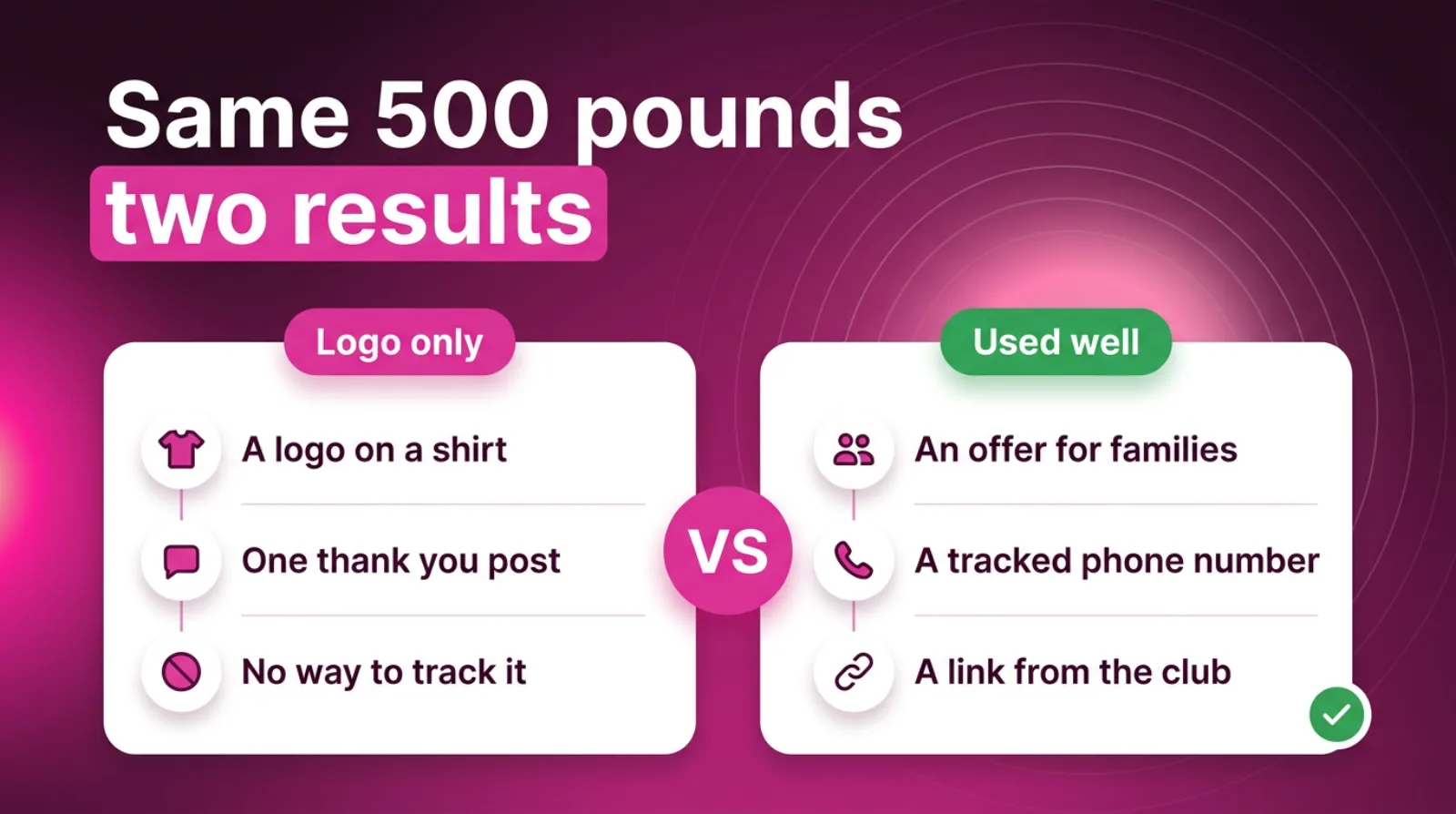
A side-by-side comparison of a shirt-logo-only sponsorship, which gets a logo, a thank-you post and no way to track results, against an active sponsorship, which adds a family offer, a tracked phone number and a website link, with the active sponsorship highlighted as the one that pays back.
The same £500 can buy a logo nobody reads or a local channel you can measure. The difference is the work you add.
Is Sponsoring A Local Sports Team Tax Deductible?
Usually, yes, if you are doing it for your business. HMRC treats sponsorship as an allowable business cost, as long as it's paid wholly and exclusively for the business. If there's a personal reason behind it, HMRC can refuse the whole amount.
As of its August 2026 update, HMRC's Business Income Manual (BIM42555) says sponsorship costs are allowable. The exceptions are capital spending, costs not wholly and exclusively for the business, and costs blocked by name, like entertaining.
The trap is the personal link. HMRC's guidance at BIM42565 names two warning signs. The sponsored person is a relative or close friend, or the owner is personally involved in the activity.
In plain English: sponsoring your own child's team is the case HMRC looks at hardest.
It isn't banned. But you would need to show a real business reason. HMRC says it looks for things like:
- Why you chose that club over others
- Whether you negotiated what you get in return
- How your name reaches your customers
- How you use the deal, such as offers or local press
- How you check whether it's working
HMRC also lists paying whatever the club asks, with no talk about what you get back. That's a sign the deal isn't commercial.
There's a second route for limited companies.
 LIVE
Live every Tuesday at 2pm UK. Bring your marketing questions.
Get your Google, local SEO and AI questions answered live.
HMRC's Company Taxation Manual covers relief for spending on grassroots sport. As of its August 2026 update, CTM09525 caps direct payments at £2,500 a year. The payments must support amateur sport that's open to the public.
You cannot claim both. If a payment already counts as trade sponsorship, it can't also claim the grassroots relief.
Keep the club's sponsorship pack, your invoice and a note of what you got in return. That paper trail is what makes the cost hold up if anyone asks.
This is general guidance from HMRC's manuals, not tax advice. Check your own case with your accountant before you rely on it.
How Do You Track Whether The Sponsorship Paid Off?
Give the sponsorship its own way in, then count what comes through it. A unique phone number, a code or a short web address tells you exactly which customers came from the club.
Without that, you are guessing. And most owners guess on the gloomy side, because they cannot see the word of mouth.
Here are five simple ways to track it:
- A tracked phone number. Use a call-tracking number only on the club website, the banner and any club offers. Every call to it came from the sponsorship.
- An offer code. Give club families a code like "ROVERS10" for 10% off. Count how many people use it.
- A short page on your website. Something like yoursite.co.uk/rovers. Put it on the banner and the club's website, then check the visits in your analytics.
- One question at the end of every enquiry. Ask, "How did you hear about us?" Write the answer down every time. It's free and it catches word of mouth.
- Your brand searches. Watch how many people search your business name in Google Search Console or your Google Ads account. A rise during the season is a good sign.
Then do the sum before you sign. Work out how many jobs you need to break even.
Here is an example. Say you're a plumber and an average job leaves you £150 of profit. A £500 deal needs four jobs from the club to break even.
Four jobs over a season, from a club with 15 teams of families, is a low bar. That is how you decide whether the deal is sensible.
Set that number before the season starts. Then you're judging the deal against a target, not a feeling.
What Should You Ask The Club Before You Pay?
Ask what you get, how long it lasts and how many people it reaches. A good club answers easily. A vague answer tells you the deal needs more work before you sign.
Here are the questions we'd ask:
- How many players, teams and families does the club have?
- Which age groups and which teams would carry my logo?
- How long does the deal last, one season or two?
- Is my business the only one in my trade the club works with?
- Will the club link to my website, and from which page?
- How many social posts will mention me, and when?
- Can I send an offer to club members through the club's email or WhatsApp?
- Can I put a banner up, and where will it hang?
- Will I get a team photo I can use on my own pages?
- What happens to the money, kit, travel or pitch hire?
Question four matters more than people think. If two plumbers sponsor the same club, both get half the value.
Question seven is the one most sponsors forget. A message to every club parent, sent by the club, is worth more than the shirt logo.
And question ten keeps everyone honest. You will feel better, and so will HMRC, if you know where the money goes.
Which Teams Give A Business The Best Return?
The best team is the one whose families look like your customers. A kitchen fitter wants homeowners. A tutor wants parents of school-age children. Match the audience first, then think about the sport.
Youth teams suit most home and family businesses. The parents are adults with homes, cars and bills. They come every week and they stay for years as their children move up the age groups.
Girls' and women's teams are often a smart choice. Starling Bank's July 2026 research found 40% of female players say male teams get more sponsorship. Less competition means more attention for you.
Adult Sunday league teams suit pubs, takeaways, gyms and physios. The players are the customers.
Cricket, rugby and running clubs tend to have older members with more to spend. They often hold events and dinners, which gives you more chances to meet people.
Location matters as much as the sport. A club ten miles away might pull its families from towns you don't serve. Ask where the families live before you sign, not after.
How Do You Make The Most Of It Once You've Signed?
Treat the first month as a launch. Announce it, make an offer, get your link and show up in person. A sponsorship people do not know about can't work.
Here is a simple plan for the first four weeks:
- Post the news on your own social pages and your Google Business Profile. Tag the club and thank them.
- Send the club a short offer for its families. Keep it simple, such as 10% off or a free check. Ask the club to share it.
- Check the club's website lists you with a working link to your site.
- Go to a match. Take a photo with the team in your kit, with the club's and parents' permission.
- Add the club to your website, on your about page or a community page.
Then keep it going through the season. Share the team's wins. Turn up to the presentation day. Offer a small prize for player of the match.
None of this takes long. An hour a month is enough. It's the difference between a shirt logo and a local channel.
Reviews are a bonus most sponsors miss. When a club family uses you, ask them for a Google review. Happy local customers are exactly what Google rewards in local search.
What Does A Good Deal Look Like For Different Businesses?
A good deal fits what you sell and who you sell to. The shirt logo is the same for everyone, but the offer and the follow-up should change with your trade.
Here are four examples of how we'd shape it. They are illustrations, not client results.
A roofer or builder. Sponsor a youth team in the towns you cover. Offer club families a free roof or gutter check.
Put a tracked number on the pitch-side banner, because parents stare at the banner for 90 minutes.
A dentist or physio. Back an adult team or a running club. Offer players a free injury check or a discount on a first visit. Ask the club to share it in the players' group chat.
A café or takeaway. Sponsor a team that plays near you. Give the players a discount after the match and put the team photo on your wall. The players and parents become regulars.
An accountant or solicitor. Look at cricket, rugby or golf clubs, where members often run their own firms. Offer a free half-hour chat. Go to the club dinner, because that's where the real conversations happen.
In each case, the logo opens the door. The offer gives people a reason to walk through it.
Notice what they have in common. Each one picks a club close to its customers. Each one makes a simple offer and gives the club something easy to share.
The best sponsors make it easy for the club to promote them. Send the club a ready-made post with your photo and offer. Most club volunteers are busy and will gladly share it.
Why Isn't My Sponsorship Bringing In Customers?
Usually because nobody was asked to do anything. A logo builds awareness, but customers need an offer, a reason and an easy way to get in touch.
Here are the most common reasons a deal falls flat:
- No offer. The families know your name but have no reason to call this month.
- No tracking. Work may be coming in, but you cannot see where from.
- The wrong audience. The club's families live outside your area or don't need what you sell.
- Too short. One season is often too short for word of mouth to build.
- Nobody knows. You never posted about it, and the club never shared it.
Most of these are fixable mid-season. Add an offer, set up a tracked number and ask the club to share a post.
If the audience is wrong, though, no amount of effort will save it. Do not renew. Pick a club closer to your customers next time.
When Is Sponsoring A Team Not Worth It?
It isn't worth it when your customers aren't local, cash is tight or you have no time to use it.
In those cases, give to the club as a gift if you want to, but don't call it marketing.
Some businesses simply are not a fit. A national online shop gains little from a village under-9s team. A firm selling only to large companies won't find its buyers on the touchline.
Cash matters too. If £500 is the difference between running Google Ads this month or not, the ads will usually bring work faster. Come back to sponsorship once the leads are steady.
And be honest about the reason. If you are paying because your own child plays, that's a lovely thing to do. Just be careful about calling it a business cost, for the tax reasons above.
There is nothing wrong with giving to a club because it's the right thing to do. Just know which one you are doing.
Frequently asked questions
Should I sponsor my child's team?
You can, but HMRC looks hardest at deals where the owner's family is involved. If you claim it as a business cost, keep clear records of the business reason and what you got in return. Speak to your accountant first.
Is a pitch-side banner better than a shirt sponsorship?
A banner is easier to read than a moving shirt, so it's better for a phone number or web address. A shirt gets your name in every team photo and on social media. Many clubs bundle both.
How long should a sponsorship deal last?
Two seasons is a good length. Word of mouth takes time to build, and many clubs price kit deals over two years anyway. Agree a review point at the end of the first season.
Does sponsoring a local team help my Google ranking?
A little. A link from the club's website and local mentions help Google see you as part of the community. It will not replace a strong Google Business Profile and good reviews, but it helps.
How much should a small business spend on sponsorship?
Start small. One kit deal of £300 to £850 is plenty to test it. Work out how many jobs you need to break even, track the results and only spend more if the first deal pays back.
Can a sole trader claim tax relief on sponsorship?
Yes, if the sponsorship is wholly and exclusively for the business, it can count as a business cost. The separate £2,500 grassroots sport relief is only for companies. Check your own case with your accountant.
Keep Reading
If you're weighing up where your local marketing money goes, these posts are worth a read next.
- How Do I Promote My Business When I Have No Budget And A Van?
- How To Grow A Local Business That Only Serves One Town
- The Five-Mile Test: Is Your Local Advertising Reaching Anyone Who Can Actually Buy?
- The £10 A Day Google Ads Brand Campaign Every Local Business Should Run
- Stop Calling It a “Brand Awareness” Campaign Just Because It’s Not Generating Leads
We picked these because a sponsorship works best as one part of a local plan, not on its own.
Sources
The prices and rules in this post come from the pages below. We checked them on 12 November 2026. Club prices change each season, so ask your own club for theirs.
- BIM42565 - Specific deductions: advertising: sponsorship: purpose
- CTM09525 - Corporation Tax: relief for expenditure on grassroots sport
- Next generation of football talent at risk, as girls' grassroots football chronically underfunded
- Youth & Girls Football Sponsorship Redhill
So, Will You Sign The Shirt Deal?
Sponsoring a local team can be one of the best things a small business does. It can also be £500 that disappears without a trace.
The difference is not the club or the sport. It's what you do after you pay.
Pick a club whose families look like your customers. Agree what you get. Make an offer, track it and turn up. Then judge it against a number you set before the season started.
If you would like a hand building the rest of your local plan around it, book a call. We'll look at how your sponsorship, your Google profile and your ads can work together.

Written by Uzair Kharawala
Partner at SF Digital Studios, a Google Premier Partner agency. Uzair has been helping businesses grow with Google Ads since 2002 and teaches it every week on YouTube.
Get our best Google Ads tips by email
New articles and videos, straight to your inbox. Unsubscribe any time.